

Content Repurposing for Meta Ads: Blog to Ad Pipeline
Turn a verified blog idea into a complete Meta carousel, document production costs and test reader interest separately from customer acquisition.
A blog post is a source for a creative hypothesis, not proof that the same audience will buy from a paid ad. Select content for product relevance and verifiable claims, turn one useful idea into a complete creative, then include editorial labor when judging its commercial value.
Rank a 90-day shortlist with a disclosed formula
Illustrative selection rule, not a validated prediction model: first exclude stale claims, unclear rights, irrelevant topics and broken destinations. For the remaining posts in the same 90-day window, score buyer relevance B, factual support E and reusable visual/message potential R from 0 to 2. Let T be the percentile rank of eligible sessions, scaled 0 to 1. Candidate score = 3B + 2E + R + T. Traffic contributes at most one point; buyer relevance contributes up to six. This deliberately favors useful commercial content over raw visits.
Document who assigns qualitative scores, the session definition, analytics gaps and tie handling. Low-volume posts are not necessarily bad concepts; organic rankings, scroll depth and dwell time are discovery diagnostics, not paid-purchase validation. The weights are a team choice to test, not an algorithm proven to select winners.
Source one real article without inventing proprietary data
Use the NovaStorm article Diminishing Returns in Meta Ads: Finding the Spend Sweet Spot as a concrete source. Its spend/contribution examples are explicitly fictional, and its main distinction is between average attributed ROAS and the value of additional spend. Preserve that qualification in the ad; do not turn the calculation into a customer result or a guaranteed scaling rule.
Source check: review the current article version, its linked break-even framework and every numerical assumption; record the source date and paragraph used. Reuse your own explanatory wording and owned designs. For external quotations, charts, photos or webinar excerpts, confirm rights for paid advertising and preserve context. A public URL is not a license.
A complete carousel adapted from that source
Illustrative finished copy, not a launched creative. Use an original text-and-shape visual system with the brand name on each card. Verify the selected carousel format’s current card requirements and preview in Meta; the sequence below is a content storyboard, not a universal placement specification.
| Card | Exact proposed copy | Source/claim check |
|---|---|---|
| 1 | “Does the next ad dollar pay back?” | Question, not promised outcome. |
| 2 | “Average ROAS describes reported credit. It does not guarantee the next increase.” | Paraphrase the article’s average-versus-marginal distinction. |
| 3 | “Illustrative: USD 300 extra sales − 30 refunds − 135 goods − 10 fulfillment − 5 fees = USD 120 before ads.” | All inputs hypothetical; the label stays on the card at readable size. |
| 4 | “Subtract USD 100 extra ad spend: USD 20 remains before fixed costs. This calculation is not causal lift.” | Derived from the same fictional inputs; do not omit the uncertainty. |
| 5 | “Check mature orders, variable costs and your approved budget. Read the spending worksheet.” | Destination is the source article, whose content actually fulfills this informational CTA. |
Alternative single-image concept: “Average ROAS is not your next-dollar return.” Caption: “Compare mature paid orders and contribution after refunds, fulfillment and fees. Read the worksheet before proposing a budget increase.” This avoids numbers while preserving the actionable lesson. Organic success does not decide which concept wins paid distribution.
Stop wasting ad budget
NovaStorm AI cuts Meta Ads CPA by 30% on average. No complex setup required.
Price the complete production work
Illustrative production ledger, not measured savings: source verification 1 hour at USD 40; copy 1 hour at USD 40; design 2 hours at USD 50; approval and rework 1 hour at USD 60; export/QA 0.5 hour at USD 40. Total is 5.5 hours and USD 260. Include purchased assets, agency fees and additional revisions if incurred. Compare with an actually logged fresh-creative process; do not assume a percentage saving or eight-to-twelve useful variants per post.
Test readers separately from potential buyers
For a reading CTA, measure qualified article engagement and its downstream contribution in a stated maturity window. For customer acquisition, run a separately defined concept with a relevant product offer and matching product destination; do not count a worksheet reader as a qualified buyer. A business audience interested only in general advertising advice may never need the advertised product.
Pre-register repurposed concept versus a fresh concept for the same eligible buyer population, objective, offer and destination. Hold placement coverage and attribution fixed where possible and use eligible randomized assignment. Include paid media, all creative labor and downstream follow-up cost. Choose sample, order/sales maturity and spend ceiling before evaluating sales; CTR is a diagnostic, not the commercial primary outcome.
Illustrative cost calculation: USD 1,000 media + USD 260 production + USD 140 follow-up = USD 1,400 total. If an assumed mature cohort produces 20 paid customers, fully loaded acquisition cost is USD 70. Twenty customers is a hypothetical input; no result has been measured. If the fresh concept costs differently, use its own complete ledger rather than attributing the whole CPA difference to repurposing.
Maintain a source-to-creative record
- Store source URL/version, extracted idea, factual checks, rights scope and final asset versions.
- Record actual editorial, design, approval and rework hours; count only distinct approved concepts, not trivial exports.
- Preview small-screen claims, cards and destination; ensure every relevant qualification remains legible.
- Use mature commercial evidence to decide the next iteration; revise immediately if a source fact or offer changes rather than rotating on an arbitrary calendar.
Prepare the approved draft
Bring the verified article idea, completed storyboard, approved assets and destination to a NovaStorm campaign brief and draft. A human reviewer approves the claims and final setup before Meta launch. This does not claim NovaStorm automatically ranks blog analytics, extracts licensed citations or measures paid-versus-organic performance.
Published by NovaStorm AI. Worked examples and test fixtures in this article are illustrative, not observed customer results.
Disclaimer: This article was generated with the assistance of AI and reviewed by the NovaStorm AI team. While we strive for accuracy, we recommend verifying specific data points and consulting official sources (linked where available) for critical business decisions.
Ready to automate your Meta Ads?
NovaStorm AI takes full responsibility for your campaigns — from monitoring to optimization.
Start NowMore on Creative production and UGC
Motion Graphics for Meta Ads: Animated Explainers on a Budget
Build a six-scene animated explainer from a 60-word script, include labor and licensing costs, and plan exports and affordable variant comparisons.
Webinar Replays as Meta Ads: Evergreen Lead Generation
Create a truthful self-contained webinar ad clip, retain source dates and rights, and evaluate mature qualified demand with full funnel costs.
Case Study Ads on Meta: Turning Customer Success Into Creatives
Build case study ads from verifiable claims, permissions and transparent comparisons, then test the story using mature paid outcomes.
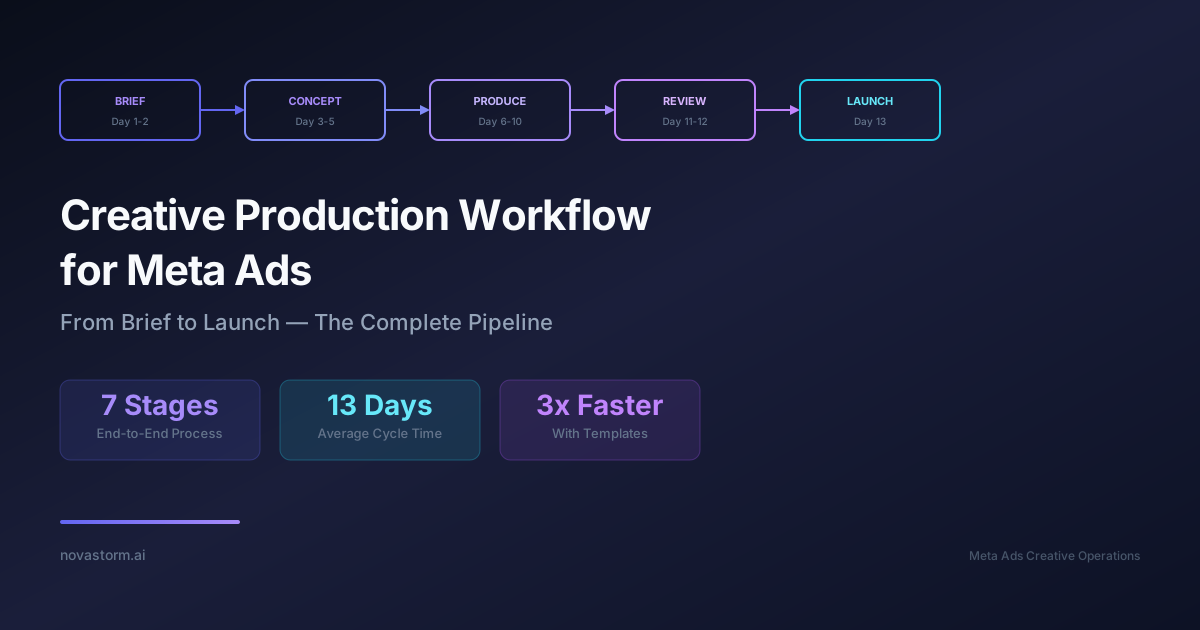
Creative Production Workflow for Meta Ads: From Brief to Launch
Organize a creative project with a filled brief, evidence and rights checks, a coherent schedule and mandatory launch acceptance gates.