

Creative Production Workflow for Meta Ads: From Brief to Launch
Organize a creative project with a filled brief, evidence and rights checks, a coherent schedule and mandatory launch acceptance gates.
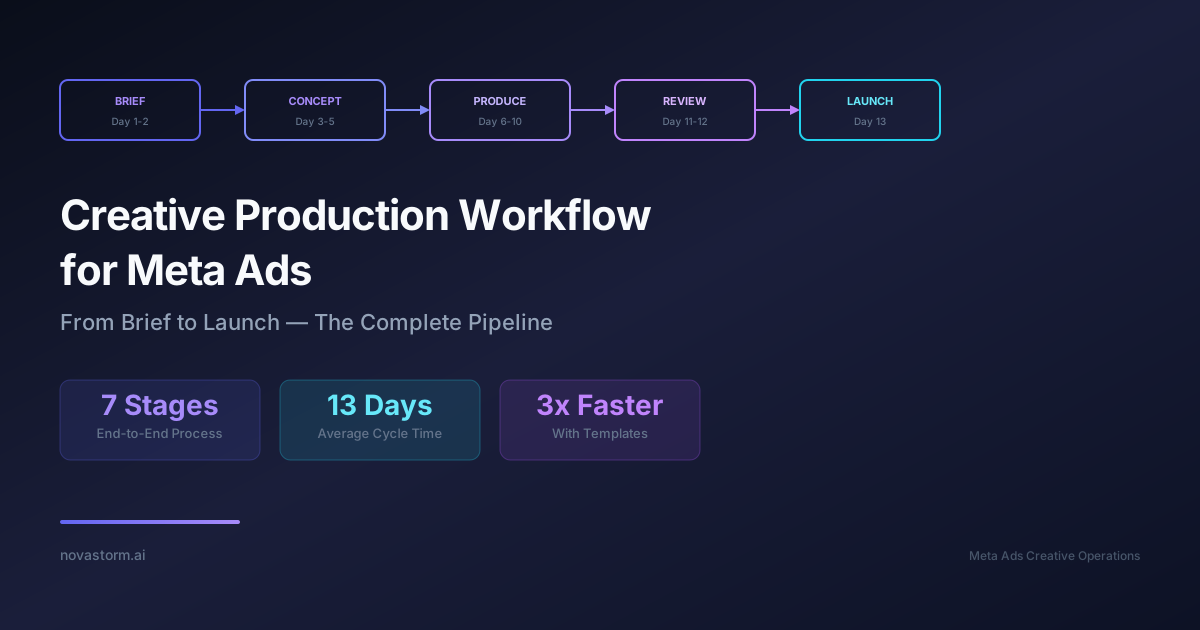
A creative workflow should produce a launch-ready asset with a known owner, honest claims, usable rights and an approved spending decision. It does not need an arbitrary weekly asset quota. This guide provides a fictional completed brief, a coherent schedule and a review ledger you can adapt to a real project.
A filled brief with evidence and rights gates
Hypothetical project: a plain notebook ad. All product, budget and team decisions below are invented teaching inputs; no real customer approval or measured advertising result is claimed.
| Brief field | Fictional filled example | Real acceptance needed |
|---|---|---|
| Outcome | Visits to an owned notebook product page | Choose the actual goal and measurable business outcome |
| Message | “One place for your notes.” | Show the actual notebook; no unsupported productivity uplift |
| Factual claim | “120 ruled pages” proposed in the copy | Count/manufacturer specification for the real SKU before publication |
| Assets | Original shapes for the draft; owner-supplied product photo for launch | Photo ownership/license, participant releases if people appear, commercial font rights |
| Formats | Square static and portrait adaptation; optional silent demonstration | Current selected-placement specifications and cropped previews |
| Destination | Actual product page with price, stock and delivery terms | Mobile URL/redirect and truthful offer checks |
| Production/media | Assumed USD 200 production and USD 300 total media test | Actual budget owner records approval; no approval inferred from this example |
| Owners | Strategist, designer, rights reviewer and launch operator | Named real people with authority and access |
Link each factual claim to a dated evidence record and each asset to permitted purpose, territory, term and editing rights. A stock photo purchase is not a testimonial or proof that a model recommends the notebook. Canva’s content license illustrates why material categories and client transfers need their own checks; rights differ by source. Store the actual licenses securely rather than embedding private agreements in public ad copy.
A consistent thirteen-working-day plan
Illustrative sequential plan, not an average or service-level guarantee. The ranges below are day numbers in this example, not uncertain estimates that should be added independently. A delay at an approval gate shifts later work; additional creative rounds require a revised plan.
| Working days | Owner | Output and gate |
|---|---|---|
| 1 | Strategist | Filled brief, evidence list and requested budget |
| 2–3 | Copy/design | Two concept candidates; choose a hypothesis |
| 4–7 | Designer/editor | Source files and initial exports |
| 8 | Reviewers together | Consolidated, classified feedback |
| 9–10 | Designer | Two planned creative feedback rounds |
| 11 | Rights/QA owner | Mandatory defects resolved; block launch if unresolved |
| 12 | Media owner | Mobile and placement previews, URL/event checks |
| 13 | Launch operator | Approved paused draft and explicit later publication decision |
Total = 1 + 2 + 4 + 1 + 2 + 1 + 1 + 1 = 13 working days. Performance review follows launch on a separately defined reporting horizon. Do not count a paused draft as a delivered campaign or report a 21-to-8-day improvement without timestamped before/after projects.
Classify feedback before limiting rounds
| Feedback | Example | Treatment |
|---|---|---|
| Creative preference | Try a warmer background | Use a planned round; new preference after approval changes scope |
| Factual defect | Notebook has 100 pages, not 120 | Mandatory correction; not blocked by the two-round allowance |
| Rights defect | Music license excludes paid advertising | Replace or obtain appropriate rights before launch |
| Technical defect | Headline disappears under placement UI | Fix and recheck relevant placements |
| Offer defect | Destination price or availability differs | Stop release until truthful offer is consistent |
Use one approval ledger with asset name, version, claim evidence, unresolved issue, owner and acceptance result. Example filename: notebook_notes_feed_1x1_conceptA_v03_20261002.png. The portrait export is an adaptation of the same concept, not automatically a second independent creative test.
Stop wasting ad budget
NovaStorm AI cuts Meta Ads CPA by 30% on average. No complex setup required.
A mobile preview packet, not just a desktop export
- Export the exact square and portrait candidates and retain their source versions. Use a phone-sized preview to read every line; include captions and a silent-view check for video.
- Upload the approved candidates into the supported destination as a paused draft. Inspect each selected placement with its actual profile, caption, CTA and interface overlays; an editor canvas has none of those controls.
- Check the final product photo against the real SKU, price and page count. Test the actual redirect chain and event route under permitted consent states.
- Record asset version, placement, device/viewport and whether text, product and controls are visible. A failed placement needs a different crop or asset, not a blanket assumption that automatic resizing is safe.
For the fictional concept, a proposed copy-generation input is: “Write three short notebook headlines using only the verified page count and ruled-paper facts; do not invent testimonials, discounts or productivity results.” Review each output against the evidence ledger. This is an input specification, not a claim that the prompt was run inside NovaStorm or that a generated file passed QA.
An original NovaStorm demo: generation and correction, not ad performance
Our documented September 18, 2026 MCP demonstration used actual calls to create a prompt → image → creative workflow, run it once, attach the generated result to an unpublished campaign and review the saved output. The recorded footage shows the saved result; it is an abbreviated demonstration rather than a live conversation. The campaign stayed paused, had no external Meta delivery IDs, and was not published. All performance figures shown in that demo were explicitly synthetic.
| Recorded production step | What the evidence supports | What it does not establish |
|---|---|---|
| One provider-backed generation | Preflight estimated 14 US cents; the returned image metadata identified Seedream v5 Pro rather than the requested Gemini image model; the ledger recorded a 9-cent reservation | A reservation is not a universal settled image price, and one run does not measure advertising effectiveness |
| Branded correction | A separate real MCP correction used the saved background and official wordmark; preflight reported zero provider calls and zero estimated provider cost | This does not mean every correction is free or that rights, placement and claim review happen automatically |
| Paused campaign preparation | Actual clone/update and attachment calls prepared the saved creative for review | No campaign delivery, real customer revenue, production-speed comparison or sales uplift was measured |
The practical lesson is to inspect returned assets, model provenance and actual saved status instead of treating a requested model or finished image as a completed launch. Keep generation receipts, correction versions, claim evidence, rights and placement acceptance together. This historical engineering example is separate from the fictional notebook schedule and cost worksheet.
Measure throughput and cost before claiming efficiency
Hypothetical cost worksheet: eight production hours at USD 25 plus two review hours at USD 30 plus USD 20 of licensed materials = USD 280. Four accepted exports cost USD 70 each, or USD 140 per concept if those exports represent two concepts. Include rejected files and revisions in the denominator decision. These are calculations from assumptions; neither hundreds of exports nor fresh creative establishes lower CPM.
For a real before/after comparison, record brief-ready, work-start, first-review and accepted-release timestamps, person-hours, license/tool costs and the same acceptance quality. Separate queue time from active work. A larger batch can increase total output while slowing each accepted concept.
Use the reconstructible static layout for a concrete production starting point. Prepare the approved concept and spending request as a NovaStorm campaign draft for manual review. The reviewed campaign dialog defaults to PAUSED; actual rights approval, mobile preview evidence and launch authorization remain separate gates.
Published by NovaStorm AI. Worked examples and test fixtures in this article are illustrative, not observed customer results.
Disclaimer: This article was generated with the assistance of AI and reviewed by the NovaStorm AI team. While we strive for accuracy, we recommend verifying specific data points and consulting official sources (linked where available) for critical business decisions.
Ready to automate your Meta Ads?
NovaStorm AI takes full responsibility for your campaigns — from monitoring to optimization.
Start NowMore on Creative production and UGC
Influencer Content Licensing for Meta Ads: Legal and Creative Guide
License creator ads with explicit paid-use, edit and third-party rights, then track each live ad against approval and expiration records.
Canva for Meta Ads: Designing Professional Ads Without a Designer
Build a Canva ad from an original notebook layout, verify content rights and export options, and inspect both mobile adaptations before approval.
Case Study Ads on Meta: Turning Customer Success Into Creatives
Build case study ads from verifiable claims, permissions and transparent comparisons, then test the story using mature paid outcomes.
Content Repurposing for Meta Ads: Blog to Ad Pipeline
Turn a verified blog idea into a complete Meta carousel, document production costs and test reader interest separately from customer acquisition.