

Meta Ads Budget Calculator: How to Set Your Monthly Ad Spend
Calculate monthly Meta ad spend from contribution and lead quality, test sensitivity, and reconcile cash limits with a paused campaign draft.
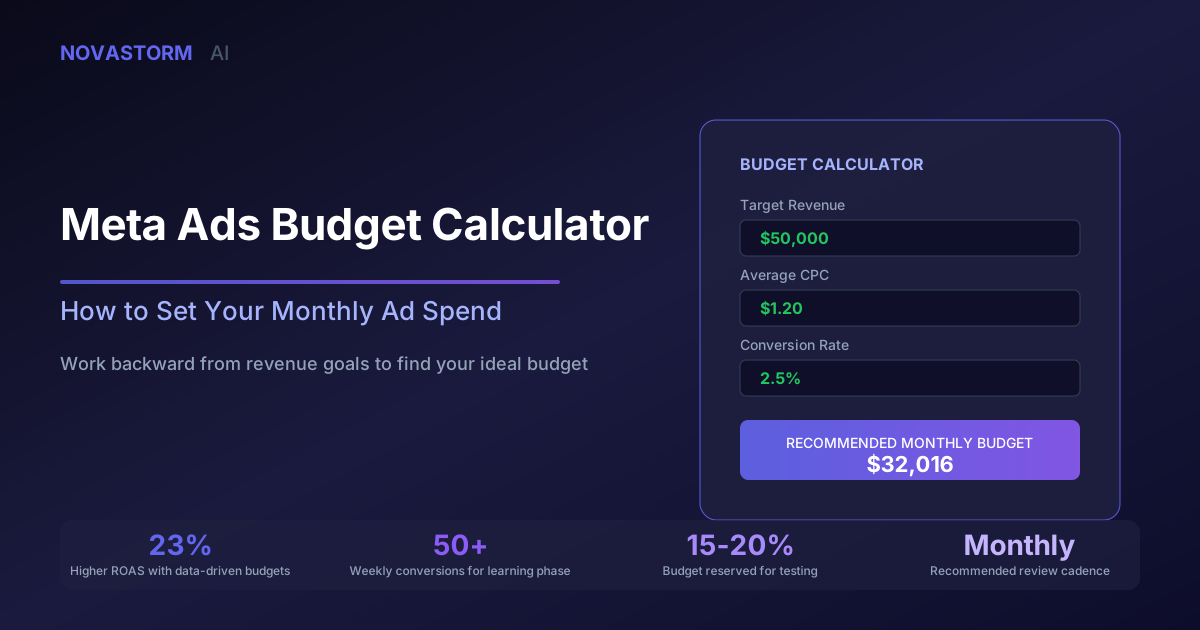
Your starting budget should answer a question you can afford to investigate. A platform minimum, a learning-phase estimate and a business spending limit are different numbers. Begin with the cost of a useful result, the evidence you need and the cash you can risk; then build the monthly plan.
The inputs to collect before setting a budget
- Choose one outcome: a paid order, a qualified lead or another action that matters to the business.
- Calculate contribution after variable costs and the amount you want to retain. Use the break-even ROAS calculation for purchase campaigns.
- Estimate CPA from comparable, mature results. Without history, write a range as a planning assumption, not an industry fact.
- Record a maximum test spend, conversion delay, review date and operational capacity before launching.
Example 1: a shop testing a new acquisition offer
This is a worked planning example, not a NovaStorm customer result. The shop sells an item for $100 net of sales tax. Product, fulfillment, payment fees and expected return losses total $60, leaving $40 before advertising. It wants to keep $10 per order, so its target acquisition cost is at most $30.
| Input or calculation | Illustrative value | Meaning |
|---|---|---|
| Contribution before advertising | $100 − $60 = $40 | Acquisition ceiling before fixed costs |
| Target CPA | $40 − $10 = $30 | Leaves $10 per paid order |
| Initial test | 20 orders × $30 = $600 | Planning estimate, not a guaranteed sample |
| 14-day average spend | $600 / 14 ≈ $42.86 | One concentrated test |
| Monthly acquisition plan | 100 orders × $30 = $3,000 | Feasible only if CPA and demand support it |
If the test spends $600 and yields only ten mature orders, the observed CPA is $60. Raising the monthly budget does not fix the economics. Diagnose measurement, creative and checkout before financing more of the same. Twenty orders can reveal a large problem; they cannot establish a small statistical improvement with confidence.
Example 2: a service business buying leads
Suppose a new client contributes $400 after delivery costs, and the business is willing to spend $120 acquiring that client. Its planning assumption is that 25% of raw leads qualify and 40% of qualified leads close. The expected raw-lead-to-client rate is 0.25 × 0.40 = 10%; therefore the target raw CPL is $120 × 0.10 = $12.
| Planning step | Illustrative value |
|---|---|
| First test: 50 raw leads | 50 × $12 = $600 |
| Expected qualified leads | 50 × 25% = 12.5 on average |
| Expected clients | 50 × 10% = 5 on average |
| Monthly goal: 10 clients | 100 raw leads at the assumed close rate |
| Monthly acquisition budget | 100 × $12 = $1,200 |
Fractional expected counts are averages, not promises of half a client. If fewer leads qualify, the acceptable raw CPL falls. Use CRM outcomes and wait through the normal sales cycle; a cheap form submission is not the same as an acquired customer.
How to assess the minimum viable test
Estimate expected results as test spend / assumed CPA. If your maximum affordable spend cannot produce enough outcomes to answer the question, narrow the test, lengthen it without increasing its cap, or choose a larger effect to investigate. Do not switch from purchases to clicks solely to make the dashboard look busy. The minimum viable budget guide focuses on judging evidence under a small cap.
The often-quoted learning-volume estimate is not an entry requirement for advertising or a guarantee of profit. Avoid turning it into a compulsory monthly spend. Compare your actual delivery status, conversion delay and business results using the learning-phase monitoring guide.
Stop wasting ad budget
NovaStorm AI cuts Meta Ads CPA by 30% on average. No complex setup required.
Turn the test into a controlled monthly plan
- Keep the first test and ongoing campaigns inside one approved monthly ceiling.
- Separate expected ad spend from creative costs, software, taxes and specialist time.
- Recalculate the forecast using qualified or paid outcomes, not all reported events.
- Review pacing and remaining cash before increasing spend; stop when the pre-agreed risk limit is reached.
Sensitivity before committing the month
Additional illustrative assumptions: the shop’s $60 variable cost already includes its base return loss. If extra return losses add $10 per order, contribution falls from $40 to $30 and the CPA target preserving $10 falls from $30 to $20. Adding $300 creative production to a 100-order month reduces the media allowance preserving the same total contribution by $3 per order, from $30 to $27 in the base case.
| Service qualification / close assumptions | Client rate | Raw CPL ceiling at $120/client |
|---|---|---|
| 25% qualify;40% close | 10% | $12 |
| 25% qualify;20% close | 5% | $6 |
| 15% qualify;40% close | 6% | $7.20 |
If client contribution falls from $400 to $300 and the business retains its assumed 30% acquisition share, its client allowance falls from $120 to $90. At a 10% client rate, raw CPL becomes $9. These are sensitivity scenarios, not measured sales rates.
Fillable monthly plan
| Plan field | Worked shop example | Your entry |
|---|---|---|
| Goal / capacity | 100 paid orders; fulfillment capacity 100/month | Enter goal and actual capacity |
| Unit economics | CPA ceiling $30 before extra production | Enter cost ledger and retained contribution |
| Media cap / first test | $2,700 total media; first $600 included; $300 production separately | Enter authorized cumulative limits |
| Production / credits | $300 assumed production; credits separately priced | Enter actual cash amounts |
| Outcome maturity | Assumed 14 days after last test interaction | Enter your conversion and return windows |
| Cash availability | Confirm pre-payout financing separately | Enter payout dates and available cash |
| Review decision | $600/10 mature orders=$60; hold expansion | Enter finding, owner and next action |
In the hypothetical ten-order result, base contribution after media is 10 × $40 − $600 = −$200 before production and fixed costs. Hold the remaining monthly acquisition forecast, reconcile tracking and diagnose the offer; do not authorize $3,000 solely because it appeared in the original plan.
Reconcile a paused draft with the person approving spend
Proposed review example, not a completed live campaign: at $25/day, twelve days at that planning average imply $300. The average is not a guaranteed hard cap. Before launch, the budget owner confirms account currency, daily amount, start/end dates, cumulative allowance and separate production/credit charges. Read the saved values back and record the approval time.
The NovaStorm offer separates platform access, generation credits and advertising spend paid to Meta. Check the current credit charge before generating assets. A paused draft records intended settings; it does not establish spend, a successful customer test or guaranteed results.
Published by NovaStorm AI. Worked examples and proposed tests are labeled in the article.
Disclaimer: This article was generated with the assistance of AI and reviewed by the NovaStorm AI team. While we strive for accuracy, we recommend verifying specific data points and consulting official sources (linked where available) for critical business decisions.
Ready to automate your Meta Ads?
NovaStorm AI takes full responsibility for your campaigns — from monitoring to optimization.
Start NowMore on Budget and unit economics

Meta Ads Budget Pacing: Managing Delivery Within a Spending Plan
Control cumulative Meta spend against a saved allowance, account for reporting and pause delays, and investigate underspend without forcing delivery.

Budget Allocation Across Funnel Stages in Meta Ads
Allocate Meta budget by campaign job, deduplicate credited orders, model retargeting capacity and review mature contribution under one cap.
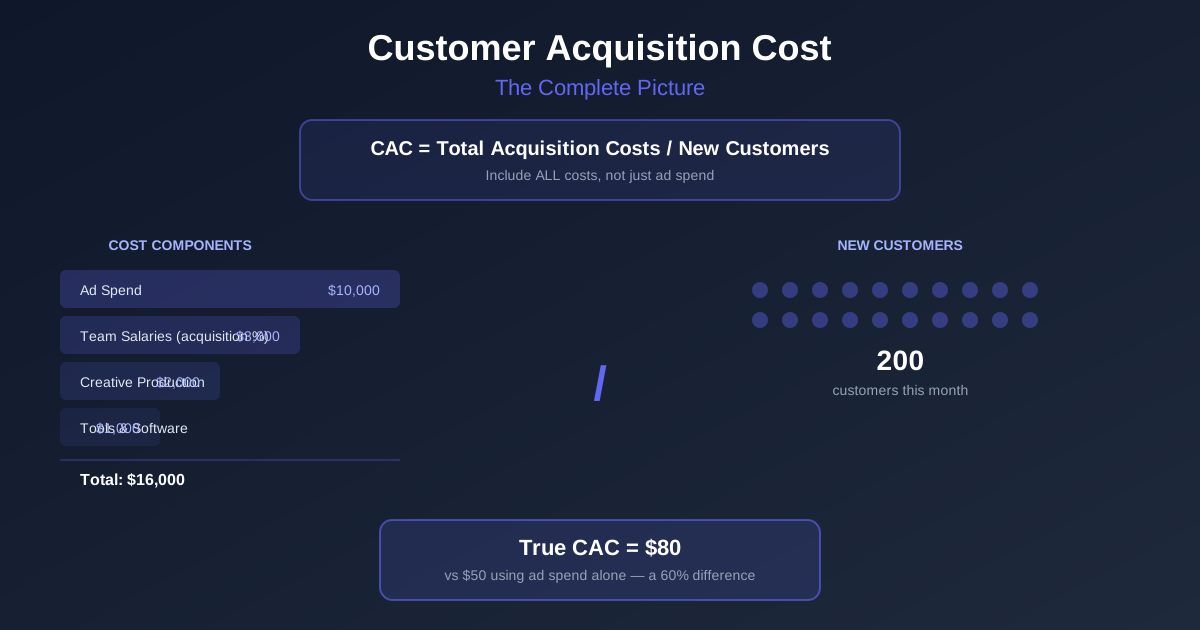
Customer Acquisition Cost: The Complete Guide to CAC for Advertisers
Reconcile full acquisition costs and unique new customers, model contribution payback with churn and apply a cash-constrained campaign ceiling.
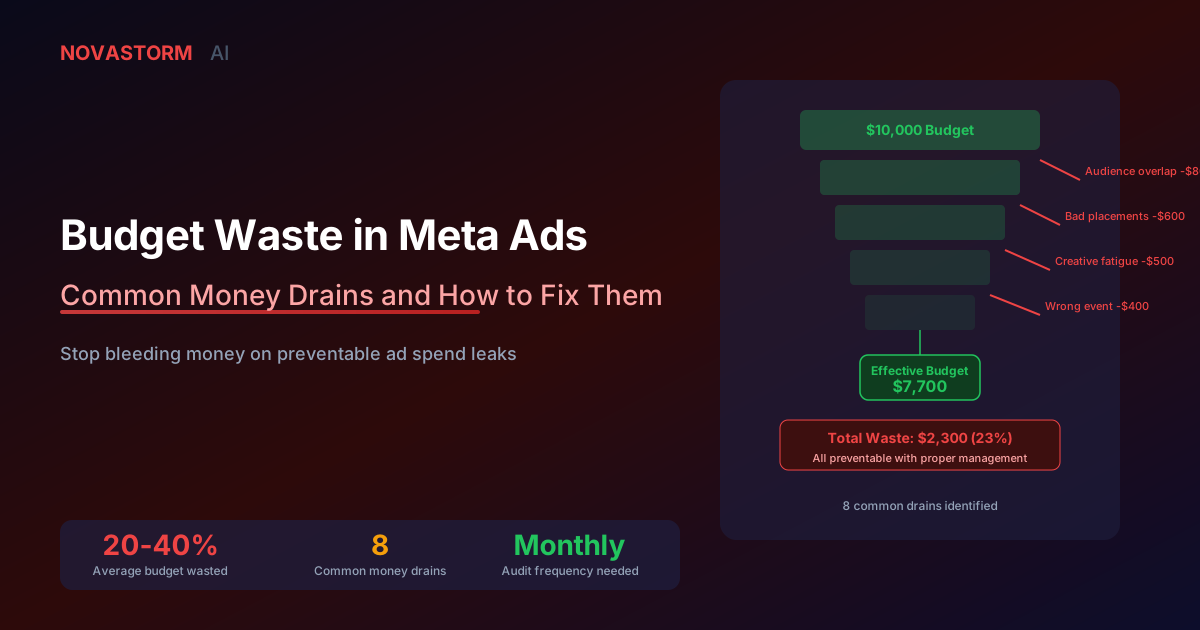
Budget Waste in Meta Ads: Common Money Drains and How to Fix Them
Audit eight potential Meta budget leaks with evidence, owners and acceptance checks, distinguish event mismatches, and act on cash-limit risk.