

Minimum Viable Budget for Meta Ads: What You Need to Start
Judge what a small Meta ad budget can answer, verify tracking before spending, and close a capped test honestly with mature or inconclusive evidence.
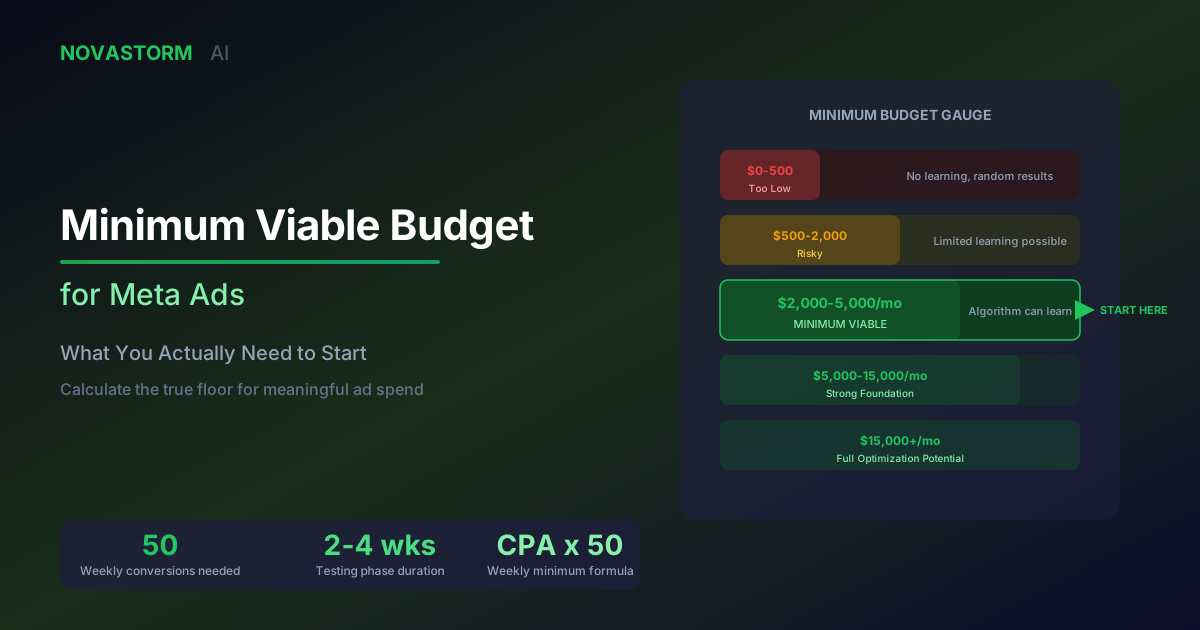
A minimum viable budget is the smallest affordable test that can answer a defined question. It is not a fixed dollar tier that guarantees optimization. This guide focuses on evidence under a small cap; use the budget calculator for full shop and service-business spending examples.
Separate platform minimums from useful evidence
The platform’s permitted budget depends on setup and current rules. Your business ceiling depends on cash and contribution. Your evidence requirement depends on the outcome, baseline and effect you need to detect. Those three quantities need not agree.
Worked small-budget check
Suppose a fictional shop can risk $300 and assumes CPA between $20 and $40. Expected acquisitions range from $300 / $40 = 7.5 to $300 / $20 = 15. These are expectations, not promised order counts. The test may expose a broken checkout or an expensive offer, but a dozen purchases cannot automatically establish a modest creative lift.
| Question | Is this cap plausibly useful? | Decision |
|---|---|---|
| Does the destination and purchase signal work? | A controlled test order and delivery checks can answer the technical part | Verify before paid exploration |
| Can this offer acquire some orders within the risk cap? | Potentially, with noisy CPA evidence | Run a concentrated, explicitly exploratory test |
| Does a headline improve purchase rate from 2.0% to 2.4%? | Not at this expected volume | Use the planned sample requirement, not a spend tier |
What to do when the evidence budget exceeds your cap
- Reduce the number of simultaneous hypotheses instead of spreading the same money thinner.
- Investigate a larger difference that could matter operationally.
- Extend the observation window for conversion lag without silently increasing the spend allowance.
- Accept an exploratory result with uncertainty; do not rename it a statistically proven winner.
- If the cash risk is unaffordable, postpone the paid test and fix technical or offer issues first.
Switching from Purchase to clicks changes the question rather than solving a purchase-sample problem. Check objective selection before changing the event. A learning-status threshold is not a compulsory minimum monthly spend.
Close the test with a decision
Save actual spend, mature outcomes and the assumptions that failed or held. Stop at the approved cap; delayed orders can be reconciled later. A low-volume test can legitimately end inconclusive. For a controlled comparison, the experiment card and sample-size guide explain how to choose evidence requirements.
What the $300 cap can answer
Stop wasting ad budget
NovaStorm AI cuts Meta Ads CPA by 30% on average. No complex setup required.
Illustrative midpoint CPA assumption $30 gives $300 ÷ $30 =10 expected orders. This can support exploratory evidence that the offer acquires some paid orders. It cannot establish a reliable CPA from a small sample or prove that changing a headline lifts purchase rate from 2% to 2.4%.
For scale context, an approximate equal-group two-sided test of 2% versus 2.4%, at 5% significance and 80% power, needs roughly 21,100 eligible visitors per group under a simple independent-binomial planning model. Allocation, multiple comparisons and actual traffic can change the requirement. Ten expected orders do not meet that plan.
A small test can close inconclusive
Hypothetical ledger for a test that stops delivery at its $300 cap. “Pending” means the purchase outcome is still within the chosen delay window, not a promised future order. The seven-day delay allowance is an example choice.
| Review | Cumulative spend | Confirmed cohort orders | Outcome state | Decision |
|---|---|---|---|---|
| 2026-10-09 | $225 | 5 | Recent interactions still within delay window | Do not extrapolate a stable CPA |
| 2026-10-12 | $300 | 8 | Stop delivery; wait through last interaction + 7 days | No further spend authorization |
| 2026-10-19 | $300 | 10 | Declared purchase window reconciled | CPA $30 descriptive; headline test inconclusive |
If no further orders arrive, the eight-order result instead costs $37.50 per order. Neither result guarantees the next cohort’s CPA. Reconcile return losses later using a provision or a longer declared business window; do not keep spending while waiting for maturation.
Technical acceptance before paid exploration
- Open the actual mobile destination and validate offer, price, availability, checkout and confirmation.
- Run an authorized controlled test order or sandbox flow; verify unique purchase identity, event scope, value/currency and consent behavior. A test event is not campaign revenue.
- Check objective, account currency, destination, eligibility and actual accepted settings.
- Record each check’s owner, date and pass/fail evidence. Resolve defects before advertising spends money.
Reconcile a $25/day draft with the cash owner
Proposed planning example, not a completed account test: twelve days at a $25 daily average imply $300. Confirm account currency, planned dates, business cap, reporting delay and the supported stopping controls. A daily average alone is not a hard ceiling. Read back the saved NovaStorm draft and verify it is paused before launch approval.
The NovaStorm offer separates generation credits from Meta advertising spend. Agree any credit charge and other production costs separately; if $300 is the entire cash envelope rather than the media allowance, subtract those costs before planning delivery. A paused draft and technical pass do not guarantee affordable purchases.
Published by NovaStorm AI. Worked examples and proposed tests are labeled in the article.
Disclaimer: This article was generated with the assistance of AI and reviewed by the NovaStorm AI team. While we strive for accuracy, we recommend verifying specific data points and consulting official sources (linked where available) for critical business decisions.
Ready to automate your Meta Ads?
NovaStorm AI takes full responsibility for your campaigns — from monitoring to optimization.
Start NowMore on Budget and unit economics
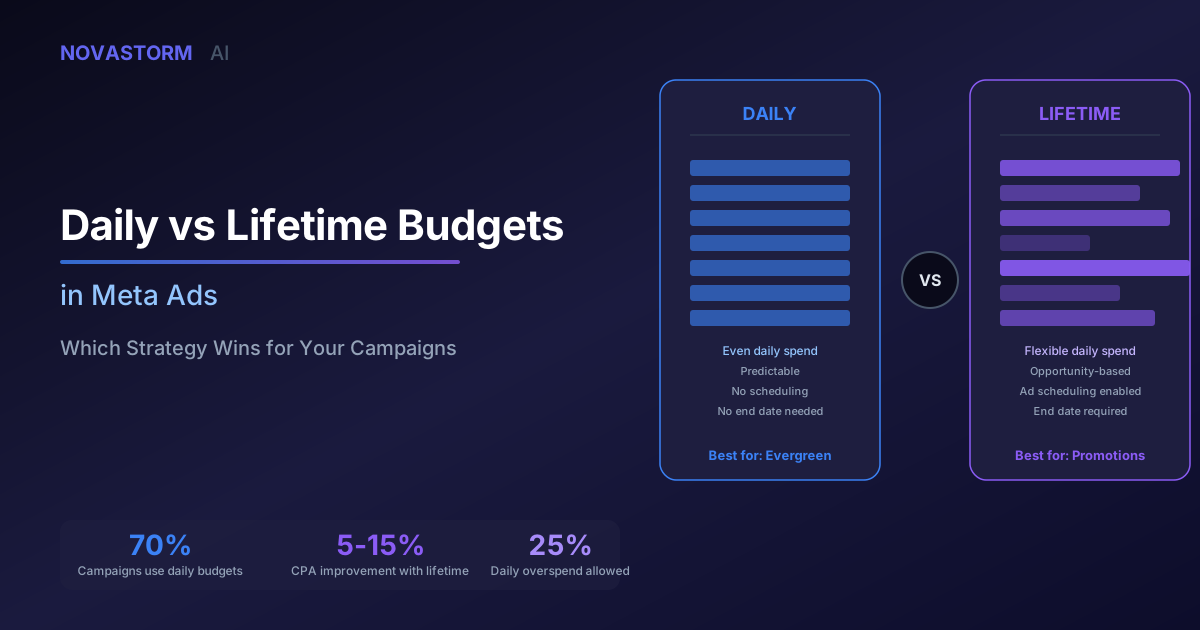
Daily vs Lifetime Budgets in Meta Ads: Which Strategy Wins
Choose daily or lifetime Meta budgets by operating horizon, log accepted settings and dates, and track remaining allowance with reporting delay.
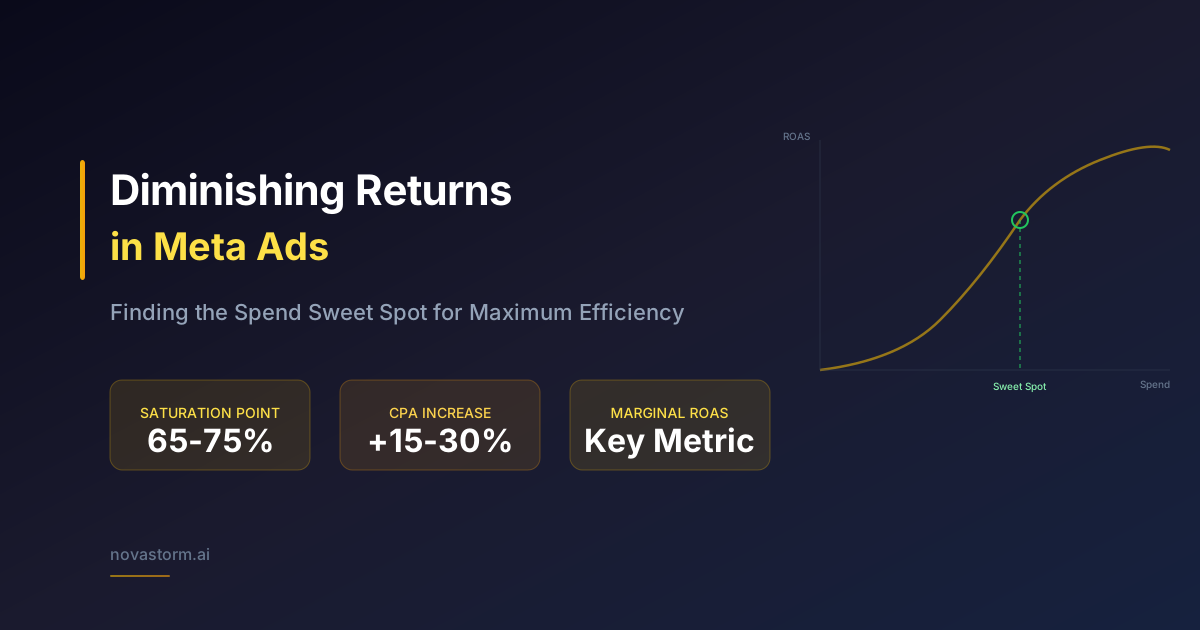
Diminishing Returns in Meta Ads: Finding the Spend Sweet Spot
Calculate a refund-adjusted marginal spending diagnostic, record confounders and propose a bounded budget test.
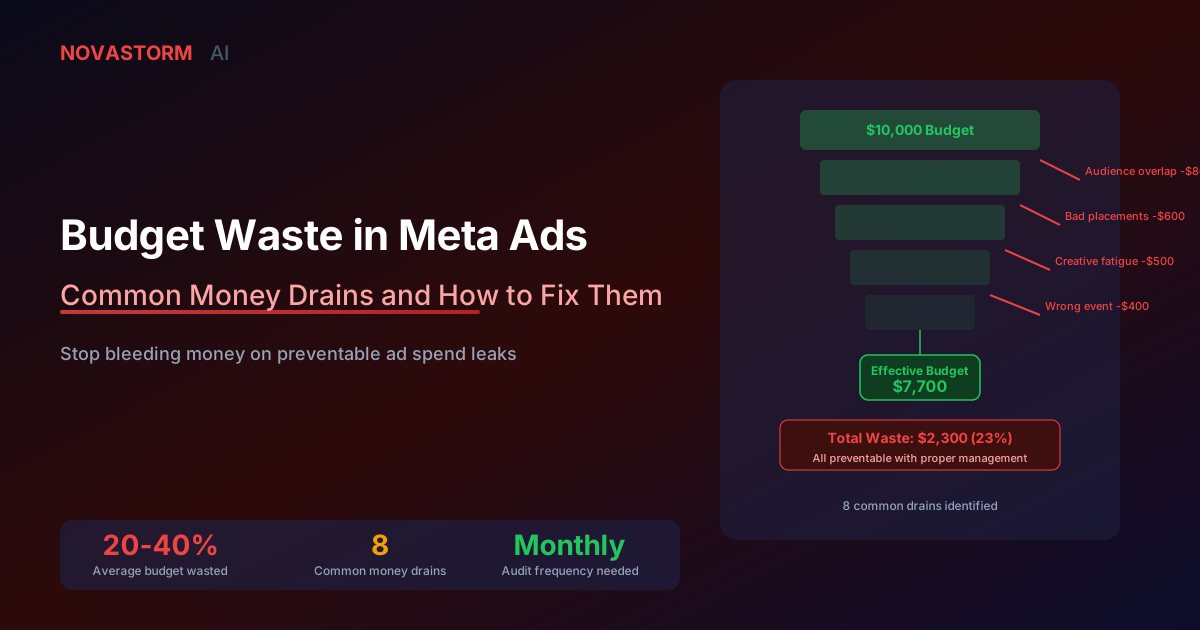
Budget Waste in Meta Ads: Common Money Drains and How to Fix Them
Audit eight potential Meta budget leaks with evidence, owners and acceptance checks, distinguish event mismatches, and act on cash-limit risk.
Meta Ads for Startups: Budget-Friendly Scaling Strategies
Build a capped startup Meta Ads test with contribution sensitivity, a fictional acceptance journal, maturity checks and a paused campaign brief.