

The Complete Guide to Meta Ads Learning Phase
Monitor a new Meta campaign day by day, distinguish delivery status from business performance and decide when a change is justified.
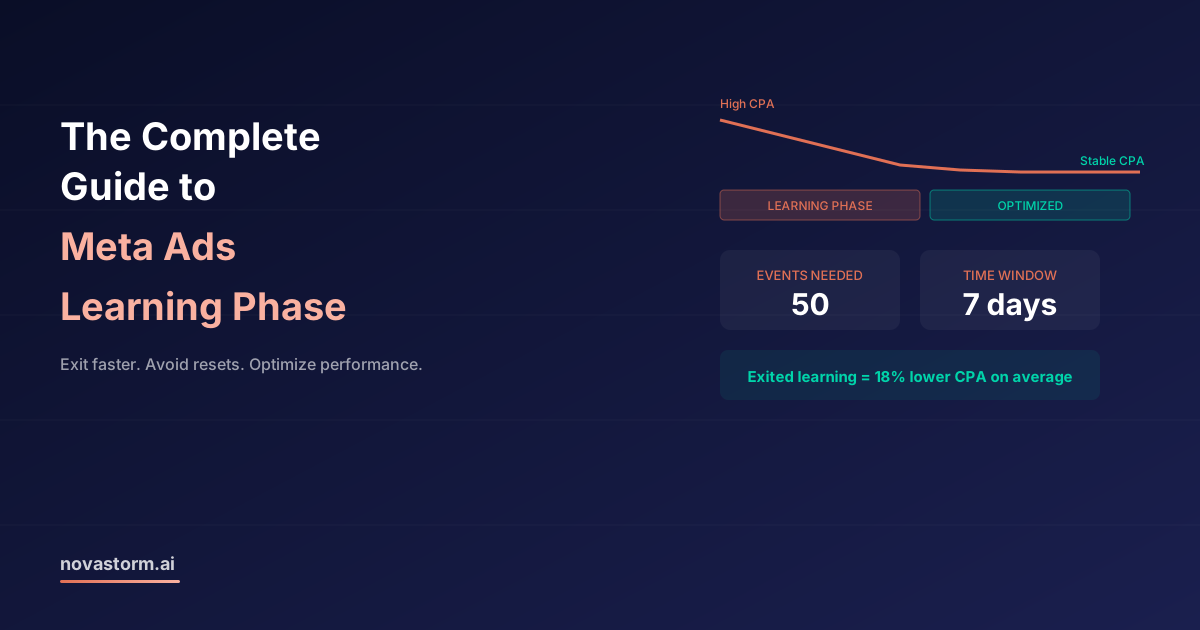
A new campaign may have unstable delivery and few mature outcomes. The useful question is not “How do I force a green label?” but “Is the campaign collecting valid evidence within the risk limit?” Delivery status, statistical certainty and profitability are different things.
Before launch: define what the first week must establish
- Verify the selected conversion event through the real destination and confirm value/currency where relevant.
- Record objective, audience controls, creative versions, budget and attribution settings.
- Set an affordable test cap, allowable CPA and a conversion-delay assumption.
- Define the first review window from expected volume and the customer’s buying cycle, not a universal seven-day promise.
Consult Meta’s learning-phase reference and the current delivery guidance in your account. Do not use a copied weekly-event threshold as a compulsory minimum budget, an eligibility condition or a guaranteed graduation date.
An illustrative observation schedule
This is a schedule for a fictional 14-day test with a $600 spending ceiling and a $30 planning CPA. It is not Meta’s internal timeline or a NovaStorm customer result. The estimated 20 acquisitions come from $600 / $30; actual outcomes may differ.
| When | Observe | Intervene if | Otherwise |
|---|---|---|---|
| Before launch | Event trigger, payment/form path, settings and cap | The objective or event is wrong, or the path fails | Save the baseline configuration |
| Days 1–2 | Delivery, spend, rejection/errors and incoming events | Spend is uncontrolled or collection/destination is broken | Do not declare a winner from a few outcomes |
| Days 3–4 | Mature outcomes available so far and normal conversion delay | The agreed loss cap is reached or a confirmed defect appears | Log observations without unrelated edits |
| Days 5–7 | Current delivery guidance and comparison with the planned evidence | A documented constraint prevents useful delivery | Choose one justified change, if needed |
| Days 8–14 | Paid or qualified outcomes after their delay | Economics or technical validity fail the decision rule | Close the test or explicitly extend within a revised approved cap |
When a change can affect learning
Changes to optimization, targeting, bidding, budget or creative can alter the delivery problem. Their effect depends on the change and campaign context. Avoid the contradictory rules “adding creative never resets learning” and “all changes always reset learning.” Check the account’s current warning and record status before and after an edit.
The familiar 20% budget step is a practitioner heuristic, not a universal guarantee against re-entering learning. If the destination is broken, correct it even during learning. If the campaign has simply had a weak day and conversions arrive later, first wait for comparable evidence.
How to respond to limited learning or sparse volume
Check whether the event is collected correctly, the audience and budget can support the question, and similar groups unnecessarily divide scarce evidence. Consolidation may simplify the design, but it is not automatically the right fix for distinct countries, offers or acquisition economics.
Stop wasting ad budget
NovaStorm AI cuts Meta Ads CPA by 30% on average. No complex setup required.
Do not switch from Purchase to AddToCart only to increase the event count. That changes the optimization target. If an earlier-funnel action is necessary, verify its relationship to paid orders and state the tradeoff. See the objective selection guide and budget calculations.
When to wait, investigate or stop
- Wait when collection is valid, spend stays within the cap and the cohort has not had time to convert.
- Investigate when the outcome changed after an event, consent, destination or campaign-setting release.
- Stop affected spend when the conversion path fails or the agreed risk limit is reached; a learning label does not override cash limits.
The pause-or-wait decision tree helps distinguish those cases. Completing a learning phase does not establish profitable acquisition, and limited learning does not prove that every acquisition is unprofitable.
What NovaStorm’s draft review demonstrates
Keep a change log with the reason for each intervention. At the final review, report mature acquisition cost, remaining uncertainty and the next action. Use actual observations rather than a day-by-day acquisition-cost forecast.
An illustrative observation ledger through the risk limit
Constructed log continuing the 14-day $600 test with planning CPA $30, not observed campaign performance. The 20 planned acquisitions are an expectation calculation ($600 /$30), not a requirement imposed on Meta.
| Review point | Cumulative spend | Mature orders | Pending orders | Decision |
|---|---|---|---|---|
| Day 2 | $80 | 1 | 2 | Collection works; preserve baseline and wait within cap |
| Day 7 | $300 | 7 | 3 | CPA about $42.86 on mature orders; investigate mix, no automatic winner |
| Day 14 | $600 | 12 | 4 | Cap exhausted; CPA $50 on mature orders; pause new spend and await pending outcomes |
Suppose those twelve mature orders each contribute an assumed $30 after returns and variable costs. Their $360 contribution minus $600 spend is−$240 before overhead. Even if a delivery indicator is green, that economics and the exhausted cap do not authorize continued spend. If all four pending orders later mature at the same contribution, total contribution would be $480 and result−$120; this sensitivity is a calculation, not a promised recovery.
- Before extending, the owner approves a new amount, the additional question, outcome-maturity date and cash exposure. “Give learning more time” is not a replacement for a budget decision.
- For a NovaStorm paused draft, verify the intended optimization event, destination, value/currency and chosen delay assumption against the brief. A local draft has not delivered ads or entered live learning.
- Rehearse a controlled payment/form action before activation, distinguishing accepted events from a broken page. A page error justifies immediate repair even while commercial results are still pending.
- Retain actual status/settings/observations after publication in the account change log; preparation does not establish learning behavior or CPA.
Published by NovaStorm AI. Worked examples and proposed tests are labeled in the article.
Disclaimer: This article was generated with the assistance of AI and reviewed by the NovaStorm AI team. While we strive for accuracy, we recommend verifying specific data points and consulting official sources (linked where available) for critical business decisions.
Ready to automate your Meta Ads?
NovaStorm AI takes full responsibility for your campaigns — from monitoring to optimization.
Start NowMore on Campaign structure and objectives
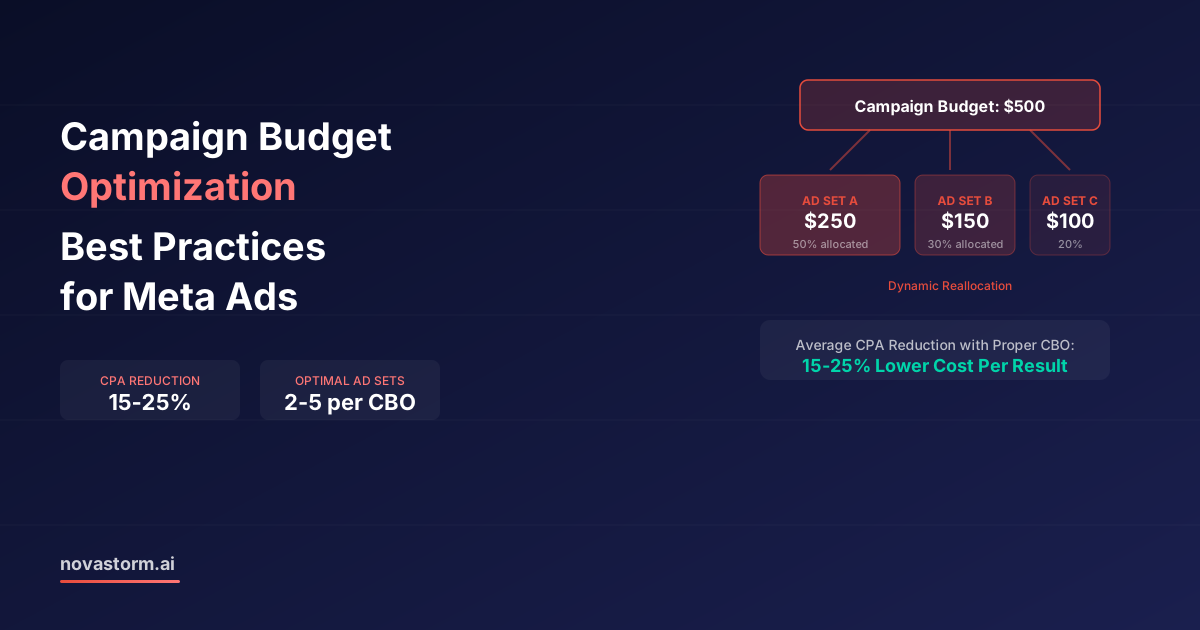
Campaign Budget Optimization Best Practices for Meta Ads
Check a campaign-level Meta budget configuration: shared outcomes, saved limits, dates, pacing and how to diagnose uneven ad-set allocation.
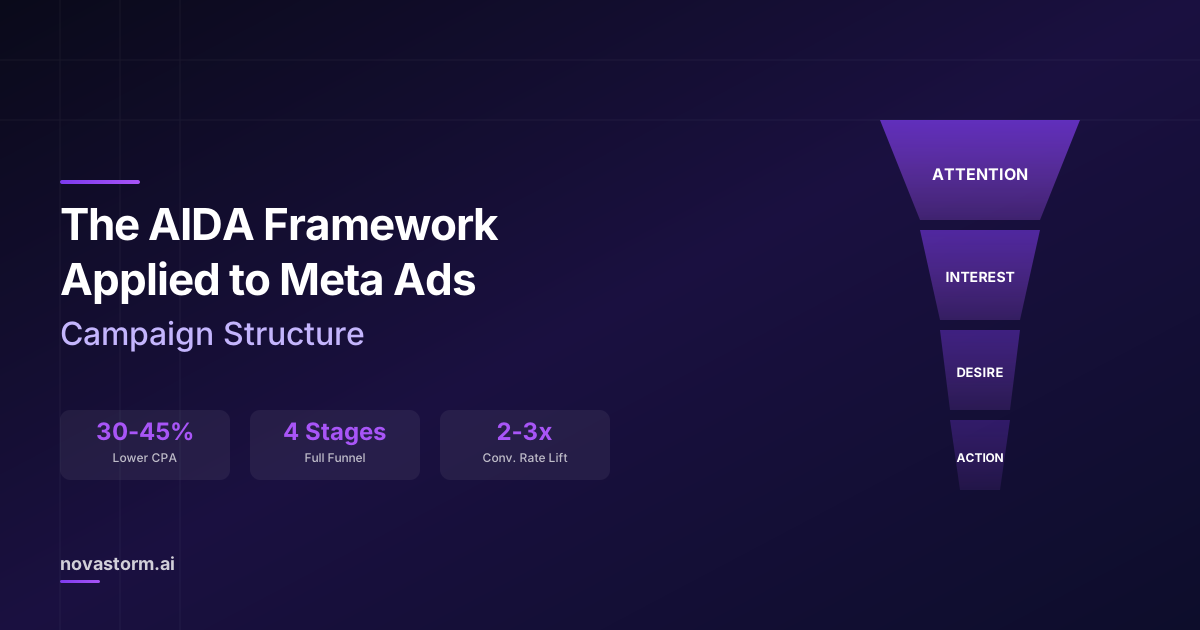
The AIDA Framework Applied to Meta Ads Campaign Structure
Use Attention, Interest, Desire and Action as message-planning questions, without mandatory campaign objectives, funnel ratios or promised CPA improvement.
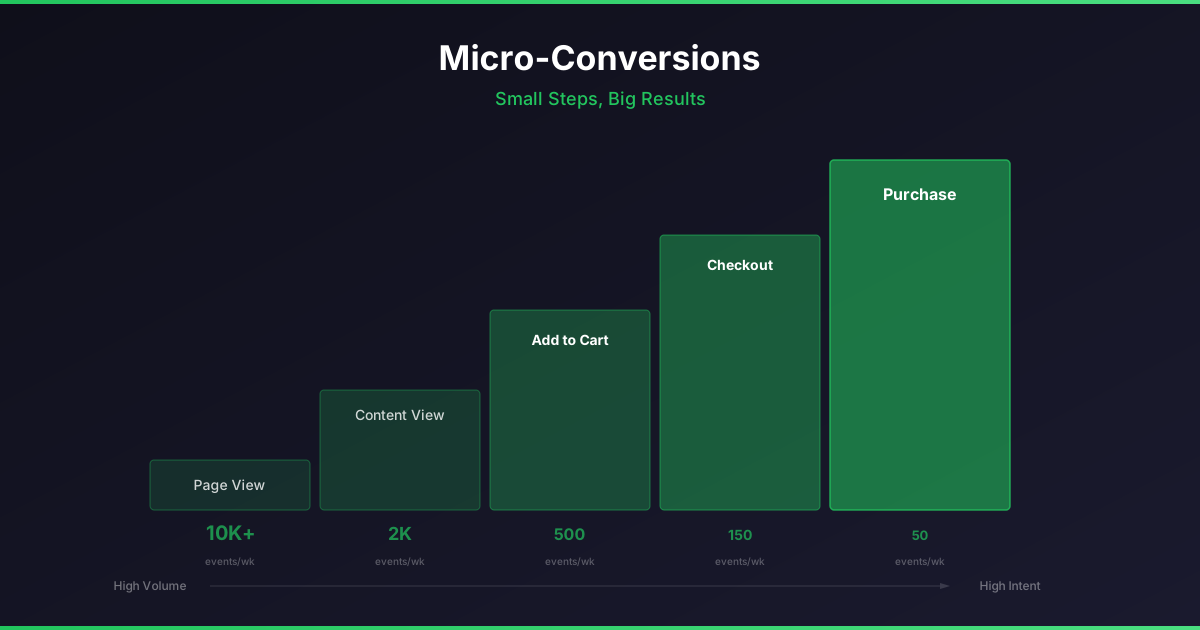
Micro-Conversions in Meta Ads: Diagnose the Funnel and Validate the Proxy
Use micro-conversions to diagnose a funnel, clean event counts, and test whether a proxy predicts mature business outcomes.
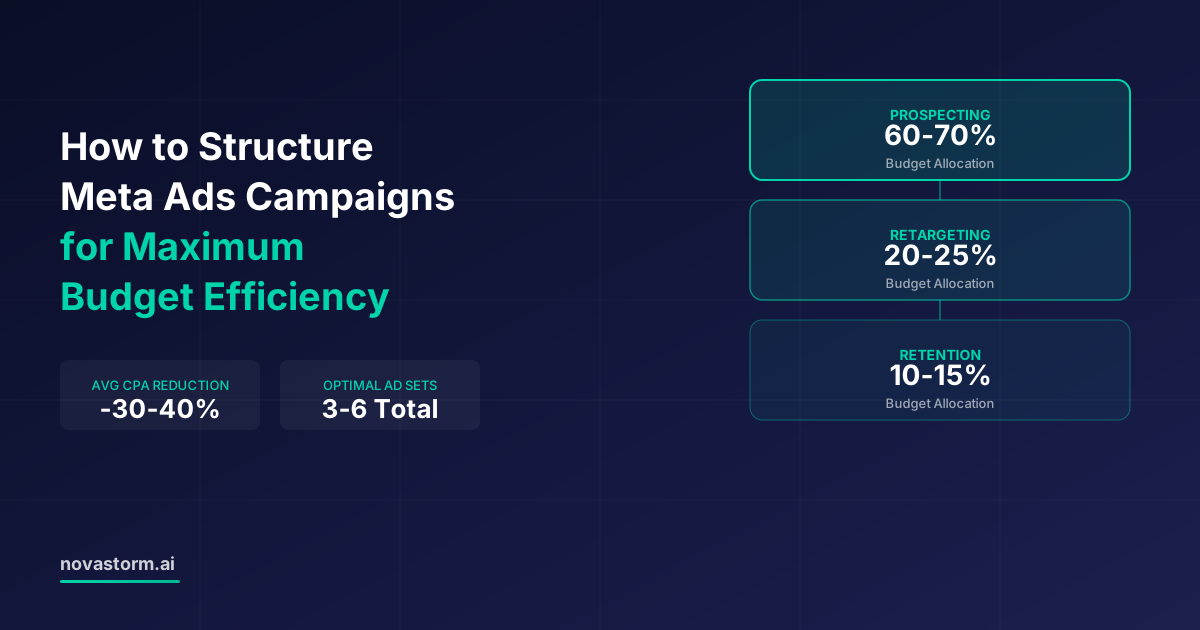
How to Structure Meta Ads Campaigns for Maximum Budget Efficiency
Review each Meta campaign’s job, group separation and budget control without promising CPA savings from consolidation or automatic overlap penalties.