

Budget Allocation Across Funnel Stages in Meta Ads
Allocate Meta budget by campaign job, deduplicate credited orders, model retargeting capacity and review mature contribution under one cap.

Funnel allocation is a decision about which business job each campaign serves. Prospecting can acquire new customers; consideration can address unanswered questions; retargeting can remind an eligible existing audience. Those labels do not require an Awareness → Engagement → Sales sequence or a universal percentage split.
Start from the commercial allowance
Use the shop and service budget calculations to establish an affordable test and monthly allowance. Record whether the target is new paid customers, qualified clients or a deliberate awareness outcome. Buying views merely to fill a pixel is not a business result by itself.
An illustrative allocation hypothesis
A fictional shop can risk $600. It initially assigns $450 to new-customer acquisition and $150 to a distinct retargeting hypothesis. This 75/25 split is simply a test choice, not a benchmark. Before spending, check whether the eligible retargeting pool can reasonably use its allowance and whether both campaigns’ order economics are comparable.
| Job | Decision evidence | Reason to hold or investigate |
|---|---|---|
| New-customer acquisition | Mature new paid orders and contribution | Unclear identity, weak contribution or cash cap |
| Consideration hypothesis | Defined downstream business outcome | Cheap engagement without evidence of useful progression |
| Retargeting | Eligible pool, mature outcomes and repeat exposure | Shrinking pool or unexplained cost deterioration |
Reconcile the combined result
Suppose the fictional plan spends $600 and the business records 20 unique paid orders in the chosen scope. Media cost is $30 per order. If campaign reports credit 18 and eight orders respectively, their sum of 26 is not automatically 26 unique orders; duplicate channel credit or different scopes must be reconciled.
Separate new-customer contribution from returning-customer sales and use a consistent revenue basis. A low retargeting CPA may include customers who would have bought anyway. The combined report is useful for cost coverage; it does not establish the incremental value of every stage.
Change allocations around a diagnosed constraint
- Allow conversion delay before judging the acquisition cohort.
- Inspect available reach and frequency in equal windows rather than using a fixed cutoff.
- Check actual customer contribution when blended revenue looks attractive.
- Test a defined change instead of moving money solely because a stage label looks weak.
- Retain the total cap when introducing another hypothesis.
The budget-leak diagnosis distinguishes a confirmed failure from a signal that needs investigation. A shrinking retargeting audience is a reason to review demand and eligibility; it does not automatically require more spend on a different stage.
Report the decision and uncertainty
Stop wasting ad budget
NovaStorm AI cuts Meta Ads CPA by 30% on average. No complex setup required.
Save the planned and actual allocation, unique outcomes and the next action. The SBA break-even framework separates sales from the variable and fixed costs they must cover. Use that commercial basis rather than a promised funnel-wide CPA reduction to decide whether the next allocation is affordable.
A deduplication worksheet
Illustrative order IDs, not customer records: assume both campaign reports refer to the same twenty paid orders, market and observation window. The table below supplies one possible explanation of 18+8 credits; it is not a claim that every discrepancy has this cause.
| Unique order group | Count | Acquisition credit | Retargeting credit |
|---|---|---|---|
| O 01–O 12 | 12 | 12 | 0 |
| O 13–O 18 | 6 | 6 | 6 |
| O 19–O 20 | 2 | 0 | 2 |
| Total unique orders | 20 | 18 | 8 |
Union count =18+8−6=20. At $600 media, combined cost per unique paid order is $30, not $23.08 from dividing by 26. This is a descriptive portfolio cost; twenty store orders are not automatically twenty incremental ad-caused purchases. Reconcile event IDs and scopes if overlap does not explain your reports.
Check retargeting capacity before keeping $150
Additional fictional assumptions: an eligible pool of 1,000 people; a seven-day window; assumed CPM $15. Spending $150 implies about 10,000 impressions. If all 1,000 are reached, average frequency would be 10. These calculations do not promise reach or establish a universal fatigue threshold; a smaller reached subset would have higher average exposure.
| Same seven-day comparison | Assumed impressions | Assumed reached people | Calculated frequency |
|---|---|---|---|
| Week A | 6,000 | 1,000 | 6 |
| Week B | 10,000 | 1,000 | 10 |
Compare equal windows and mature outcomes before changing the allowance. If you choose an exploratory exposure target of 4 for this pool,1,000×4×$15/1,000=$60 is its modeled media allowance. Moving the other $90 to prospecting would be a separate hypothesis, not a guarantee of demand.
Suppose the twenty unique orders include fourteen new and six returning customers. With assumed contributions of $40 and $30 respectively, total pre-media contribution is 14×$40+6×$30=$740; after $600 media,$140 remains before production and overhead. Do not calculate new-customer CPA as $600/20 or infer which stage caused each order from this total.
Approve one combined envelope
- Write acquisition $450 plus retargeting $150 equals $600 total, including existing active campaigns in the same scope.
- Record currency, dates, budget level, audience eligibility, actual capacity and the person approving the total.
- Prepare NovaStorm drafts and read back each saved budget and paused status. Confirm account-level eligibility for any spend controls separately.
- At the agreed mature review, reconcile unique orders, new/returning contribution and cumulative cash. Revise only around a diagnosed constraint; do not exceed the total cap.
Published by NovaStorm AI. Worked examples and proposed tests are labeled in the article.
Disclaimer: This article was generated with the assistance of AI and reviewed by the NovaStorm AI team. While we strive for accuracy, we recommend verifying specific data points and consulting official sources (linked where available) for critical business decisions.
Ready to automate your Meta Ads?
NovaStorm AI takes full responsibility for your campaigns — from monitoring to optimization.
Start NowMore on Budget and unit economics
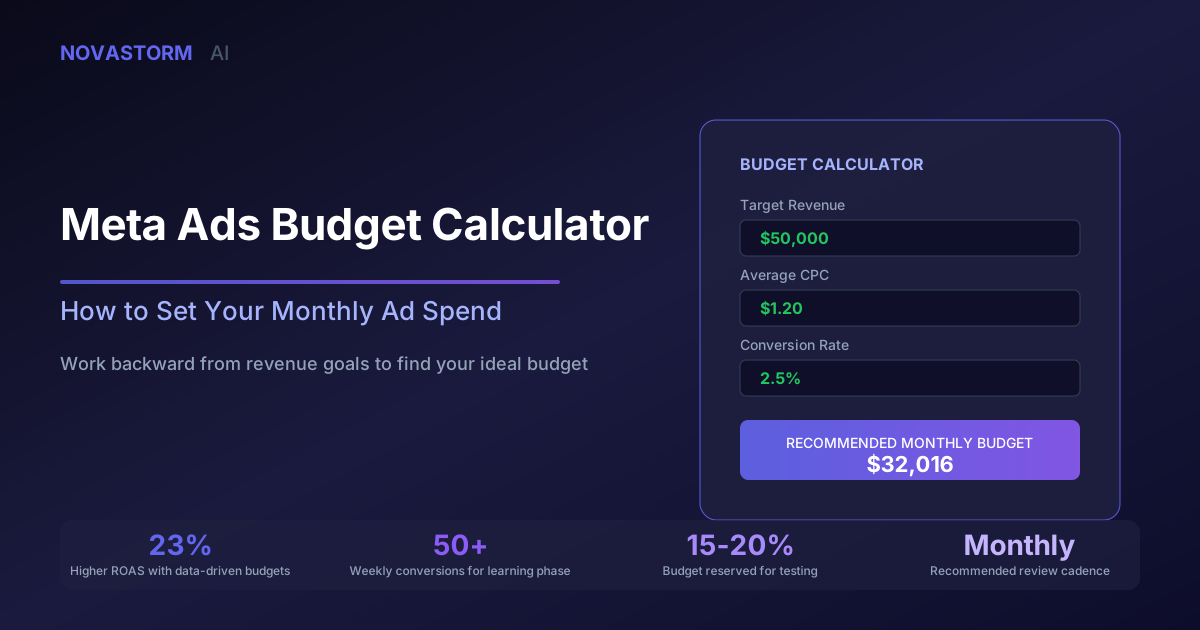
Meta Ads Budget Calculator: How to Set Your Monthly Ad Spend
Calculate monthly Meta ad spend from contribution and lead quality, test sensitivity, and reconcile cash limits with a paused campaign draft.
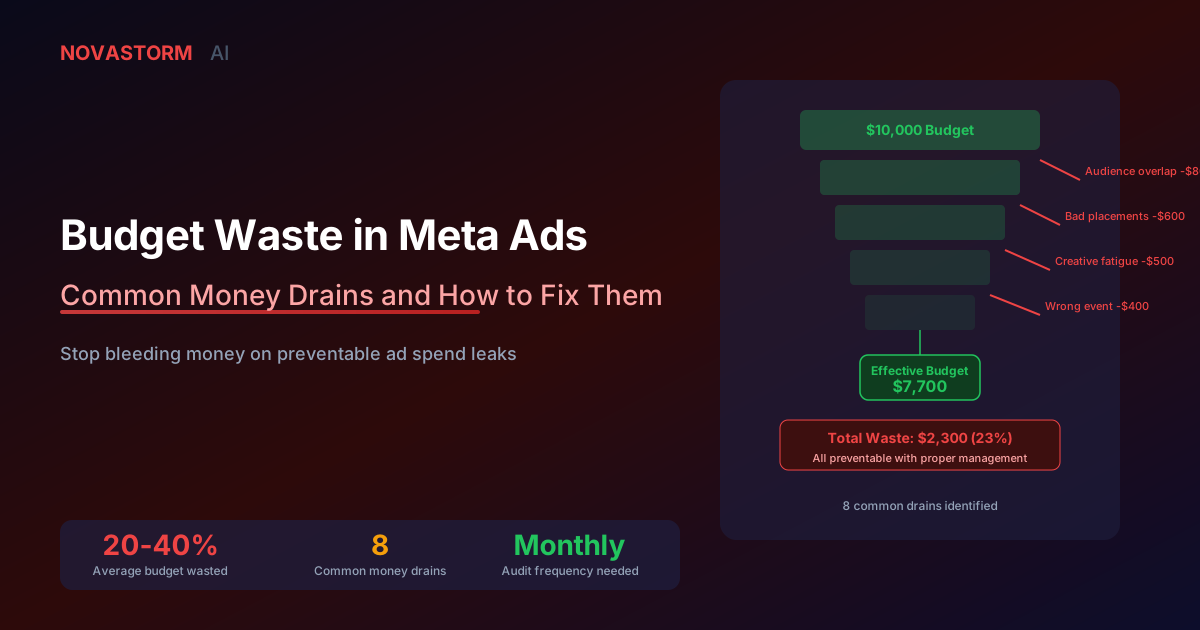
Budget Waste in Meta Ads: Common Money Drains and How to Fix Them
Audit eight potential Meta budget leaks with evidence, owners and acceptance checks, distinguish event mismatches, and act on cash-limit risk.
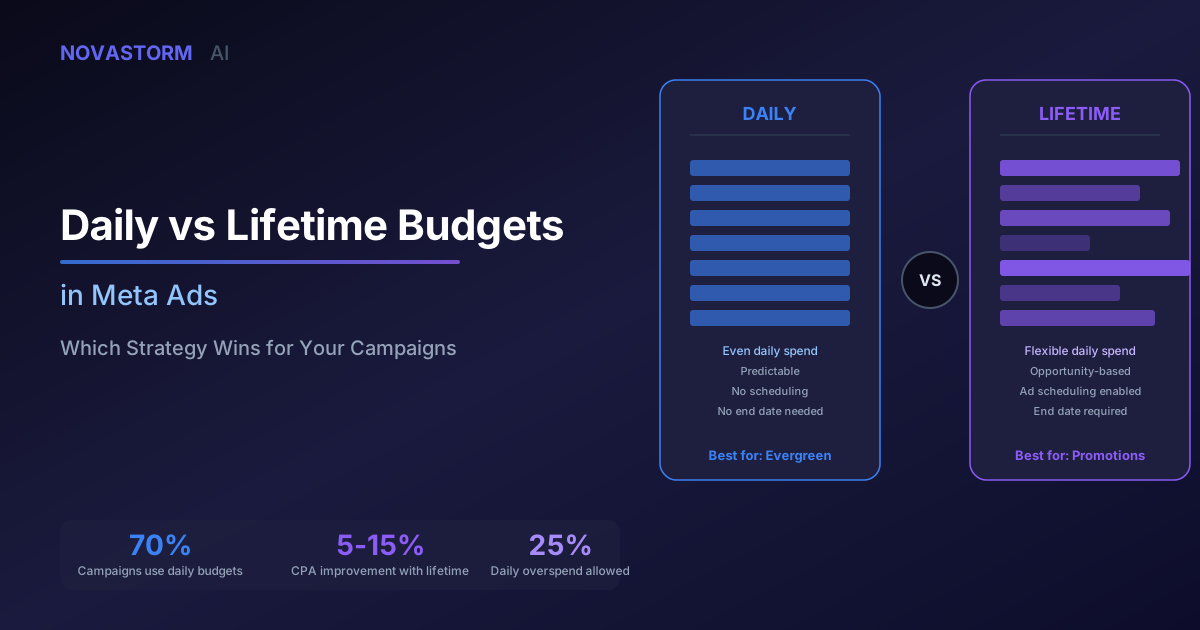
Daily vs Lifetime Budgets in Meta Ads: Which Strategy Wins
Choose daily or lifetime Meta budgets by operating horizon, log accepted settings and dates, and track remaining allowance with reporting delay.

Meta Ads Budget Pacing: Managing Delivery Within a Spending Plan
Control cumulative Meta spend against a saved allowance, account for reporting and pause delays, and investigate underspend without forcing delivery.