

Customer Acquisition Cost: The Complete Guide to CAC for Advertisers
Reconcile full acquisition costs and unique new customers, model contribution payback with churn and apply a cash-constrained campaign ceiling.
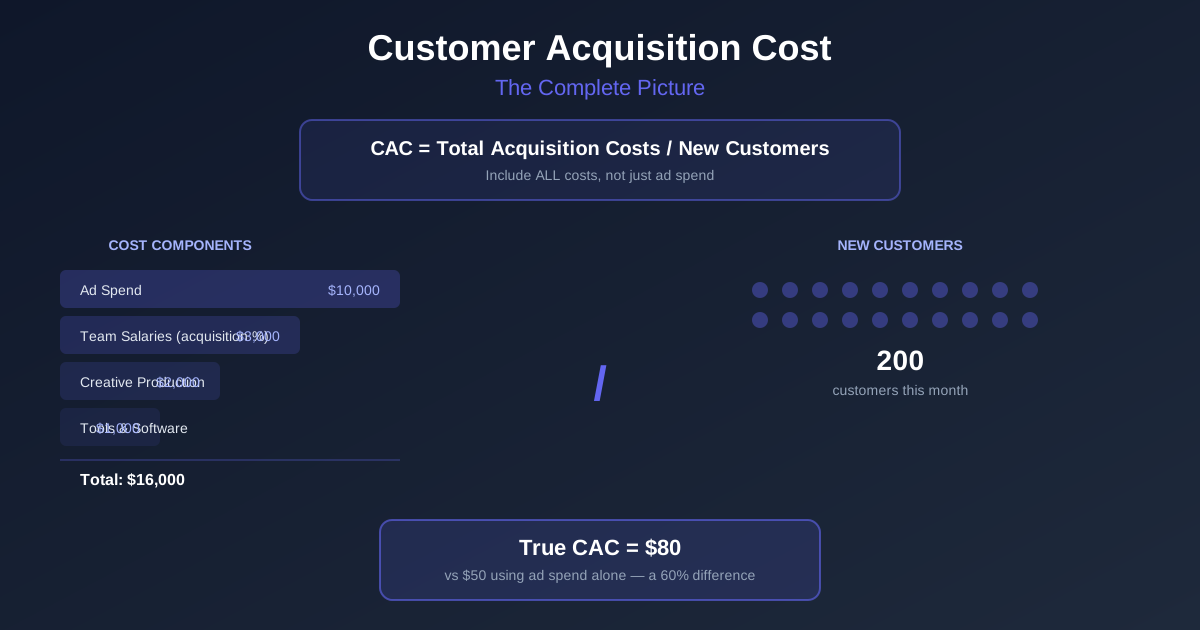
Customer acquisition cost divides the declared acquisition cost by unique qualifying new customers. A platform purchase CPA may count repeat orders, registrations or credited events. Define the business denominator first, using the cost-per-result definitions.
Reconcile $16,000 and 200 new buyers
All figures in this worked month are hypothetical. The allocation policy includes acquisition work and excludes retention and general overhead; verify the time allocation with finance rather than assigning the whole payroll to advertising.
| Acquisition expense | Allocated amount | Evidence to collect |
|---|---|---|
| Delivered advertising | 10,000 | Account spend export reconciled with the chosen cost basis |
| Creative production | 2,000 | Approved invoices or allocated production time |
| Tools | 1,000 | Subscription costs allocated to acquisition |
| Team and agency acquisition time | 3,000 | Time or contract allocation with an owner |
| Total acquisition cost | 16,000 | No duplicated invoices or retention costs |
| Reconciliation step | Record count | Denominator policy |
|---|---|---|
| Candidate buyer records | 215 | Stable customer identity and first qualifying payment |
| Duplicate identities removed | −8 | Two records for one person are not two customers |
| Existing customers removed | −5 | Earlier qualifying payment in historical records |
| Fully refunded first purchases excluded | −2 | This example defines a qualifying customer as a new retained paid buyer after the refund window |
| Unique qualifying new buyers | 200 | 215 − 8 − 5 − 2 |
Partial refunds reduce contribution and remain visible; a full refund exclusion depends on the declared customer policy. If your policy includes fully refunded new buyers, keep them in the denominator and include their losses rather than switching definitions to improve CAC. Unknown channel source does not remove a qualifying buyer from blended CAC.
Full allocated CAC = $16,000 ÷ 200 = $80. Media-only cost per new buyer = $10,000 ÷ 200 = $50. These are different cost scopes, not conflicting measurements. A customer credited by two platforms still counts once in the business denominator.
Payback under constant contribution, churn and irregular receipts
Consider a separate hypothetical subscription cohort with acquisition cost $500 per new customer and $20 monthly contribution after service costs. Without churn and with constant settled contribution, $500 ÷ $20 = 25 months. Revenue of $50 per month would recover the same cash in ten months only if service and other costs were incorrectly ignored.
Stop wasting ad budget
NovaStorm AI cuts Meta Ads CPA by 30% on average. No complex setup required.
| Scenario | Cumulative contribution calculation | What it means |
|---|---|---|
| Constant $20; no churn | 25 × 20 = 500 by month 25 | Simplified payback under restrictive assumptions |
| 5% monthly churn; $20 per active customer | Expected month-m contribution = 20 × 0.95^(m−1); infinite sum = 20 ÷ 0.05 = 400 | Under this model expected contribution never covers $500 |
| Irregular contribution | Months 1–6 at $10 = $60; months 7–18 at $25 add $300; months 19–25 at $20 add $140 | Cumulative $500 at month 25, but only $360 by month 18 |
These paths are model assumptions, not observed customer retention. In real cohorts use settled receipts, refunds and service outflows. Even two paths with the same eventual payback can have different cash gaps. A forecast is not available money, and later retention spend must be included in later contribution.
Apply a confirmed ceiling to a budget plan
Suppose a finance-approved plan allows $30,000 cash for this acquisition cohort after committed bills and reserves, and the verified target full CAC is $75. If approved nonmedia acquisition costs are $6,000 and the target is 400 qualifying buyers, the proposed media envelope is 400 × $75 − $6,000 = $24,000. This is a ceiling calculation, not a forecast that spending $24,000 will acquire 400 buyers.
In NovaStorm, a proposed workflow is to prepare the offer and campaign materials as paused campaign and local ad-set drafts, then have the owner approve the $24,000 exposure allowance and maturity-based review outside the draft. Start with a smaller declared tranche if outcomes are uncertain. Record actual full CAC, retained contribution and remaining cash before allowing more exposure; draft preparation does not enforce the business ceiling or guarantee payback.
- Choose a cash-payback limit from the bills the business must finance and downside contribution, not a universal six- or twelve-month rule.
- Reconcile actual customer identities, refund maturity and allocated costs at the same cohort age. Keep forecast repeat money separate.
- Use channel credit as a reporting allocation. To estimate incremental customers caused by a channel, design a separate controlled lift comparison.
- Limit or stop expansion when settled contribution, cash headroom or data coverage fails the approved plan; do not compensate for losses solely by changing attribution windows.
Revenue LTV of $300 does not support CAC $100 if it costs $230 to serve those customers: only $70 remains before acquisition. Use the contribution-based ceiling worksheet and a mature cohort curve before approving scale.
Published by NovaStorm AI. Planning examples are illustrative assumptions, not measured customer results.
Disclaimer: This article was generated with the assistance of AI and reviewed by the NovaStorm AI team. While we strive for accuracy, we recommend verifying specific data points and consulting official sources (linked where available) for critical business decisions.
Ready to automate your Meta Ads?
NovaStorm AI takes full responsibility for your campaigns — from monitoring to optimization.
Start NowMore on Budget and unit economics
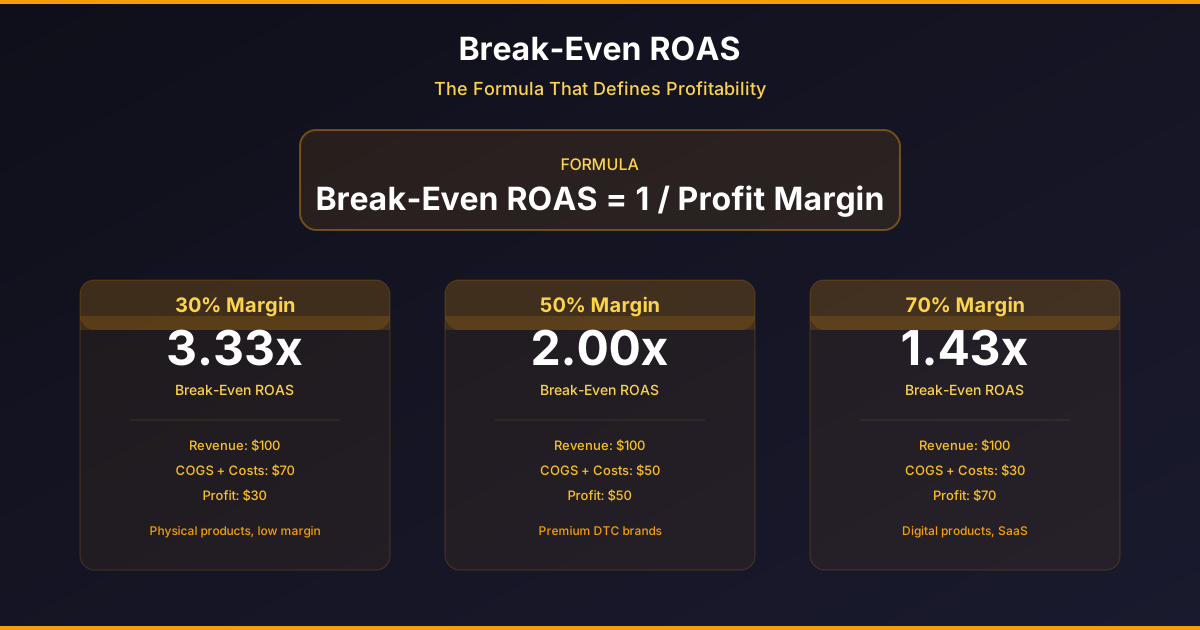
How to Calculate Your Break-Even ROAS for Meta Ads
Calculate a contribution-based CPA ceiling and ROAS target, then stress-test refunds, delivery, new-customer mix and mature campaign costs.

Meta Ads Budget Pacing: Managing Delivery Within a Spending Plan
Control cumulative Meta spend against a saved allowance, account for reporting and pause delays, and investigate underspend without forcing delivery.
Meta Purchase-Value Optimization: Revenue, Refunds and Margin
Evaluate purchase-value optimization with an event-quality worksheet, refund-adjusted contribution and a separate mature-outcome comparison.
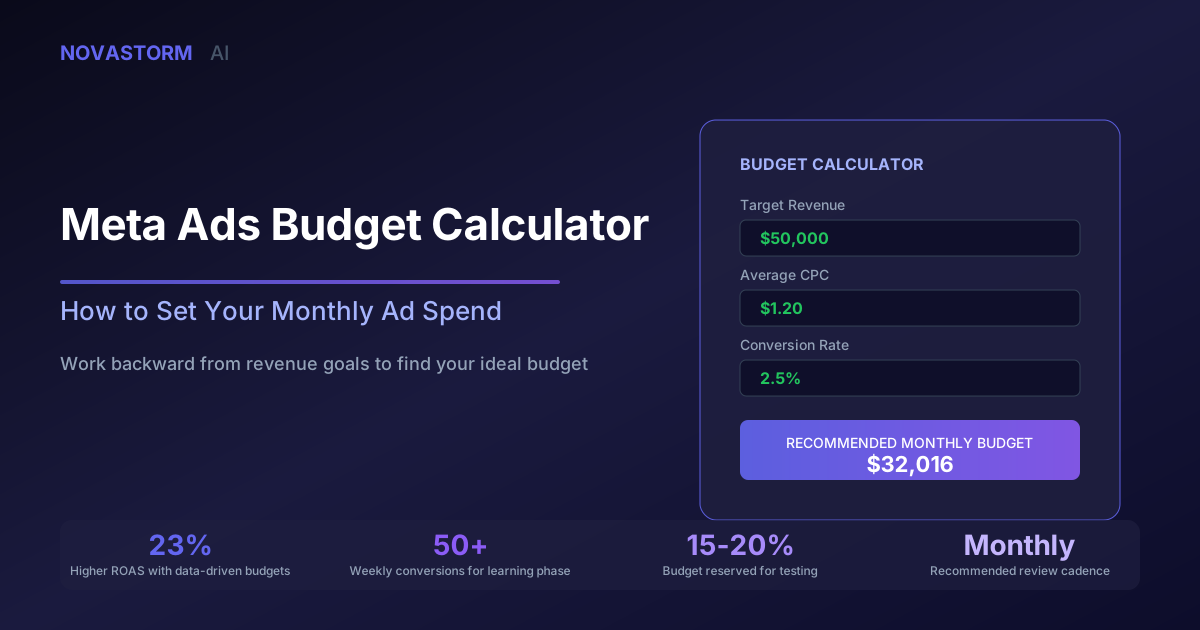
Meta Ads Budget Calculator: How to Set Your Monthly Ad Spend
Calculate monthly Meta ad spend from contribution and lead quality, test sensitivity, and reconcile cash limits with a paused campaign draft.