

North Star Metric for Meta Ads: Choosing the Right Optimization Goal
Choose a business success metric and a timely observable optimization signal, then validate their relationship with guardrails and mature cohorts.

A North Star metric is a planning choice about sustained customer value. The event selected for Meta delivery is a platform configuration choice. They can be related without being the same measure: a 90-day customer outcome may arrive too late or too rarely to guide the immediate campaign decision.
Separate outcome, input and guardrail
| Role | Illustrative subscription example |
|---|---|
| Business outcome | Customers still receiving value at day 90 |
| Candidate early input | Completed onboarding with a defined useful action |
| Commercial guardrail | Acquisition cost within contribution and cash limits |
| Quality guardrail | Refund, cancellation or unsuitable-customer rate |
Do not label an arbitrary signup as activation. Specify the action and determine whether it predicts the later outcome in mature customer groups. The cohort comparison method helps avoid evaluating recent signups before they have had time to reach day 90.
Worked proxy check
Illustrative equal-age cohorts: 100 customers complete action A and 60 remain active at day 90; 100 who do not complete A include 20 active customers. The association makes A worth investigating. It does not prove causing A will create retention, and it may reflect customers’ original intent or product suitability.
Confirm that the candidate event can be collected reliably, sent appropriately and selected under the current campaign configuration. Meta’s server event contract defines a server event’s structure; receiving an event does not establish it is available as an optimization goal in your account.
| Synthetic equal-age cohort | Eligible at start | Active day 90 | Known inactive | Unknown status |
|---|---|---|---|---|
| Completed action A | 100 | 60 | 35 | 5 |
| Did not completeA | 100 | 20 | 70 | 10 |
These are invented training counts, not observed customer data. The recorded-active fractions are 60/100=60% and 20/100=20%; do not silently drop unknown outcomes to inflate either rate. If unknowns were all active, upper bounds would be 65% and 30%, respectively. Record actual activation date, horizon date and outcome source per customer privately; compare cohorts only after the same 90-day age. The association may reflect selection rather than an effect of forcing action A.
An optimization signal needs a separate availability check
Stop wasting ad budget
NovaStorm AI cuts Meta Ads CPA by 30% on average. No complex setup required.
Hypothetical acceptance record: business outcome=active at day 90; early signal=completed setup A; collection owner=application; permitted server delivery=reviewed event contract; selectable optimization goal=unverified until the account owner checks the actual configuration. A successful server receipt is not selection evidence. Save a dated preview/configuration record if selection is supported; otherwise use a verified available event and retain the long-term metric in business reporting.
Version definitions before changing the goal
- Name the metric version, eligibility denominator, horizon, unknown-state rule and data owner.
- For a revised activation definition, report old and new counts in parallel during an agreed transition; do not splice their history into one apparent trend.
- Re-evaluate the proxy on mature cohorts and inspect business suitability, not just correlation.
- Get the account owner’s approval for any changed delivery configuration and maximum cash risk.
Do not expand attribution to fit the framework
A business measurement horizon is not an arbitrary Meta attribution window. Check the supported configuration and retain long-term evaluation in your own cohort reporting. Do not instruct the platform to extend credit to three months just because the business outcome occurs then.
Use the funnel metric definitions to document the early signal’s denominator and how it differs from customers, purchases and credited conversions. Keep cost and quality guardrails even when one headline outcome provides direction.
Review the metric when evidence changes
Choose a baseline, meaningful business improvement and risk limit from actual economics. Document changes and report old and new definitions during transition. There is no universal rule that ROAS is always forbidden, that every useful metric must mature within 90 days, or that a 10–20% target fits every business.
Illustrative NovaStorm brief: verified objective/event, setup A definition, confirmed destination and acquisition ceiling derived from contribution. If assumed contribution per acquired customer is USD 30 and required reserve USD 10, the proposed CPA ceiling is USD 20; these are hypothetical inputs, not measured lifetime value. The reader’s business owner must verify long-term retention and margin separately before approving a campaign draft.
Published by NovaStorm AI. Worked examples and test fixtures in this article are illustrative, not observed customer results.
Disclaimer: This article was generated with the assistance of AI and reviewed by the NovaStorm AI team. While we strive for accuracy, we recommend verifying specific data points and consulting official sources (linked where available) for critical business decisions.
Ready to automate your Meta Ads?
NovaStorm AI takes full responsibility for your campaigns — from monitoring to optimization.
Start NowMore on Metrics and reporting
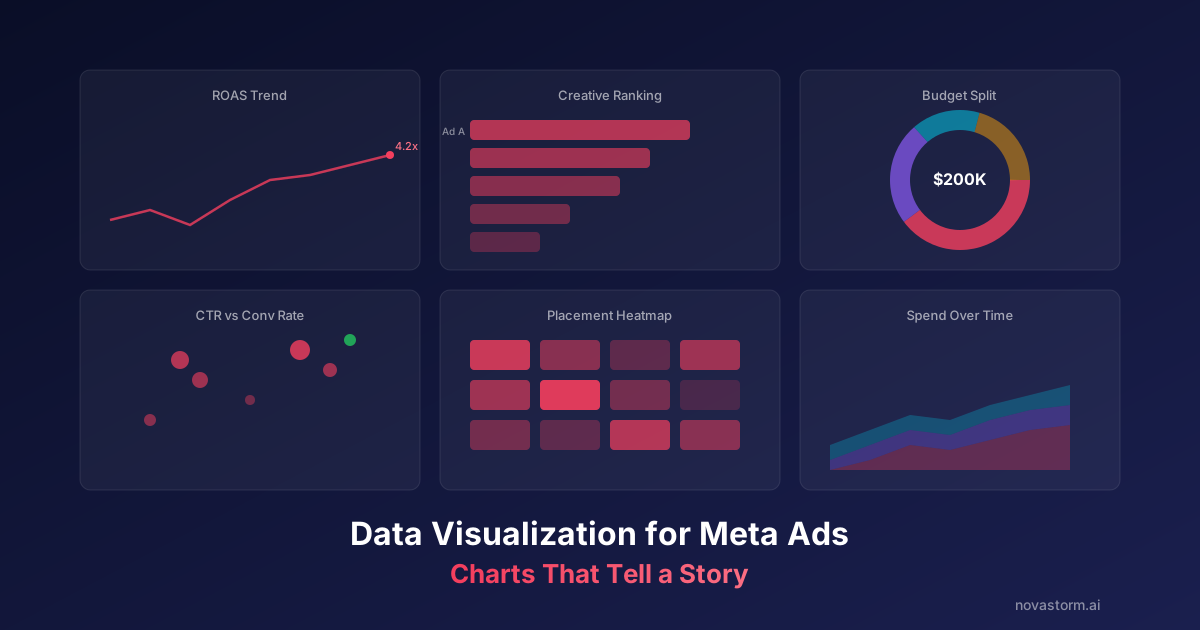
Data Visualization for Meta Ads: Charts That Tell a Story
Verify Meta reporting charts with source rows, weighted CPA, join checks and accessible labels before drawing conclusions from a visual.
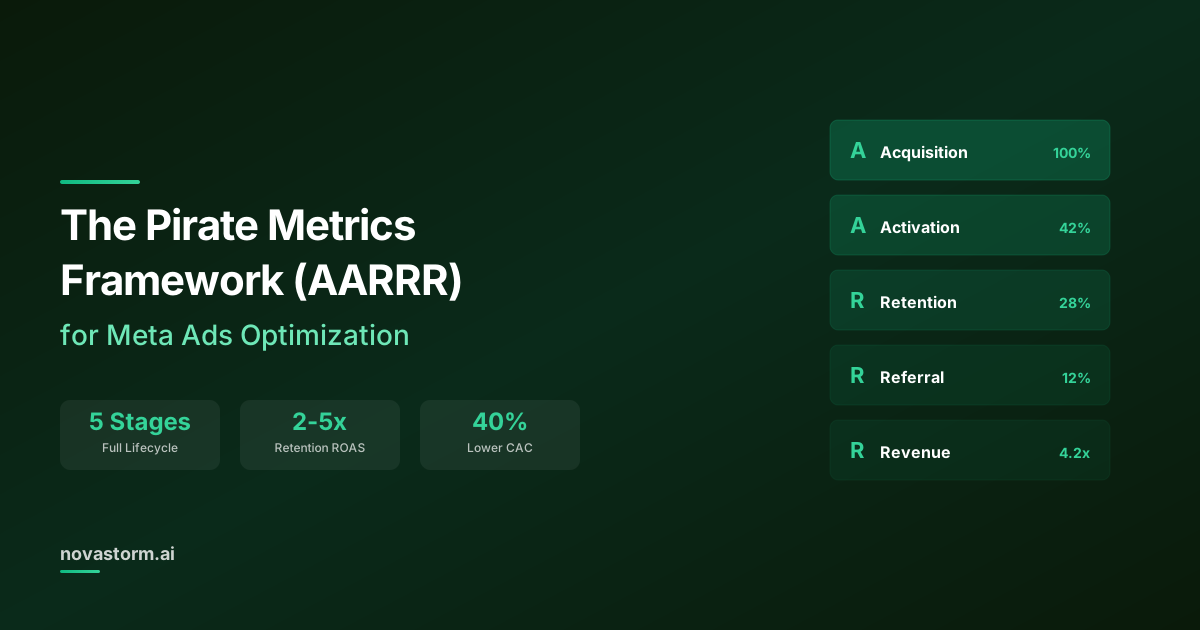
The Pirate Metrics Framework (AARRR) for Meta Ads Optimization
Use AARRR to define acquisition, activation, retention, referral and revenue measures, then prioritize evidence-backed constraints rather than the smallest rate.
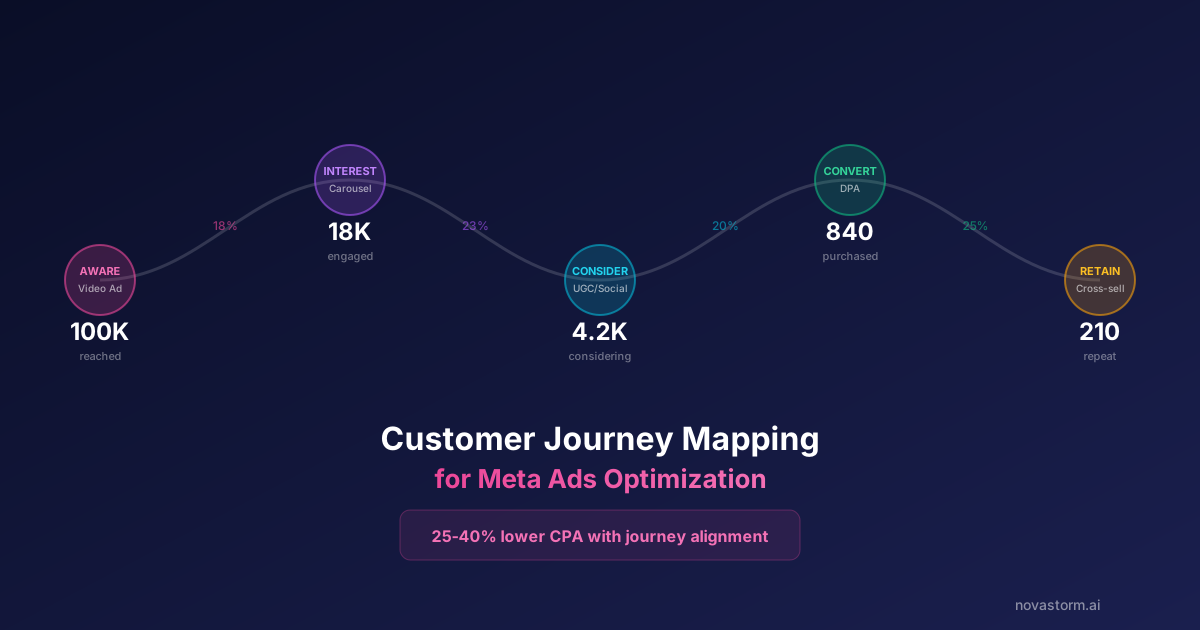
Customer Journey Mapping for Meta Ads Optimization
Build an evidence-based journey map, distinguish interviews from recorded events and test one pricing-message change with costs and mature outcomes.
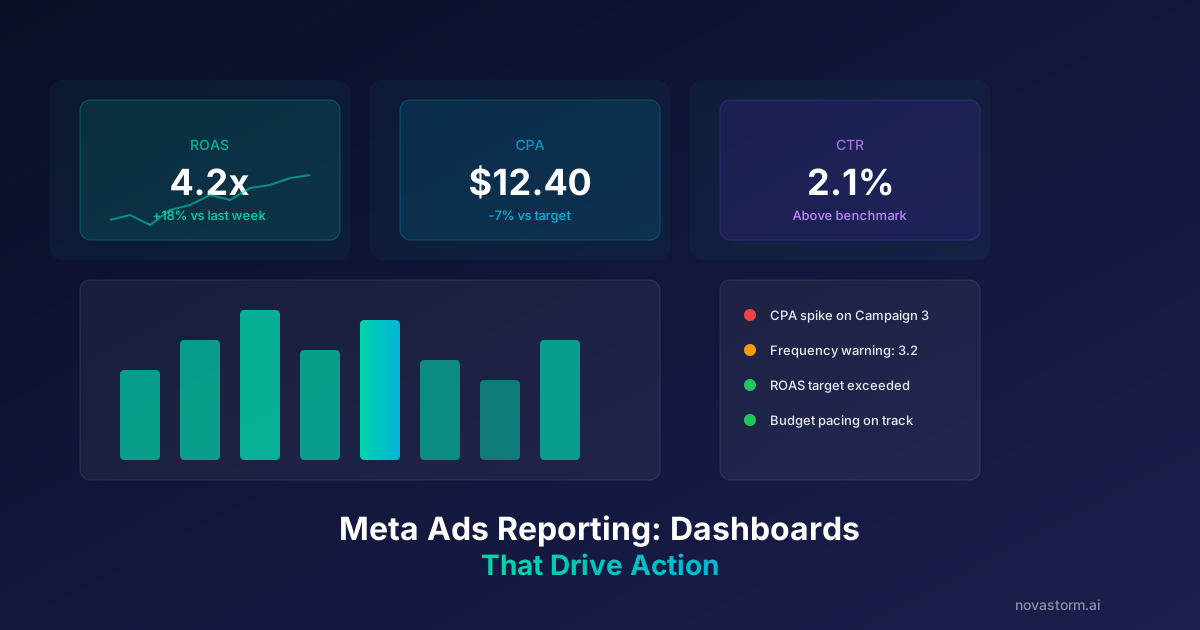
Meta Ads Reporting: Building Dashboards That Drive Action
Build a dated reporting dashboard with explicit gaps, reconciliation cards, owners, approval records and completed-decision reviews.