

ROAS: The Complete Guide to Return on Ad Spend
Calculate ROAS and contribution after returns, reconcile duplicate channel credit and record comparable report scope before changing budget.
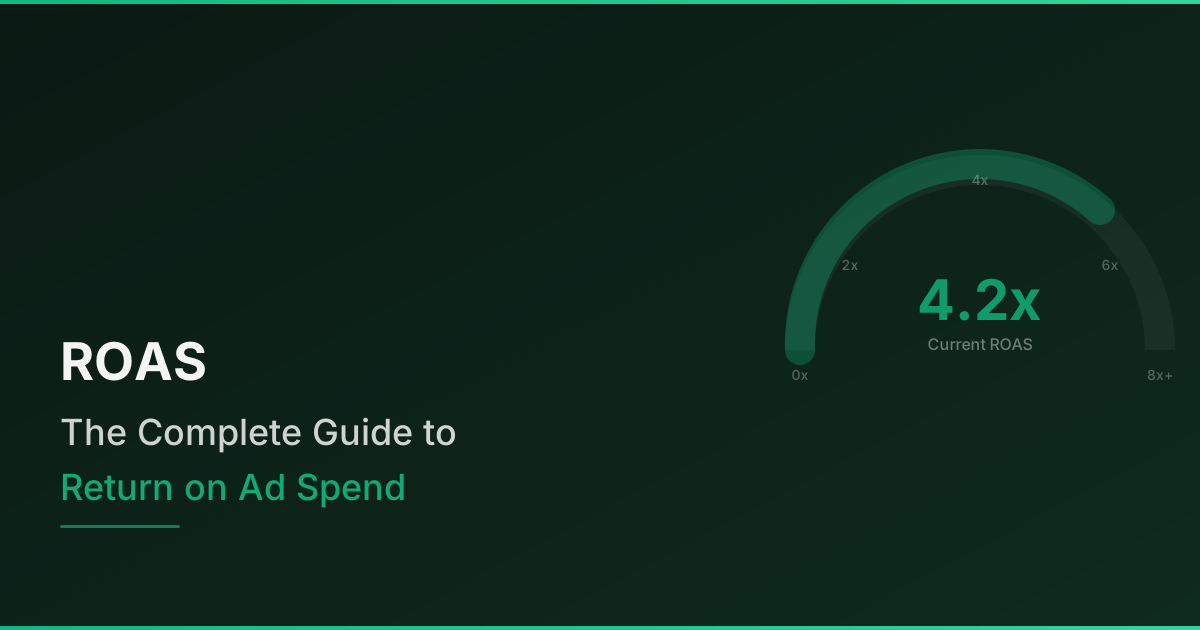
ROAS is credited revenue divided by included advertising spend. It is not profit and it is not an incremental advertising effect. Define currency, period, revenue treatment and attribution scope before comparing ratios.
Continue the $1,000/$4,000 example
Hypothetical report: $1,000 spend receives credit for $4,000 gross sales, giving ROAS 4.0. At an assumed 40% contribution before ads, $1,600 contribution leaves $600 after advertising before fixed costs. The 40% margin must already include all declared variable costs; do not subtract the same costs twice.
| Illustrative cost revision | Calculation | Meaning |
|---|---|---|
| Gross sales and booked variable costs | $4,000 revenue − $2,400 cost = $1,600 | 40% contribution before ads |
| Nonrecoverable returns | Assumed $800 refunds with no recovery of those booked costs | $3,200 net revenue − $2,400 = $800 |
| Additional variable costs | Assumed $200 payment/return/support cost not previously included | $800 − $200 = $600 before ads |
| Advertising | Subtract $1,000 | $400 loss after ads despite net ROAS 3.2 |
Inputs are illustrative and the no-cost-recovery return assumption matters: recovered inventory or refunded supplier costs would change contribution. Declare tax, shipping, discounts, fulfilment and service costs consistently. A positive ROAS can coexist with a negative cash contribution.
One order, two attribution credits
Synthetic order demo-order-A has $80 net sales. A person clicked Meta, later clicked paid search and purchased. Suppose each platform’s allowed model/report credits the same $80 order: their attributed revenue sums to $160, while the order system has one $80 sale. This is a reconciliation example, not a claim about a particular account or proof that either channel caused the purchase.
Stop wasting ad budget
NovaStorm AI cuts Meta Ads CPA by 30% on average. No complex setup required.
Google’s attribution overview describes credit allocation across touchpoints. Different credit rules cannot be added as though they were independent transactions. Incremental lift needs a separate valid controlled experiment.
A report-row contract
| Field | Example planning definition | Confirm before comparing |
|---|---|---|
| Currency | USD; dated conversion for any other currency | Same accounting basis |
| Period/timezone | October 1–7, declared reporting timezone | Same dates and maturity |
| Revenue | Net paid orders after stated refund treatment | No gross/net mismatch |
| Spend | All included media fees/campaigns | Same cost scope |
| Attribution | Exact click/view/lookback model and reporting basis | Do not mix different credit rules |
| Order key | Stable synthetic order ID in this example | Deduplicate actual business transactions privately |
Approve comparability before a budget recommendation
In NovaStorm, use the reporting brief to prepare a paused campaign plan only after the user confirms scope, actual contribution and risk. No customer ROAS or implemented reconciliation feature is claimed. Check mature new-customer mix and refunds before increasing spend; follow the Meta/GA4 reconciliation guide when totals differ.
Published by NovaStorm AI. Planning examples are illustrative assumptions, not measured customer results.
Disclaimer: This article was generated with the assistance of AI and reviewed by the NovaStorm AI team. While we strive for accuracy, we recommend verifying specific data points and consulting official sources (linked where available) for critical business decisions.
Ready to automate your Meta Ads?
NovaStorm AI takes full responsibility for your campaigns — from monitoring to optimization.
Start NowMore on Budget and unit economics

Shopify Profit Reports for Meta Ads: Calculate Variant-Level Allowable Bids
Learn how to reconcile Shopify variant profit reports, discounts, and fulfillment costs to calculate maximum allowable Meta ad bids (bid_amount) and margin guardrails.

Cost Per Result: Understanding Your True Acquisition Cost
Distinguish media cost per reported result from full new-customer CAC, allocate acquisition costs once and set a commercial media ceiling.
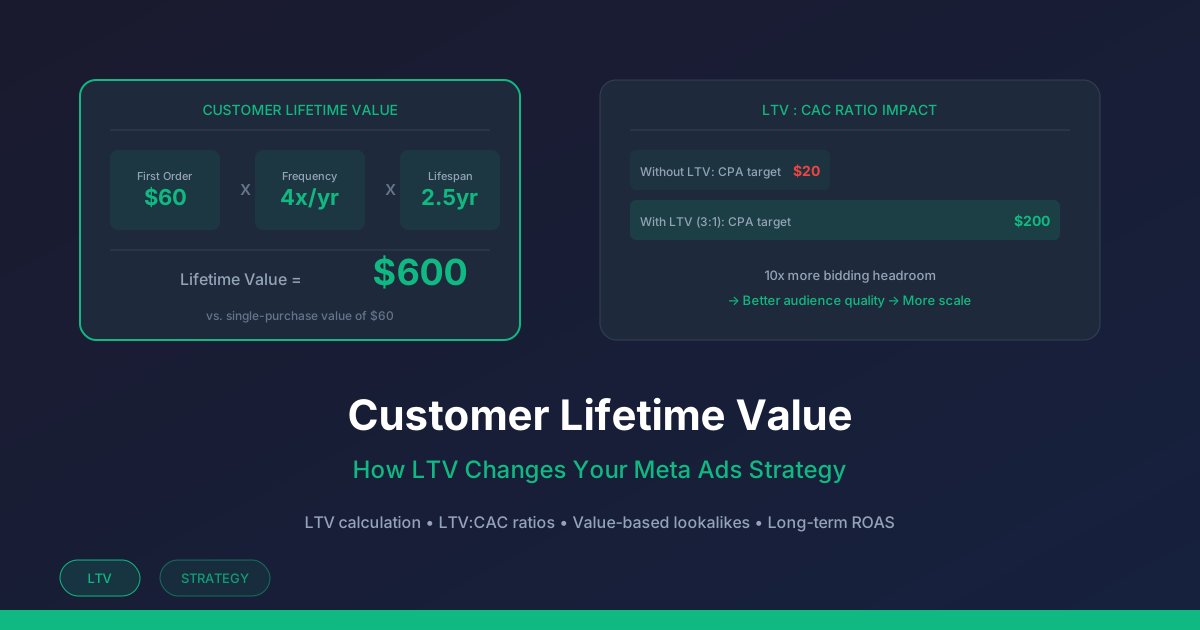
Customer Lifetime Value: How LTV Changes Your Meta Ads Strategy
Separate revenue and contribution LTV, compare equal-age cohorts, validate forecasts and set acquisition limits around cash and payback.
Meta Purchase-Value Optimization: Revenue, Refunds and Margin
Evaluate purchase-value optimization with an event-quality worksheet, refund-adjusted contribution and a separate mature-outcome comparison.