

Check Shopify Order Extract Completeness Before a Meta Ads Budget Review
Complete an accept-or-return worksheet for Shopify order extracts: check pagination, duplicate IDs, test orders, date scope and refund coverage.
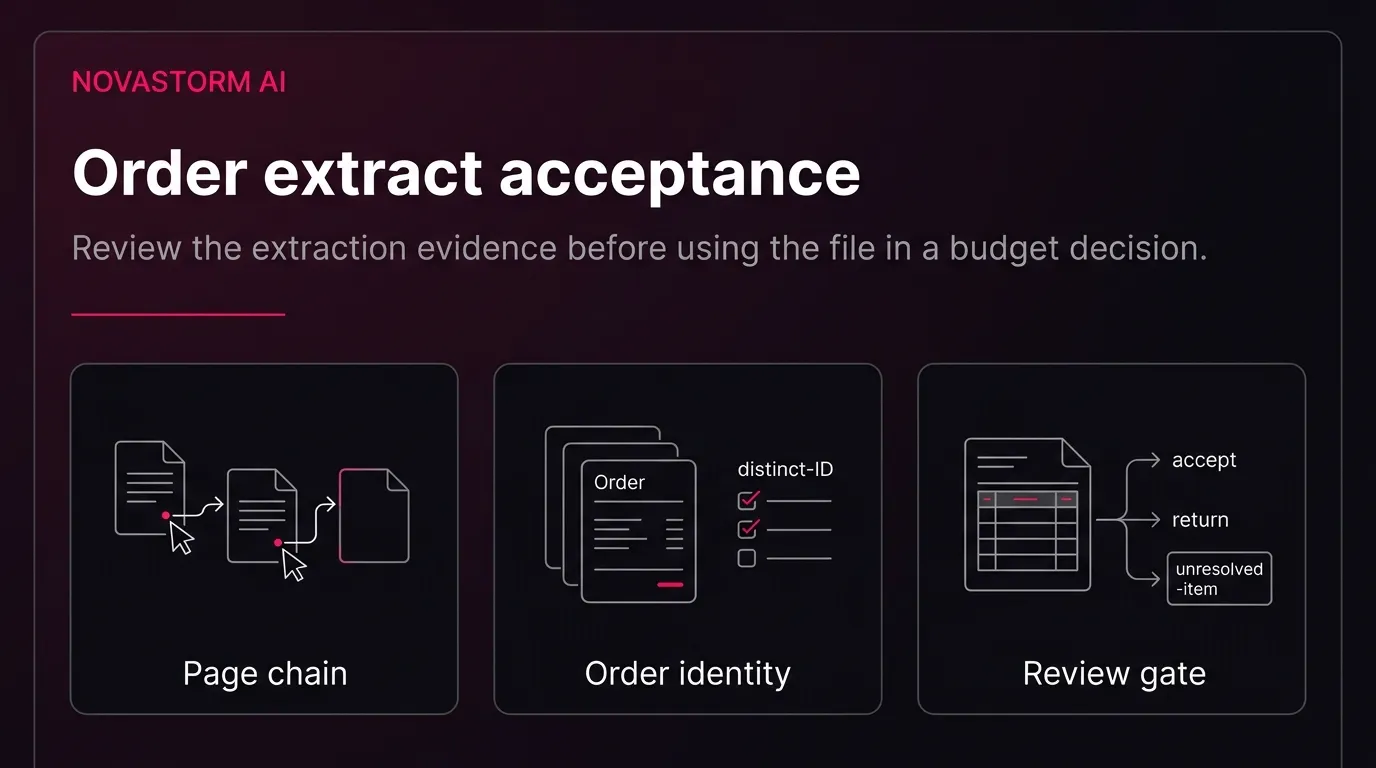
AI-generated conceptual illustration; not a platform screenshot or customer result.
For an e-commerce media buyer, the task here is file acceptance—not choosing a budget. Your output is a worksheet connecting the analyst’s extraction evidence to the population intended for review. No actual extract, query record or page log was supplied for this article; the filled example is not a verdict on a real file.
Define the acceptance decision before inspecting the file
The original framework below supplies the prerequisites, procedure, acceptance rules and a test of the proposed control. It is an administrative hypothesis, not a Shopify-prescribed workflow. Hypothesis: An explicit accept-or-return worksheet could make scope and completeness exceptions visible before an order extract is used in a Meta budget review. No lift has been measured here. Scope: Original administrative framework, not a Shopify-prescribed best practice. Assume an analyst can supply the file, store identity, API version, query and variables, field mappings, extraction timestamp, page log and intended order-level grain. Record the review's creation-date interval, time zone, test-order rule, financial-status inclusion and refund observation cutoff before checking the file. Reconcile page-level returned counts against raw exported rows, then reconcile raw rows against distinct nonmissing Shopify order IDs and duplicate excess. Investigate missing IDs and repeated IDs before selecting any surviving record; joined line-item rows and conflicting snapshots require different corrections. Check test flags and date membership on the reconciled order-level population, accounting for exclusions without double counting. Compare the actual date filter with the required creation-date cohort. For forward pagination, request the initial request, cursor continuity, unchanged query scope and a terminal response indicating no next page; a terminal flag alone does not prove earlier pages were retained. Record every unresolved exception, owner and correction request. Accept only for the declared scope after required checks pass; otherwise return the extract and block its use as budget-review evidence. Refutable test: give reviewers fictional extracts containing known missing-page, repeated-ID, test-order and date-scope defects, and compare their worksheets with the seeded defect inventory. A missed seeded defect refutes reliable detection for that exercise. This does not test advertising effectiveness or prove absolute store-wide completeness.
Copy this intake and sign-off sheet for each review. Its procedure and disposition rules come from the proposed acceptance framework; its financial-coverage section uses the separate maturity control. “To confirm” remains unresolved, not passed. Hypothesis: An explicit accept-or-return worksheet could make scope and completeness exceptions visible before an order extract is used in a Meta budget review. No lift has been measured here. Scope: Original administrative framework, not a Shopify-prescribed best practice. Assume an analyst can supply the file, store identity, API version, query and variables, field mappings, extraction timestamp, page log and intended order-level grain. Record the review's creation-date interval, time zone, test-order rule, financial-status inclusion and refund observation cutoff before checking the file. Reconcile page-level returned counts against raw exported rows, then reconcile raw rows against distinct nonmissing Shopify order IDs and duplicate excess. Investigate missing IDs and repeated IDs before selecting any surviving record; joined line-item rows and conflicting snapshots require different corrections. Check test flags and date membership on the reconciled order-level population, accounting for exclusions without double counting. Compare the actual date filter with the required creation-date cohort. For forward pagination, request the initial request, cursor continuity, unchanged query scope and a terminal response indicating no next page; a terminal flag alone does not prove earlier pages were retained. Record every unresolved exception, owner and correction request. Accept only for the declared scope after required checks pass; otherwise return the extract and block its use as budget-review evidence. Refutable test: give reviewers fictional extracts containing known missing-page, repeated-ID, test-order and date-scope defects, and compare their worksheets with the seeded defect inventory. A missed seeded defect refutes reliable detection for that exercise. This does not test advertising effectiveness or prove absolute store-wide completeness. Hypothesis: Recording refund observation coverage separately from extraction completeness could prevent a structurally complete file from being mistaken for a financially final cohort. No lift has been measured here. Scope: Assume the review owner defines the refund observation cutoff and the analyst can explain whether the delivered financial fields include changes through that cutoff. Record the cohort boundaries, extraction timestamp, observation cutoff, meaning of exported amount fields, status exclusions and any unobserved refund interval. Do not invent a universal maturity threshold or infer historical as-of balances from a current snapshot. Mark maturity unresolved when coverage cannot be established and request clarification or a suitable replacement. Refutable test: supply fictional worksheets with deliberately mismatched extraction and refund coverage and check whether reviewers flag every mismatch. If they accept an unobserved interval as covered, the proposed control fails for that exercise. Neither passing this check nor passing pagination checks establishes profit, full CAC, Meta attribution or grounds for increasing spend.
| Worksheet section | Evidence or decision to record | Current entry |
|---|---|---|
| Extraction identity | Store, API version, file and extraction timestamp | To confirm |
| Population contract | Creation-date interval, time zone and boundary inclusivity | To confirm |
| Query record | Actual query, variables, filters and field mappings | To confirm |
| Grain and identity | Intended order-level grain; raw rows, missing IDs, distinct IDs and duplicate excess | To confirm |
| Page reconciliation | Page counts, exported rows, cursor continuity and terminal response | To confirm |
| Inclusion policy | Test-order rule and approved financial-status inclusion | To confirm |
| Financial coverage | Amount definitions, refund cutoff and unobserved interval | To confirm |
| Exceptions | Evidence gap, owner and correction request | To confirm |
| Disposition | Accept for declared scope, or return and block use | To confirm |
Check the page chain before cleaning rows
The documented retrieval mechanism supplies the basis for examining the analyst’s extraction record: The Shopify orders query supports pagination, sorting and filtering. Source. Scope: Applies to the supplied Shopify GraphQL Admin API orders documentation, identified as version 2026-10. These capabilities do not establish that an analyst's extract used them correctly. The after argument selects elements following a specified cursor. Source. Scope: Applies to cursor-based retrieval with the orders query. Preserve the analyst's actual cursor sequence rather than assuming successive requests covered different records. The first argument limits retrieval to the requested initial number of elements in the paginated list. Source. Scope: Applies to the orders connection. A request using first alone is not evidence that every matching order was retrieved.
Shopify’s example shows relevant pagination evidence, but the example is not evidence about your file: Shopify's order-list example requests order IDs, edge cursors and pagination metadata including next-page availability and the ending cursor. Source. Scope: The adjacent query and response belong to an example, not an actual extraction record. Request equivalent evidence from the analyst; do not present the documentation response as evidence about the supplied file. The sample response indicates that another page is available after the returned order list. Source. Scope: This describes only Shopify's documented sample response. It illustrates why a returned page of orders is not necessarily a complete extract.
For this step, use the page-reconciliation portion of the proposed framework. The expected output is a connected extraction record, not merely a plausible row count. Keep the correction request open wherever the page evidence cannot be connected to the exported file. Hypothesis: An explicit accept-or-return worksheet could make scope and completeness exceptions visible before an order extract is used in a Meta budget review. No lift has been measured here. Scope: Original administrative framework, not a Shopify-prescribed best practice. Assume an analyst can supply the file, store identity, API version, query and variables, field mappings, extraction timestamp, page log and intended order-level grain. Record the review's creation-date interval, time zone, test-order rule, financial-status inclusion and refund observation cutoff before checking the file. Reconcile page-level returned counts against raw exported rows, then reconcile raw rows against distinct nonmissing Shopify order IDs and duplicate excess. Investigate missing IDs and repeated IDs before selecting any surviving record; joined line-item rows and conflicting snapshots require different corrections. Check test flags and date membership on the reconciled order-level population, accounting for exclusions without double counting. Compare the actual date filter with the required creation-date cohort. For forward pagination, request the initial request, cursor continuity, unchanged query scope and a terminal response indicating no next page; a terminal flag alone does not prove earlier pages were retained. Record every unresolved exception, owner and correction request. Accept only for the declared scope after required checks pass; otherwise return the extract and block its use as budget-review evidence. Refutable test: give reviewers fictional extracts containing known missing-page, repeated-ID, test-order and date-scope defects, and compare their worksheets with the seeded defect inventory. A missed seeded defect refutes reliable detection for that exercise. This does not test advertising effectiveness or prove absolute store-wide completeness.
Reconcile order identity before exclusions
The source establishes which identity and status fields appear in its detailed example: Shopify's detailed order-query example retrieves the order ID, creation timestamp and displayed financial status. Source. Scope: Applies to the fields shown in the documented example. This does not verify the analyst's column mappings, extract grain or handling of joined line items. It also identifies a limitation of a possible substitute identifier: The confirmation number displayed to a customer is not guaranteed to be unique. Source. Scope: Applies specifically to confirmation_number. Do not substitute this identifier for Shopify order IDs when reconciling an extract.
Apply the identity-reconciliation portion of the framework before interpreting test-order or date exclusions. The worksheet should make unresolved identity and grain problems visible rather than conceal them behind a chosen surviving row. Hypothesis: An explicit accept-or-return worksheet could make scope and completeness exceptions visible before an order extract is used in a Meta budget review. No lift has been measured here. Scope: Original administrative framework, not a Shopify-prescribed best practice. Assume an analyst can supply the file, store identity, API version, query and variables, field mappings, extraction timestamp, page log and intended order-level grain. Record the review's creation-date interval, time zone, test-order rule, financial-status inclusion and refund observation cutoff before checking the file. Reconcile page-level returned counts against raw exported rows, then reconcile raw rows against distinct nonmissing Shopify order IDs and duplicate excess. Investigate missing IDs and repeated IDs before selecting any surviving record; joined line-item rows and conflicting snapshots require different corrections. Check test flags and date membership on the reconciled order-level population, accounting for exclusions without double counting. Compare the actual date filter with the required creation-date cohort. For forward pagination, request the initial request, cursor continuity, unchanged query scope and a terminal response indicating no next page; a terminal flag alone does not prove earlier pages were retained. Record every unresolved exception, owner and correction request. Accept only for the declared scope after required checks pass; otherwise return the extract and block its use as budget-review evidence. Refutable test: give reviewers fictional extracts containing known missing-page, repeated-ID, test-order and date-scope defects, and compare their worksheets with the seeded defect inventory. A missed seeded defect refutes reliable detection for that exercise. This does not test advertising effectiveness or prove absolute store-wide completeness.
Compare the selected cohort with the required cohort
Start with the distinct documented meanings of the date filters: The created_at search filter selects orders by when they were created in Shopify. Source. Scope: Applies to the documented orders query filter. The review must separately define its intended time zone and inclusive or exclusive date boundaries. The updated_at search filter selects orders by when they were last updated in Shopify. Source. Scope: Read with the preceding fragment identifying updated_at. An update-date selection is not documentation of a creation-date cohort; do not treat the fields as interchangeable.
Use the scope-comparison portion of the acceptance framework to decide whether the actual selection matches the review contract. The output is a recorded scope decision and, where necessary, a correction request—not a locally filtered subtotal presented as a replacement extract. Hypothesis: An explicit accept-or-return worksheet could make scope and completeness exceptions visible before an order extract is used in a Meta budget review. No lift has been measured here. Scope: Original administrative framework, not a Shopify-prescribed best practice. Assume an analyst can supply the file, store identity, API version, query and variables, field mappings, extraction timestamp, page log and intended order-level grain. Record the review's creation-date interval, time zone, test-order rule, financial-status inclusion and refund observation cutoff before checking the file. Reconcile page-level returned counts against raw exported rows, then reconcile raw rows against distinct nonmissing Shopify order IDs and duplicate excess. Investigate missing IDs and repeated IDs before selecting any surviving record; joined line-item rows and conflicting snapshots require different corrections. Check test flags and date membership on the reconciled order-level population, accounting for exclusions without double counting. Compare the actual date filter with the required creation-date cohort. For forward pagination, request the initial request, cursor continuity, unchanged query scope and a terminal response indicating no next page; a terminal flag alone does not prove earlier pages were retained. Record every unresolved exception, owner and correction request. Accept only for the declared scope after required checks pass; otherwise return the extract and block its use as budget-review evidence. Refutable test: give reviewers fictional extracts containing known missing-page, repeated-ID, test-order and date-scope defects, and compare their worksheets with the seeded defect inventory. A missed seeded defect refutes reliable detection for that exercise. This does not test advertising effectiveness or prove absolute store-wide completeness.
Then distinguish available filter mechanics from the review owner’s inclusion policy: The financial_status filter uses the order's displayFinancialStatus field and supports paid, pending, authorized, partially paid, partially refunded, refunded, voided and expired categories. Source. Scope: Applies to the supplied orders-query documentation. Supported categories do not prescribe which categories a budget review should include, nor do they establish realized revenue or refund maturity. Shopify documents a Boolean test-order filter. Source. Scope: Read with the adjacent description of orders made through the Shopify Bogus Gateway or a payment provider in test mode. The documentation does not establish whether the analyst applied this filter or supplied a reliable mapped test flag.
Use the framework’s inclusion checks to record the approved status policy and the evidence behind the supplied test-flag mapping. Treat an unexplained mapping or undecided restriction as an exception requiring closure. Hypothesis: An explicit accept-or-return worksheet could make scope and completeness exceptions visible before an order extract is used in a Meta budget review. No lift has been measured here. Scope: Original administrative framework, not a Shopify-prescribed best practice. Assume an analyst can supply the file, store identity, API version, query and variables, field mappings, extraction timestamp, page log and intended order-level grain. Record the review's creation-date interval, time zone, test-order rule, financial-status inclusion and refund observation cutoff before checking the file. Reconcile page-level returned counts against raw exported rows, then reconcile raw rows against distinct nonmissing Shopify order IDs and duplicate excess. Investigate missing IDs and repeated IDs before selecting any surviving record; joined line-item rows and conflicting snapshots require different corrections. Check test flags and date membership on the reconciled order-level population, accounting for exclusions without double counting. Compare the actual date filter with the required creation-date cohort. For forward pagination, request the initial request, cursor continuity, unchanged query scope and a terminal response indicating no next page; a terminal flag alone does not prove earlier pages were retained. Record every unresolved exception, owner and correction request. Accept only for the declared scope after required checks pass; otherwise return the extract and block its use as budget-review evidence. Refutable test: give reviewers fictional extracts containing known missing-page, repeated-ID, test-order and date-scope defects, and compare their worksheets with the seeded defect inventory. A missed seeded defect refutes reliable detection for that exercise. This does not test advertising effectiveness or prove absolute store-wide completeness.
Stop wasting ad budget
Plan, create and run Meta Ads campaigns with AI. Free to start, no complex setup.
Filled worksheet: a subtotal that must not pass
The following worksheet organizes the declared teaching inputs and exceptions. Hypothetical example. All inputs are assumed for teaching purposes and are not customer results. A fictional filled worksheet reconciles raw rows to unique Shopify order IDs and identifies identical repeated rows, a test order and an order created outside the intended cohort. The residual in-scope non-test population is only a diagnostic subtotal, not an accepted extract or an attributed-sales result. Assumed inputs: Assumed raw exported rows = 12 rows; Assumed distinct nonmissing Shopify order IDs = 10 orders; Assumed excess identical rows beyond unique order IDs = 2 rows; Assumed unique test orders excluded after identity reconciliation = 1 orders; Assumed unique non-test orders outside the creation-date interval = 1 orders; Assumed reconciled in-scope non-test diagnostic subtotal = 8 orders. Period: September 2026 creation-date teaching cohort; extraction and refund observation cutoff October 4, 2026 at 12:00 UTC. Scope: Assume a single-store file intended to contain one row per order. Duplicate excess consists of identical copies with no conflicting fields. After collapsing these identical copies for diagnosis, the test-order and out-of-period exclusions are disjoint. The review interval is September 2026 in UTC, from the start of September inclusive to the start of October exclusive. The extraction timestamp and refund observation cutoff are October 4, 2026 at 12:00 UTC. The worksheet records that the actual selection used updated_at rather than the required created_at scope, its last retained page indicates another page is available, and no subsequent response is supplied. Its declared financial-status inclusion is paid only, while the review owner has not approved that restriction. Missing orders cannot be counted from the file. Outcome: RETURN; use of this extract for the budget decision is BLOCKED. Correction request: rerun the declared creation-date cohort, provide the complete page chain and matching export counts, investigate repeated IDs, apply and document the agreed test-order rule, obtain an explicit status-inclusion decision, and document refund coverage at the observation cutoff. Re-audit the replacement rather than treating the diagnostic subtotal as a corrected total.
| Check | Recorded evidence or assumed input | Worksheet disposition |
|---|---|---|
| Required creation-date interval | September 2026; UTC; start of September inclusive to start of October exclusive | Required scope |
| Extraction and refund observation cutoff | October 4, 2026 at 12:00 UTC | Refund coverage: To confirm |
| Raw exported rows | 12 rows | Recorded |
| Distinct nonmissing Shopify order IDs | 10 orders | Recorded |
| Duplicate excess | 2 identical repeated rows | Investigate repeated IDs |
| Test-order exclusion after identity reconciliation | 1 order | Apply and document agreed rule |
| Non-test order outside the creation-date interval | 1 order | Scope exception |
| Residual diagnostic population | 8 orders | Diagnostic only; not accepted |
| Actual date selection | updated_at rather than required created_at scope | Return |
| Pagination evidence | Last retained page indicates another page; no subsequent response supplied | Incomplete evidence |
| Page counts matched to exported rows | To confirm | Unresolved |
| Financial-status inclusion | Paid only; restriction not approved by review owner | Unresolved |
| Refund coverage through cutoff | To confirm | Unresolved |
| Final disposition | RETURN; budget-review use BLOCKED | Re-audit replacement |
Read the example by its unresolved exceptions, not its most reassuring subtotal. The disposition remains the one declared in the teaching scenario; identifying repeated rows does not close the other exceptions. Hypothetical example. All inputs are assumed for teaching purposes and are not customer results. A fictional filled worksheet reconciles raw rows to unique Shopify order IDs and identifies identical repeated rows, a test order and an order created outside the intended cohort. The residual in-scope non-test population is only a diagnostic subtotal, not an accepted extract or an attributed-sales result. Assumed inputs: Assumed raw exported rows = 12 rows; Assumed distinct nonmissing Shopify order IDs = 10 orders; Assumed excess identical rows beyond unique order IDs = 2 rows; Assumed unique test orders excluded after identity reconciliation = 1 orders; Assumed unique non-test orders outside the creation-date interval = 1 orders; Assumed reconciled in-scope non-test diagnostic subtotal = 8 orders. Period: September 2026 creation-date teaching cohort; extraction and refund observation cutoff October 4, 2026 at 12:00 UTC. Scope: Assume a single-store file intended to contain one row per order. Duplicate excess consists of identical copies with no conflicting fields. After collapsing these identical copies for diagnosis, the test-order and out-of-period exclusions are disjoint. The review interval is September 2026 in UTC, from the start of September inclusive to the start of October exclusive. The extraction timestamp and refund observation cutoff are October 4, 2026 at 12:00 UTC. The worksheet records that the actual selection used updated_at rather than the required created_at scope, its last retained page indicates another page is available, and no subsequent response is supplied. Its declared financial-status inclusion is paid only, while the review owner has not approved that restriction. Missing orders cannot be counted from the file. Outcome: RETURN; use of this extract for the budget decision is BLOCKED. Correction request: rerun the declared creation-date cohort, provide the complete page chain and matching export counts, investigate repeated IDs, apply and document the agreed test-order rule, obtain an explicit status-inclusion decision, and document refund coverage at the observation cutoff. Re-audit the replacement rather than treating the diagnostic subtotal as a corrected total.
Keep refund coverage separate from extraction completeness
The source provides a narrowly defined price-filter mechanism, not verification of any exported amount column: The current_total_price filter refers to an order's current total in shop currency, including returns, refunds and removals. Source. Scope: This is the documented meaning of a search filter, not proof that an exported total column uses that definition. It supplies no universal refund-maturity period or historical as-of reconstruction method.
Complete the financial-coverage section using the separate proposed control. Its expected output is an explicit coverage decision or an unresolved maturity exception, rather than an invented waiting period or historical balance. Hypothesis: Recording refund observation coverage separately from extraction completeness could prevent a structurally complete file from being mistaken for a financially final cohort. No lift has been measured here. Scope: Assume the review owner defines the refund observation cutoff and the analyst can explain whether the delivered financial fields include changes through that cutoff. Record the cohort boundaries, extraction timestamp, observation cutoff, meaning of exported amount fields, status exclusions and any unobserved refund interval. Do not invent a universal maturity threshold or infer historical as-of balances from a current snapshot. Mark maturity unresolved when coverage cannot be established and request clarification or a suitable replacement. Refutable test: supply fictional worksheets with deliberately mismatched extraction and refund coverage and check whether reviewers flag every mismatch. If they accept an unobserved interval as covered, the proposed control fails for that exercise. Neither passing this check nor passing pagination checks establishes profit, full CAC, Meta attribution or grounds for increasing spend.
Send a correction request with closure conditions
Use the following reusable correction request for the fictional worksheet. The listed actions belong to the administrative framework and the assumed scenario, not to a verified Shopify recommendation. Hypothesis: An explicit accept-or-return worksheet could make scope and completeness exceptions visible before an order extract is used in a Meta budget review. No lift has been measured here. Scope: Original administrative framework, not a Shopify-prescribed best practice. Assume an analyst can supply the file, store identity, API version, query and variables, field mappings, extraction timestamp, page log and intended order-level grain. Record the review's creation-date interval, time zone, test-order rule, financial-status inclusion and refund observation cutoff before checking the file. Reconcile page-level returned counts against raw exported rows, then reconcile raw rows against distinct nonmissing Shopify order IDs and duplicate excess. Investigate missing IDs and repeated IDs before selecting any surviving record; joined line-item rows and conflicting snapshots require different corrections. Check test flags and date membership on the reconciled order-level population, accounting for exclusions without double counting. Compare the actual date filter with the required creation-date cohort. For forward pagination, request the initial request, cursor continuity, unchanged query scope and a terminal response indicating no next page; a terminal flag alone does not prove earlier pages were retained. Record every unresolved exception, owner and correction request. Accept only for the declared scope after required checks pass; otherwise return the extract and block its use as budget-review evidence. Refutable test: give reviewers fictional extracts containing known missing-page, repeated-ID, test-order and date-scope defects, and compare their worksheets with the seeded defect inventory. A missed seeded defect refutes reliable detection for that exercise. This does not test advertising effectiveness or prove absolute store-wide completeness. Hypothetical example. All inputs are assumed for teaching purposes and are not customer results. A fictional filled worksheet reconciles raw rows to unique Shopify order IDs and identifies identical repeated rows, a test order and an order created outside the intended cohort. The residual in-scope non-test population is only a diagnostic subtotal, not an accepted extract or an attributed-sales result. Assumed inputs: Assumed raw exported rows = 12 rows; Assumed distinct nonmissing Shopify order IDs = 10 orders; Assumed excess identical rows beyond unique order IDs = 2 rows; Assumed unique test orders excluded after identity reconciliation = 1 orders; Assumed unique non-test orders outside the creation-date interval = 1 orders; Assumed reconciled in-scope non-test diagnostic subtotal = 8 orders. Period: September 2026 creation-date teaching cohort; extraction and refund observation cutoff October 4, 2026 at 12:00 UTC. Scope: Assume a single-store file intended to contain one row per order. Duplicate excess consists of identical copies with no conflicting fields. After collapsing these identical copies for diagnosis, the test-order and out-of-period exclusions are disjoint. The review interval is September 2026 in UTC, from the start of September inclusive to the start of October exclusive. The extraction timestamp and refund observation cutoff are October 4, 2026 at 12:00 UTC. The worksheet records that the actual selection used updated_at rather than the required created_at scope, its last retained page indicates another page is available, and no subsequent response is supplied. Its declared financial-status inclusion is paid only, while the review owner has not approved that restriction. Missing orders cannot be counted from the file. Outcome: RETURN; use of this extract for the budget decision is BLOCKED. Correction request: rerun the declared creation-date cohort, provide the complete page chain and matching export counts, investigate repeated IDs, apply and document the agreed test-order rule, obtain an explicit status-inclusion decision, and document refund coverage at the observation cutoff. Re-audit the replacement rather than treating the diagnostic subtotal as a corrected total.
- Scope and pagination: Please supply a replacement using the declared creation-date cohort, with its time zone and boundary rules, actual query and variables, complete retained page chain, and page counts reconciled to exported rows. These are the proposed closure conditions for the fictional exceptions. Hypothesis: An explicit accept-or-return worksheet could make scope and completeness exceptions visible before an order extract is used in a Meta budget review. No lift has been measured here. Scope: Original administrative framework, not a Shopify-prescribed best practice. Assume an analyst can supply the file, store identity, API version, query and variables, field mappings, extraction timestamp, page log and intended order-level grain. Record the review's creation-date interval, time zone, test-order rule, financial-status inclusion and refund observation cutoff before checking the file. Reconcile page-level returned counts against raw exported rows, then reconcile raw rows against distinct nonmissing Shopify order IDs and duplicate excess. Investigate missing IDs and repeated IDs before selecting any surviving record; joined line-item rows and conflicting snapshots require different corrections. Check test flags and date membership on the reconciled order-level population, accounting for exclusions without double counting. Compare the actual date filter with the required creation-date cohort. For forward pagination, request the initial request, cursor continuity, unchanged query scope and a terminal response indicating no next page; a terminal flag alone does not prove earlier pages were retained. Record every unresolved exception, owner and correction request. Accept only for the declared scope after required checks pass; otherwise return the extract and block its use as budget-review evidence. Refutable test: give reviewers fictional extracts containing known missing-page, repeated-ID, test-order and date-scope defects, and compare their worksheets with the seeded defect inventory. A missed seeded defect refutes reliable detection for that exercise. This does not test advertising effectiveness or prove absolute store-wide completeness. Hypothetical example. All inputs are assumed for teaching purposes and are not customer results. A fictional filled worksheet reconciles raw rows to unique Shopify order IDs and identifies identical repeated rows, a test order and an order created outside the intended cohort. The residual in-scope non-test population is only a diagnostic subtotal, not an accepted extract or an attributed-sales result. Assumed inputs: Assumed raw exported rows = 12 rows; Assumed distinct nonmissing Shopify order IDs = 10 orders; Assumed excess identical rows beyond unique order IDs = 2 rows; Assumed unique test orders excluded after identity reconciliation = 1 orders; Assumed unique non-test orders outside the creation-date interval = 1 orders; Assumed reconciled in-scope non-test diagnostic subtotal = 8 orders. Period: September 2026 creation-date teaching cohort; extraction and refund observation cutoff October 4, 2026 at 12:00 UTC. Scope: Assume a single-store file intended to contain one row per order. Duplicate excess consists of identical copies with no conflicting fields. After collapsing these identical copies for diagnosis, the test-order and out-of-period exclusions are disjoint. The review interval is September 2026 in UTC, from the start of September inclusive to the start of October exclusive. The extraction timestamp and refund observation cutoff are October 4, 2026 at 12:00 UTC. The worksheet records that the actual selection used updated_at rather than the required created_at scope, its last retained page indicates another page is available, and no subsequent response is supplied. Its declared financial-status inclusion is paid only, while the review owner has not approved that restriction. Missing orders cannot be counted from the file. Outcome: RETURN; use of this extract for the budget decision is BLOCKED. Correction request: rerun the declared creation-date cohort, provide the complete page chain and matching export counts, investigate repeated IDs, apply and document the agreed test-order rule, obtain an explicit status-inclusion decision, and document refund coverage at the observation cutoff. Re-audit the replacement rather than treating the diagnostic subtotal as a corrected total.
- Identity and inclusion: Please investigate repeated Shopify order IDs, explain the intended grain, document the agreed test-order rule, and obtain the review owner’s explicit financial-status inclusion decision. Keep unresolved items attached to the replacement. Hypothesis: An explicit accept-or-return worksheet could make scope and completeness exceptions visible before an order extract is used in a Meta budget review. No lift has been measured here. Scope: Original administrative framework, not a Shopify-prescribed best practice. Assume an analyst can supply the file, store identity, API version, query and variables, field mappings, extraction timestamp, page log and intended order-level grain. Record the review's creation-date interval, time zone, test-order rule, financial-status inclusion and refund observation cutoff before checking the file. Reconcile page-level returned counts against raw exported rows, then reconcile raw rows against distinct nonmissing Shopify order IDs and duplicate excess. Investigate missing IDs and repeated IDs before selecting any surviving record; joined line-item rows and conflicting snapshots require different corrections. Check test flags and date membership on the reconciled order-level population, accounting for exclusions without double counting. Compare the actual date filter with the required creation-date cohort. For forward pagination, request the initial request, cursor continuity, unchanged query scope and a terminal response indicating no next page; a terminal flag alone does not prove earlier pages were retained. Record every unresolved exception, owner and correction request. Accept only for the declared scope after required checks pass; otherwise return the extract and block its use as budget-review evidence. Refutable test: give reviewers fictional extracts containing known missing-page, repeated-ID, test-order and date-scope defects, and compare their worksheets with the seeded defect inventory. A missed seeded defect refutes reliable detection for that exercise. This does not test advertising effectiveness or prove absolute store-wide completeness. Hypothetical example. All inputs are assumed for teaching purposes and are not customer results. A fictional filled worksheet reconciles raw rows to unique Shopify order IDs and identifies identical repeated rows, a test order and an order created outside the intended cohort. The residual in-scope non-test population is only a diagnostic subtotal, not an accepted extract or an attributed-sales result. Assumed inputs: Assumed raw exported rows = 12 rows; Assumed distinct nonmissing Shopify order IDs = 10 orders; Assumed excess identical rows beyond unique order IDs = 2 rows; Assumed unique test orders excluded after identity reconciliation = 1 orders; Assumed unique non-test orders outside the creation-date interval = 1 orders; Assumed reconciled in-scope non-test diagnostic subtotal = 8 orders. Period: September 2026 creation-date teaching cohort; extraction and refund observation cutoff October 4, 2026 at 12:00 UTC. Scope: Assume a single-store file intended to contain one row per order. Duplicate excess consists of identical copies with no conflicting fields. After collapsing these identical copies for diagnosis, the test-order and out-of-period exclusions are disjoint. The review interval is September 2026 in UTC, from the start of September inclusive to the start of October exclusive. The extraction timestamp and refund observation cutoff are October 4, 2026 at 12:00 UTC. The worksheet records that the actual selection used updated_at rather than the required created_at scope, its last retained page indicates another page is available, and no subsequent response is supplied. Its declared financial-status inclusion is paid only, while the review owner has not approved that restriction. Missing orders cannot be counted from the file. Outcome: RETURN; use of this extract for the budget decision is BLOCKED. Correction request: rerun the declared creation-date cohort, provide the complete page chain and matching export counts, investigate repeated IDs, apply and document the agreed test-order rule, obtain an explicit status-inclusion decision, and document refund coverage at the observation cutoff. Re-audit the replacement rather than treating the diagnostic subtotal as a corrected total.
- Financial coverage: Please explain the exported amount definitions and refund coverage through the declared observation cutoff, including any unobserved interval. Where coverage cannot be established, provide clarification or a suitable replacement rather than treating the extraction timestamp as sign-off. Hypothesis: Recording refund observation coverage separately from extraction completeness could prevent a structurally complete file from being mistaken for a financially final cohort. No lift has been measured here. Scope: Assume the review owner defines the refund observation cutoff and the analyst can explain whether the delivered financial fields include changes through that cutoff. Record the cohort boundaries, extraction timestamp, observation cutoff, meaning of exported amount fields, status exclusions and any unobserved refund interval. Do not invent a universal maturity threshold or infer historical as-of balances from a current snapshot. Mark maturity unresolved when coverage cannot be established and request clarification or a suitable replacement. Refutable test: supply fictional worksheets with deliberately mismatched extraction and refund coverage and check whether reviewers flag every mismatch. If they accept an unobserved interval as covered, the proposed control fails for that exercise. Neither passing this check nor passing pagination checks establishes profit, full CAC, Meta attribution or grounds for increasing spend.
- Disposition: Record the exception owner and correction request, then re-audit the replacement against the same declared scope. For the teaching scenario, use remains blocked while the extract is returned; its diagnostic subtotal is not the corrected population. Hypothesis: An explicit accept-or-return worksheet could make scope and completeness exceptions visible before an order extract is used in a Meta budget review. No lift has been measured here. Scope: Original administrative framework, not a Shopify-prescribed best practice. Assume an analyst can supply the file, store identity, API version, query and variables, field mappings, extraction timestamp, page log and intended order-level grain. Record the review's creation-date interval, time zone, test-order rule, financial-status inclusion and refund observation cutoff before checking the file. Reconcile page-level returned counts against raw exported rows, then reconcile raw rows against distinct nonmissing Shopify order IDs and duplicate excess. Investigate missing IDs and repeated IDs before selecting any surviving record; joined line-item rows and conflicting snapshots require different corrections. Check test flags and date membership on the reconciled order-level population, accounting for exclusions without double counting. Compare the actual date filter with the required creation-date cohort. For forward pagination, request the initial request, cursor continuity, unchanged query scope and a terminal response indicating no next page; a terminal flag alone does not prove earlier pages were retained. Record every unresolved exception, owner and correction request. Accept only for the declared scope after required checks pass; otherwise return the extract and block its use as budget-review evidence. Refutable test: give reviewers fictional extracts containing known missing-page, repeated-ID, test-order and date-scope defects, and compare their worksheets with the seeded defect inventory. A missed seeded defect refutes reliable detection for that exercise. This does not test advertising effectiveness or prove absolute store-wide completeness. Hypothetical example. All inputs are assumed for teaching purposes and are not customer results. A fictional filled worksheet reconciles raw rows to unique Shopify order IDs and identifies identical repeated rows, a test order and an order created outside the intended cohort. The residual in-scope non-test population is only a diagnostic subtotal, not an accepted extract or an attributed-sales result. Assumed inputs: Assumed raw exported rows = 12 rows; Assumed distinct nonmissing Shopify order IDs = 10 orders; Assumed excess identical rows beyond unique order IDs = 2 rows; Assumed unique test orders excluded after identity reconciliation = 1 orders; Assumed unique non-test orders outside the creation-date interval = 1 orders; Assumed reconciled in-scope non-test diagnostic subtotal = 8 orders. Period: September 2026 creation-date teaching cohort; extraction and refund observation cutoff October 4, 2026 at 12:00 UTC. Scope: Assume a single-store file intended to contain one row per order. Duplicate excess consists of identical copies with no conflicting fields. After collapsing these identical copies for diagnosis, the test-order and out-of-period exclusions are disjoint. The review interval is September 2026 in UTC, from the start of September inclusive to the start of October exclusive. The extraction timestamp and refund observation cutoff are October 4, 2026 at 12:00 UTC. The worksheet records that the actual selection used updated_at rather than the required created_at scope, its last retained page indicates another page is available, and no subsequent response is supplied. Its declared financial-status inclusion is paid only, while the review owner has not approved that restriction. Missing orders cannot be counted from the file. Outcome: RETURN; use of this extract for the budget decision is BLOCKED. Correction request: rerun the declared creation-date cohort, provide the complete page chain and matching export counts, investigate repeated IDs, apply and document the agreed test-order rule, obtain an explicit status-inclusion decision, and document refund coverage at the observation cutoff. Re-audit the replacement rather than treating the diagnostic subtotal as a corrected total.
Check the worksheet itself
Before adopting the worksheet, use the refutable exercises attached to these hypotheses. The first concerns seeded extraction defects; the second concerns deliberately mismatched refund coverage. They test the proposed administrative controls, not advertising performance. Hypothesis: An explicit accept-or-return worksheet could make scope and completeness exceptions visible before an order extract is used in a Meta budget review. No lift has been measured here. Scope: Original administrative framework, not a Shopify-prescribed best practice. Assume an analyst can supply the file, store identity, API version, query and variables, field mappings, extraction timestamp, page log and intended order-level grain. Record the review's creation-date interval, time zone, test-order rule, financial-status inclusion and refund observation cutoff before checking the file. Reconcile page-level returned counts against raw exported rows, then reconcile raw rows against distinct nonmissing Shopify order IDs and duplicate excess. Investigate missing IDs and repeated IDs before selecting any surviving record; joined line-item rows and conflicting snapshots require different corrections. Check test flags and date membership on the reconciled order-level population, accounting for exclusions without double counting. Compare the actual date filter with the required creation-date cohort. For forward pagination, request the initial request, cursor continuity, unchanged query scope and a terminal response indicating no next page; a terminal flag alone does not prove earlier pages were retained. Record every unresolved exception, owner and correction request. Accept only for the declared scope after required checks pass; otherwise return the extract and block its use as budget-review evidence. Refutable test: give reviewers fictional extracts containing known missing-page, repeated-ID, test-order and date-scope defects, and compare their worksheets with the seeded defect inventory. A missed seeded defect refutes reliable detection for that exercise. This does not test advertising effectiveness or prove absolute store-wide completeness. Hypothesis: Recording refund observation coverage separately from extraction completeness could prevent a structurally complete file from being mistaken for a financially final cohort. No lift has been measured here. Scope: Assume the review owner defines the refund observation cutoff and the analyst can explain whether the delivered financial fields include changes through that cutoff. Record the cohort boundaries, extraction timestamp, observation cutoff, meaning of exported amount fields, status exclusions and any unobserved refund interval. Do not invent a universal maturity threshold or infer historical as-of balances from a current snapshot. Mark maturity unresolved when coverage cannot be established and request clarification or a suitable replacement. Refutable test: supply fictional worksheets with deliberately mismatched extraction and refund coverage and check whether reviewers flag every mismatch. If they accept an unobserved interval as covered, the proposed control fails for that exercise. Neither passing this check nor passing pagination checks establishes profit, full CAC, Meta attribution or grounds for increasing spend.
What acceptance does not authorize
Keep the channel-classification question separate from the advertising-attribution question: The sales_channel filter selects orders by the sales channel where the order was made. Source. Scope: Read with the preceding fragment naming the filter. This description supplies no Meta ad-attribution method; keep channel categorization separate from advertising attribution.
Treat sign-off as bounded by the framework’s declared scope and limits, not as permission to increase spend. No real file has been assessed here. Hypothesis: An explicit accept-or-return worksheet could make scope and completeness exceptions visible before an order extract is used in a Meta budget review. No lift has been measured here. Scope: Original administrative framework, not a Shopify-prescribed best practice. Assume an analyst can supply the file, store identity, API version, query and variables, field mappings, extraction timestamp, page log and intended order-level grain. Record the review's creation-date interval, time zone, test-order rule, financial-status inclusion and refund observation cutoff before checking the file. Reconcile page-level returned counts against raw exported rows, then reconcile raw rows against distinct nonmissing Shopify order IDs and duplicate excess. Investigate missing IDs and repeated IDs before selecting any surviving record; joined line-item rows and conflicting snapshots require different corrections. Check test flags and date membership on the reconciled order-level population, accounting for exclusions without double counting. Compare the actual date filter with the required creation-date cohort. For forward pagination, request the initial request, cursor continuity, unchanged query scope and a terminal response indicating no next page; a terminal flag alone does not prove earlier pages were retained. Record every unresolved exception, owner and correction request. Accept only for the declared scope after required checks pass; otherwise return the extract and block its use as budget-review evidence. Refutable test: give reviewers fictional extracts containing known missing-page, repeated-ID, test-order and date-scope defects, and compare their worksheets with the seeded defect inventory. A missed seeded defect refutes reliable detection for that exercise. This does not test advertising effectiveness or prove absolute store-wide completeness. Hypothesis: Recording refund observation coverage separately from extraction completeness could prevent a structurally complete file from being mistaken for a financially final cohort. No lift has been measured here. Scope: Assume the review owner defines the refund observation cutoff and the analyst can explain whether the delivered financial fields include changes through that cutoff. Record the cohort boundaries, extraction timestamp, observation cutoff, meaning of exported amount fields, status exclusions and any unobserved refund interval. Do not invent a universal maturity threshold or infer historical as-of balances from a current snapshot. Mark maturity unresolved when coverage cannot be established and request clarification or a suitable replacement. Refutable test: supply fictional worksheets with deliberately mismatched extraction and refund coverage and check whether reviewers flag every mismatch. If they accept an unobserved interval as covered, the proposed control fails for that exercise. Neither passing this check nor passing pagination checks establishes profit, full CAC, Meta attribution or grounds for increasing spend.
For the subsequent commercial review, use the ROAS guide to work on return-on-ad-spend definitions and comparable reporting scope as a separate task. NovaStorm is a place to prepare and review Meta advertising work; bring the review brief and its unresolved questions.
Disclaimer: This article was generated with the assistance of AI and reviewed by the NovaStorm AI team. While we strive for accuracy, we recommend verifying specific data points and consulting official sources (linked where available) for critical business decisions.
Ready to automate your Meta Ads?
NovaStorm AI takes full responsibility for your campaigns — from monitoring to optimization.
Start NowMore on Budget and unit economics

Shopify Profit Reports for Meta Ads: Calculate Variant-Level Allowable Bids
Learn how to reconcile Shopify variant profit reports, discounts, and fulfillment costs to calculate maximum allowable Meta ad bids (bid_amount) and margin guardrails.
ROAS: The Complete Guide to Return on Ad Spend
Calculate ROAS and contribution after returns, reconcile duplicate channel credit and record comparable report scope before changing budget.

Meta Ads for Startups: Budget-Friendly Scaling Strategies
Build a capped startup Meta Ads test with contribution sensitivity, a fictional acceptance journal, maturity checks and a paused campaign brief.
Diminishing Returns in Meta Ads: Finding the Spend Sweet Spot
Calculate a refund-adjusted marginal spending diagnostic, record confounders and propose a bounded budget test.