

Cost Per Result: Understanding Your True Acquisition Cost
Distinguish media cost per reported result from full new-customer CAC, allocate acquisition costs once and set a commercial media ceiling.
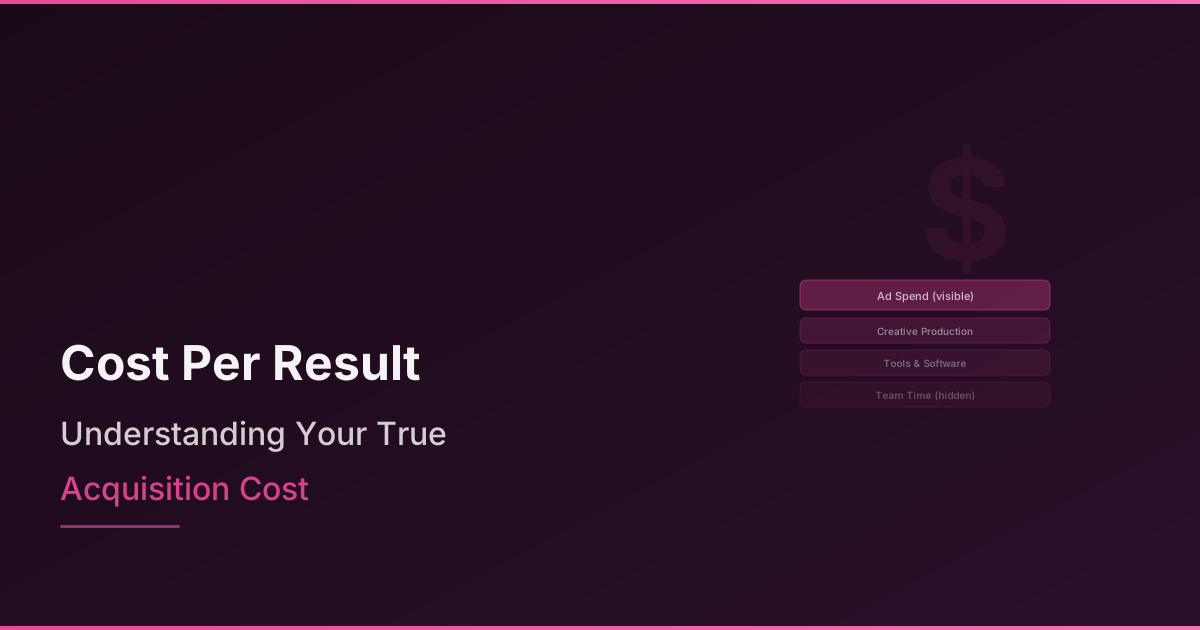
Cost per result depends on its denominator: submissions, attributed purchases and new paid customers are different units. Keep the platform action report separate from the deduplicated business acquisition cohort.
Allocate the $4,000 once
Synthetic monthly ledger: media spend $10,000 already includes unsuccessful tests. Creative $2,000, tools $500 and allocated team cost $1,500 add $4,000, producing $14,000 total included acquisition cost. With 400 outcomes, media cost per outcome is $25 and allocated cost per outcome $35. These illustrative ratios are not yet new-customer CAC unless the 400 are verified new customers.
| Allocated item | Illustrative amount | Double-counting rule |
|---|---|---|
| Creative | $2,000 | Include the declared acquisition share once in this period |
| Tools | $500 | Use one documented shared-cost allocation |
| Team | $1,500 | Exclude unrelated retention/service work or disclose its allocation |
| Total nonmedia | $4,000 | Do not re-add test media already in the $10,000 |
| Total acquisition | $14,000 | Same period and currency as the customer cohort |
Reconcile customers privately
Illustrative order ledger:450 platform purchase events;20 duplicates;30 cancelled/refunded orders;400 valid orders remain. If 100 of those are returning-customer orders and the remaining 300 belong to 300 unique new customers, media cost per attributed/valid order and CAC still differ: $10,000/400 =$25 per valid order, but $14,000/300 =$46.67 full new-customer CAC. A customer placing two orders must count once in the new-customer denominator.
Stop wasting ad budget
NovaStorm AI cuts Meta Ads CPA by 30% on average. No complex setup required.
- Fix date range, currency, attribution basis, payment/refund treatment and customer-newness rule.
- Use stable private order/customer keys; remove replayed events and count confirmed payments.
- Reconcile returning customers and multiple orders separately. Platform credit may not identify every business new customer.
- Allocate acquisition costs to the same declared cohort/horizon and publish only aggregate counts.
- Keep pending refunds/outcomes explicit until the cohort is mature.
Convert CAC to an advertising allowance
Hypothetical commercial inputs: allowable total acquisition cost $50 per new customer and allocated nonmedia acquisition cost $10 imply a media ceiling $40. That is arithmetic under declared assumptions. If the full CAC is $46.67 it is below the chosen $50 ceiling, but the margin buffer and uncertainty still matter. Future repeat purchases cannot be used as guaranteed contribution without a supported mature cohort estimate.
Prepare the budget from confirmed inputs
In NovaStorm, prepare a paused budget plan only after the user confirms customer counts, allocated costs, contribution horizon and cash-loss cap. The product is not claimed to reconcile orders or calculate full CAC automatically. Use the CAC calculation and contribution ceiling for the underlying business worksheet.
Published by NovaStorm AI. Planning examples are illustrative assumptions, not measured customer results.
Disclaimer: This article was generated with the assistance of AI and reviewed by the NovaStorm AI team. While we strive for accuracy, we recommend verifying specific data points and consulting official sources (linked where available) for critical business decisions.
Ready to automate your Meta Ads?
NovaStorm AI takes full responsibility for your campaigns — from monitoring to optimization.
Start NowMore on Budget and unit economics
ROAS: The Complete Guide to Return on Ad Spend
Calculate ROAS and contribution after returns, reconcile duplicate channel credit and record comparable report scope before changing budget.
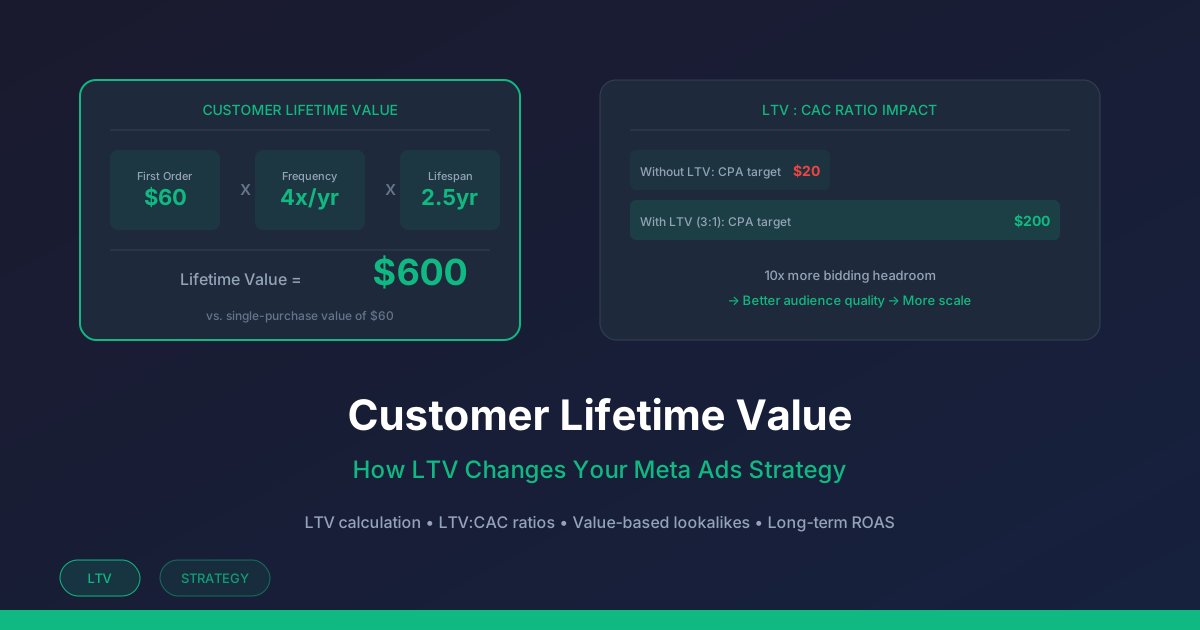
Customer Lifetime Value: How LTV Changes Your Meta Ads Strategy
Separate revenue and contribution LTV, compare equal-age cohorts, validate forecasts and set acquisition limits around cash and payback.
Meta Purchase-Value Optimization: Revenue, Refunds and Margin
Evaluate purchase-value optimization with an event-quality worksheet, refund-adjusted contribution and a separate mature-outcome comparison.
How to Calculate Your Break-Even ROAS for Meta Ads
Calculate a contribution-based CPA ceiling and ROAS target, then stress-test refunds, delivery, new-customer mix and mature campaign costs.