

Post-Purchase Advertising: Turn Buyers Into Repeat Customers on Meta
Plan post-purchase Meta ads around delivery, product use and replenishment; define exclusions and test whether repeat orders add contribution after costs.
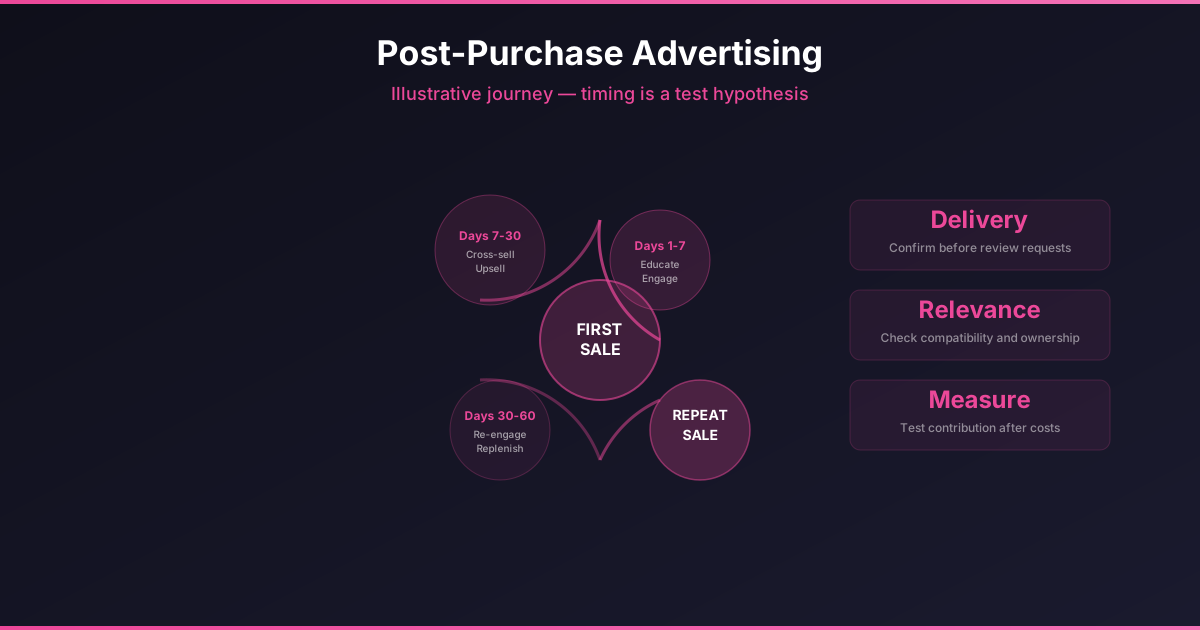
Illustrative planning framework. Timing is a hypothesis to test, not a measured customer result.
Post-purchase advertising gives an ecommerce team a way to test helpful messages after a first order: product education, compatible add-ons and replenishment reminders. The hypothesis is that a relevant message can encourage an additional purchase. It is not evidence that ads outperform email or that repeat buyers are always more profitable. Use this guide to create an eligibility, timing and measurement plan before committing a retention budget.
The Post-Purchase Funnel
Start with the order and delivery journey, not a universal calendar. Record purchase and delivery dates, product usage or replenishment assumptions, returns and customer permissions. An order awaiting delivery needs a different message from a delivered product that is nearly consumed.
The three phases below are an illustrative test plan. Days 1–7, 7–30 and 30–60 are assumed teaching windows, not benchmarks or guaranteed optimal timing. Adjust them for shipping, product lifetime and your observed repeat-purchase interval.
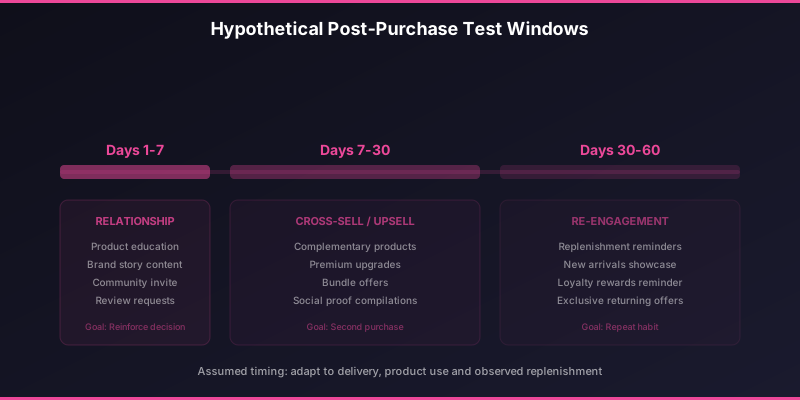
Phase 1: Days 1-7 After Purchase
Hypothesis for the first test window: product education may be more useful than another sales offer while a customer is waiting for delivery or learning to use the product. Confirm delivery and unresolved support issues before requesting a review. Compare this approach with your existing communications rather than assuming paid ads are necessary.
- Product education ads: Show the customer how to get the most from what they just bought. Tutorial videos, setup guides, and usage tips.
- Brand story content: Deepen the relationship with behind-the-scenes content, founder stories, or mission-driven messaging.
- Community invitation ads: Invite buyers to join your community, follow your social accounts, or sign up for a loyalty program.
- Review request ads: After the estimated delivery date, show a gentle prompt to leave a review. This generates UGC while reinforcing satisfaction.
Phase 2: Days 7-30 After Purchase
Hypothesis for a later window: after confirmed delivery and enough time to use the product, a compatible add-on may be relevant. The proposed days 7–30 window is a test input. Do not assume that every buyer has received the order by the second week or needs an upgrade.
- Cross-sell ads: Recommend complementary products. If they bought running shoes, show them running socks, insoles, or a running watch.
- Upsell ads: Present premium versions or upgrades of what they bought. Larger sizes, bundles, or subscription options.
- Accessory ads: Test an add-on only when compatibility and usefulness are clear. A low price alone does not establish a high conversion rate or positive contribution.
- Social proof compilations: Show reviews and UGC from other buyers of the same product, reinforcing that they made a good choice while featuring related products.
Phase 3: Days 30-60 After Purchase
For consumables, test a replenishment reminder against a product-specific estimate of depletion. For durable goods, a new range or compatible accessory may be more relevant. Days 30–60 are an illustrative window, not evidence of fading brand affinity or a required repeat-purchase schedule.
- Replenishment reminders: For consumable products, time your ads to when the product is likely running low.
- New arrival ads: Show the customer what is new since their last purchase. Fresh inventory creates a reason to browse again.
- Loyalty program ads: Explain benefits that actually exist. Do not imply that an ad displays a customer’s current points unless you have verified that implementation.
- Returning-customer offers: Test an actual offer or early-access benefit. Include discounts in the contribution calculation instead of assuming exclusivity drives purchases.
Cross-Sell and Upsell Ad Strategies
Cross-selling and upselling are the workhorses of post-purchase advertising. When done well, they feel helpful rather than pushy. The key is relevance: the recommendation must logically connect to what the customer already bought.
| Strategy | Illustrative timing hypothesis | Creative approach | Decision to validate |
|---|---|---|---|
| Compatible cross-sell | After confirmed delivery; proposed days 7–21 | Complete the set | Compatibility, existing ownership and contribution after costs |
| Premium upgrade | After sufficient product use; proposed days 14–30 | Explain the added benefit | Whether an upgrade is useful and whether returns undermine margin |
| Bundle offer | After delivery; proposed days 7–14 | State the actual bundle price | Contribution after the bundle discount and fulfillment |
| Replenishment | Near estimated depletion; proposed days 30–60 | A timely refill reminder | Observed consumption interval and duplicate-purchase exclusions |
For product selection and purchaser exclusions, use our cross-sell and upsell campaign guide. Before launch, verify the audience and catalog controls available in your account. Suppress customers who already own the proposed add-on and those with returns, unresolved delivery issues or withdrawn permission. List matching and refresh can lag; do not promise instant suppression.
Stop wasting ad budget
NovaStorm AI cuts Meta Ads CPA by 30% on average. No complex setup required.
Review and UGC Collection Through Ads
Hypothesis: a post-purchase ad can complement a review request after confirmed delivery. It may also spend money reaching people who would have responded to email anyway. Keep the request neutral, allow negative as well as positive feedback, and compare incremental responses with a control group before expanding paid distribution.
Ask for permission before reusing a customer’s content in advertising. Record which material you can use, in which placements and for how long. A review collection experiment does not itself establish that the resulting creative improves acquisition performance.
Loyalty Program Promotion
If you have a loyalty program, test whether a clear explanation helps eligible customers understand its benefits. There is no verified channel ranking here: enrollment cost and subsequent contribution depend on your offer, customer base and other communications.
Use truthful creative showing actual program rules and rewards. A proposed days 3–7 test window should follow delivery where relevant. Compare incremental enrollment and later contribution with your existing program promotion, and avoid claiming personalized points balances without a verified data flow.
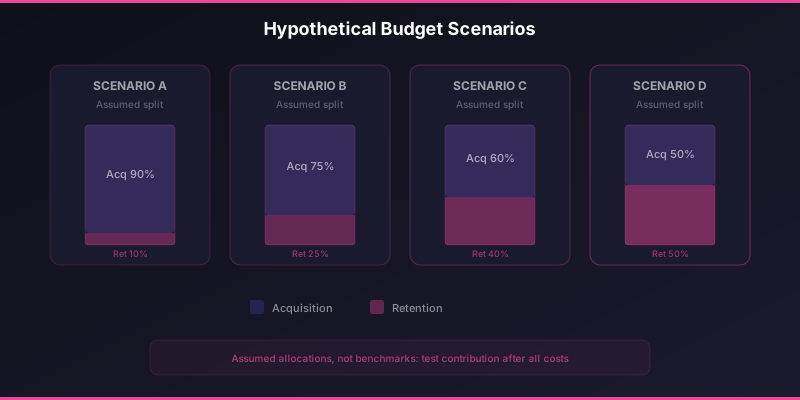
Retention vs Acquisition: The Budget Split
Set an initial test budget from contribution margin, the number of eligible customers and the amount you can afford to lose while learning. The splits below are fictional planning scenarios. Customer count alone does not determine an optimal allocation, and a high reported retention ROAS can include orders that would have occurred without ads.
| Hypothetical scenario | Assumed acquisition share | Assumed retention share | What to validate |
|---|---|---|---|
| Small eligible repeat-buyer cohort | 90% | 10% | Whether there are enough eligible customers for a useful test |
| Growing eligible cohort | 75% | 25% | Incremental contribution after advertising and discounts |
| Established eligible cohort | 60% | 40% | Whether more retention spend adds contribution rather than repeating organic orders |
| Large repeat-buyer program | 50% | 50% | Whether this allocation beats smaller retention tests; size alone does not justify it |
Do not use an assumed ROAS uplift to approve a retention budget. Define the decision before launch: contribution from additional orders must cover the ad spend, discount, product and fulfillment costs included in your measurement. Use our holdout testing guide to plan the comparison.
A hypothetical contribution check
Assumed teaching inputs, not customer results: randomly assign 1,000 eligible customers to each of two groups. Both receive the usual emails; the treatment group also receives the proposed paid campaign, while the control group is excluded from that campaign. Observe both for the same completed 30-day window. Assume 140 treatment customers and 110 control customers each place one qualifying repeat order. The observed difference is 30 orders. With an assumed contribution of $20 per order after product, discounts, payment, fulfillment and return costs, the additional contribution is 30 × $20 = $600. Subtract $400 in campaign spend to obtain an observed net difference of $200 before any omitted program overhead.
This calculation illustrates the decision rule; it does not prove a lift or statistical significance. Confirm assignment integrity, equal follow-up, exclusions, refunds and overlap with other campaigns. If the observed difference is compatible with random variation, record the result as inconclusive. Predefine the analysis and stopping rule rather than extending the test until it looks positive.
Write down the launch decision
- Define eligible purchasers, confirmed delivery, product compatibility and the customer identifier used for matching.
- Record a timing hypothesis, the actual offer and an exit rule for another purchase, a return, a support issue or permission withdrawal.
- Choose one primary outcome and a complete observation window. Keep normal email activity comparable between treatment and control.
- Write the contribution inputs, spend ceiling and uncertainty rule before launch. Record additional overhead that the simple calculation omits.
- Check delivery and suppression while the test runs. Investigate a data or customer-experience failure before increasing spend.
- At the declared end, compare complete cohorts. Expand only if the evidence and contribution justify it; otherwise revise the hypothesis or stop.
A post-purchase plan is ready to test when it has a useful message, an eligible customer definition, a delivery-aware timing hypothesis, suppression rules and a declared outcome. Keep budgets limited until the measurement supports expansion. Repeat orders matter only if the business benefits after costs.
Use this framework to plan and evaluate a post-purchase advertising test. The examples are hypothetical and do not establish customer or NovaStorm performance.
Disclaimer: This article was generated with the assistance of AI and reviewed by the NovaStorm AI team. While we strive for accuracy, we recommend verifying specific data points and consulting official sources (linked where available) for critical business decisions.
Ready to automate your Meta Ads?
NovaStorm AI takes full responsibility for your campaigns — from monitoring to optimization.
Start NowMore on E-commerce offers and retention
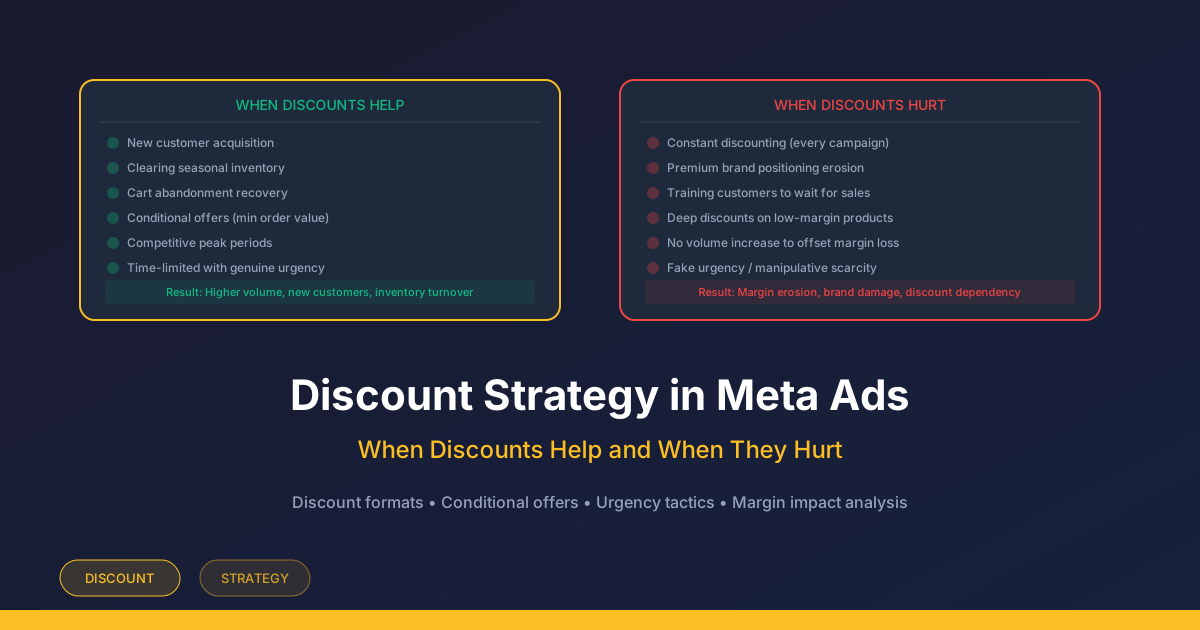
Discount Strategy in Meta Ads: When Discounts Help and When They Hurt
Compare discounts, delivery subsidies and full-price offers using contribution after advertising and returns, then run a bounded paired comparison.
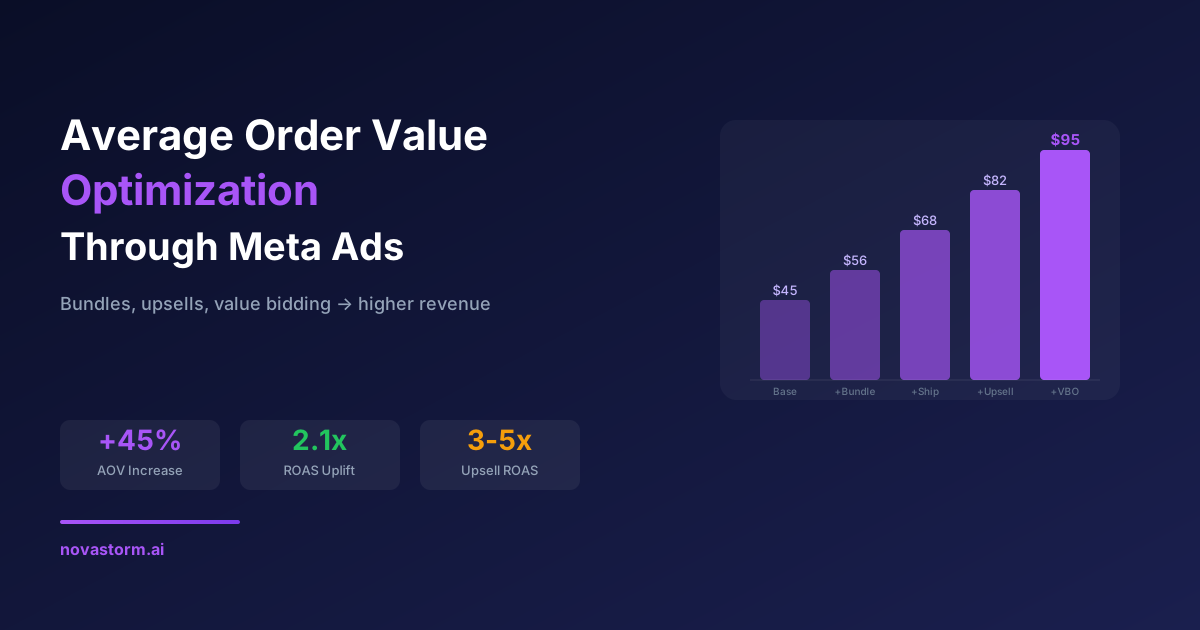
Average Order Value Optimization Through Meta Ads
Calculate AOV and contribution separately, price bundles and shipping thresholds, and compare mature offer results without assuming profit guarantees.
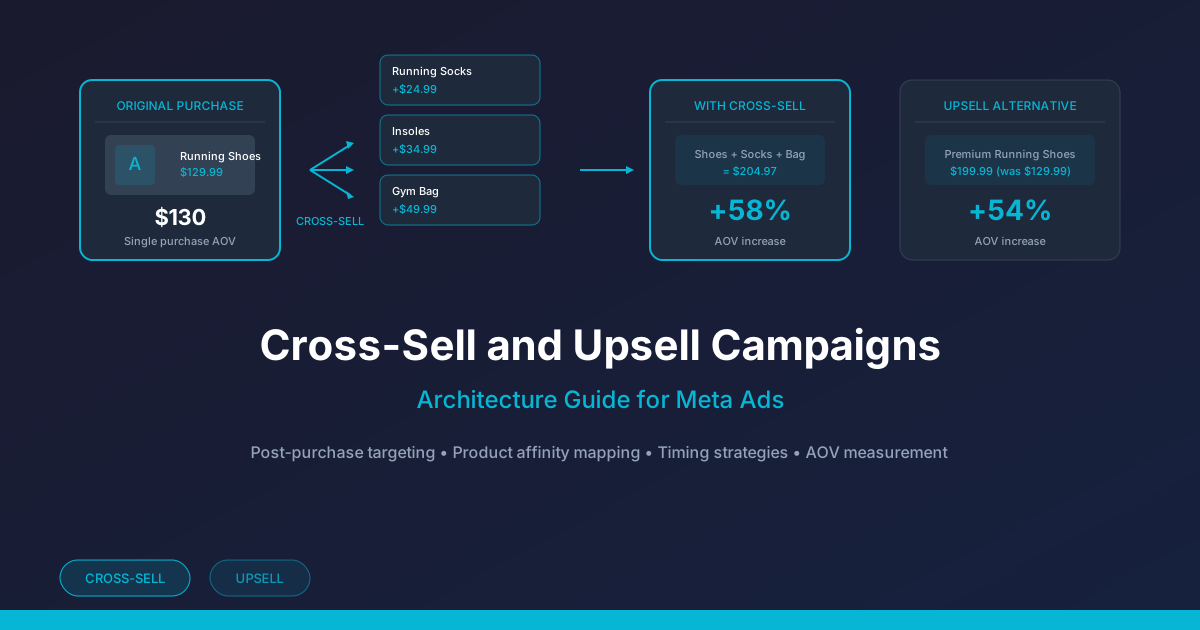
Cross-Sell and Upsell Campaigns on Meta: Architecture Guide
Calculate product affinity from equal observation windows, define purchaser exclusions and test incremental contribution from cross-sell or upsell ads.
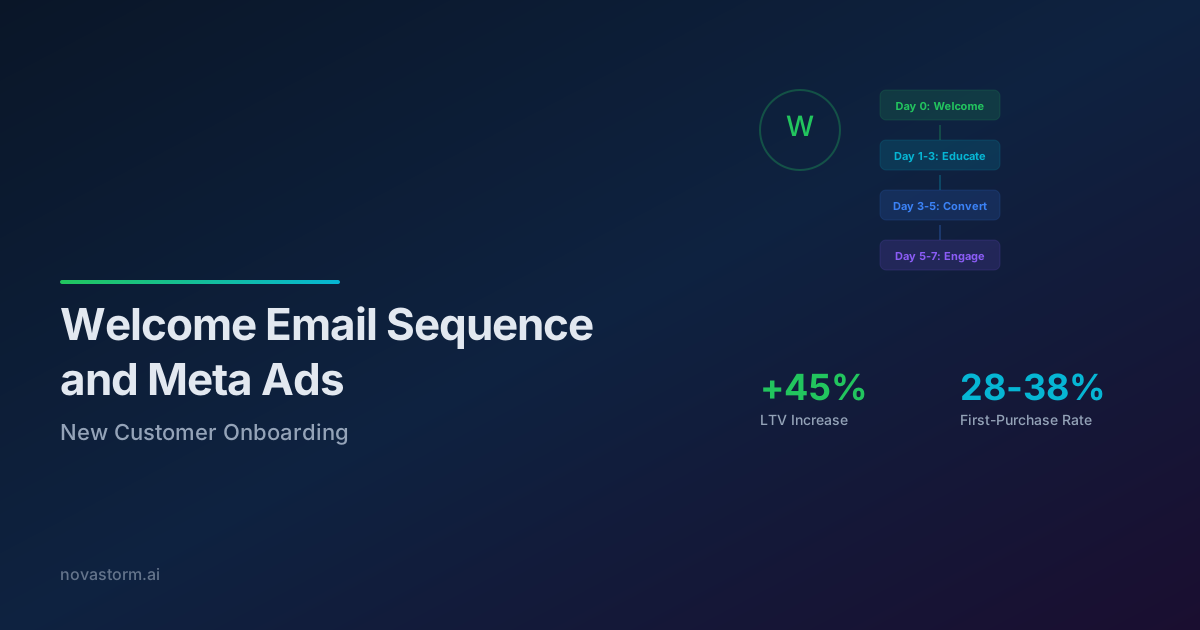
Welcome Email Sequence and Meta Ads: New Customer Onboarding
Design separate welcome paths for subscribers and buyers, verify delivery and permissions, and evaluate added Meta ads using mature useful actions.