

Discount Strategy in Meta Ads: When Discounts Help and When They Hurt
Compare discounts, delivery subsidies and full-price offers using contribution after advertising and returns, then run a bounded paired comparison.
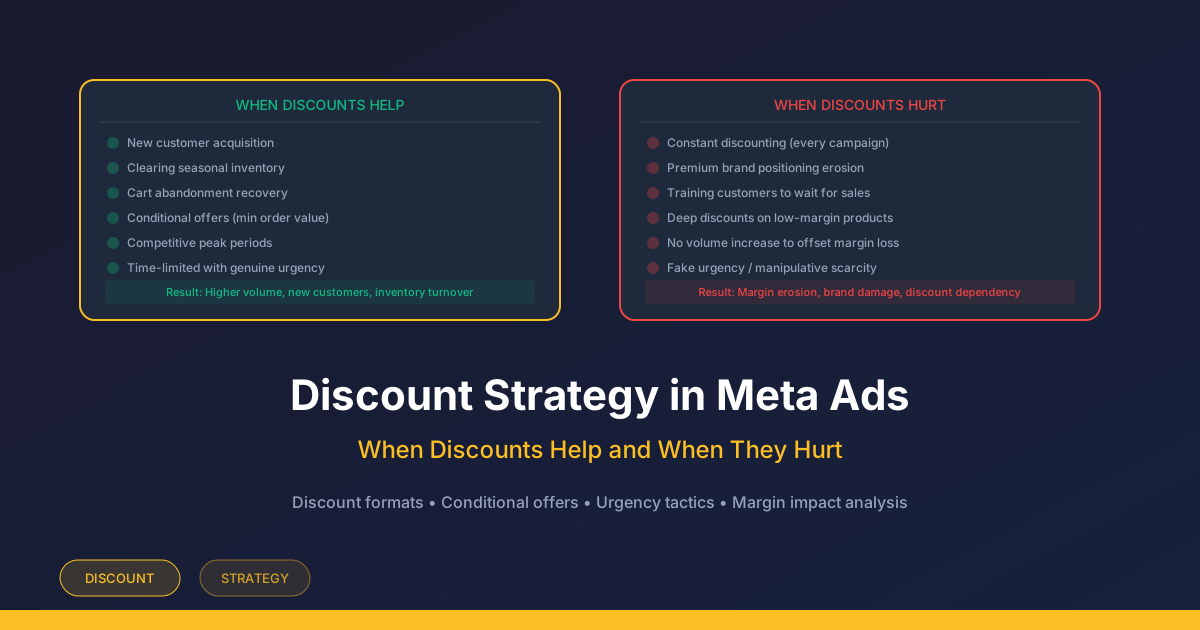
A promotion should improve the commercial outcome you need, not merely increase orders or attributed revenue. Start with the actual price, variable costs, acquisition costs and refund policy. Treat framing and buyer response as hypotheses, not universal rules.
Extend the 20% discount calculation
Illustrative assumptions: a $100 product has $40 variable costs, leaving $60 contribution before advertising. A 20% discount reduces price to $80 and contribution to $40. Selling 15 discounted units produces the same $600 before-ad contribution as ten full-price units. That 50% volume increase preserves only this narrow subtotal, not profit after advertising and returns.
| Synthetic scenario | Orders × contribution | Advertising | Additional return-related contribution loss | Remainder |
|---|---|---|---|---|
| Full price | 10 × $60 = $600 | $200 | $30 | $370 |
| 20% discount | 15 × $40 = $600 | $250 | $80 | $270 |
These invented scenarios are not a causal experiment. Return-related loss includes only costs/receipts not already accounted for; avoid double counting. Record new versus returning customers and promotion eligibility too. A discount may pay for orders that would have happened at full price, or attract a different buyer mix with different refund and repeat behavior.
Treat framing as a separate question
For the same $100 item, "20% off" and "Save $20" describe the same price reduction. Which framing helps this audience is a testable hypothesis, not a guaranteed rule at the $100 boundary. A high share of discounted revenue alone does not diagnose dependence: seasonality, clearance and product mix may explain it. Compare full-price demand and mature contribution over comparable periods.
A filled discount-versus-delivery brief
Stop wasting ad budget
NovaStorm AI cuts Meta Ads CPA by 30% on average. No complex setup required.
| Offer | Illustrative contribution before ads | Required retained contribution | Candidate CPA ceiling |
|---|---|---|---|
| 20% off | $80 price − $40 costs = $40 | $20 | $20 |
| Free delivery | $100 price − $40 costs − $8 additional subsidy = $52 | $20 | $32 |
| Full price reference | $100 − $40 = $60 | $20 | $40 |
The delivery subsidy is an assumed additional cost; replace it with the true incremental fulfillment expense and check any delivery revenue already in the model. An offer with a higher CPA ceiling is not automatically better, because actual demand, acquisition costs and customer quality may differ.
- Compare the same product, market, eligibility, inventory, destination and observation horizon. Change only the approved offer and necessary truthful price/terms wording.
- For a causal comparison, use feasible supported controlled assignment. Ordinary separate ad sets do not guarantee comparable buyers.
- Apply a hypothetical $200 spend ceiling per arm only if affordable, plus a declared combined cash-loss limit and review date. Check expected mature orders before deciding the sample can answer the question.
- Ensure codes, delivery regions, minimum spend, exclusions and actual expiry agree between ad and checkout. Remove expired claims and stop if the offer cannot be honored.
- Evaluate net contribution per assigned customer, including non-buyers, discount expense, refunds and creative costs. Keep an inconclusive option and follow mature repeat purchases separately.
Prepare truthful offer variants
Example copy for the fictional item: "Save $20 on the everyday bag. See eligible items and offer terms." The alternative is "Delivery included on the everyday bag in eligible regions. See terms." Publish neither until the user confirms the offer and checkout. NovaStorm can prepare these briefs as paused campaign and local ad-set drafts; pricing enforcement and transaction reconciliation require the store owner’s verified systems.
Use the contribution and allowable CPA guide to replace the assumptions with your own costs.
Published by NovaStorm AI. Planning examples are illustrative assumptions, not measured customer results.
Disclaimer: This article was generated with the assistance of AI and reviewed by the NovaStorm AI team. While we strive for accuracy, we recommend verifying specific data points and consulting official sources (linked where available) for critical business decisions.
Ready to automate your Meta Ads?
NovaStorm AI takes full responsibility for your campaigns — from monitoring to optimization.
Start NowMore on E-commerce offers and retention
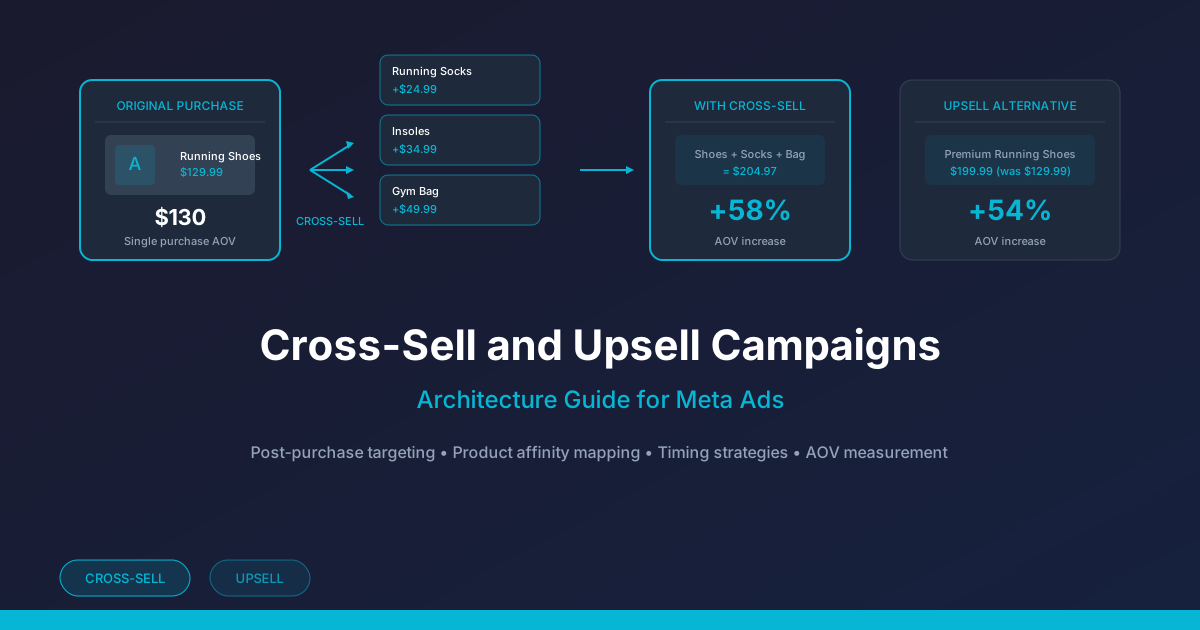
Cross-Sell and Upsell Campaigns on Meta: Architecture Guide
Calculate product affinity from equal observation windows, define purchaser exclusions and test incremental contribution from cross-sell or upsell ads.
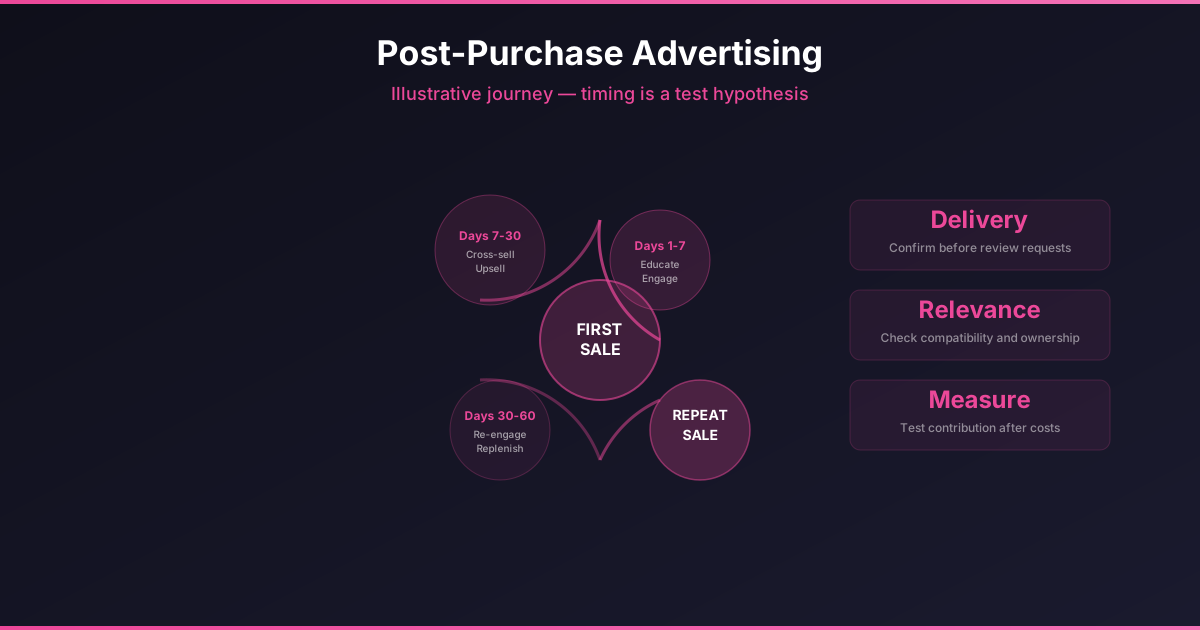
Post-Purchase Advertising: Turn Buyers Into Repeat Customers on Meta
Plan post-purchase Meta ads around delivery, product use and replenishment; define exclusions and test whether repeat orders add contribution after costs.
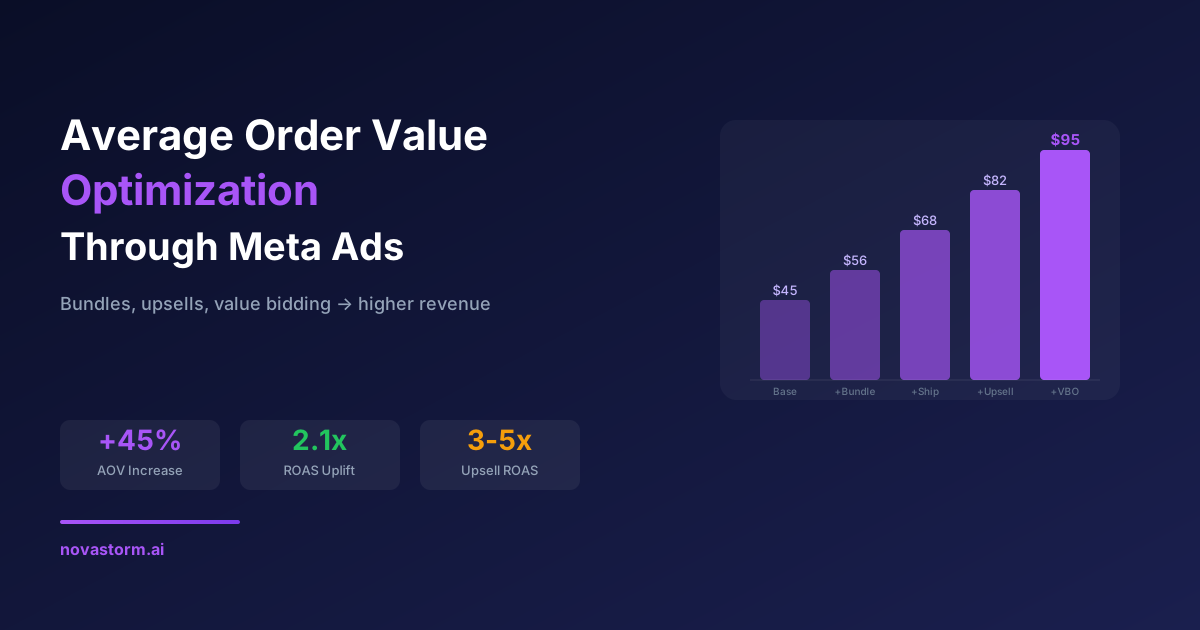
Average Order Value Optimization Through Meta Ads
Calculate AOV and contribution separately, price bundles and shipping thresholds, and compare mature offer results without assuming profit guarantees.
Flash Sale Campaigns on Meta: Urgency-Driven E-commerce Ads
Plan a flash sale with genuine deadlines, verified stock and checkout terms, a hard allowance and contribution after displaced full-price demand.