

Welcome Email Sequence and Meta Ads: New Customer Onboarding
Design separate welcome paths for subscribers and buyers, verify delivery and permissions, and evaluate added Meta ads using mature useful actions.
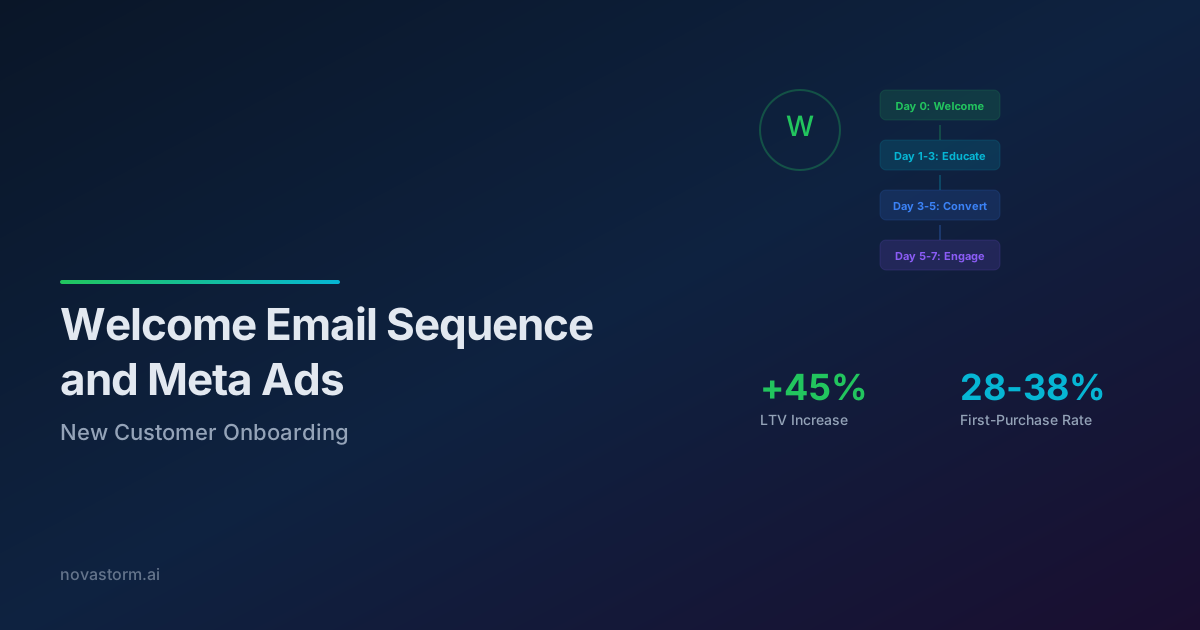
A new newsletter subscriber and a paying customer waiting to activate need different welcome paths. Email and Meta can support those paths, but recorded opens do not prove reading and multiple channels do not guarantee contact. Start from the customer state and a useful next action, then test whether additional advertising is worth its cost.
Separate the two onboarding jobs
| State | Useful next action | Message example |
|---|---|---|
| Confirmed subscriber, no purchase | Use promised resource and decide whether the product fits | “Your planning worksheet is ready. See the worked example before choosing a tool.” |
| Paying customer, no activation | Complete the first task that delivers purchased value | “Create your first project from this guide. Contact support if setup is blocked.” |
| Activated customer | Return to a relevant continuing task | “Review the next project when you need it.” |
| Withdrawn promotional permission | Stop the affected marketing use | Keep necessary service messages distinct and review their purpose |
These are illustrative messages, not tested copy. Do not send a sales coupon to a paid customer who needs help completing setup. Define activation as an actual valuable action, such as finishing a valid project; opening a welcome email or viewing a pricing page alone is a different event. Use product-led signup planning to connect the signup promise to the first useful task.
A calendar is a hypothesis, not a delivery promise
Illustrative sequence: after confirmed subscription, deliver the requested resource; on the next chosen follow-up, explain one concrete use; later offer help and a relevant product choice. For a buyer, replace those messages with setup instructions and support. Choose follow-up delays from the buying cycle, permissions and support capacity, and document them before testing. No universal 48-hour window determines lifetime value.
Mailchimp’s double opt-in documentation distinguishes pending signup, confirmation and subscribed state, and describes an optional final welcome email. Verify the actual form integration and automation separately. Test valid confirmation, missing confirmation, expired link, duplicate signup, ESP rejection, bounce and unsubscribe with controlled addresses. Inspect a received welcome message and its resource link. A queued send is not a delivered message; a server acceptance event is not proof of inbox placement.
Apple’s privacy documentation explains background loading of email content independently of engagement. Use voluntary replies or verified product actions to measure useful onboarding; filter scanner clicks where possible. Do not infer that a non-opener needs more ads or that every opener consumed your instructions.
Permission and state changes must survive delay
Maintain separate email and advertising preference records with notice versions and applicable purposes. European Commission marketing guidance explains the importance of lawful use and objections. Check local email and tracking requirements too. A confirmed email subscription is not automatic permission to upload identifiers for advertising.
Stop wasting ad budget
NovaStorm AI cuts Meta Ads CPA by 30% on average. No complex setup required.
Illustrative failure: a buyer activates at 09:05, while an audience export captured “not activated” at 09:00. Recheck product state before an email send, cancel stale queued messages and dispatch the audience change through the external integration. Record acknowledgement and processing delay; matching and other campaigns may prevent immediate disappearance from every impression. A withdrawal after export overrides additions and retries. If the dependent marketing use cannot be safely suppressed, pause that use and escalate the failure.
A welcome ad can demonstrate one task without exposing a person’s account state in public copy. Frequency is a reporting-window average; it does not establish an optimal two-to-four daily impressions or a universal cap setting. Verify objective-specific controls and review complaints, spend and useful outcomes before increasing exposure.
Compare mature email-only and email-plus-Meta cohorts
- Choose one onboarding state and eligible population; do not mix subscribers and buyers in the same success denominator.
- Randomize permitted identifiable people before campaign delivery into the same email program alone or email plus Meta eligibility. Keep discounts, support and assignment constant.
- Predefine activation, settled first purchase or a specific retention endpoint, observation window, return maturation, uncertainty analysis and cost limit.
- Audit control leakage, failed matches, unsubscribe handling and audience-update delays. Analyze all assigned people, including people not reached; otherwise selection can distort the comparison.
Hypothetical buyer test: two groups each contain 100 customers. Email alone produces 40 activations and 30 customers completing the defined task again by day 30. Email plus Meta produces 45 activations and 32 such repeat users. These assumed differences are 5 activation points and 2 repeat-use points, not proof of effect. A cohort admitted yesterday has not matured to day 30 and must not be compared with a complete cohort.
If additional advertising, creative and operations cost USD 120, the illustrative cost per additional repeat user is USD 120 / (32 − 30) = USD 60. If their modeled contribution is USD 25 each, the modeled marginal contribution is USD 50 − USD 120 = −USD 70. Mark this valuation as an assumption, not observed LTV. Randomization validity and uncertainty still matter; the small example does not establish significance. Include incentives and support costs if they differ.
Keep the product handoff concrete
Prepare a welcome creative and paused campaign draft in NovaStorm, review the promised task and budget, then manage the external email and product-state processes with their owners. The test ledger is separate. No automatic movement between welcome and post-purchase audiences, two-channel event ingestion or measured LTV improvement is established by this workflow.
Published by NovaStorm AI. Worked examples and test fixtures in this article are illustrative, not observed customer results.
Disclaimer: This article was generated with the assistance of AI and reviewed by the NovaStorm AI team. While we strive for accuracy, we recommend verifying specific data points and consulting official sources (linked where available) for critical business decisions.
Ready to automate your Meta Ads?
NovaStorm AI takes full responsibility for your campaigns — from monitoring to optimization.
Start NowMore on E-commerce offers and retention

Tiered Pricing in Meta Ads: Good-Better-Best Frameworks
Explain useful pricing tiers with verified popularity, clear billing terms and contribution measured through refunds and retention.
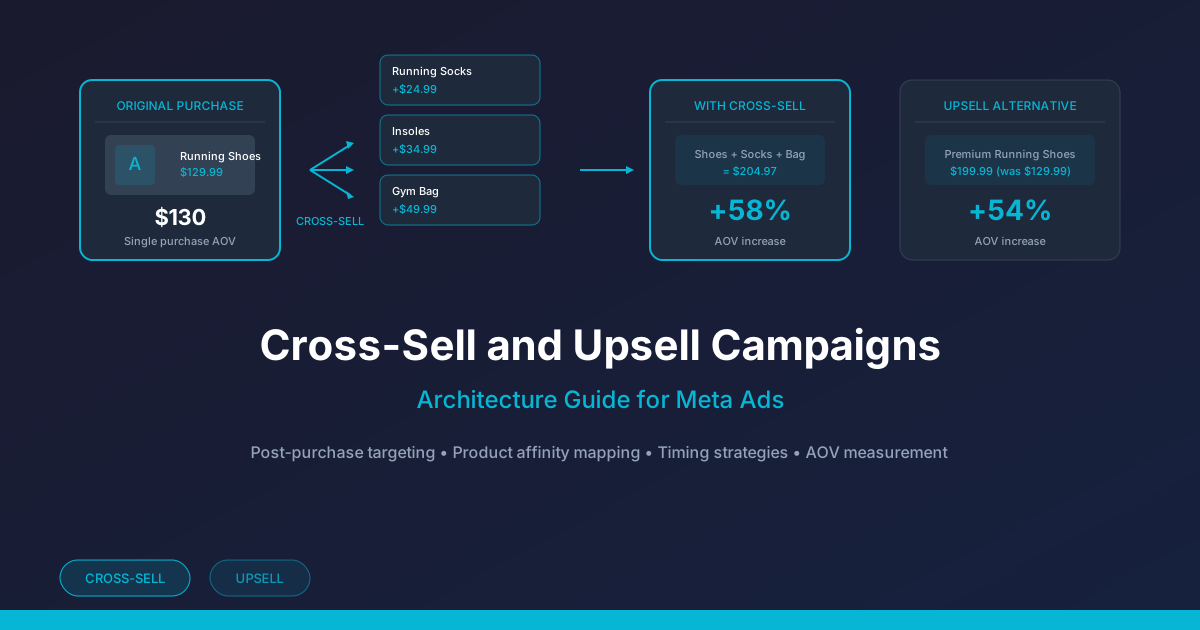
Cross-Sell and Upsell Campaigns on Meta: Architecture Guide
Calculate product affinity from equal observation windows, define purchaser exclusions and test incremental contribution from cross-sell or upsell ads.
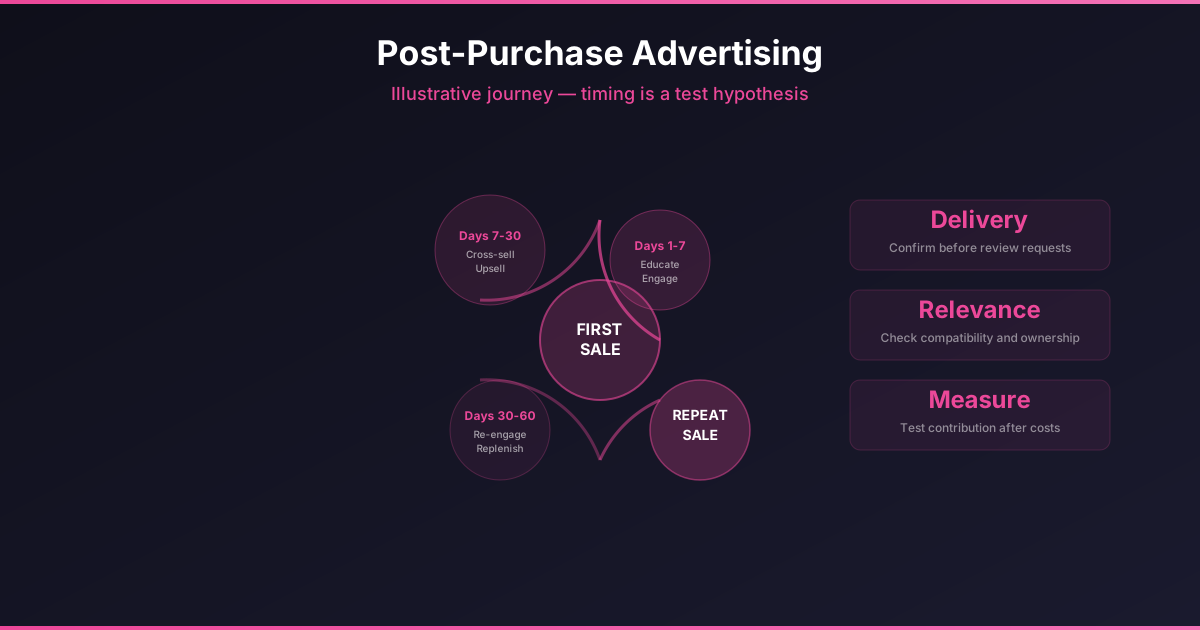
Post-Purchase Advertising: Turn Buyers Into Repeat Customers on Meta
Plan post-purchase Meta ads around delivery, product use and replenishment; define exclusions and test whether repeat orders add contribution after costs.
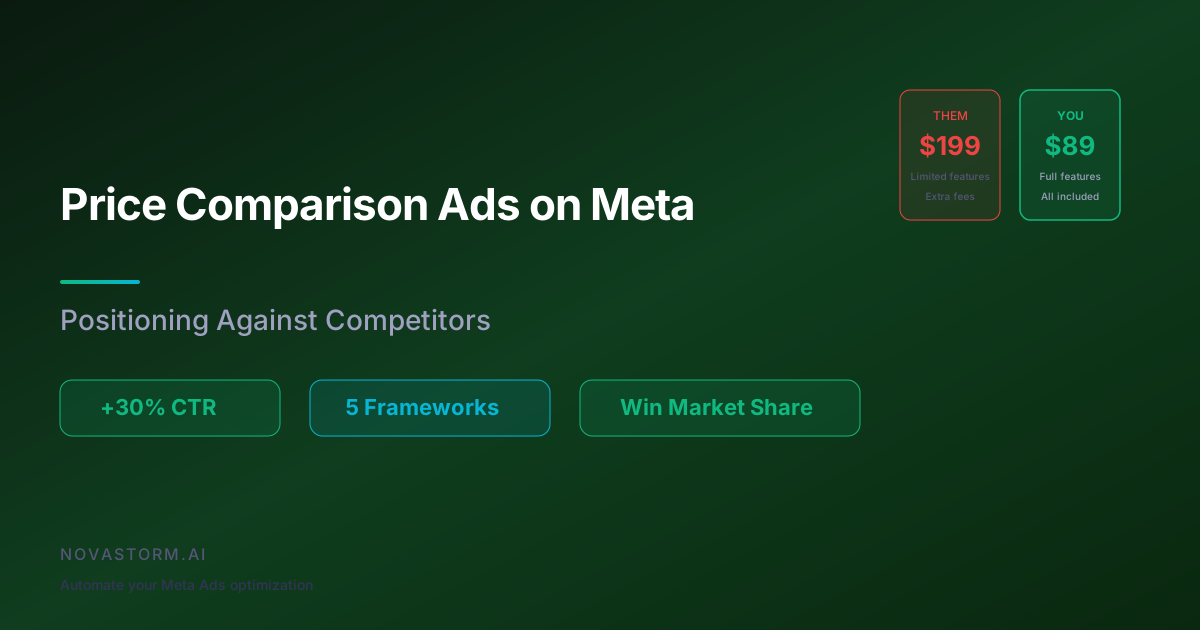
Price Comparison Ads on Meta: Positioning Against Competitors
Build fair comparison ads from current evidence and a complete cost model, with audience, trademark and market-specific review.