

Average Order Value Optimization Through Meta Ads
Calculate AOV and contribution separately, price bundles and shipping thresholds, and compare mature offer results without assuming profit guarantees.
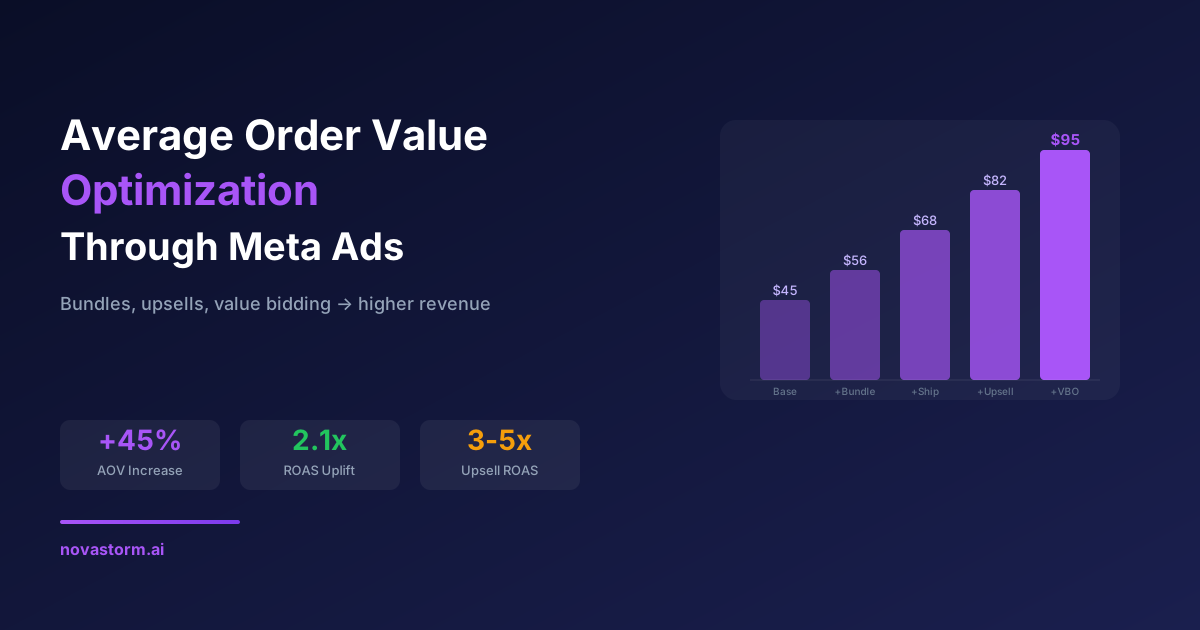
A bigger order can improve campaign economics, but only after product costs, discounts, delivery and refunds are included. Increasing AOV does not automatically reduce CPA, and a separate repeat purchase is not an increase in the first order’s value. Use the worked calculations below to choose a bundle or delivery offer worth testing.
AOV, CPA and contribution measure different things
Define AOV as revenue under one stated net/gross convention divided by distinct orders in the same cohort. CPA is acquisition spend divided by the chosen acquisition outcome; neither equation contains the other metric. Track new versus repeat customers separately. A second order can improve customer lifetime contribution but must not be added to first-order AOV or attributed twice to acquisition.
| Illustrative campaign | A | B |
|---|---|---|
| Retained orders | 100 | 80 |
| Media spend | $3,000 | $2,800 |
| AOV under the assumed revenue convention | $50 | $75 |
| Revenue | $5,000 | $6,000 |
| Media CPA | $30 | $35 |
| ROAS | 1.67 | 2.14 |
| Contribution before media at assumed 40% of revenue | $2,000 | $2,400 |
| Contribution after media | −$1,000 | −$400 |
These are hypothetical assumptions, not campaign results. B improves contribution after media by $600, not $1,200, and both campaigns remain negative before other costs. The $1,200 difference in revenue minus media ignores product/fulfilment costs. B’s AOV is 50% higher while CPA is 16.67% higher; ROAS rises about 28.57%. A higher order value can therefore coexist with higher acquisition cost and losses.
Calculate a bundle before advertising the saving
| Hypothetical order economics | Single bottle | Bottle plus accessory bundle |
|---|---|---|
| Paid merchandise after discount | $30 | $42 |
| Product cost | $10 | $17 |
| Fulfilment and payment fees | $4 | $5 |
| Merchant-paid shipping | $5 | $5 |
| Expected refund/return allowance | $2 | $3 |
| Contribution before acquisition | $9 | $12 |
Illustrative assumptions, not a real offer: the bundle lifts paid merchandise value 40%, but contribution rises only $3. A $2-per-order extra promotional acquisition cost would leave only $1 of that improvement. Check component stock, pack cost, separate prices, delivery restrictions and returns. Show a saving only against genuine applicable standalone prices; do not invent crossed-out reference prices. Proposed copy: “Bottle and cleaning accessory together for $42. See contents and delivery terms.” This example price is hypothetical.
A delivery threshold has a merchant cost
Hypothetical cart: $42, free-delivery threshold $55 and an optional $15 accessory. If the accessory costs $7, adds $1 fulfilment and $1 expected return cost, and the merchant absorbs $5 shipping previously paid by the customer, incremental contribution is $15 − $7 − $1 − $1 − $5 = $1. Reaching $57 does not create $15 profit. Include any lost shipping revenue, tax convention and discounts once, and test whether the offer also causes abandonment or unprofitable substitutions. Choose the threshold from the actual basket and unit economics rather than a universal percentage above AOV.
Stop wasting ad budget
NovaStorm AI cuts Meta Ads CPA by 30% on average. No complex setup required.
Value optimization is not a margin guarantee
Check whether your actual account and purchase-data setup supports the intended value objective and bid strategy. Meta’s campaign SDK includes a minimum-ROAS bidding enum, but that does not prove account eligibility or guarantee profit on every conversion. Purchase value is not contribution margin. A target based on a fixed fraction of historical ROAS cannot protect losses if margins, returns or product mix changed.
Illustrative margin calculation: at a 40% contribution ratio before media, revenue-only media break-even ROAS is 1 / 0.40 = 2.5 before other acquisition cost and surplus. At 25% it is 4.0. Use the actual weighted product mix and approved full-cost ceiling; do not use a universal weekly event count as a promise of learning or profitability. Validate currency and purchase-value composition before changing optimization.
Test the offer and inspect retained contribution
Hypothetical controlled design: compare the ordinary bottle offer with the bundle on the same eligible audience/assignment, creative quality, landing-page path, stock and common reporting age. The bundle price/content is the intended treatment. Use an eligible randomized test when available; document descriptive limits otherwise. Primary metric is contribution per eligible visitor and full acquisition cost, with AOV, conversion rate, refunds and new-customer share as supporting outcomes.
Illustrative mature outcomes: control has 100 eligible visitors, ten orders at $9 contribution = $90; bundle has 100 visitors, seven orders at $12 contribution = $84. Although the bundle has higher order value and contribution per order, it produces less contribution per visitor ($0.84 versus $0.90), before media differences. Small counts do not establish a reliable winner. Approve a total allowance and observation period, and report uncertainty instead of scaling the highest early AOV.
Prepare the campaign handoff
Keep the merchandise/shipping/refund worksheet and permitted customer segmentation in the business system. Prepare the approved offer, commercial ceiling and creative in a NovaStorm campaign draft, then review the actual saved fields before publication. This workflow does not assume automatic AOV segmentation or bundle recommendations. For the follow-up purchase, use customer lifetime contribution and record it as a separate order.
Published by NovaStorm AI. Worked examples and proposed tests are labeled in the article.
Disclaimer: This article was generated with the assistance of AI and reviewed by the NovaStorm AI team. While we strive for accuracy, we recommend verifying specific data points and consulting official sources (linked where available) for critical business decisions.
Ready to automate your Meta Ads?
NovaStorm AI takes full responsibility for your campaigns — from monitoring to optimization.
Start NowMore on E-commerce offers and retention
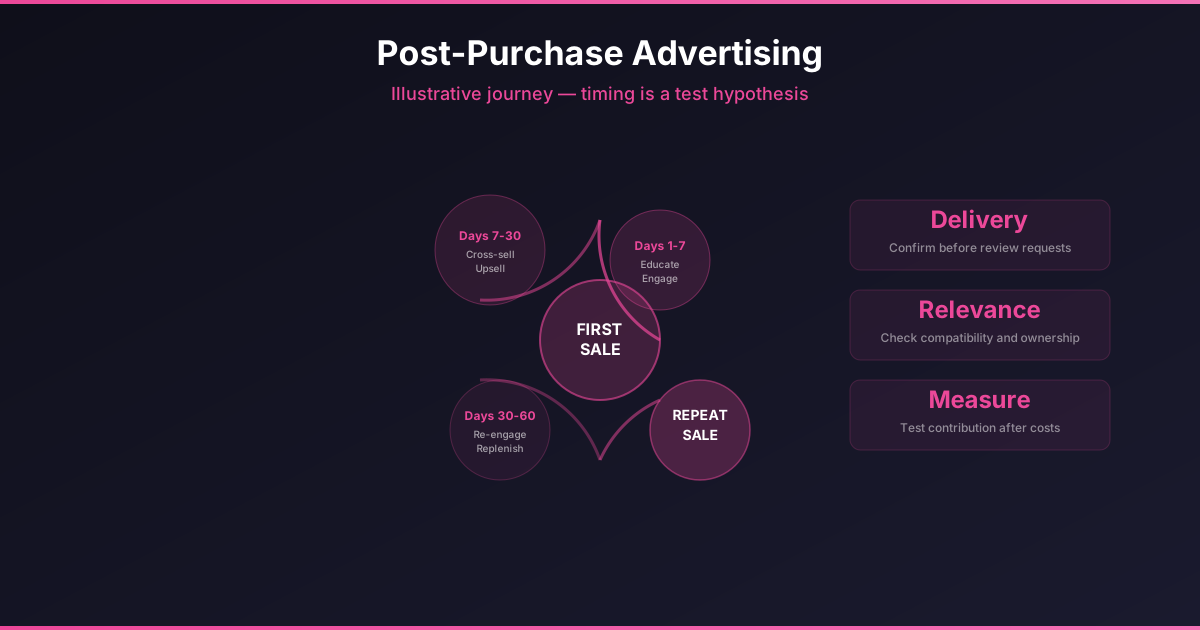
Post-Purchase Advertising: Turn Buyers Into Repeat Customers on Meta
Plan post-purchase Meta ads around delivery, product use and replenishment; define exclusions and test whether repeat orders add contribution after costs.
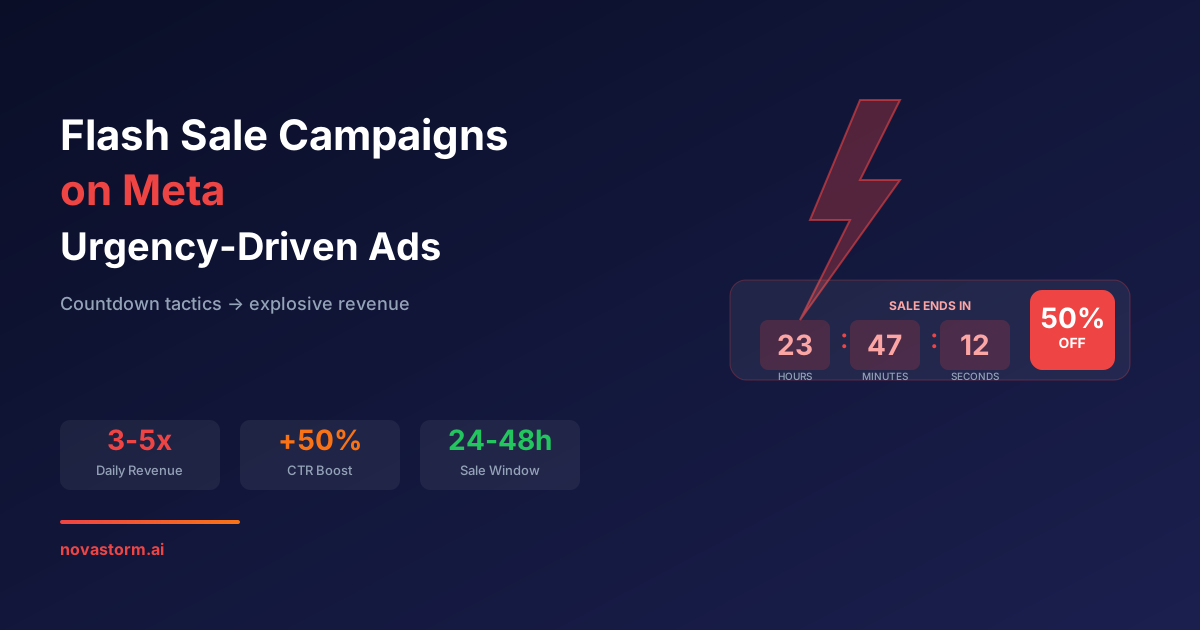
Flash Sale Campaigns on Meta: Urgency-Driven E-commerce Ads
Plan a flash sale with genuine deadlines, verified stock and checkout terms, a hard allowance and contribution after displaced full-price demand.
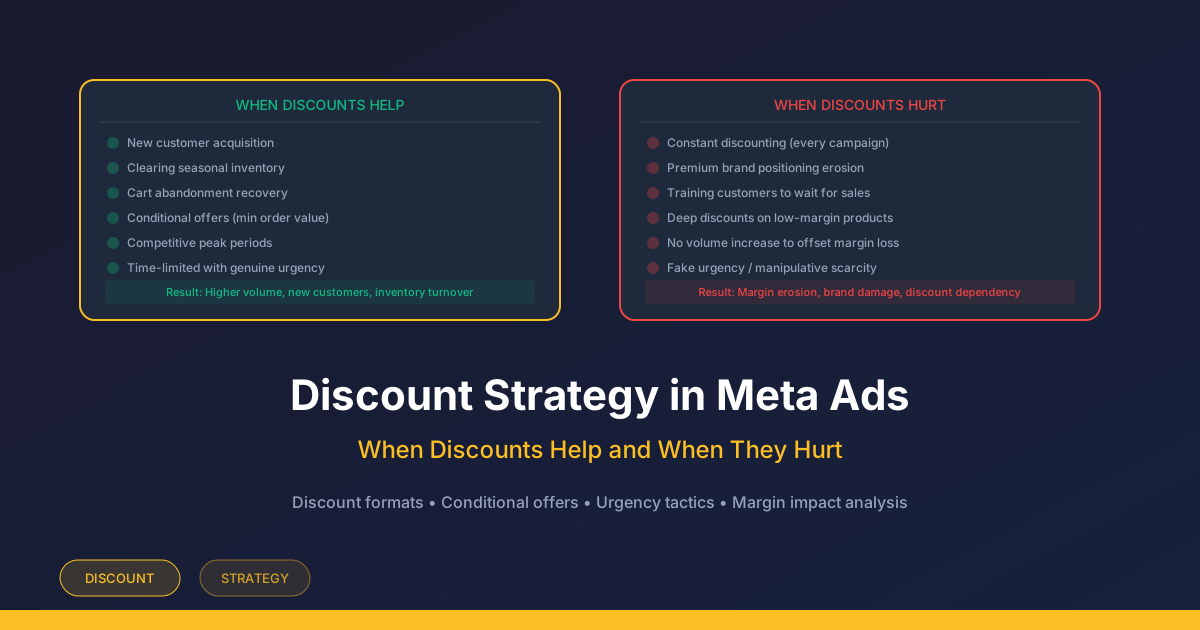
Discount Strategy in Meta Ads: When Discounts Help and When They Hurt
Compare discounts, delivery subsidies and full-price offers using contribution after advertising and returns, then run a bounded paired comparison.
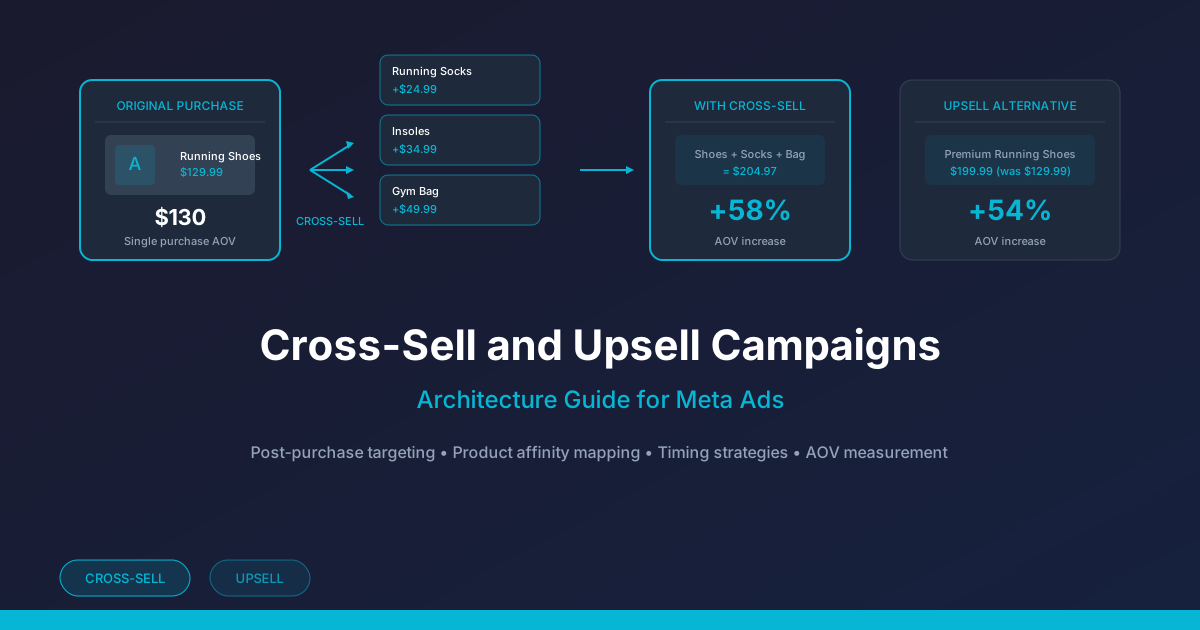
Cross-Sell and Upsell Campaigns on Meta: Architecture Guide
Calculate product affinity from equal observation windows, define purchaser exclusions and test incremental contribution from cross-sell or upsell ads.