

Holdout Testing for Meta Ads: Measuring Baseline Performance
Design a holdout with explicit scope, power and opportunity cost, then calculate consistent incremental outcomes with uncertainty.
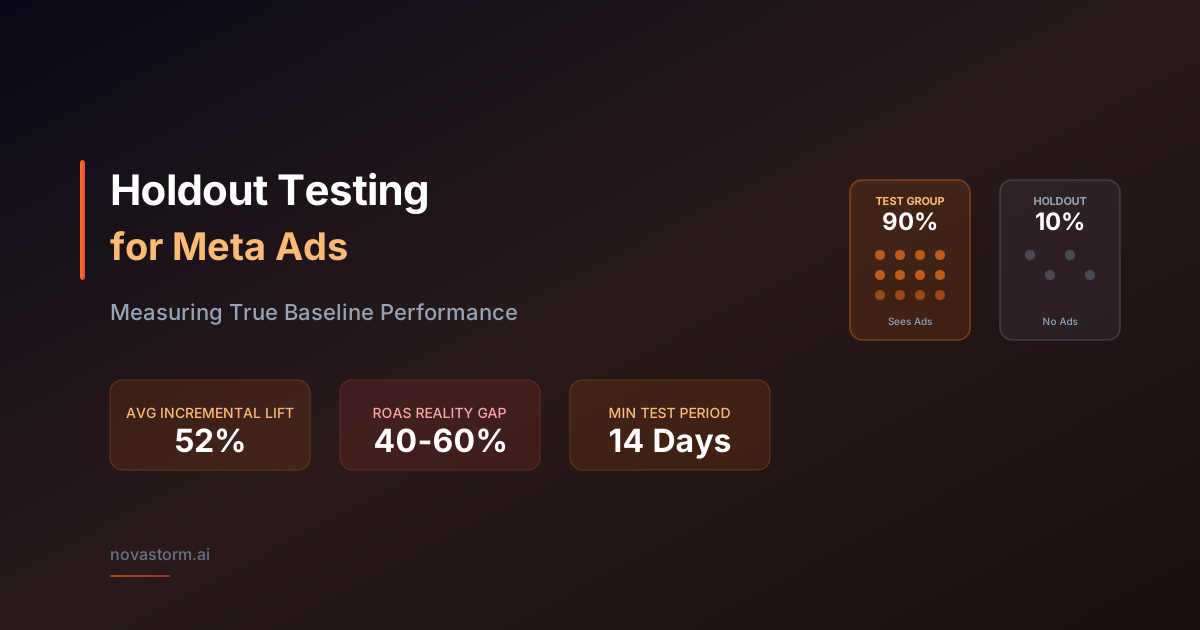
A randomized holdout compares outcomes under an advertising strategy with outcomes when that strategy is withheld. The causal interpretation depends on assignment, contamination, outcome measurement and the population tested. Attribution credit is different; not every reported ROAS must be inflated.
Select an available experiment
Meta Blueprint’s incrementality course distinguishes Conversion Lift, cross-channel and geographic methods and emphasizes real advertiser eligibility. Check the study tools available to your account or contact the measurement representative. Record campaign/account scope, assignment unit, control suppression, event source, eligibility and reporting method before launch. A brand survey measures perceptions, not paid conversions.
Do not assume an experiment excludes control users from every account campaign. If testing one campaign group, document what other advertising both groups may receive. A manually excluded customer list is not proof of randomized assignment or complete suppression. Use a design that the selected tool actually supports.
Plan power and control opportunity cost
Define baseline outcome rate, smallest useful lift, significance, power, expected eligible sample and conversion lag before deciding group size or duration. The NIST two-proportion reference describes comparison from counts and denominators. A fixed fourteen days or one hundred conversions does not guarantee adequate power. Have an analyst calculate the plan for the actual allocation and clustering.
Illustrative planning approximation: for equal independent groups, a conservative baseline near 50%, two-sided 5% significance, 80% power and five-percentage-point target difference, n ≈ 2 × (1.96 + 0.84)² × 0.5 × 0.5 / 0.05² = 1,568 per group. This rough approximation is not a Meta eligibility rule; low baseline rates, unequal allocation, repeated users and clusters need a different calculation.
Control withholding has a potential commercial cost. If 10,000 eligible control users would hypothetically gain 1.1 percentage points from the strategy, 110 possible incremental orders are withheld. At assumed USD 40 contribution each, the planning opportunity cost is USD 4,400. The unknown true lift could be smaller, zero or negative; this is a risk assumption, not observed lost revenue.
Stop wasting ad budget
NovaStorm AI cuts Meta Ads CPA by 30% on average. No complex setup required.
One internally consistent worked result
| Synthetic group | Assigned eligible users | Paid converters | Rate |
|---|---|---|---|
| Advertising strategy | 30,000 | 960 | 3.2% |
| Control | 10,000 | 210 | 2.1% |
Use assigned groups, not only people who actually received an impression. Rate difference is 1.1 percentage points and relative lift is (3.2 − 2.1) / 2.1 ≈ 52.38%. Applied to 30,000 strategy-assigned users, estimated baseline outcomes are 630 and the increment is 960 − 630 = 330. Baseline as a share of strategy-group outcomes is 2.1 / 3.2 ≈ 65.63%, about two thirds, not one third.
With assumed USD 15,000 spend and USD 100 net revenue per additional order, incremental cost is 15,000 / 330 ≈ USD 45.45 and incremental revenue/spend is 33,000 / 15,000 = 2.2. Revenue credit from all 960 orders would be 96,000 / 15,000 = 6.4 under that different convention. These are synthetic calculations, not a typical attributed/incremental ratio.
A simple independent-binomial normal 95% interval for the rate difference is about 0.756–1.444 percentage points. This is approximately 227–433 incremental orders in the strategy population. Real platform reports may use another method; account for clusters, noncompliance, multiple outcomes, returns and missing data instead of copying this interval blindly.
Make only the decision the study supports
- Freeze a primary outcome and logging rules; record changes, outages and cross-campaign control exposure.
- Keep equal outcome maturity and reconcile unique paid converters without revealing personal identities.
- An account-level result cannot automatically rank individual campaigns. Run a scoped follow-up for that question.
- Compare uncertainty in incremental contribution with the proposed marginal spend and affordable downside. Prepare a limited NovaStorm campaign draft with an approved amount and period; leave experiment setup and interpretation with the measurement owner.
Published by NovaStorm AI. Worked examples and test fixtures in this article are illustrative, not observed customer results.
Disclaimer: This article was generated with the assistance of AI and reviewed by the NovaStorm AI team. While we strive for accuracy, we recommend verifying specific data points and consulting official sources (linked where available) for critical business decisions.
Ready to automate your Meta Ads?
NovaStorm AI takes full responsibility for your campaigns — from monitoring to optimization.
Start NowMore on Attribution and incrementality
Self-Reported Attribution: Asking Customers How They Found You
Use optional self-reported discovery answers with order-linked storage, unknown categories and honest nonresponse reporting.
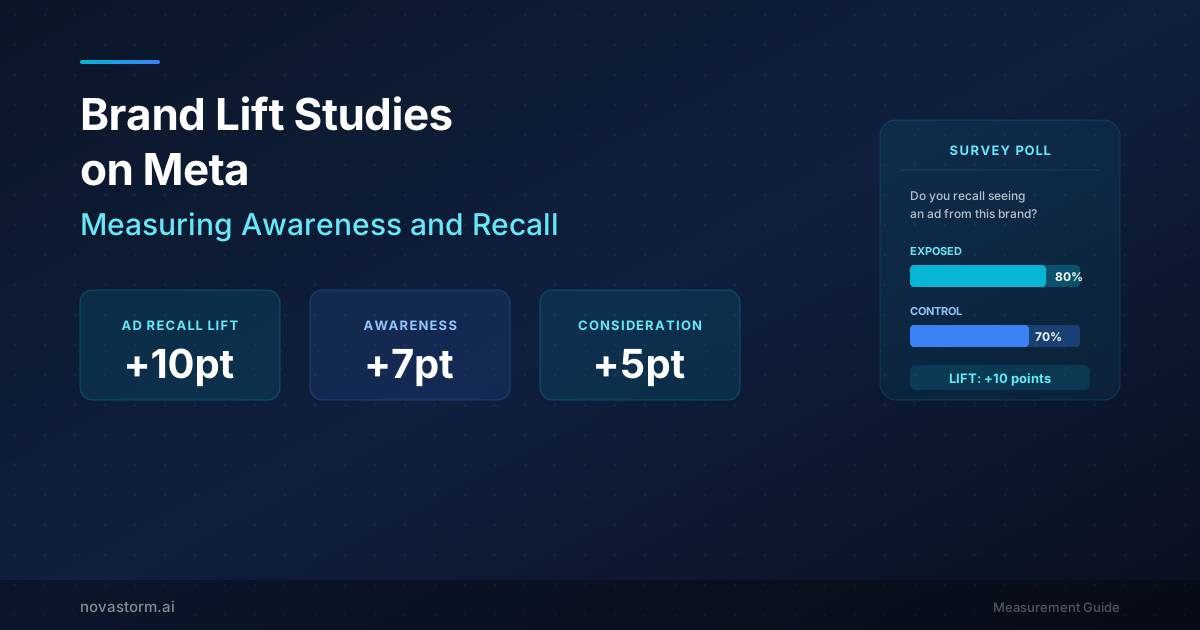
Brand Lift Studies on Meta: Measuring Awareness and Recall
Plan a brand-lift survey with account eligibility, neutral questions, response denominators and properly interpreted uncertainty.
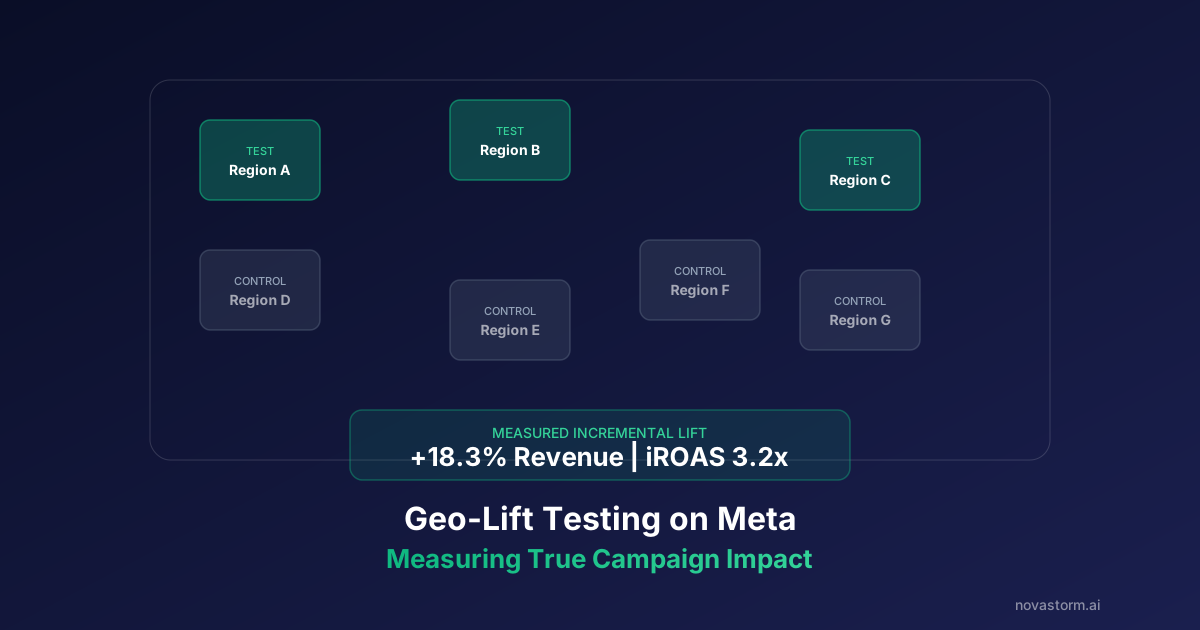
Geo-Lift Testing on Meta: Measuring True Campaign Impact
Design a geo-lift test with GeoLift tutorial data, pre-period checks, power planning and margin-based decisions that account for uncertainty.
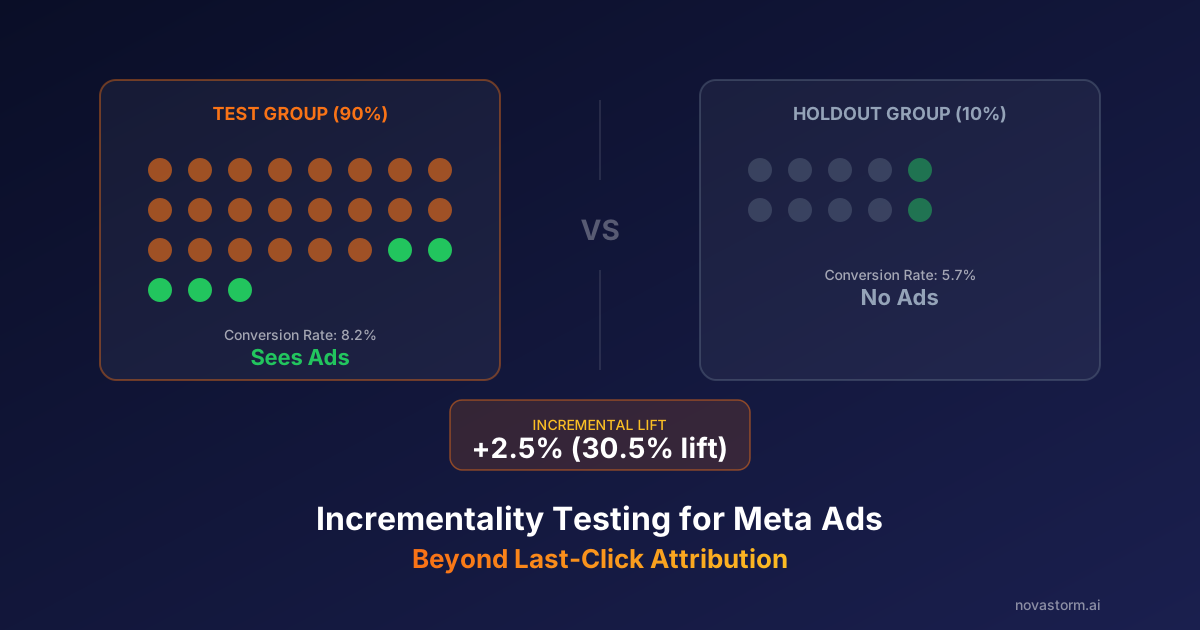
Incrementality Testing for Meta Ads: Beyond Last-Click Attribution
Design an incrementality test with a defined holdout, group-based sample assumptions, effect intervals and contribution economics.