

Meta Custom Audience Syncing via Usersreplace: Prevent Learning Resets and Session Errors
Learn how to update Meta Custom Audiences using the usersreplace endpoint without triggering ad set learning resets or session timeout errors.
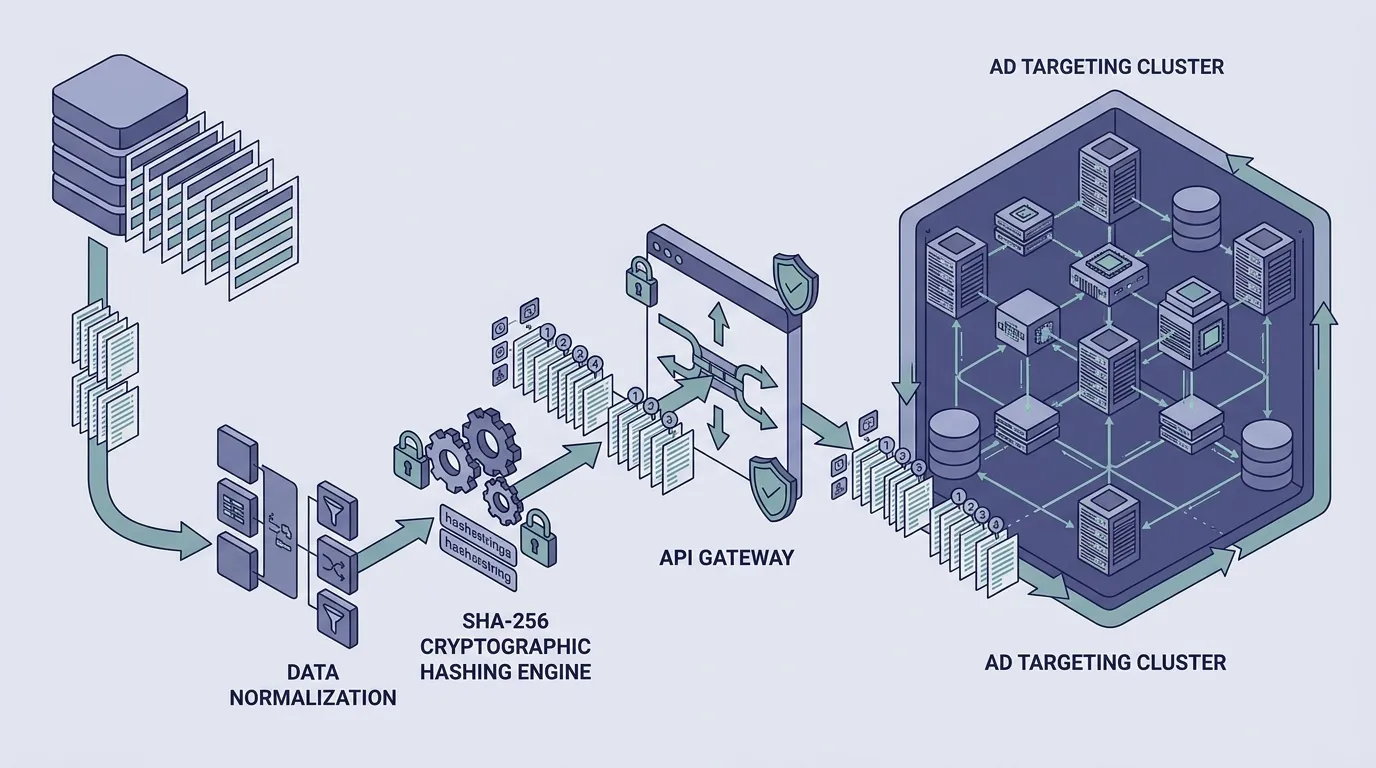
AI-generated conceptual illustration; not a platform screenshot or customer result.
Why Customer File Audience Syncs Fail During Production Runs
Automating CRM customer list synchronization to Meta Ads often creates unexpected production disruptions. Engineering teams frequently default to standard add and delete mutations against audience endpoints, unintentionally pushing live campaigns back into the calibration state. The usersreplace endpoint replaces audience members without resetting the learning phase of active ad sets targeting that audience, unlike POST or DELETE calls to the /users endpoint. Source. Scope: Applied when calling the /{audience_id}/usersreplace endpoint for custom audiences with subtype CUSTOM and fewer than 100 million members.
When ad sets re-enter the learning phase, conversion delivery fluctuates and bid algorithms must re-evaluate targeting density from scratch. Hypothesis: Maintaining stable audience IDs via in-place user replacement prevents performance volatility associated with targeting swaps in active ad sets. No lift has been measured here. Scope: Hypothesis: Syncing customer lists via daily usersreplace payload updates maintains lower day-over-day CPA variance compared to creating new audience IDs and swapping ad set targeting. Refutable test: Run an A/B test over 4 weeks comparing ad sets targeted with in-place usersreplace synced audiences versus ad sets updated weekly with fresh audience IDs, measuring CPA stability and learning state transitions. No lift has been measured here. In addition to algorithm volatility, large customer uploads frequently encounter session expiration and strict payload schema rejections when multi-batch sessions are poorly orchestrated.
Prerequisites and Endpoint Architecture
Before initiating an automated sync pipeline using the /{audience_id}/usersreplace endpoint, verify that the following infrastructure criteria are met:
- Active Meta Ad Account with Custom Audience Terms accepted for the operating business portfolio.
- A valid system user access token provisioned with
ads_managementpermissions. - An existing custom audience of subtype
CUSTOMcontaining fewer than 100 million members. - Source CRM customer lists containing raw identifiers (such as EMAIL, PHONE, or EXTERN_ID) ready for deterministic sanitization.
To understand how initial first-party audience schemas are structured prior to replacement automation, review our guide on customer list upload strategy and prepare targeting staging in NovaStorm.
Data Normalization and Multi-Key Schema Construction
Meta enforces strict formatting standards prior to cryptographic hashing. Any mismatch in normalization generates invalid entry warnings and degrades matching efficacy without returning explicit fatal HTTP errors. Email addresses must be normalized by trimming leading and trailing whitespace and converting all characters to lowercase before SHA-256 hashing. Source. Scope: Applied when formatting customer identifiers prior to uploading via the Marketing API. Phone numbers must have all non-numeric symbols, country formatting spaces, and leading zeros stripped before hashing.
When configuring multi-key payloads, combine attributes such as email, phone, first name, last name, and external identifiers to improve match resolution. Ensure personally identifiable information (PII) is encoded in hex format using lowercase hexadecimal characters:
- EMAIL: Trim whitespace, force lowercase, apply SHA-256.
- PHONE: Remove punctuation and leading zeroes, include country code, apply SHA-256.
- FN / LN: Lowercase Roman characters, remove punctuation, apply SHA-256.
- EXTERN_ID: Pass as unhashed string (or hashed identically across requests); note that external IDs carry lower matching precedence than PII.
- DATA_PROCESSING_OPTIONS: Pass
[\x22LDU\x22]or an empty array[]to control Limited Data Use compliance for US jurisdictions.
Multi-Batch Session Sequencing and Sizing Logic
Individual API calls to Meta Custom Audience endpoints accept a maximum of 10,000 records per HTTP request. Datasets exceeding this volume must be partitioned into sequential batches managed under a single unified session ID. Batch sequence numbers must be positive integers that are strictly sequential and start from 1 within the upload session. Source. Scope: Applied during multi-batch session parameter configuration for customer list custom audience creation or replacement.
Stop wasting ad budget
NovaStorm AI cuts Meta Ads CPA by 30% on average. No complex setup required.
Hypothetical example. All inputs are assumed for teaching purposes and are not customer results. Splitting a customer list across sequential requests respecting the single-request batch ceiling. Assumed inputs: Total CRM records to sync = 45000 records; Max records per API request = 10000 records; Calculated total batches = 5 batches. Period: Single sync run teaching scenario. Scope: Hypothetical example. All inputs are assumed for teaching purposes and are not customer results. Illustrates batch sizing and upload chunk calculation for CRM audience synchronization. Calculate the theoretical batch volume ratio: Calculation: 45000 / 10000 = 4.5 records / records. Period: Single sync run teaching scenario. requests needed before ceiling rounding. Distribute the records evenly into discrete chunks that do not exceed the 10,000 record maximum per request.
Multi-batch upload sessions automatically terminate 90 minutes after Meta receives the first batch if the last_batch_flag is not transmitted, discarding any batches received after the 90-minute window. Source. Scope: Applied to multi-batch customer file uploads where total records exceed the single request limit of 10,000 records. Failure to transmit last_batch_flag: true on your final payload leaves the session in an uncommitted state until the 90-minute timeout occurs, potentially delaying audience recalculation.
Payload Verification Checklist and Diagnostic Reference
Use this diagnostic matrix to resolve common API response codes and operational statuses during audience replacement runs:
| Response / Status | Root Cause | Remediation Step |
|---|---|---|
| operation_status: 471 | Audience flagged for policy restrictions on sensitive categories (e.g., health, financial status). | Review customer segmentation rules; remove prohibited attribute targeting and submit appeal via Meta Business Help Center. |
| Error 100 / Subcode 1713098 | Invalid rule JSON format or malformed session/payload structure. | Validate that batch_seq starts at 1, schema array length matches data row element count, and JSON escaping is intact. |
| Error 200 / Subcode 1870090 | Custom Audience Terms of Service not accepted on the acting ad account. | Accept terms within Meta Ads Manager or Meta Business Suite for the specific asset portfolio. |
| num_invalid_entries > 0 | Formatting anomalies in source records prior to hashing (e.g., uppercase hex chars, untrimmed whitespace). | Inspect invalid_entry_samples in the response; sanitize raw strings with regex trimming before generating SHA-256 hashes. |
Custom audiences flagged for policy restrictions regarding sensitive categories return an operation_status code of 471 in the Marketing API. Source. Scope: Applied when reviewing custom audience status for compliance flags starting September 2, 2025. When an audience receives status 471, it cannot be targeted in new campaigns, and active campaigns must be edited or paused to avoid delivery interruptions.
Execution Procedure: Executing an In-Place Usersreplace Call
Follow these structured execution steps to run a production customer list replacement:
- Generate Session Identifier: Construct a positive 64-bit integer unique to your ad account for the sync job.
- Verify Audience State: Query the audience object to ensure
operation_statusis normal and no concurrent replace operations are in progress. - Stream Batch Requests: Send sequential POST requests to
https://graph.facebook.com/v25.0/{audience_id}/usersreplaceincrementingbatch_seqby 1 for each chunk. - Mark Final Batch: Ensure the payload where
batch_seqequals total batch count setslast_batch_flag: true. - Inspect Match Diagnostics: Evaluate the response JSON for
num_receivedandnum_invalid_entriesto verify transmission integrity.
Do not issue simultaneous POST or DELETE requests to the standard /users endpoint while a usersreplace session is executing. Concurrent mutation calls will fail or result in locked audience states.
Operating Limits and Monitoring Safeguards
Audience updates processed through the Replace Users API are not instantaneous; propagation across Meta delivery systems typically takes up to 24 hours depending on audience size and account volume. Furthermore, automated pipelines must respect rate limits and implement exponential backoff retry logic on transient HTTP 5xx errors to prevent broken batch sequences. Maintain automated alerts on ad set learning state flags to confirm that customer lists update smoothly without resetting live bidding algorithms.
Disclaimer: This article was generated with the assistance of AI and reviewed by the NovaStorm AI team. While we strive for accuracy, we recommend verifying specific data points and consulting official sources (linked where available) for critical business decisions.
Ready to automate your Meta Ads?
NovaStorm AI takes full responsibility for your campaigns — from monitoring to optimization.
Start NowMore on Custom audiences and retargeting
Abandoned Cart Email and Meta Ad Retargeting: Combined Recovery
Coordinate cart emails and Meta retargeting with consent, purchase suppression, illustrative margin calculations and an explicit holdout design.
Custom Audiences: The Complete Guide to First-Party Data Targeting
Prepare a permitted customer-list upload, diagnose its processing errors and plan audience refreshes without invented match-rate benchmarks.
Blog Reader Retargeting on Meta Ads: Content-Based Audiences
Instrument consented active reading heuristics, verify supported content audiences, and test a relevant offer under a small cash cap.

Cross-Platform Retargeting Pools: Combining Meta and Google Data
Coordinate permitted first-party Meta and Google audiences, verify Customer Match eligibility, and reconcile attribution without inventing cross-platform identity.