

Abandoned Cart Email and Meta Ad Retargeting: Combined Recovery
Coordinate cart emails and Meta retargeting with consent, purchase suppression, illustrative margin calculations and an explicit holdout design.
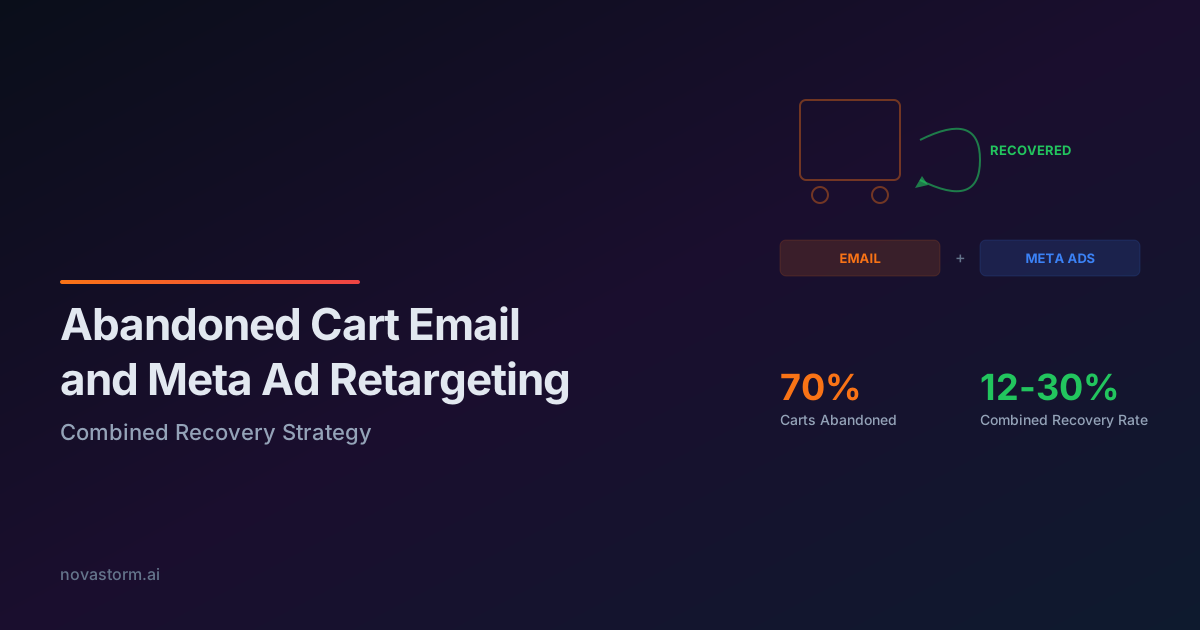
Adding Meta retargeting to cart emails is a hypothesis about extra settled purchases. Neither channel reaches every cart creator, and a cart is not an order. Build an eligible recovery cohort, stop messages after purchase or withdrawal, then compare email alone with email plus Meta using contribution after all costs.
Measure the reachable sets instead of adding percentages
Email requires a usable address and a permitted sending purpose; Meta delivery depends on permitted tracking or audience data, matching, eligible audience settings and auction delivery. Irish Data Protection Commission guidance explains the prior-consent principle for non-essential tracking with specific exceptions. Check requirements in your markets before deploying advertising trackers. An anonymous visitor is not automatically identifiable or targetable.
Hypothetical inventory of 100 distinct cart creators: 40 meet the email criteria, 50 meet the Meta audience criteria, and 20 belong to both sets. The union is 40 + 50 − 20 = 70 people, leaving 30 outside both sets. These are eligible-set assumptions, not delivered reach. Do not infer a combined reach from incompatible “unreachable” percentages or from individual channel totals. A blocked tracker or failed match can reduce realized delivery.
Create a recovery state machine
| State | Email decision | Meta decision |
|---|---|---|
| Unpaid eligible cart | Send permitted reminder with working cart link | Include only through a permitted eligible setup |
| Paid order before next sync | Cancel queued reminder after rechecking order state | Queue suppression/update; record delay |
| Refunded or cancelled order | Review customer service and recovery intent separately | Do not silently restart first-purchase ads |
| Withdrawn permission | Suppress affected promotional sends | Remove affected identifiers and stop dependent advertising use if removal fails |
| ESP or audience update failure | Alert owner; retry only after current-state check | Do not claim the cohort is fully suppressed |
Illustrative race: a shopper pays at 10:02, the ESP queued a reminder at 10:01 and the audience job next runs at 10:15. Recheck the paid-order state before the email send. Record the advertising removal request and actual processing evidence; do not promise zero impressions during the gap. Server-side purchase confirmation and unique order IDs should govern purchase counts; browser cart additions and duplicate checkout attempts do not.
Coordinate honest messages and discounts
Suggested email: “Your cart link is still available. Check the current shipping total before completing your order.” Suggested ad: “See the materials and delivery options for this collection.” These are example messages to adapt, not measured winners. Use real reviews with permission and genuine shipping promises. A countdown or stock warning needs a real deadline or inventory basis. Matching messages may reinforce memory; different messages may address separate objections. Neither has a predetermined zero or multiplicative effect.
For catalog recovery, verify event product identifiers against the catalog and the destination cart. Do not assume the exact abandoned item will be shown in every impression. The catalog troubleshooting guide helps isolate mapping and destination failures. Select the recovery window from buying delay and inventory validity; hourly per-person ad delivery is not a guaranteed campaign schedule.
Stop wasting ad budget
NovaStorm AI cuts Meta Ads CPA by 30% on average. No complex setup required.
Frequency equals impressions divided by reached people over the stated reporting window. It is an average, not each person’s exposure. Monitor complaints, concentrated delivery and mature purchases; no universal three-to-five impressions per day recommendation is supplied. Verify whether your selected objective and delivery setup actually support a frequency control before proposing one.
Test the addition of Meta to a constant email program
- Before delivery, randomly assign identifiable, permitted eligible cart creators to email-only control or the same emails plus Meta eligibility. Keep assignment stable across repeated carts.
- Exclude control from the experimental Meta campaign and audit other recovery campaigns for leakage. If exclusions or matching prevent isolation, label the comparison descriptive.
- Choose a primary endpoint such as settled purchase within a specified recovery window plus return maturation. Count every assigned person, including those never shown an ad, rather than comparing reached people with controls.
- Hold discounts, email content and support constant when testing the ad addition. Predefine uncertainty analysis and a maximum affordable spend; do not declare lift from a handful of orders.
Hypothetical equal groups of 500 eligible people produce 50 settled orders in control and 60 in email plus Meta: 10% versus 12%, a difference of 2 percentage points. The illustrative added count is 60 − 50 = 10 orders, not all 60. No significance or measured recovery effect is claimed. Cross-device identities, household spillover, unmatched exclusions and return delays can weaken interpretation.
A margin ledger can reverse the revenue conclusion
Illustrative assumptions for the same comparison: each order has USD 100 gross revenue, USD 10 discount, USD 40 product cost, USD 8 shipping, USD 4 payment cost and USD 3 return allowance. Contribution is USD 35 per settled order. Ten extra orders contribute USD 350. Added Meta media USD 250 plus creative USD 50 and incremental operations USD 30 leaves USD 20. Email costs shared equally between groups cancel in this marginal calculation but still belong in total program costs. If the treatment discount differs, recompute contribution for all treatment orders; do not price only the extra ten.
Apply the result without claiming touchpoint truth
Prepare a reviewed recovery campaign draft in NovaStorm after confirming the external store, ESP and audience processes. Keep experiment assignment and settled-order reconciliation outside that draft workflow. Platform attribution can describe credited events, but it does not reveal the true contribution of each email, ad or direct visit. No NovaStorm cross-channel attribution or automated suppression integration is established here.
Published by NovaStorm AI. Worked examples and test fixtures in this article are illustrative, not observed customer results.
Disclaimer: This article was generated with the assistance of AI and reviewed by the NovaStorm AI team. While we strive for accuracy, we recommend verifying specific data points and consulting official sources (linked where available) for critical business decisions.
Ready to automate your Meta Ads?
NovaStorm AI takes full responsibility for your campaigns — from monitoring to optimization.
Start NowMore on Custom audiences and retargeting
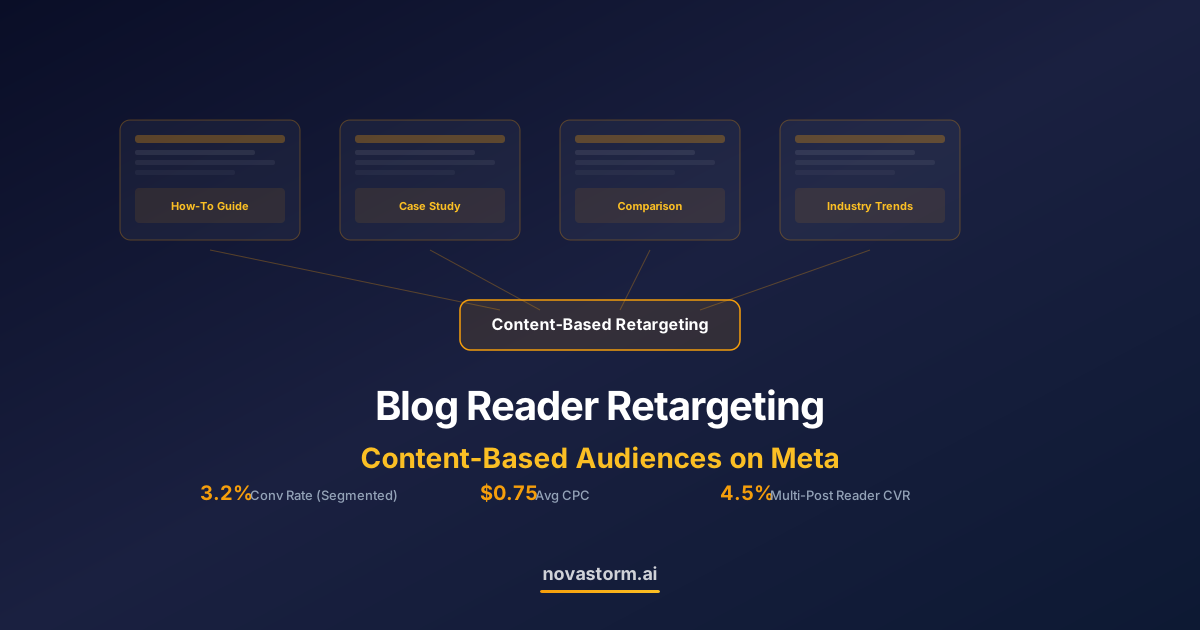
Blog Reader Retargeting on Meta Ads: Content-Based Audiences
Instrument consented active reading heuristics, verify supported content audiences, and test a relevant offer under a small cash cap.
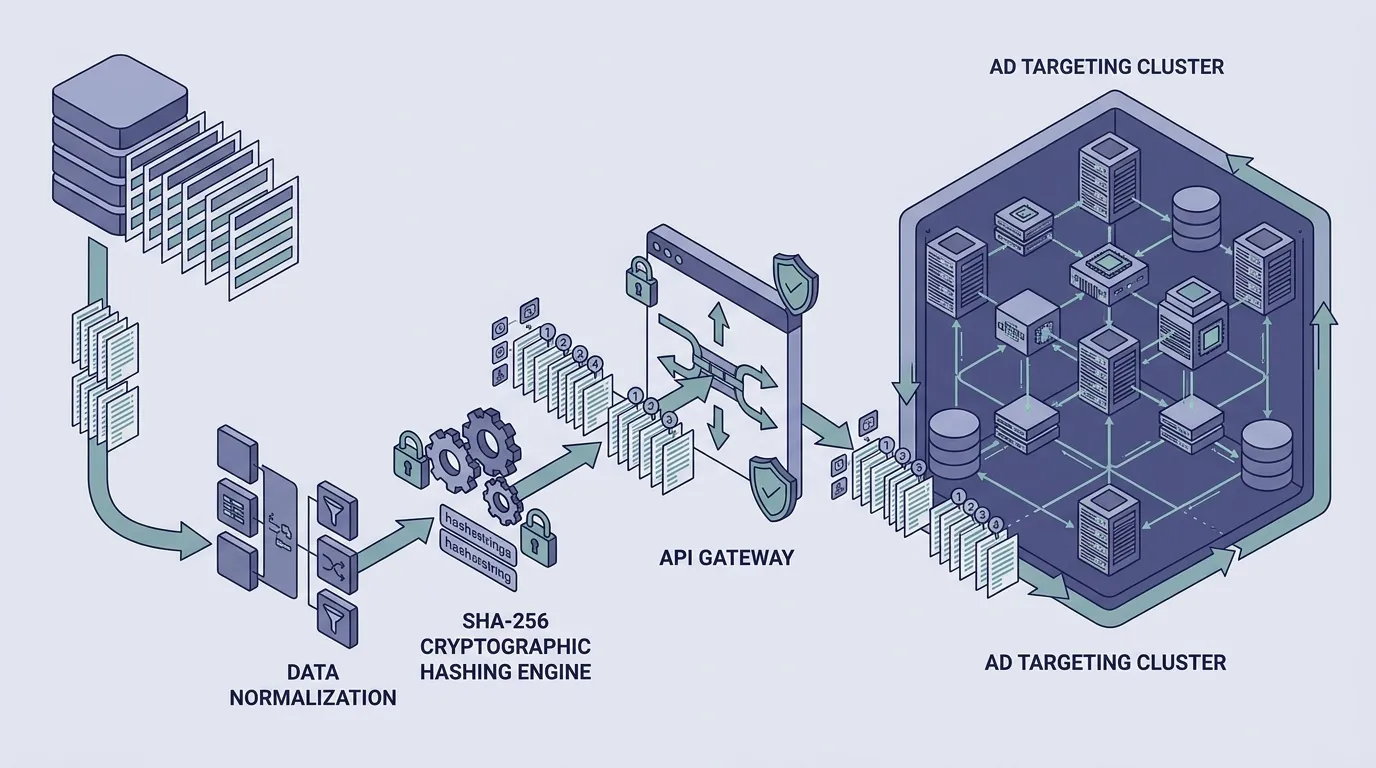
Meta Custom Audience Syncing via Usersreplace: Prevent Learning Resets and Session Errors
Learn how to update Meta Custom Audiences using the usersreplace endpoint without triggering ad set learning resets or session timeout errors.

Cross-Platform Retargeting Pools: Combining Meta and Google Data
Coordinate permitted first-party Meta and Google audiences, verify Customer Match eligibility, and reconcile attribution without inventing cross-platform identity.
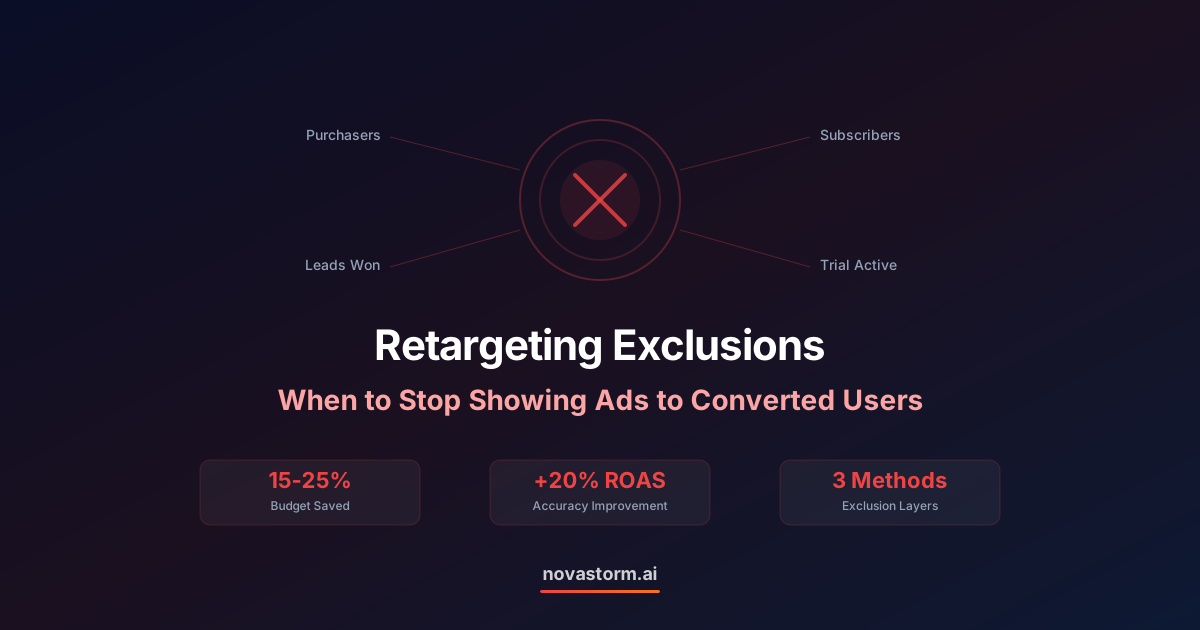
Retargeting Exclusions: When to Stop Showing Ads to Converted Users
Plan retargeting exclusions by customer lifecycle, handle refunds and permission withdrawals, and verify matching and refresh limits.