

Cross-Platform Retargeting Pools: Combining Meta and Google Data
Coordinate permitted first-party Meta and Google audiences, verify Customer Match eligibility, and reconcile attribution without inventing cross-platform identity.

A cross-platform plan can share permitted first-party business definitions while activating separate Meta and Google audiences. It does not provide a complete personal view of impressions on both platforms or automatically merge their identities. Keep collection, matching, attribution and incrementality distinct.
Design around information you actually own
| Internal field | Permitted use to verify | Unknown or excluded |
|---|---|---|
| Local event/order ID | Deduplicate your own events and paid orders | Not a platform person identifier |
| Event time / source / campaign UTM | Describe an observed own-site arrival | Not all prior impressions or actual private search terms |
| First-party customer ID | Join own authenticated/CRM records under permissions | Anonymous visits remain unjoined |
| Consent state / purpose / timestamp | Determine allowed collection and destination | No export when permission required but absent |
| Email / phone | Only supported destination-specific matching after required preparation | Match not guaranteed; no raw values in ordinary event logs |
| Order value/currency/refunds | Measure own contribution consistently | Not competitors’ outcomes |
Interactions with a competitor’s page, unclicked searches and personal ad-view histories are not supplied by your website UTM tags. Record identity as unknown unless a permitted link is actually established. Similar devices, IP addresses or names are not proof of one person.
Activate permitted customer lists separately
Google Customer Match policy requires first-party collection, disclosures and required consent, as well as account eligibility. Targeting, observation and exclusion access are not identical. Google recommends Data Manager or Data Manager API for new workflows; check your actual available route and purpose.
The Customer Match implementation guide documents normalization and hashing requirements and a current restriction on legacy upload services for projects without qualifying historical activity. Use the current destination contract, not an old universal upload recipe. Format identifiers correctly, inspect processing errors and refresh/removal results.
Meta and Google each perform matching against their own systems. Uploading the same permitted list does not guarantee the same matched people, usable audience size or cookie-independent identification. Record each audience’s source, scope, acceptance time and unknown match gaps separately.
Server-side tagging has a narrower job
Google’s server-side tagging introduction describes a container that receives and routes instrumented events. It can help control the data you send; it does not create missing impression history or a universal cross-channel identity. Consent and permitted destination fields still apply.
Stop wasting ad budget
NovaStorm AI cuts Meta Ads CPA by 30% on average. No complex setup required.
Reconcile orders before discussing attribution
Hypothetical ledger: the store records twenty unique orders. Meta credits eighteen and Google credits eight in the selected reports. If six order IDs overlap and scope matches, the union is 18+8−6=20. Counting 26 exaggerates the observed unique total. If IDs or windows cannot be reconciled, record the unresolved discrepancy instead of forcing a union.
A fractional attribution model distributes credit by its chosen rule. It does not prove incremental effect. An order with two attributed touches may have happened without either ad. Use the incrementality test plan for a causal question.
Test channel roles without promising personal sequence
- Choose consistent truthful offers and destinations; use different messages only as a declared hypothesis.
- Set one business cash allowance covering both channels and record actual spend separately.
- Use available platform frequency reporting/controls within their own scope. Do not add two reach counts and call them unique combined reach or promise a shared personal cap.
- For incremental contribution, consider a properly designed channel holdout or factorial comparison; record allocation, contamination, outcome maturity and uncertainty.
A two-by-two design may compare neither channel, Meta only, Google only and both, if feasible and ethical for your audience. It measures assigned strategies under its assumptions; it does not require obtaining every person’s ad-view history.
Keep the product handoff explicit
Prepare the Meta-side paused campaign draft in NovaStorm using the approved message and budget. Google activation, central customer-data governance, list removal and cross-channel experiments remain separate workflows. No measured ROAS uplift or fully merged identity is established here.
Published by NovaStorm AI. Worked examples and proposed tests are labeled in the article.
Disclaimer: This article was generated with the assistance of AI and reviewed by the NovaStorm AI team. While we strive for accuracy, we recommend verifying specific data points and consulting official sources (linked where available) for critical business decisions.
Ready to automate your Meta Ads?
NovaStorm AI takes full responsibility for your campaigns — from monitoring to optimization.
Start NowMore on Custom audiences and retargeting
Retargeting Exclusions: When to Stop Showing Ads to Converted Users
Plan retargeting exclusions by customer lifecycle, handle refunds and permission withdrawals, and verify matching and refresh limits.
Blog Reader Retargeting on Meta Ads: Content-Based Audiences
Instrument consented active reading heuristics, verify supported content audiences, and test a relevant offer under a small cash cap.
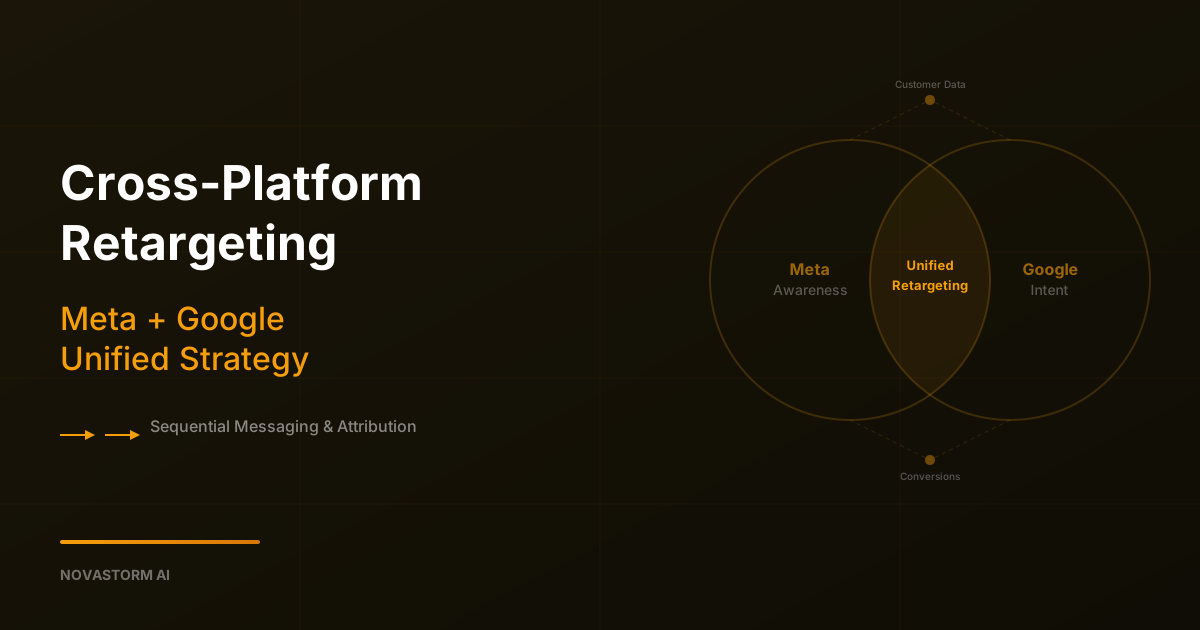
Cross-Platform Retargeting: Meta + Google Unified Strategy
Coordinate Meta and Google retargeting messages with permission-aware segment records, visible sync failures and separately tested incremental outcomes.

Dynamic Retargeting for Non-E-commerce Businesses on Meta
Map non-commerce offers safely, verify catalog eligibility and event semantics, and measure qualified clients without inventing value optimization.