

Maslow's Hierarchy and Meta Ad Messaging: Needs-Based Positioning
Discover how Maslow's hierarchy of needs transforms Meta ad messaging. Learn needs-based positioning strategies that align ad copy with audience motivations.
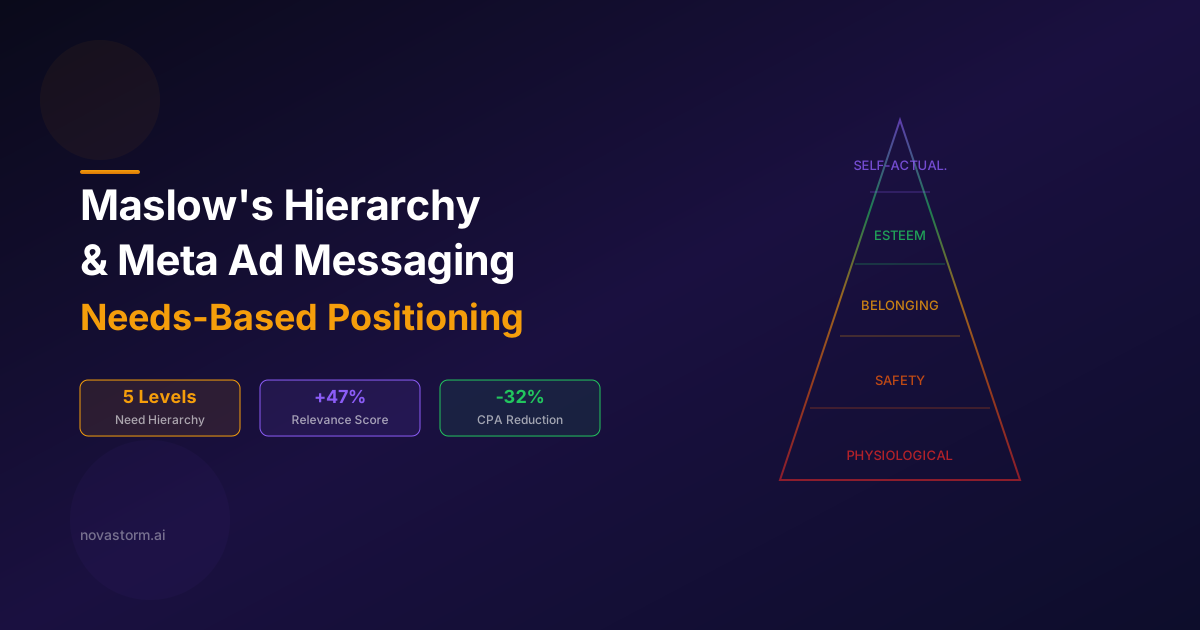
Use needs-based positioning to generate message hypotheses, not to diagnose the psychological state of an ad recipient. Safety, connection and achievement can coexist. An interest in budgeting does not establish debt, distress or a particular personal need, and affluence does not prove indifference to price.
Read the original theory with its limits
Maslow’s 1943 “A Theory of Human Motivation,” Psychological Review 50, 370–396 describes physiological, safety, belonging, esteem and self-actualization needs. It also explicitly discusses exceptions to the proposed order, overlapping motivations and the need for further research. Treating it as a rigid sequence or a validated Meta targeting taxonomy goes beyond that work. The adaptation below is an editorial exercise, not an experimentally proven advertising framework.
Three motivational variants for one offer
Hypothetical product: an introductory creative-planning workshop with a clearly disclosed fee, duration and curriculum. The text is a draft for testing, not a real available offer or a customer result. Keep the same workshop, price, destination, visual and CTA across variants; vary only the motivational headline.
| Variant | Headline to test | Shared body and CTA |
|---|---|---|
| Planning clarity | Make your next creative plan easier to review | Review the workshop curriculum, schedule and fee before booking. CTA: View workshop details. |
| Connection | Bring your team into the creative discussion | Review the workshop curriculum, schedule and fee before booking. CTA: View workshop details. |
| Skill development | Practice building a clear creative brief | Review the workshop curriculum, schedule and fee before booking. CTA: View workshop details. |
Hypotheses: clarity framing may help people seeking a practical process; connection framing may help teams coordinating work; skill framing may help people evaluating learning. These do not establish three fixed psychological audience types. Ask voluntary, relevant research questions about the task people are trying to complete; do not infer private conditions from advertising interests.
Stop wasting ad budget
NovaStorm AI cuts Meta Ads CPA by 30% on average. No complex setup required.
Check promises before running variants
- Use “risk-free” only when the complete actual terms justify it. A conditional refund policy does not remove every risk; show its conditions plainly.
- Publish a member count only from a documented, dated definition of members and current evidence. This draft needs no invented count or testimonial.
- Keep price visible in every variant. Avoid assuming affluent recipients are less price-sensitive or should only see aspirational copy.
- Review how automatic creative changes might combine text. If coherent bundled variants cannot be guaranteed in the actual setup, use separately approved complete assets instead of assuming a need-level grouping constrains combinations.
A proposed test inside one eligible audience
Unexecuted test plan: select one permitted audience and one placement scope, define a qualified workshop booking, and use a supported random-assignment experiment if available. Equal ad-set budgets are not random assignment; auction delivery can select different people and frequencies. If randomization cannot be implemented, report the comparison as observational and avoid causal conclusions.
Before launch, choose sample planning, minimum worthwhile effect, test exposure limit and maturity window using your own economics. Check assignment, duplicates, delivery imbalance and multiple comparisons across the three headlines. Report uncertainty; a winning click rate does not prove the underlying need or a durable CPA improvement. No universal duration or significance guarantee is assumed.
Prepare the chosen complete creative variants and claim evidence in a NovaStorm campaign draft, then obtain explicit user approval. The product role is preparation and review, not determining Maslow levels. Use the approval workflow to keep the tested headline attached to its approved version.
Published by NovaStorm AI. Worked examples and test fixtures in this article are illustrative, not observed customer results.
Disclaimer: This article was generated with the assistance of AI and reviewed by the NovaStorm AI team. While we strive for accuracy, we recommend verifying specific data points and consulting official sources (linked where available) for critical business decisions.
Ready to automate your Meta Ads?
NovaStorm AI takes full responsibility for your campaigns — from monitoring to optimization.
Start NowMore on Buyer psychology
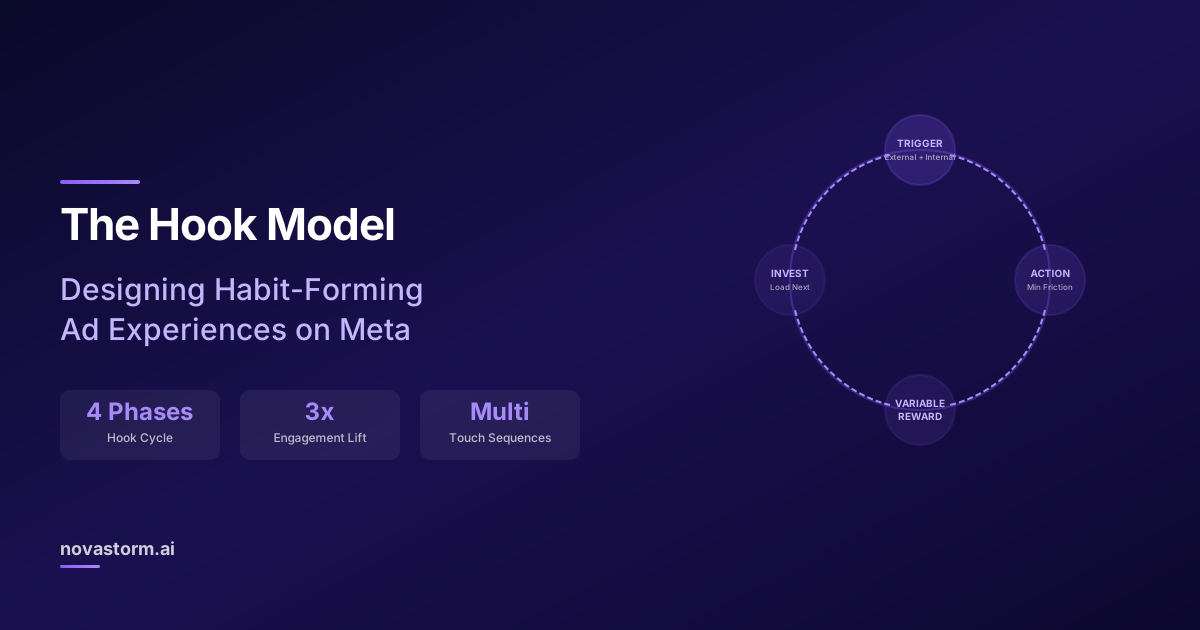
The Hook Model: Designing Habit-Forming Ad Experiences on Meta
Design a voluntary ad-to-quiz journey, separate contact permission and measure cohort costs without assuming habits or personalization support.
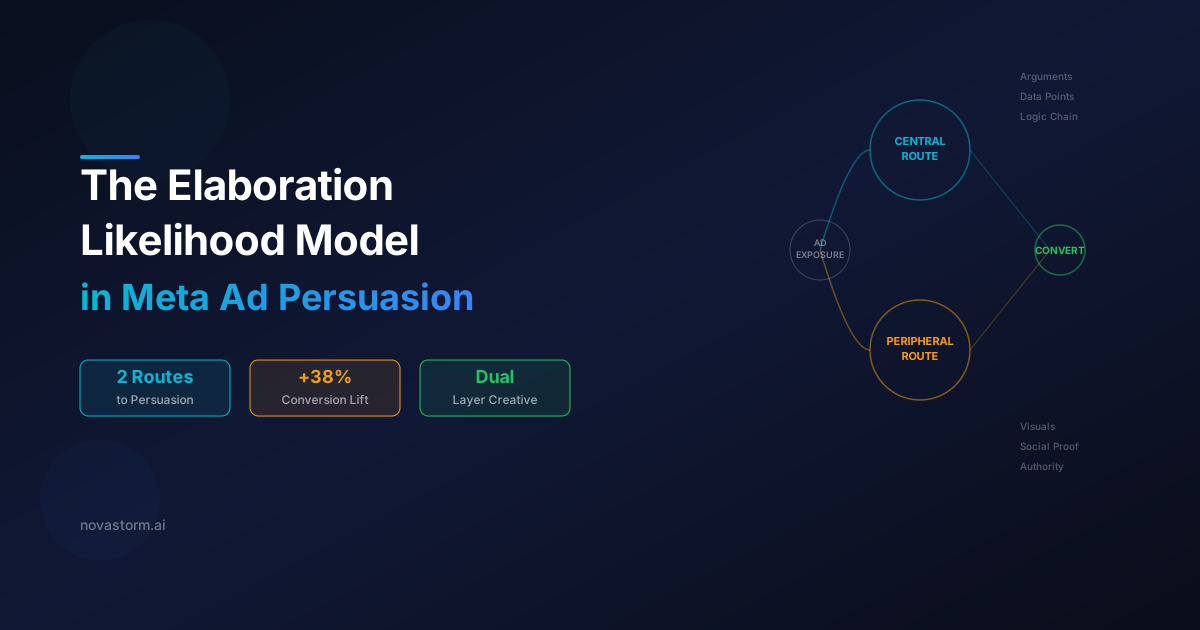
The Elaboration Likelihood Model in Meta Ad Persuasion
Learn how the Elaboration Likelihood Model shapes Meta ad persuasion through central and peripheral routes. Build ads that persuade at every engagement level.
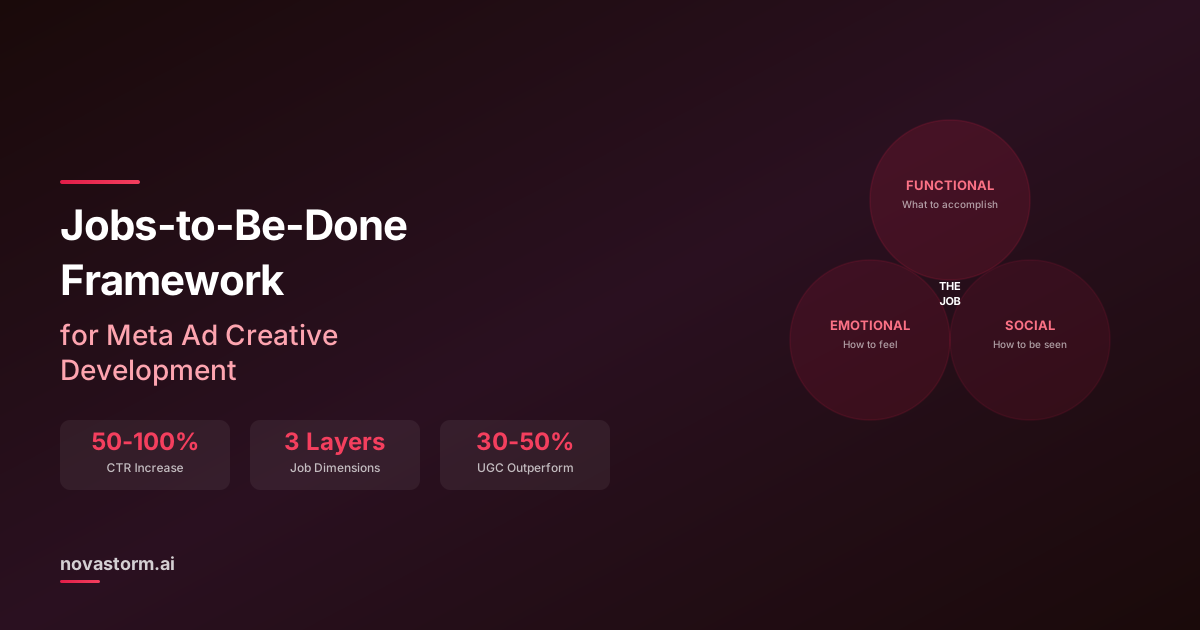
Jobs-to-Be-Done Framework for Meta Ad Creative Development
Turn a Jobs-to-Be-Done decision story into a truthful ad brief, verify targeting separately and evaluate mature customer outcomes.
Herd Mentality in Meta Ads: Test Truthful Social Proof
Use permissioned social proof in Meta creative, verify existing-post rendering and measure acquisition cost including any engagement seeding.