

The Elaboration Likelihood Model in Meta Ad Persuasion
Learn how the Elaboration Likelihood Model shapes Meta ad persuasion through central and peripheral routes. Build ads that persuade at every engagement level.
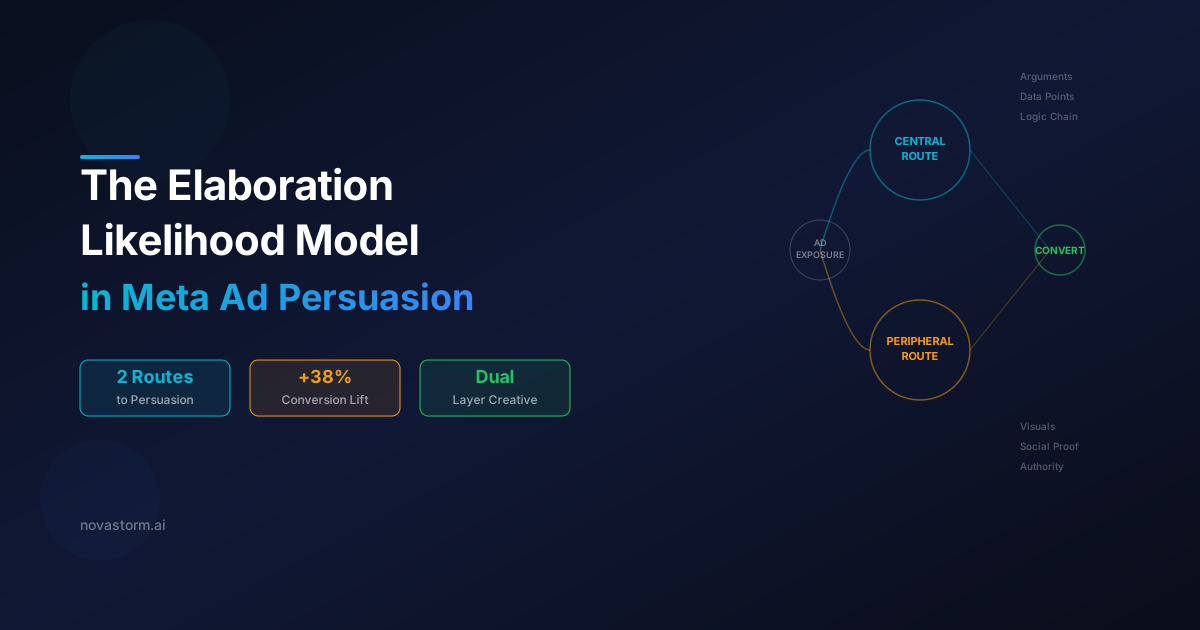
The Elaboration Likelihood Model can help you design an ad with an understandable first impression and a reasoned explanation. It does not let you identify a person’s persuasion route from video duration, scroll depth or a click. A performance difference between two ads is also not, by itself, evidence of a psychological mechanism.
What the primary model supports
Petty and Cacioppo’s 1986 chapter, “The Elaboration Likelihood Model of Persuasion,” Advances in Experimental Social Psychology 19, 123–205 describes elaboration as a continuum influenced by motivation and ability, contrasting issue-relevant argument scrutiny with lower-elaboration reliance on cues. Context matters: a visual or source characteristic is not permanently assigned to one route. Applying the model to a Meta campaign requires its own evidence; the chapter does not establish a universal feed-reading pattern or subscriber churn advantage.
One finished two-layer teaching creative
Hypothetical product: a campaign-brief workshop. No quantified improvement, testimonial or membership claim is needed. Both layers describe the same offer and lead to the same detail page.
| Layer | Complete teaching draft | Review requirement |
|---|---|---|
| Initial glance | Headline: “Build a brief your team can review.” Visual: a readable blank brief structure with sections for offer, evidence and next step. | No fake result chart, logo or customer proof |
| Explanation | Body: “Practice writing an offer, listing evidence for each claim and assigning a reviewer. Read the curriculum, duration and fee before booking.” | Each promised workshop activity must exist before publication |
| Next action | CTA: “View workshop details.” Landing page repeats curriculum, fee and terms. | The action opens details; it does not imply a free booking |
A hypothetical statement such as “CPA fell 34% across 200 accounts” is not evidence merely because it is precise. If used as a teaching example, label all its inputs fictional and keep it out of an actual ad. A publishable performance claim needs source records, comparable periods, outcome definitions and permission. This creative therefore uses no fabricated result.
Change one variable and narrow the conclusion
Stop wasting ad budget
NovaStorm AI cuts Meta Ads CPA by 30% on average. No complex setup required.
Proposed test, not executed: keep the headline, visual, destination, offer, price and CTA fixed. Variant A uses the body above. Variant B uses a concise body: “Practice creating a review-ready campaign brief. See the curriculum, duration and fee.” The single chosen variable is explanatory body wording; both remain accurate.
- Use a supported randomized comparison where feasible and record assignment and delivery integrity. Ordinary parallel ad sets may differ in audience exposure.
- Define an accepted qualified booking, maturity allowance, affordable exposure and analysis plan before launch. Track refunds and actual collection separately.
- Report counts and uncertainty. If Variant A performs better, conclude only what the design supports about these body variants in that context.
- Do not infer central processing from longer sessions or peripheral processing from fast conversions. Those can reflect confusion, navigation, familiarity or device differences.
If the research question is the persuasion mechanism itself, add an appropriate research protocol: validated comprehension or thought-response measures, relevant manipulations and safeguards against alternative explanations. Do not treat an unavailable copy-expansion metric as an automatically exposed Ads Manager signal. The advertising test above measures a business outcome, not mental processing.
Review the two layers together
Check every badge, illustration and text statement against the same evidence record. A striking visual must not contradict a detailed explanation. A reader should be able to understand the commitment without sound, enlarged fine print or an inferred testimonial. Prepare the reviewed complete creative as a NovaStorm draft; no psychological classification or experiment implementation is claimed.
The A/B testing guide and versioned approval workflow connect this brief to accountable preparation.
Published by NovaStorm AI. Worked examples and test fixtures in this article are illustrative, not observed customer results.
Disclaimer: This article was generated with the assistance of AI and reviewed by the NovaStorm AI team. While we strive for accuracy, we recommend verifying specific data points and consulting official sources (linked where available) for critical business decisions.
Ready to automate your Meta Ads?
NovaStorm AI takes full responsibility for your campaigns — from monitoring to optimization.
Start NowMore on Buyer psychology
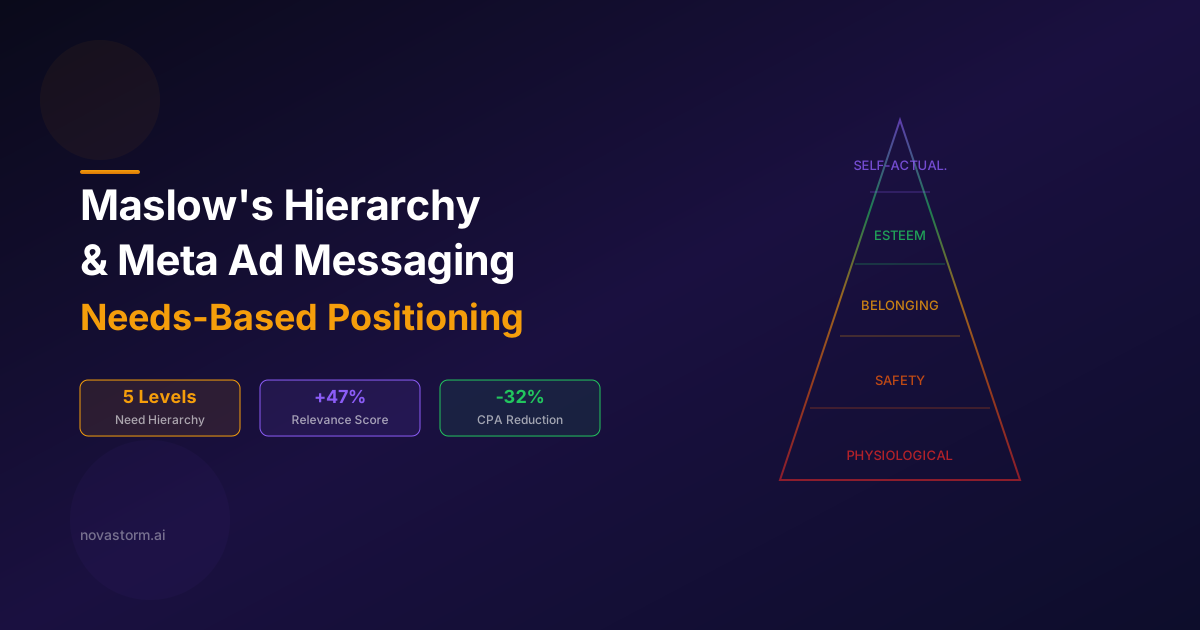
Maslow's Hierarchy and Meta Ad Messaging: Needs-Based Positioning
Discover how Maslow's hierarchy of needs transforms Meta ad messaging. Learn needs-based positioning strategies that align ad copy with audience motivations.
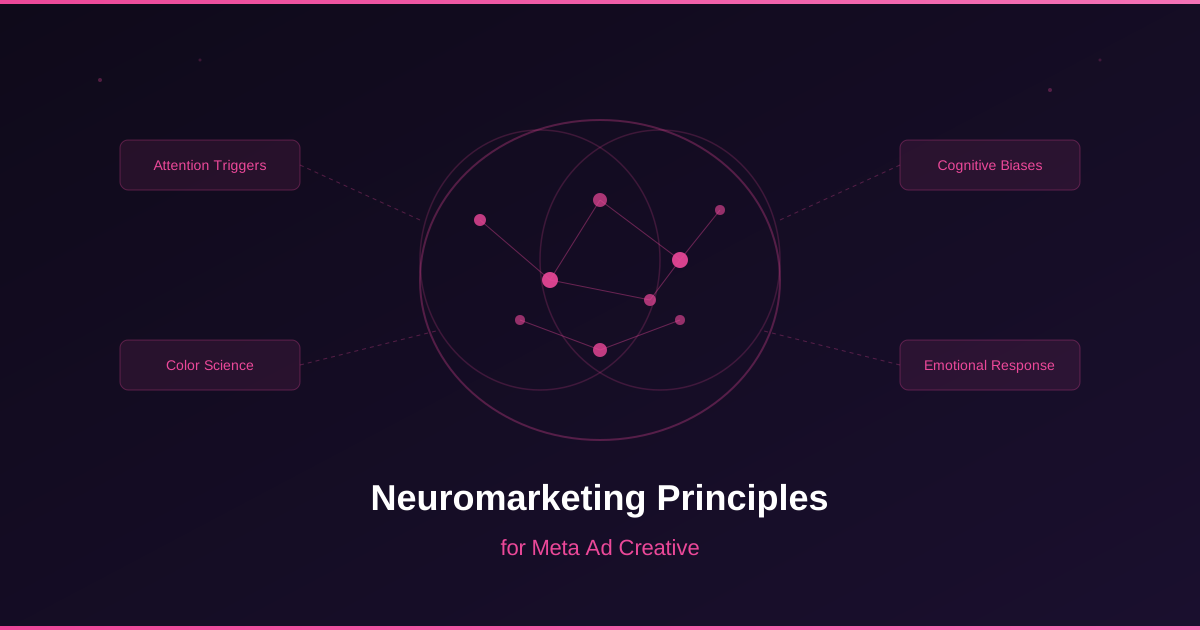
Neuromarketing for Meta Ads: Test One Visual Attention Hypothesis
Turn a visual attention idea into one honest creative hypothesis; compare mature purchase cost without claiming neuroscience or guaranteed sales.
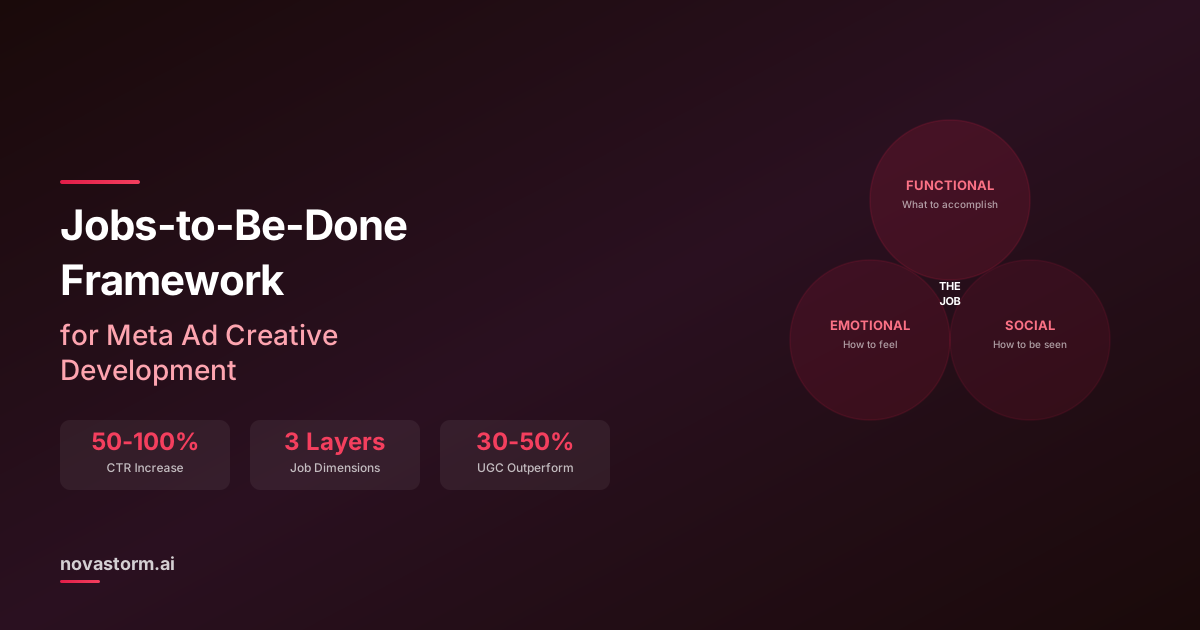
Jobs-to-Be-Done Framework for Meta Ad Creative Development
Turn a Jobs-to-Be-Done decision story into a truthful ad brief, verify targeting separately and evaluate mature customer outcomes.
The Von Restorff Effect: Making Your Meta Ad Stand Out in the Feed
Test a contrasting Meta ad layout while preserving the offer; distinguish isolation research, measurable attention and mature business outcomes.