

Herd Mentality in Meta Ads: Test Truthful Social Proof
Use permissioned social proof in Meta creative, verify existing-post rendering and measure acquisition cost including any engagement seeding.
A testimonial can answer a specific customer doubt, but reactions and displayed user counts are not evidence of purchase lift. Publish only real, permissioned statements with enough context to avoid misleading a buyer; never invent an exact-looking number to appear credible.
Separate research from ad-effect claims
Asch’s 1955 account of social-pressure experiments addresses social conformity. Nielsen’s April 2012 trust report reports 92% trust in word-of-mouth or friends/family recommendations in its historical survey. Neither establishes that an ad with likes becomes a peer recommendation or produces the claimed +34%, +43% or 40–60% conversion lift. The date, source and measurement context matter.
Verify post identity and evidence rights
Meta’s AdCreative SDK reference includes post/story-related fields, but a field’s existence does not guarantee engagement carries unchanged across creative formats or placements. If using an existing post, record the actual accepted identifier and preview its render for each intended configuration. Do not prescribe 200 reactions, 30 comments or 1,000 users as a required threshold.
| Release check | Evidence required |
|---|---|
| Testimonial | Original statement, use permission, date and material context |
| Logo/photo | Separate permission and approved scope; quote permission alone is insufficient |
| Count/rating | Defined population, measurement date and reproducible source |
| Existing post | Accepted identity and actual placement preview, not assumed transferred likes |
| After edits | Review whether a new creative/version changes identity or display |
An approval-ready carousel structure
Stop wasting ad budget
NovaStorm AI cuts Meta Ads CPA by 30% on average. No complex setup required.
Illustrative layout, not genuine testimonials: card 1 names the product and decision; card 2 is reserved for a permissioned statement about an actual relevant use; card 3 shows verified product evidence; card 4 gives price, terms and the next step. Do not publish a blank testimonial card. If no permitted quote exists, replace card 2 with a factual product demonstration. This guide has no customer quote to reproduce.
Review the exact proposed words against the authorized statement; do not turn "easy to prepare a draft" into "lowered CPA". Show any material incentive or relationship where applicable. Do not create fake live counters or claim a small real customer base is untrustworthy merely because it is below an arbitrary count.
Include seeding cost in acquisition cost
Hypothetical cost worksheet: warm-up media USD 100, acquisition media USD 400, production/permission work USD 100 and 20 unique new paid customers. Complete CAC = (100 + 400 + 100) / 20 = USD 30. Using only acquisition media yields USD 20 and understates this defined cost. Synthetic figures are not observed results.
If evaluating seeding, compare complete policies under comparable assignment and maturity. Record audience selection, time and spend. Correlation between accumulating reactions and sales can reflect longer exposure, audience choice or other changes, not a causal herd effect. Do not automatically add every purchase to a testimonial count.
Give NovaStorm a brief containing approved evidence and ordinary carousel messages, then review outputs and supported previews before approval. Rights verification, dynamic counters and guaranteed engagement transfer are not promised automatic product capabilities.
Published by NovaStorm AI. Worked examples and test fixtures in this article are illustrative, not observed customer results.
Disclaimer: This article was generated with the assistance of AI and reviewed by the NovaStorm AI team. While we strive for accuracy, we recommend verifying specific data points and consulting official sources (linked where available) for critical business decisions.
Ready to automate your Meta Ads?
NovaStorm AI takes full responsibility for your campaigns — from monitoring to optimization.
Start NowMore on Buyer psychology
Zeigarnik Effect in Ad Sequences: Unfinished Stories That Drive Clicks
Design self-contained ad chapters that fulfill their promises, count the full path cost and evaluate the sequence against a credible control.
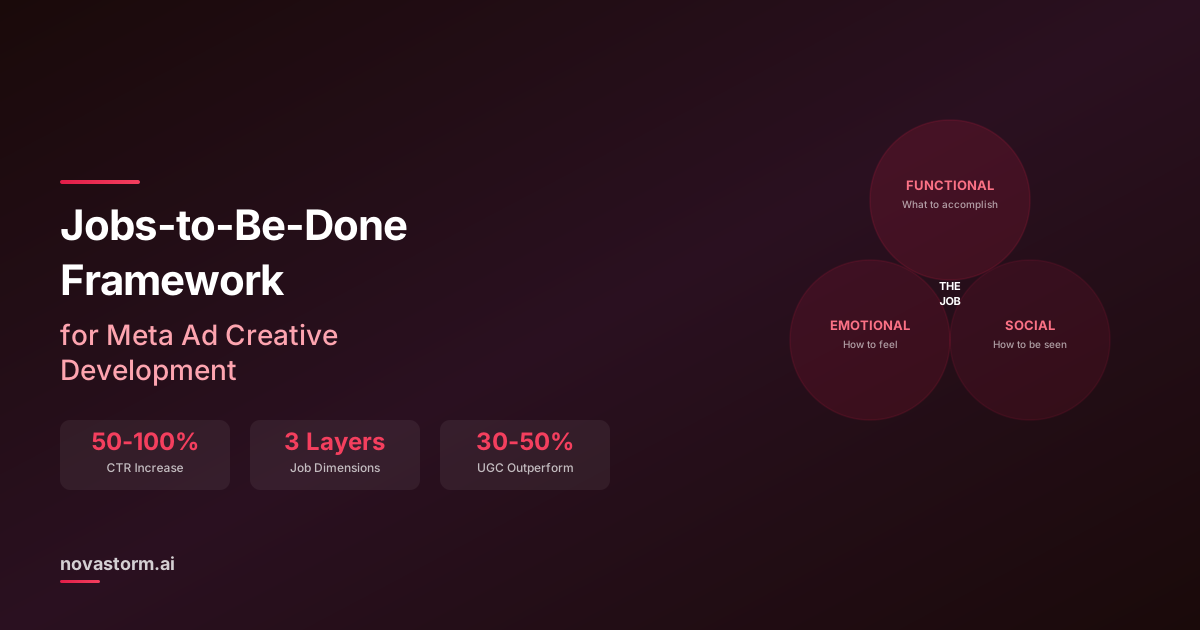
Jobs-to-Be-Done Framework for Meta Ad Creative Development
Turn a Jobs-to-Be-Done decision story into a truthful ad brief, verify targeting separately and evaluate mature customer outcomes.
The Endowment Effect in Meta Ads: Free Trials and Ownership Psychology
Test ownership language in trial ads with a single copy change, confirmed payment and clear voluntary cancellation terms.
The Bandwagon Effect: Why Social Proof Numbers Matter in Ads
Audit social-proof numbers with a dated claim register and correct CTR comparisons, then test retained contribution with approved evidence.