

Auto-Rules in Meta Ads: Automate Without Losing Control
Design automated-rule guardrails around cash, mature outcomes and cooldowns, with a false-trigger journal before enabling actions.
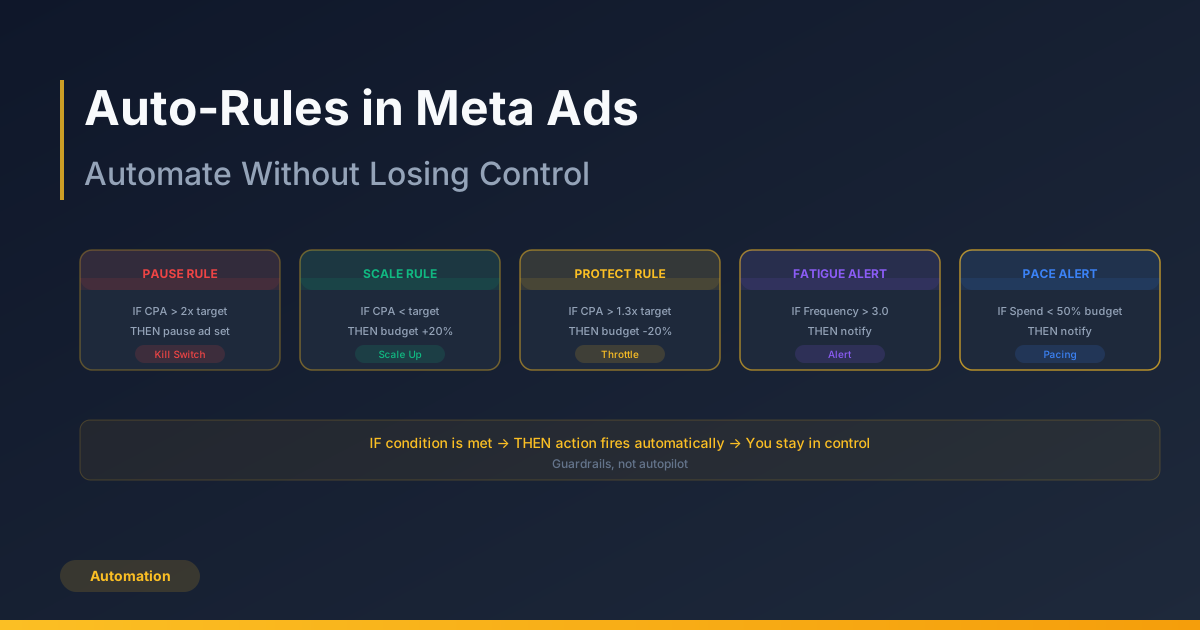
Automated advertising rules should follow a business decision, not replace it. Verify the actual rule conditions, lookback window, schedule, scope and action supported in the account. A condition on immature platform CPA can misread pending purchases.
Start with approved safety conditions
| Rule intent | Evidence condition | Safe response |
|---|---|---|
| Cash protection | Confirmed cumulative spend/loss reaches approved limit | Stop affected spend; prevent automatic re-enable |
| Technical failure | Verified broken path or unreliable collection | Alert/pause under documented policy |
| Economic review | Mature net orders and contribution fail the agreed rule | Human review or bounded approved reduction |
| Growth proposal | Mature marginal economics meet target and capacity exists | Propose one bounded increase, not unbounded compounding |
| Frequency diagnosis | Comparable exposure plus deteriorating response/economics | Alert for investigation; average frequency alone is not fatigue |
Define the cash ceiling separately from the daily planning budget and inspect supported limit behavior. A 50-conversion count, 3.0 frequency or fixed CPA multiple is not a universal action rule.
Prevent repeated increases and conflicting actions
- Set a maximum approved campaign or account budget and a total cash-loss cap, including related tests.
- After a change, apply a declared cooldown until conversions mature and the next review occurs. Verify that the actual tool can enforce it; otherwise use notifications and manual approval.
- Use one owner, an action priority and a persistent change journal so conflicting rules do not raise and lower the same budget.
- Exclude unvalidated events, fresh material changes and immature cohorts from economic growth actions. Learning status alone does not permit exceeding cash limits.
- Record previous and new budgets, conditions, time, scope, decision reason, and rollback or reactivation authority.
- Test rule logic on synthetic data or in notification-only mode before enabling consequential actions.
Stop wasting ad budget
NovaStorm AI cuts Meta Ads CPA by 30% on average. No complex setup required.
A filled false-trigger journal
Hypothetical case: at Monday review, $180 spend has three confirmed orders (reported CPA $60), with the normal purchase cycle assumed to be two days. An immediate pause at a $30 target might fire while the cohort is immature. Six paid orders confirmed on Wednesday would give $30 CPA. These are invented outcomes, not a real rule failure or promised recovery.
| Journal field | Synthetic entry |
|---|---|
| Trigger candidate | CPA $60 from three orders on Monday |
| Maturity check | Last click cohort not two days old |
| Cash check | Chosen $300 total cap; remaining $120 |
| Decision | Alert/check within cap; no automatic budget increase |
| Review | Wednesday at declared time; real payments reconciled |
| Final status | Six orders only if actually confirmed; otherwise actual count retained |
Separate platform rules from draft preparation
Meta’s official rule SDK exposes rule objects; it does not prove every current UI condition exists. Use NovaStorm for a written brief and paused campaign preparation. Do not assume it implements these rules or automatic budget changes. The user approves actual actions and checks real spend in the supported advertising reports. See the pause decision tree.
Published by NovaStorm AI. Planning examples are illustrative assumptions, not measured customer results.
Disclaimer: This article was generated with the assistance of AI and reviewed by the NovaStorm AI team. While we strive for accuracy, we recommend verifying specific data points and consulting official sources (linked where available) for critical business decisions.
Ready to automate your Meta Ads?
NovaStorm AI takes full responsibility for your campaigns — from monitoring to optimization.
Start NowMore on Meta platform and automation

Ad Tech Stack for Meta Advertisers: Essential Third-Party Tools
Discover the essential ad tech stack for Meta advertisers. Learn which third-party tools drive better ROAS, streamline workflows, and scale Facebook ad campaigns.

Meta Ads Policy Review: Rejections, Categories and Review Requests
Review a Meta ad rejection by its cited standard, market and exact creative, then prepare a documented request without promising approval or a fixed response time.
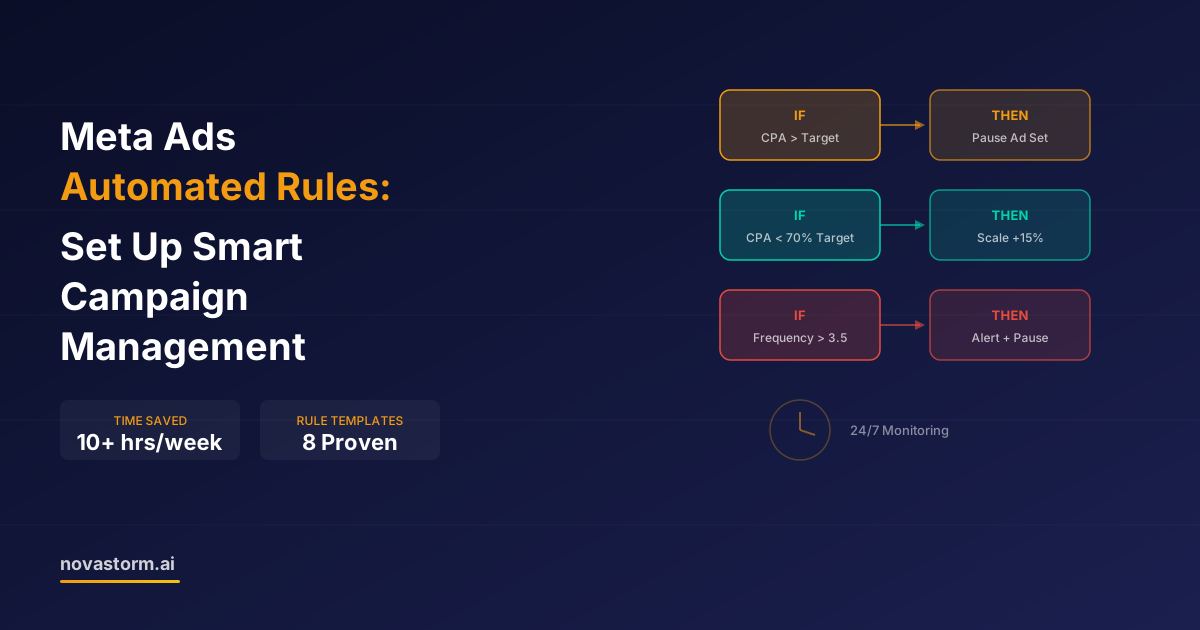
Meta Ads Automated Rules: Set Up Smart Campaign Management
Design Meta automated rules with mature inputs, zero-conversion handling, conflict priority, execution checks and a capped owner-approved budget.
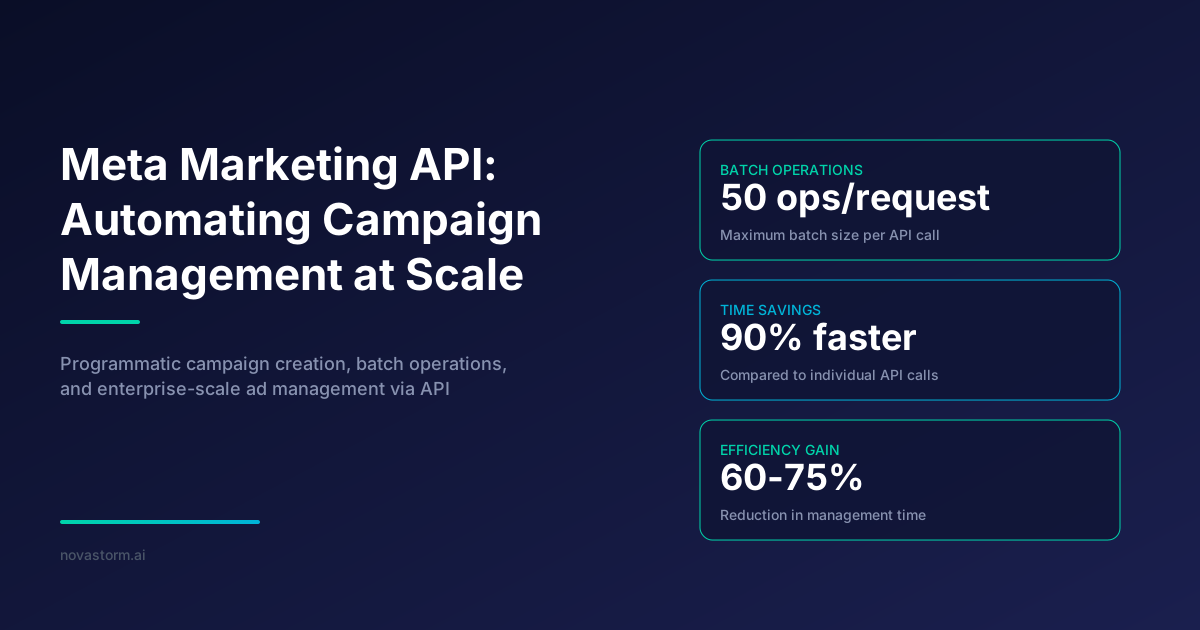
Meta Marketing API: Automating Campaign Management at Scale
Build reviewable Meta API operations with a versioned paused campaign example, saved-state checks, dependency handling and careful retry policies.