

Ad Tech Stack for Meta Advertisers: Essential Third-Party Tools
Discover the essential ad tech stack for Meta advertisers. Learn which third-party tools drive better ROAS, streamline workflows, and scale Facebook ad campaigns.
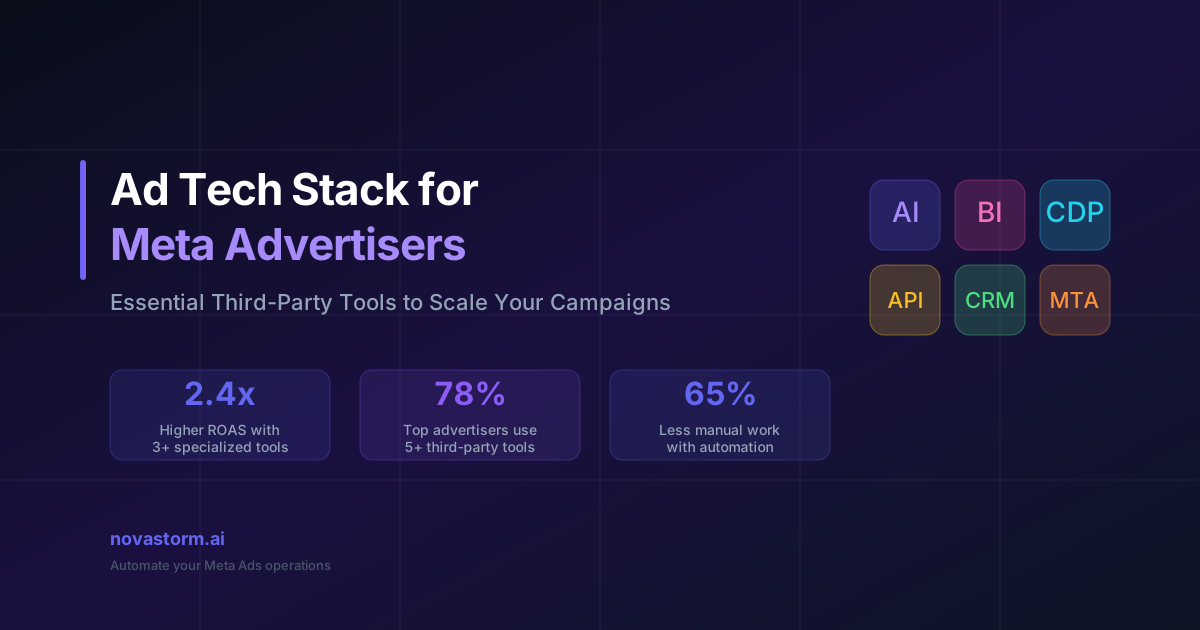
Choose the next advertising tool by the job it must perform and the evidence required for acceptance. More subscriptions do not establish better ROAS. A useful stack makes data ownership, permissions, duplicated event senders and operating cost visible before it expands.
Separate the jobs
| Job | Required input/output | What it cannot establish alone |
|---|---|---|
| Campaign preparation | Approved offer, assets and reviewed draft | Actual ad lift or qualified revenue |
| Audience transfer | Eligible identities, additions and removals | Event correctness or permission merely from hashing |
| Event delivery | Accepted business occurrence, event ID, time and receiving result | Causal attribution or guaranteed matching |
| Attribution/reporting | Defined source, windows, maturity and reconciled outcomes | Incremental effect without an appropriate design |
| Catalog transformation | Stable product identifiers, price and availability | Automatic bid decisions or user intent |
Avoid buying a category solely because media spend crosses a copied threshold. Inventory the current bottleneck: missing approval evidence, duplicated purchases, delayed exports or inconsistent outcome definitions. A source-of-truth worksheet often needs fixing before another dashboard.
Acceptance requirements for one tool
Hypothetical requirement specification for a reporting adapter named PilotReport v1, not an installed or recommended vendor. It reads an authorized account export and joins it to an internal accepted-order summary. It has no audience-upload or event-sending role.
| Requirement | Filled acceptance test |
|---|---|
| Permissions | Read-only approved scope; no campaign mutation authority; revocation verified |
| Fields | Account ID, campaign ID, reporting date, time zone, currency, spend and source version |
| Outcomes | Accepted paid orders and refunds remain separate from clicks and inquiries |
| Attribution | Record platform window versus internal cohort rule; do not merge incompatible totals |
| Freshness | Chosen daily schedule with last-success timestamp and failed-run visibility |
| Implementation | Import a synthetic fixture; detect duplicate rows, missing currency and failed joins |
| Export and exit | Readable export retained; revoke access and remove retained data under agreed policy |
Proposed tests are not completed product acceptance. Use stable IDs rather than names, compare a known fixture with the source and show incomplete rows rather than silently converting them to zero. Current vendor capability and pricing require a dated quote and actual connection test.
Stop wasting ad budget
NovaStorm AI cuts Meta Ads CPA by 30% on average. No complex setup required.
Calculate total ownership cost
Hypothetical first-year costs: subscription USD 200/month, setup fee USD 600, internal implementation eight hours at USD 60/hour and monthly maintenance two hours at USD 60/hour. Total is 12 × 200 + 600 + 8 × 60 + 12 × 2 × 60 = USD 4,920. Add actual taxes, overages and exit work if relevant. These are chosen inputs, not vendor prices or a savings estimate.
To evaluate time savings, record comparable tasks, quality defects and hours before and after a bounded pilot. Describe the sample and other workflow changes. Observational users of several tools can differ in spend, skill and selection; tool count itself is not a causal explanation for ROAS.
Remove duplicated senders before adding another
Hypothetical purchase TEST-O1 is sent by a browser Pixel and server integration A; server integration B also sends the same payment with a new event ID. Disable the unintended sender in an approved test setup, document ownership and verify the browser/server pair represents one occurrence. Do not switch off production tracking without authorized change control.
The Meta server Event implementation documents event-name/event-ID matching in browser/server deduplication. A distinct event ID can defeat occurrence identity; different payments need different identities. Keep payment ledger identity separate from product content identifiers, and inspect actual receiving diagnostics. A successful request is not proof of incrementality.
One bounded NovaStorm operation is preparation of a paused campaign draft from approved assets and settings, followed by human read-back. Do not infer immediate alerts, user-created optimization rules or autonomous budget moves from that operation. The reporting contract makes the attribution boundary explicit before a tool is accepted.
Published by NovaStorm AI. Worked examples and test fixtures in this article are illustrative, not observed customer results.
Disclaimer: This article was generated with the assistance of AI and reviewed by the NovaStorm AI team. While we strive for accuracy, we recommend verifying specific data points and consulting official sources (linked where available) for critical business decisions.
Ready to automate your Meta Ads?
NovaStorm AI takes full responsibility for your campaigns — from monitoring to optimization.
Start NowMore on Meta platform and automation
Meta Verified for Business: Impact on Advertising and Trust
Evaluate Meta Verified for Business using a current account quote, yearly cost and real profile-protection needs instead of assumed ad uplifts.
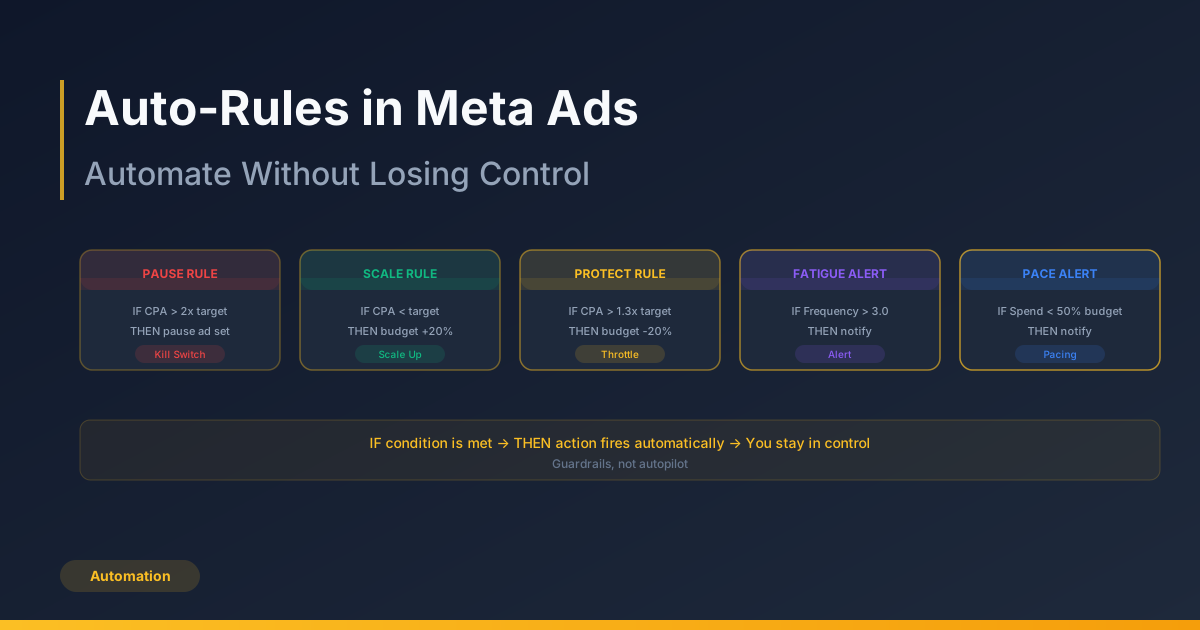
Auto-Rules in Meta Ads: Automate Without Losing Control
Design automated-rule guardrails around cash, mature outcomes and cooldowns, with a false-trigger journal before enabling actions.
The End of Detailed Targeting Exclusions: What It Means for Advertisers
Replace detailed targeting exclusions with permission-aware audience controls, honest qualification messages and economic approval limits.
Meta Ads Manager Updates 2026: New Features Every Advertiser Should Know
Review a verified Meta ad transparency update, inspect creative settings, and approve a controlled change without invented feature or performance claims.