

Retargeting Exclusions: When to Stop Showing Ads to Converted Users
Plan retargeting exclusions by customer lifecycle, handle refunds and permission withdrawals, and verify matching and refresh limits.
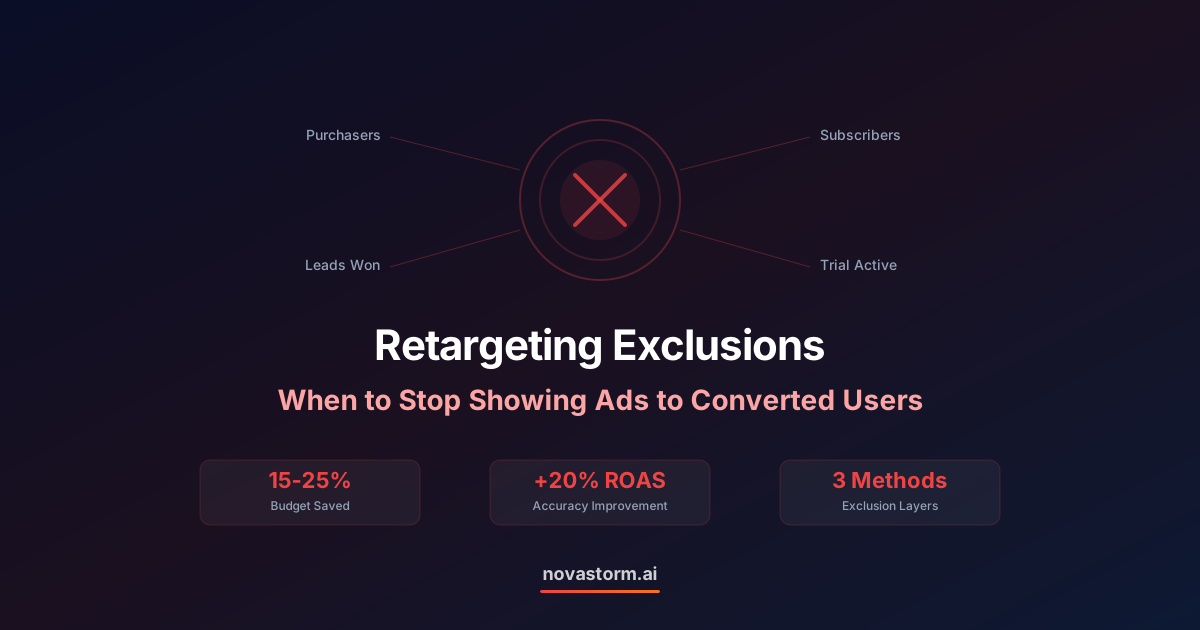
An exclusion should stop the wrong offer reaching an ineligible customer while preserving legitimate retention opportunities. Define the campaign’s purpose, business state and supported audience source first. Matching gaps and refresh delays mean an exclusion is not complete protection or evidence of a fixed saving.
Use a lifecycle matrix
| Campaign purpose | Include if permitted | Proposed exclusion | Acceptance check |
|---|---|---|---|
| New customer acquisition | Eligible prospects | Confirmed current customers | Source accepted;configuration read back |
| Repeat purchase | Customers eligible for a genuinely useful next purchase | Recent buyers of the same item where unsuitable | Repurchase timing based on own records |
| Trial signup | Eligible prospects | Active trials and paid subscribers | Trial status and refresh latency verified |
| Trial activation / upgrade | Eligible current trial users | Paid or expired users unless a separate offer is appropriate | Product states match message |
| Event registration | Eligible unregistered people | Confirmed registrants | Reminder campaign has separate purpose |
These are business rules, not guaranteed interface settings. Meta’s CustomAudience SDK defines audience sources, retention/rule and exclusion-related fields. It does not prove that an offline event, CRM list or every exclusion is available for your configuration. Confirm ownership, permitted use and accepted settings before launch.
Handle changes, not just first conversions
| Source-state change | Decision to record | Update and verification |
|---|---|---|
| Purchase confirmed | Suppress same acquisition offer if appropriate | Update permitted source;record export/job time and acceptance |
| Refund / return | Do not automatically restart acquisition | Review refund reason,service status and suitable offer |
| Deal closed-lost | Loss is not permission to advertise again | Check reason,contact restrictions and eligibility |
| Trial expires / client cancels | Decide whether a truthful return offer is appropriate | Review current state;refresh permitted audience |
| Permission withdrawn | Stop new advertising-data use and remove permitted list memberships via supported routes | Propagate withdrawal;verify processing and preserve minimal compliance record |
Removal from an audience is not an instruction to create a new “opted-out” marketing audience. Do not upload identifiers without an allowed basis merely to suppress ads. A previous platform event may remain within its own retention window; document that limitation rather than claiming a CRM update erases every prior signal.
Check refresh, matching and scope
Stop wasting ad budget
NovaStorm AI cuts Meta Ads CPA by 30% on average. No complex setup required.
- Record source version, business-state time, permitted identifier preparation, job time and success/errors. Keep raw personal data out of a public checklist.
- Read back the intended exclusion at each relevant campaign/ad-set level. Check expansion behavior and current eligibility rather than assuming a template covers every setup.
- Review match and population reporting where available. Unmatched identities, different devices and latency can leave exposure gaps.
- Reconcile consent withdrawals and refunds at your chosen operating cadence. Weekly refresh is a choice, not proof it is fast enough for every trial or order.
Measure a change without inventing savings
Illustrative ledger: twelve weeks of a $5,000 monthly planning average represent roughly $15,000 over three assumed four-week months. A proposed $5,000 saving would be about 33.3% of that spend. Without actual scoped spend and comparable outcomes, neither that amount nor any percentage is established as an exclusion result.
Instead report the actual change in the wrong-offer exposure you can measure, unique paid outcomes, contribution and total spend. A lower displayed CPA can come from customer mix or attribution; exclusions alone do not make ROAS causal or guarantee near-zero waste. Use the incrementality workflow when the question is additional sales.
A reviewable operational handoff
Prepare a paused NovaStorm campaign draft with its purpose, intended exclusions and the source owner in your brief. Verify the actual supported configuration before publishing. CRM synchronization, withdrawal propagation and lifecycle routing remain separate integrations that need their own acceptance evidence.
Published by NovaStorm AI. Worked examples and proposed tests are labeled in the article.
Disclaimer: This article was generated with the assistance of AI and reviewed by the NovaStorm AI team. While we strive for accuracy, we recommend verifying specific data points and consulting official sources (linked where available) for critical business decisions.
Ready to automate your Meta Ads?
NovaStorm AI takes full responsibility for your campaigns — from monitoring to optimization.
Start NowMore on Custom audiences and retargeting

Dynamic Retargeting for Non-E-commerce Businesses on Meta
Map non-commerce offers safely, verify catalog eligibility and event semantics, and measure qualified clients without inventing value optimization.

Cross-Platform Retargeting Pools: Combining Meta and Google Data
Coordinate permitted first-party Meta and Google audiences, verify Customer Match eligibility, and reconcile attribution without inventing cross-platform identity.

Sequential Retargeting on Meta Ads: Storytelling Across Touchpoints
Create five independent story chapters, verify supported audience transitions, and test the narrative without assuming order or personal exposure data.
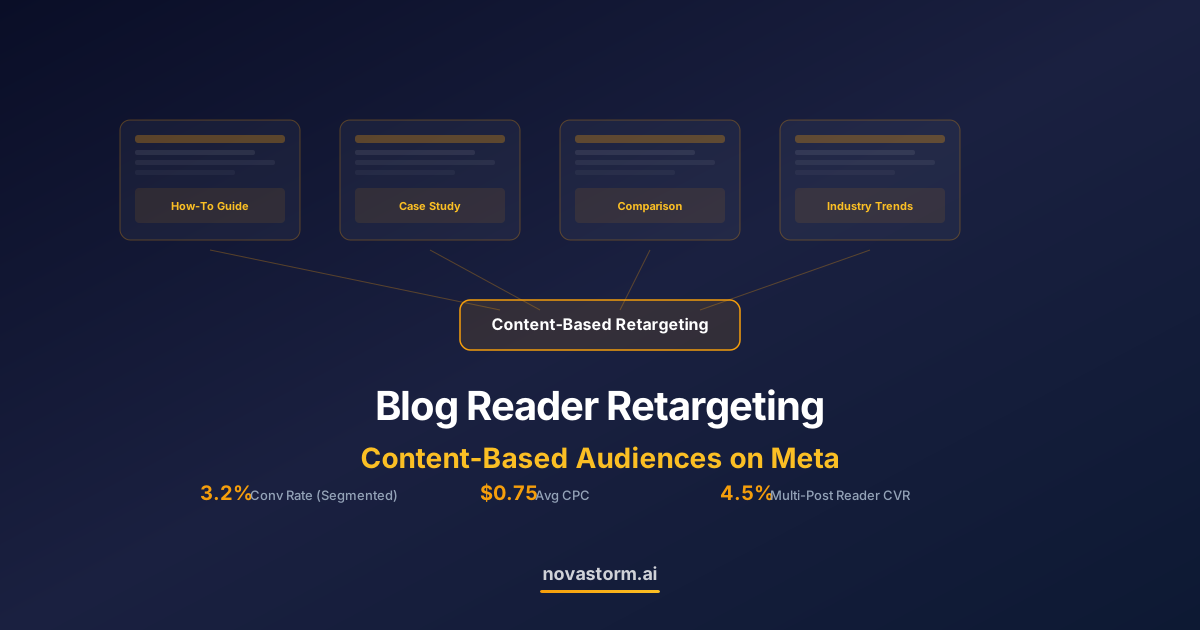
Blog Reader Retargeting on Meta Ads: Content-Based Audiences
Instrument consented active reading heuristics, verify supported content audiences, and test a relevant offer under a small cash cap.