

Traffic Campaigns on Meta: When to Optimize for Link Clicks
Set up a Traffic visit diagnostic with a tagged final URL, consent-aware click reconciliation and scoped local attribution evidence.
Use Traffic after deciding that visits are the intended outcome. A recorded load does not establish reading, subscriber quality or a paid order. For choosing the business objective, use the objective comparison; Traffic is not an obligatory warm-up stage for Sales.
Make the final URL and redirects reviewable
Illustrative redirect contract, not a tested production route: an ad requests https://example.com/go/guide?utm_source=meta&utm_medium=paid_social&utm_campaign=visit_test&utm_content=condition_A. A redirect on that controlled domain returns Location https://example.com/guide/?utm_source=meta&utm_medium=paid_social&utm_campaign=visit_test&utm_content=condition_A. The final page receives the same tags. Replace example.com with your owned destination and verify every actual intermediate response; a redirect that drops the query breaks this contract.
- Open the published ad’s actual URL on a phone or an equivalent browser test. Inspect redirects, final address and mobile page loading; a pasted destination in an editor is not enough.
- Record destination, creative identifier and consistent UTM values. Do not include email addresses or other customer details in tags.
- Confirm the available conversion location and performance goal in your account. Meta’s official campaign SDK includes OUTCOME_TRAFFIC, but the identifier does not prove a particular goal or control is available.
- Match the headline and destination. If the headline promises a condition guide, the final page should deliver that guide instead of an unrelated signup wall.
Reconcile clicks and recorded arrivals within one scope
Hypothetical reporting fixture: for the same campaign, reporting time zone and seven-day period, spend is USD 120, outbound clicks are 600 and recorded landing page views are 420. CPC = 120 / 600 = USD 0.20. Cost per recorded view = 120 / 420 ≈ USD 0.286. The ratio = 420 / 600 = 70%. These are invented counts and calculations, not an observed campaign or a required minimum arrival rate.
Before interpreting the gap, confirm both reports use compatible campaign filters, metric definitions, time boundaries and reporting delay. Click counts, landing page views and analytics sessions have different scopes. A lower measured ratio can reflect lost collection as well as failed loading; do not assign every missing view to a slow page.
| Diagnostic branch | Evidence to collect | Decision |
|---|---|---|
| Consent not granted or later withdrawn | Permitted business behavior, consent state and event collection policy | Respect refusal; describe missing coverage instead of forcing a tracking event |
| Page interrupted before loading | Actual redirect chain, errors, resource timings and device behavior | Fix the destination and retest; do not label missing observations as purchased readers |
| Event absent despite permitted completed load | Source ID, tag placement and event receipt | Fix instrumentation before comparing arrival costs |
| New tagged visit after an earlier visit | New source parameters and whole last-touch record | A genuine new touch may replace last touch; internal navigation should not |
| Loads with little useful action | A defined permitted engagement or signup outcome | Traffic delivery does not prove comprehension; revisit the business goal |
An original local attribution check with clear limits
Stop wasting ad budget
NovaStorm AI cuts Meta Ads CPA by 30% on average. No complex setup required.
On October 2, 2026, the existing NovaStorm registration-attribution unit suite passed all 10 tests using Vitest 4.1.9. Its command from the web-core project is npm run test -- src/lib/__tests__/registration-attribution.test.ts. This is a local mocked-browser storage test, not a live advertising experiment, a production registration acceptance test or a Meta CAPI acceptance result.
The suite covers a tagged /signup visit followed by /signin without a query and a module reload: the campaign keyword remains available. It also checks that a new tagged click preserves first touch and replaces last touch as a whole, rather than combining unrelated campaigns. Refusal and Global Privacy Control clear or prevent stored attribution; invalid or expired snapshots are not revived. These findings support source-handling behavior in the tested code, not advertising effectiveness.
Continue the check through a real registration acceptance gate
- In a controlled non-production environment, use synthetic campaign tags and an account approved for testing. Follow a tagged landing, a query-free return and registration while recording the permitted source snapshot.
- Inspect the registration request and the accepted server record or response through an authorized test route. Confirm source, medium, campaign and first/last-touch meaning at the actual receiving boundary; client storage alone is not server acceptance.
- Repeat with a different tagged visit: first touch stays first and last touch changes as a complete record. Repeat refusal/withdrawal and verify restricted source data is absent, without breaking signup.
- Record test environment, build and actual acceptance evidence. This protocol has not been executed here; do not promote the unit-suite result into a claim about deployed registration.
Decide when visits are no longer the right outcome
Choose an affordable total diagnostic allowance, a review owner and a stop condition for broken URLs or events. When the real goal becomes completed subscriptions, inspect a Leads or Sales path appropriate to the subscription and available event, instead of optimizing forever for cheap visits. A defined reading event can help describe engagement but does not certify that somebody understood the content.
Use the mobile destination guide before scaling. Prepare a tagged destination and capped campaign draft in NovaStorm, then approve the URL and measurement contract. Local source retention is evidence of a tested engineering behavior; campaign outcomes and production registration still require their own verification.
Published by NovaStorm AI. Worked examples and test fixtures in this article are illustrative, not observed customer results.
Disclaimer: This article was generated with the assistance of AI and reviewed by the NovaStorm AI team. While we strive for accuracy, we recommend verifying specific data points and consulting official sources (linked where available) for critical business decisions.
Ready to automate your Meta Ads?
NovaStorm AI takes full responsibility for your campaigns — from monitoring to optimization.
Start NowMore on Campaign structure and objectives
Growth Loops vs Funnels: Modern Customer Acquisition on Meta
Measure a referral, content or data feedback loop by its real outputs, costs and delay, without assuming every customer makes the next acquisition cheaper.
Conversion Campaigns vs Traffic Campaigns: Which to Choose on Meta
Choose Sales, Leads or Traffic with valid event gates, retained-order economics and a concrete paused-draft approval checklist.
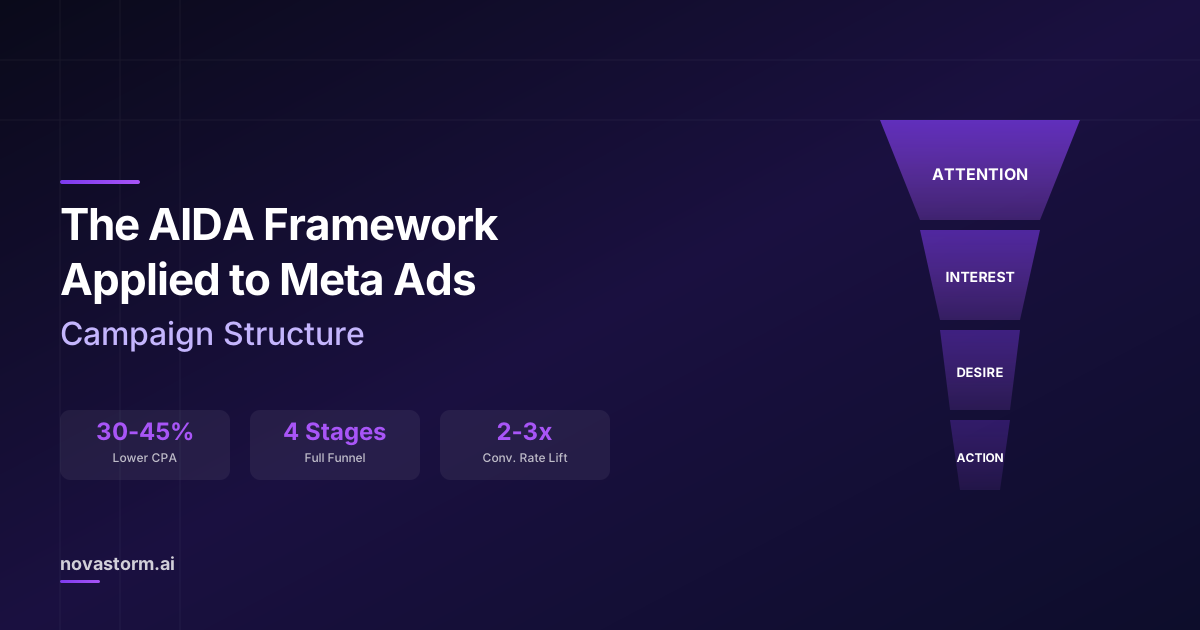
The AIDA Framework Applied to Meta Ads Campaign Structure
Use Attention, Interest, Desire and Action as message-planning questions, without mandatory campaign objectives, funnel ratios or promised CPA improvement.
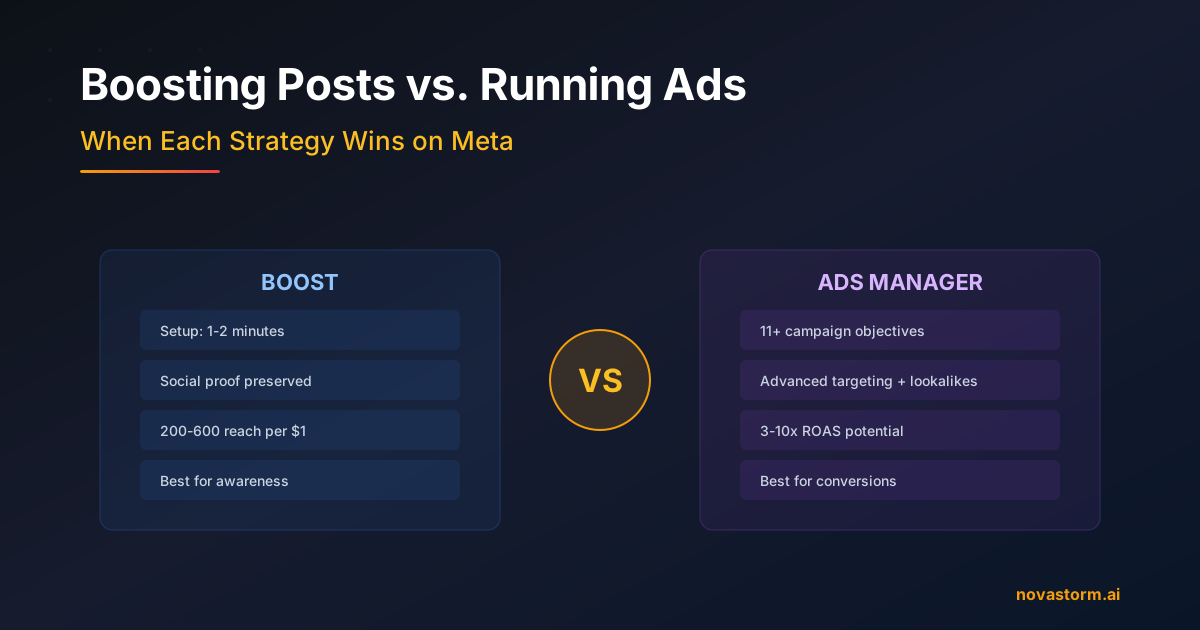
Boosting Organic Posts vs Running Ads: When Each Strategy Wins
Choose a promotion workflow by saved goals, eligible posts and actual controls. Compare equivalent mature commercial outcomes and approve a bounded draft.