

Boosting Organic Posts vs Running Ads: When Each Strategy Wins
Choose a promotion workflow by saved goals, eligible posts and actual controls. Compare equivalent mature commercial outcomes and approve a bounded draft.
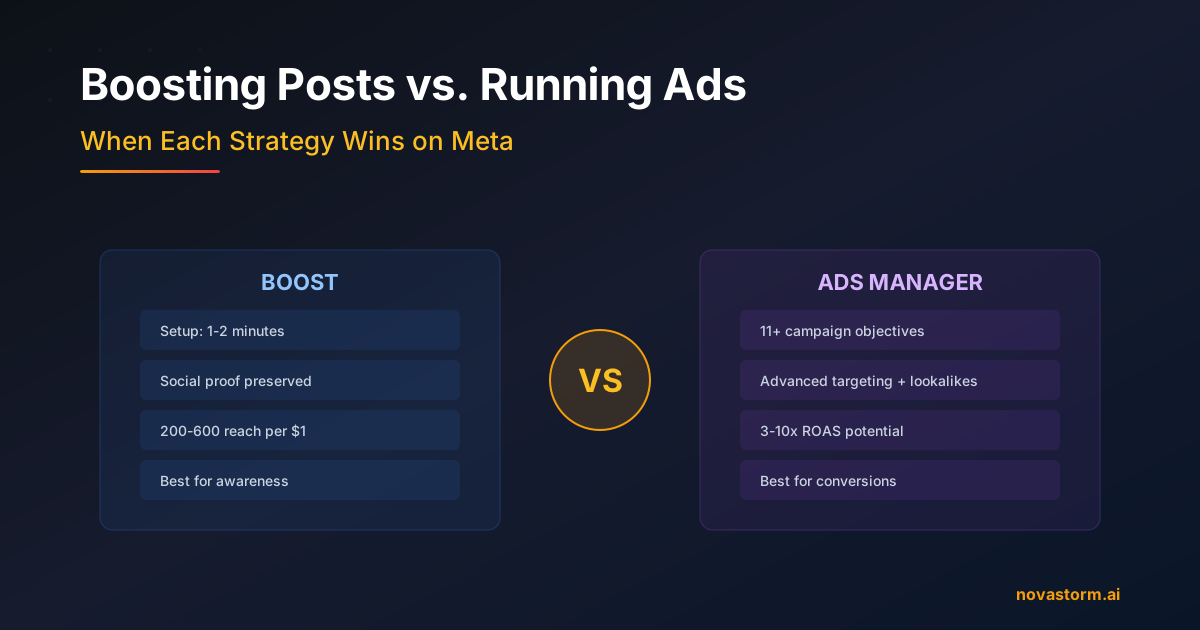
Choose Boost or Ads Manager according to the saved outcome, limits and eligible content in your account. A simplified interface can be sufficient for an appropriate task; a fuller interface is useful when the required action, reporting or business boundaries cannot be configured. Organic popularity is a paid-performance hypothesis, not proof.
An account-specific acceptance worksheet
Perform the following inspection in the same advertiser account before activation. It is an unexecuted protocol, not a claim that a particular Boost screen exposes every field. Where a field is unavailable, write “not supported in this setup” and choose a workflow that can meet the requirement.
| Field to capture from the saved setup | Boost path | Ads Manager path | Acceptance criterion |
|---|---|---|---|
| Eligible post identity and media rights | Record selected existing post and permission | Record existing-post selection if supported | Correct Page/post/identity and licensed asset |
| Action, location and performance goal | Record actual available/saved values | Record actual available/saved values | Same required commercial outcome, not merely similar button text |
| Audience and placement boundaries | Record restrictions and preview | Record restrictions and preview | Service area, legal eligibility and usable crop retained |
| Money and dates | Record currency, budget type, start/end and control | Record currency, budget type, start/end and control | Approved allowance and timezone; no silent expansion |
| Outcome collection | Record available report and independent paid-outcome source | Record available report and independent paid-outcome source | Same definition, attribution and maturity |
| After saving | Reopen setup and refresh preview | Reopen setup and refresh preview | Saved values match approval; no activation during inspection |
Meta’s campaign SDK lists Sales, Leads and Traffic outcome identifiers; the creative SDK exposes object_story_id and related existing-story fields. These references support the existence of these configuration concepts, not the eligibility of every post or access to all goals in Boost. A supported existing-post use in Ads Manager may retain eligible interactions; verify the preview and identity instead of assuming it starts with zero social proof.
A comparable business-outcome example
Hypothetical shop comparison: both paths advertise the same eligible post, price, product page and permitted geography to a randomized eligible population where the actual test method supports it. The primary outcome is a unique paid acquisition within seven days, then a common refund window. If the saved goals cannot optimize/collect the same action, the paths solve different tasks; do not declare a cheaper interaction the better purchase campaign.
| Hypothetical matured outcome | Path A | Path B |
|---|---|---|
| Media | USD 100 | USD 100 |
| Interactions | 200 | 80 |
| Unique paid acquisitions | 2 | 4 |
| Retained acquisitions after refunds | 1 | 3 |
| Cost per interaction | USD 0.50 | USD 1.25 |
| Media cost per retained acquisition | USD 100 | USD 33.33 |
Stop wasting ad budget
NovaStorm AI cuts Meta Ads CPA by 30% on average. No complex setup required.
These invented counts make Path A cheaper for interactions and Path B cheaper for retained customers. They do not establish Boost or Ads Manager as the winner. Independent campaigns can have different optimization and audience overlap even with equal money; without random allocation report a descriptive comparison and record simultaneous changes.
Set the shared allowance and wait for delayed outcomes
Hypothetical authorization: USD 200 across both paths, not USD 200 for each. Set the available actual cumulative control, assign an operator and leave room for reporting/enforcement delay. A daily budget is not a guaranteed total-expenditure cap. Pause on checkout defects, false claims or approaching the authorization; mature the already-exposed cohort after pausing. Record start/end, timezone, order dates, duplicates, unknown source and returns before evaluating the result.
A popular organic post is a useful candidate because its message has attracted some response. Its paid audience, context, objective and scale differ. Test the relevant paid outcome without inventing a guaranteed USD 20 test, conversion rate or ROAS benchmark. Check comments for misinformation or outdated offer details before reusing the post.
Prepare and approve before relying on automation
- Prepare the selected post or authorized creative, exact destination, goal, restrictions and monetary allowance in a campaign brief.
- Verify the actual account and Page permissions of the operator or connected application, its required scope and the exact supported existing-post/create/edit action. A permission grant is not proof a feature is implemented.
- Review the saved draft and preview with the approver. NovaStorm’s draft preparation does not establish that it exposes the same Boost options or preserves every post interaction.
- Activate only through a verified workflow after approval and check actual saved configuration and later delivery. Keep a rollback owner and avoid running an unintended duplicate alongside the original.
The outcome selection guide helps define the task before choosing the interface. Use the interaction-to-business assessment if the actual goal is engagement rather than purchase.
Published by NovaStorm AI. Worked examples and test fixtures in this article are illustrative, not observed customer results.
Disclaimer: This article was generated with the assistance of AI and reviewed by the NovaStorm AI team. While we strive for accuracy, we recommend verifying specific data points and consulting official sources (linked where available) for critical business decisions.
Ready to automate your Meta Ads?
NovaStorm AI takes full responsibility for your campaigns — from monitoring to optimization.
Start NowMore on Campaign structure and objectives
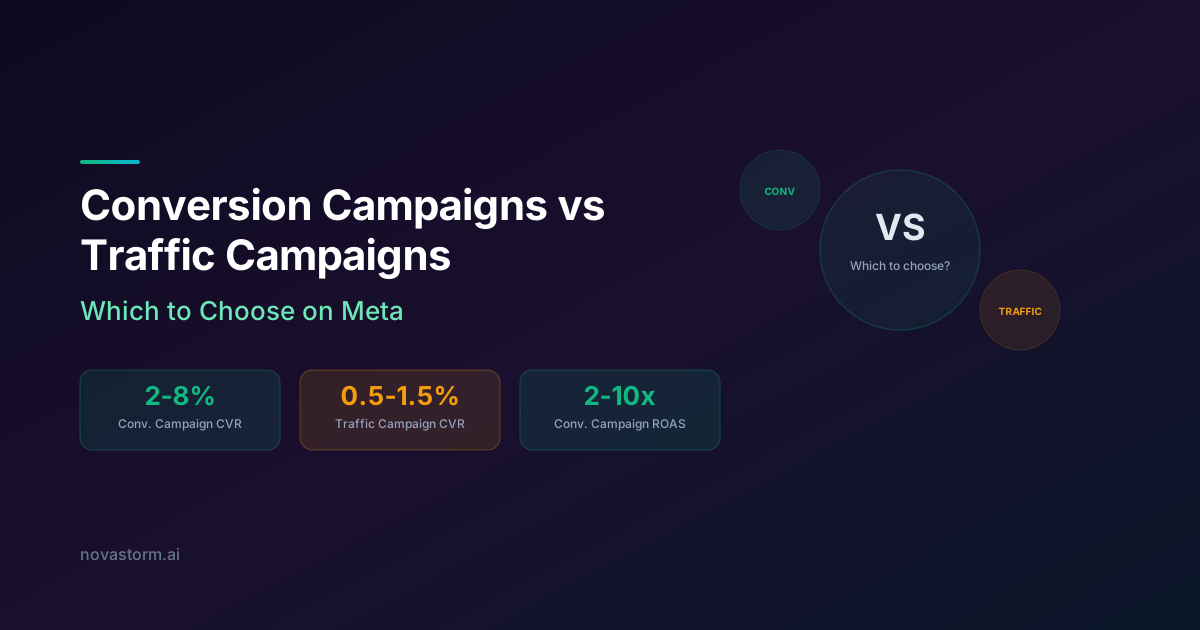
Conversion Campaigns vs Traffic Campaigns: Which to Choose on Meta
Choose Sales, Leads or Traffic with valid event gates, retained-order economics and a concrete paused-draft approval checklist.
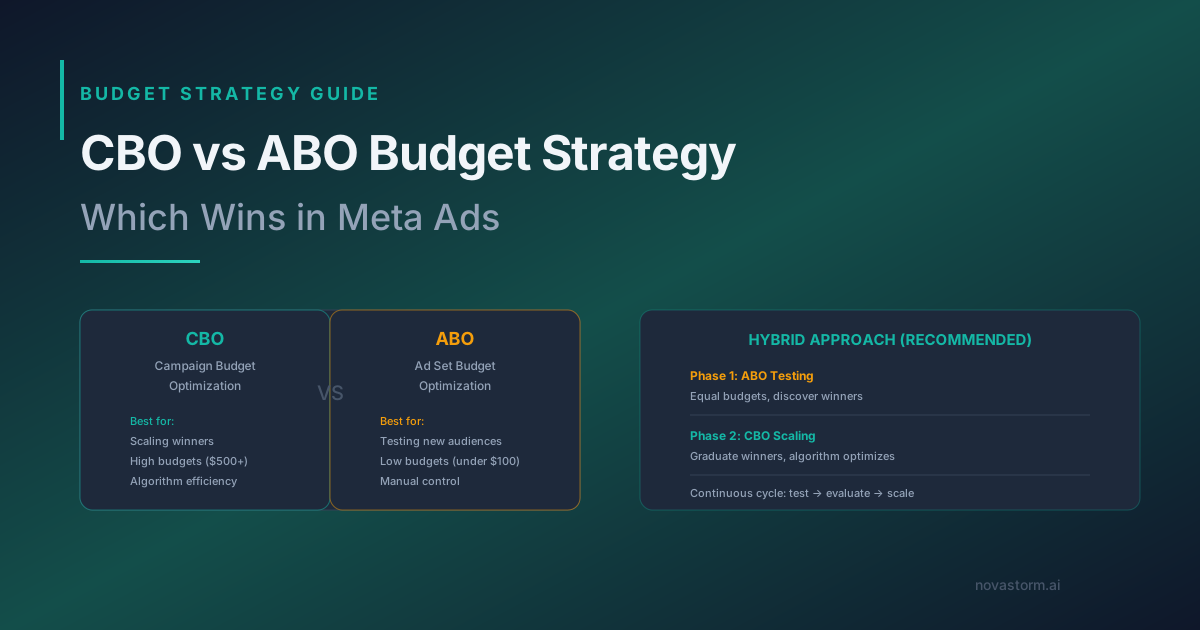
CBO vs ABO Budget Strategy: Which Wins in Meta Ads
Choose campaign- or ad-set budgeting using mature deal economics, saved spend constraints and a bounded comparison plan.
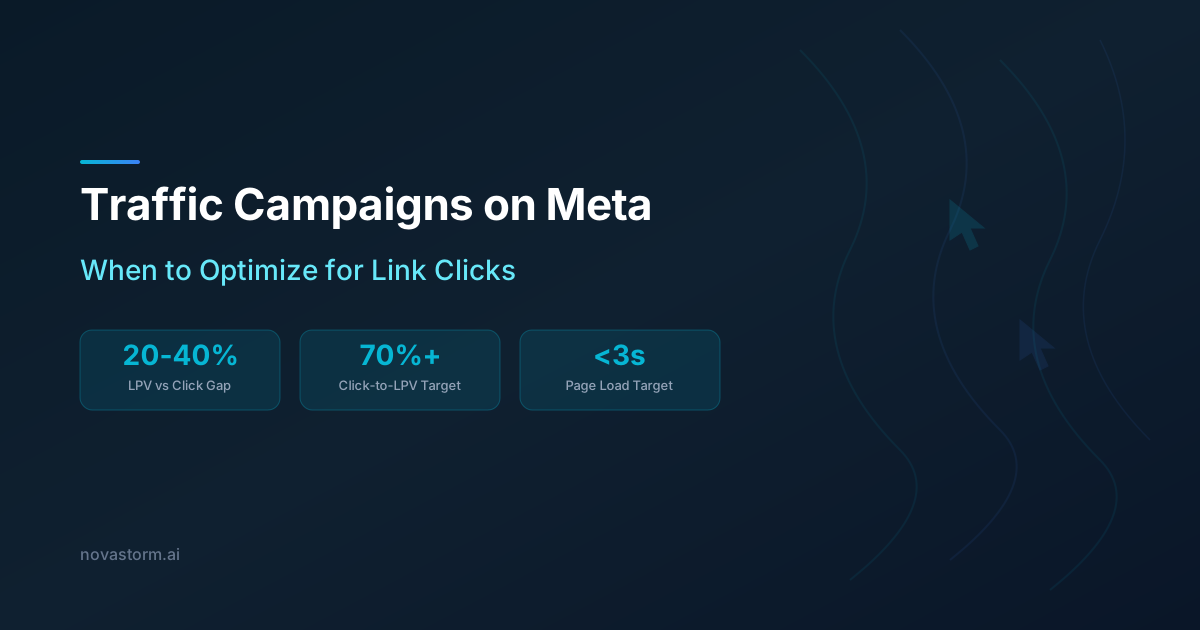
Traffic Campaigns on Meta: When to Optimize for Link Clicks
Set up a Traffic visit diagnostic with a tagged final URL, consent-aware click reconciliation and scoped local attribution evidence.
Growth Loops vs Funnels: Modern Customer Acquisition on Meta
Measure a referral, content or data feedback loop by its real outputs, costs and delay, without assuming every customer makes the next acquisition cheaper.