

Conversion Campaigns vs Traffic Campaigns: Which to Choose on Meta
Choose Sales, Leads or Traffic with valid event gates, retained-order economics and a concrete paused-draft approval checklist.
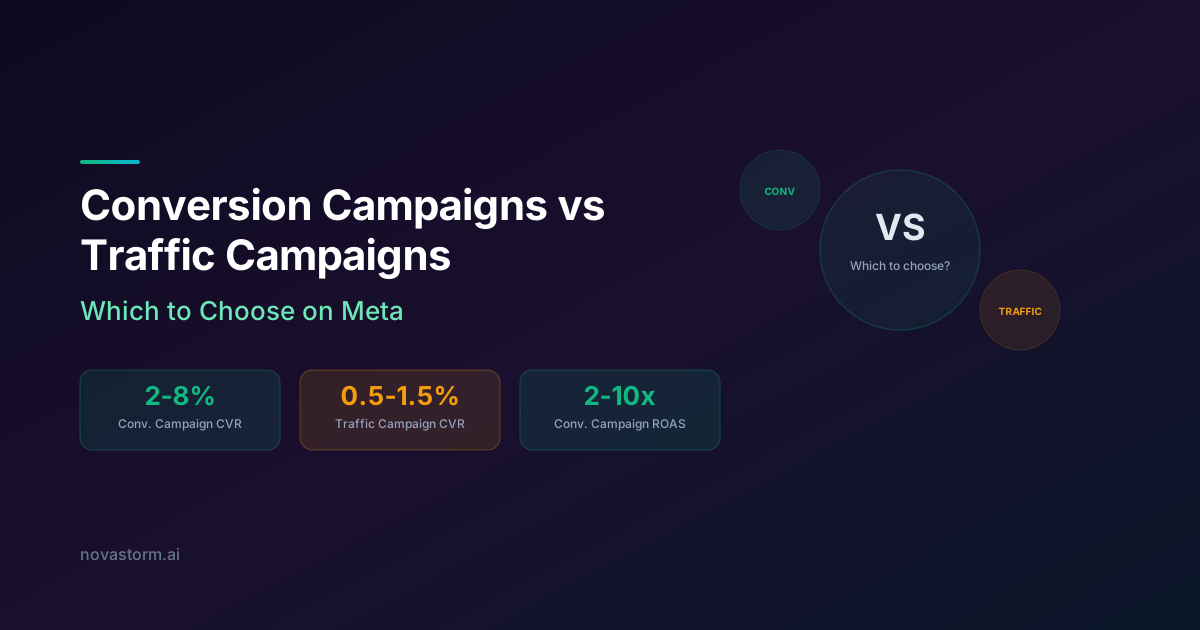
Select Sales, Leads or Traffic for the intended business result, then verify the actual conversion location, event and performance goal in your account. “Conversions campaign” is an informal phrase, not a guarantee of a current menu label. Cheap clicks and a large event count do not replace valid paid orders or qualified enquiries.
Check the outcome, location and event together
Meta’s official Business SDK includes OUTCOME_SALES, OUTCOME_LEADS and OUTCOME_TRAFFIC. Those identifiers establish API names, not every available destination or account-specific optimization control. Check the displayed setup and supported event before saving or publishing.
| Business question | Candidate, subject to account verification | Event acceptance and delay | Stop condition |
|---|---|---|---|
| Acquire website orders | Sales; website if available | Test a real paid order with correct value/currency; allow actual payment and attribution delay | Wrong destination, duplicate or unpaid Purchase, or exceeded spend allowance |
| Acquire qualified enquiries | Leads; website or supported form location | Completed submission, then distinct CRM qualification and follow-up delay | Capacity exceeded, wrong form or broken handoff |
| Distribute a useful guide | Traffic; supported click/view goal | Recorded arrival and separately defined permitted engagement | Broken loading or measured outcome no longer matches visits |
| Send visitors to an uninstrumented destination | Traffic if suitable | Report clicks/verified visits only; downstream visibility explicitly incomplete | No adequate downstream evidence for a proposed sales claim |
Before launch, submit a permitted test action and trace it from destination to the intended event source. A selected Purchase label does not demonstrate payment. For leads, record submission, contactability, qualification and eventual customer separately. Write an expected reporting/response delay based on your own workflow, a total affordable loss cap and the person who can stop spending.
Keep the click and acquisition arithmetic
Hypothetical equal-spend example, not observed results: Traffic spends USD 300 for 1,000 clicks and five paid orders; Sales spends USD 300 for 300 clicks and ten paid orders. Traffic CPC is USD 0.30 and initial order CPA USD 60. Sales CPC is USD 1 and initial order CPA USD 30. This explains why cheaper clicks can accompany more expensive orders; it does not establish that Sales always wins.
Extend that fictional comparison through returns: suppose two Traffic orders and six Sales orders are fully refunded. There are three and four retained orders, so retained-order CPA becomes USD 100 and USD 75. Assume each retained order contributes USD 40 before ads and each refunded order incurs USD 10 unrecovered costs. Traffic contribution after media = 3 × 40 − 2 × 10 − 300 = −USD 200. Sales = 4 × 40 − 6 × 10 − 300 = −USD 200. Initial CPA favored Sales, but both arms lose the same amount under these assumptions. The refund costs are separate from retained-order margin, not subtracted twice.
Compare the same paid/retained definition, observation horizon, currency and attribution model. A randomized exclusive experiment would be needed for a causal objective comparison; independent delivery may reach different people. Mature refunds, support expense and qualified-customer outcomes can change an early conclusion.
A useful role for Traffic without mandatory pixel warming
Stop wasting ad budget
NovaStorm AI cuts Meta Ads CPA by 30% on average. No complex setup required.
A capped visit test can diagnose redirects and load/event gaps or distribute an article whose intended result is arrival. It does not prove reading or commercial intent. A new sales account does not automatically require weeks of click campaigns: verify the business event and available setup. Selecting an earlier event deliberately changes the optimization question; test its relationship with eventual paid or qualified outcomes rather than assuming a universal event-count threshold.
The Traffic setup guide details destination checks. Use the CPA diagnosis when actual paid results diverge from reports.
From a brief to a paused draft: fields to approve
Proposed fictional brief: “Acquire completed consultation requests for our service, then qualify them in the CRM.” The NovaStorm campaign creation dialog defaults to PAUSED in the reviewed implementation. That is evidence about a default, not proof of a live campaign test or a rights/measurement approval system. Keep the following approval record outside the product where a field is not supported in that dialog.
| Review item | Example candidate | Who approves |
|---|---|---|
| Outcome and event | Leads; completed form, with available location confirmed | Media owner and measurement engineer |
| Destination and offer | Actual service/form URL, truthful consultation terms | Business owner |
| Creative and claim evidence | Approved service description and licensed imagery | Brand/rights reviewer |
| Name and budget | Distinct test name; business-chosen cap and pacing plan | Budget owner |
| Audience/placement and category | Current supported controls; required category reviewed | Media owner |
| Data and follow-up | Permitted event flow, CRM route, sales response capacity | Privacy and sales owners |
| Initial status | PAUSED; confirm before later publishing/activation | Launch owner |
Review the saved draft’s actual objective, budget mode, daily amount/currency and status. A paused campaign is not automatically a completed ad set, licensed creative or accepted event integration. Verify destination and event at the relevant boundary and explicitly approve publication. The process described here is a reproducible preparation workflow; it does not claim an observed MCP walkthrough or superior advertising results.
Review after launch using the intended result
For Sales, reconcile settled orders and contribution; for Leads, count qualified and eventually acquired customers; for Traffic, reconcile arrival and the defined engagement measure. Inspect measurement faults and follow-up delay before rewriting all targeting. Keep the cap in force while evidence matures and stop on known broken setup rather than waiting for an arbitrary learning status.
Published by NovaStorm AI. Worked examples and test fixtures in this article are illustrative, not observed customer results.
Disclaimer: This article was generated with the assistance of AI and reviewed by the NovaStorm AI team. While we strive for accuracy, we recommend verifying specific data points and consulting official sources (linked where available) for critical business decisions.
Ready to automate your Meta Ads?
NovaStorm AI takes full responsibility for your campaigns — from monitoring to optimization.
Start NowMore on Campaign structure and objectives
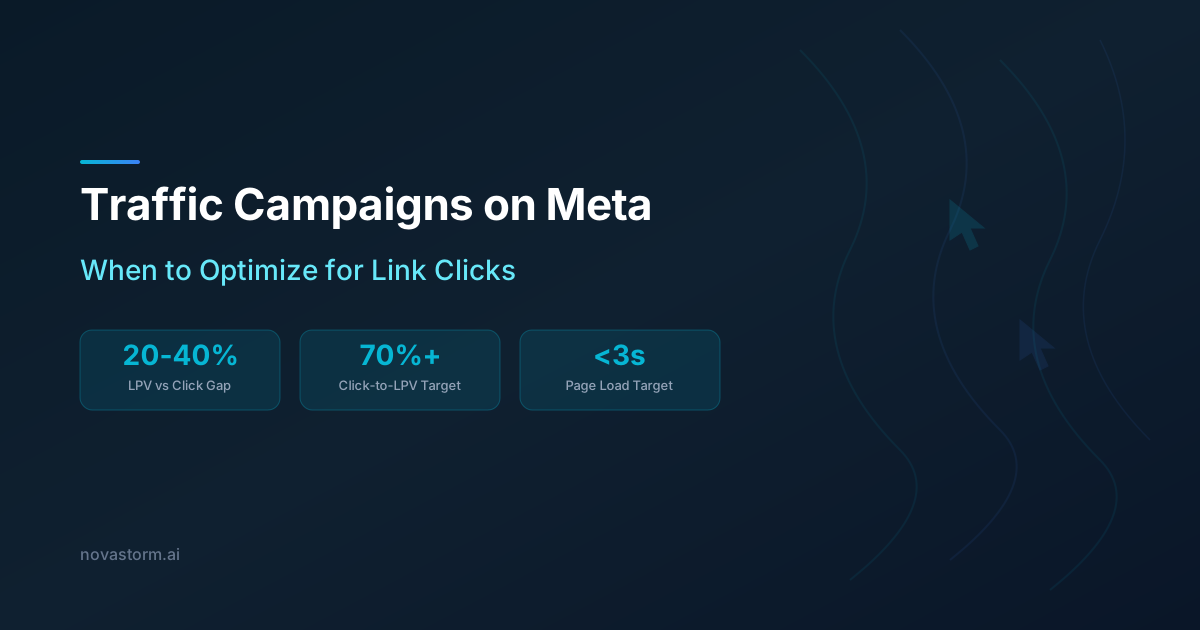
Traffic Campaigns on Meta: When to Optimize for Link Clicks
Set up a Traffic visit diagnostic with a tagged final URL, consent-aware click reconciliation and scoped local attribution evidence.
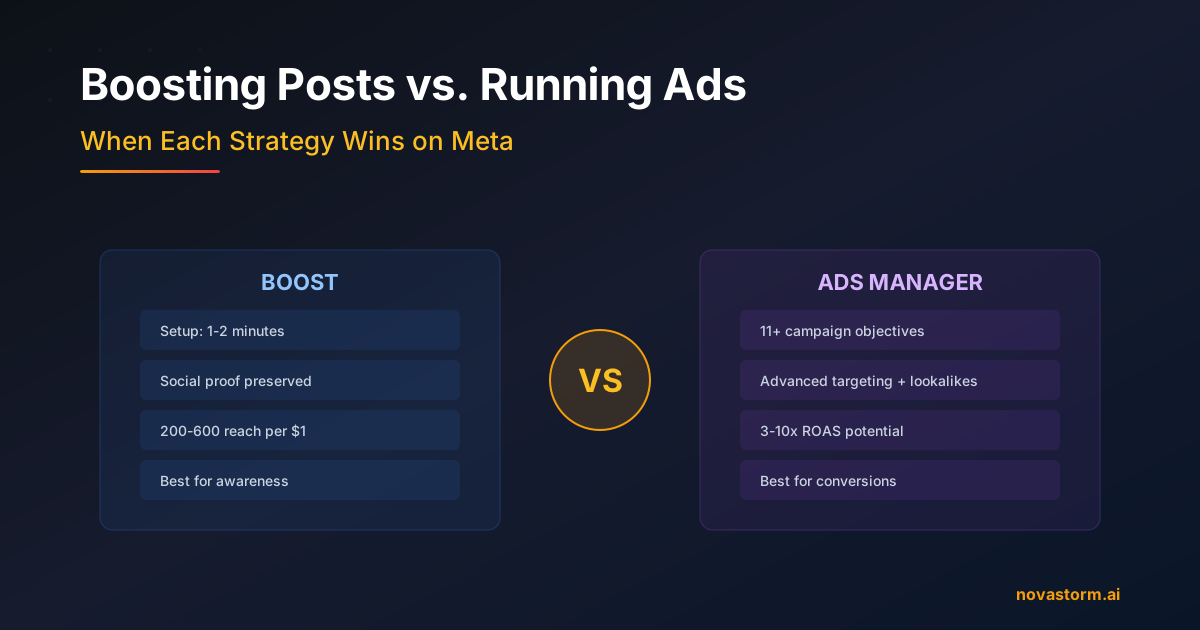
Boosting Organic Posts vs Running Ads: When Each Strategy Wins
Choose a promotion workflow by saved goals, eligible posts and actual controls. Compare equivalent mature commercial outcomes and approve a bounded draft.
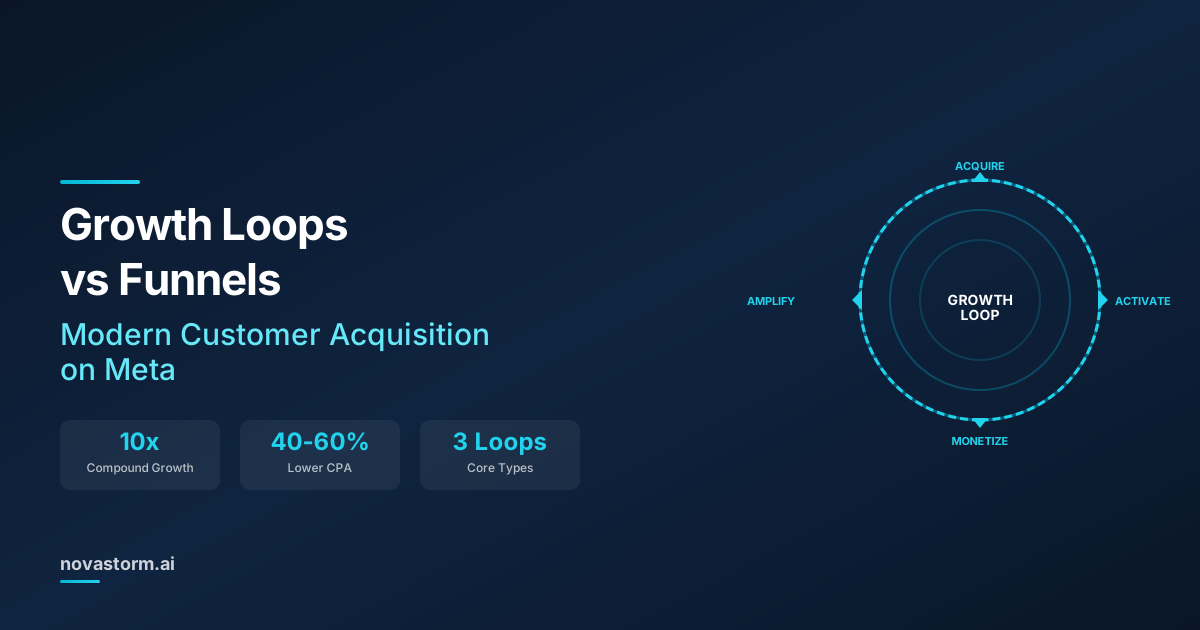
Growth Loops vs Funnels: Modern Customer Acquisition on Meta
Measure a referral, content or data feedback loop by its real outputs, costs and delay, without assuming every customer makes the next acquisition cheaper.
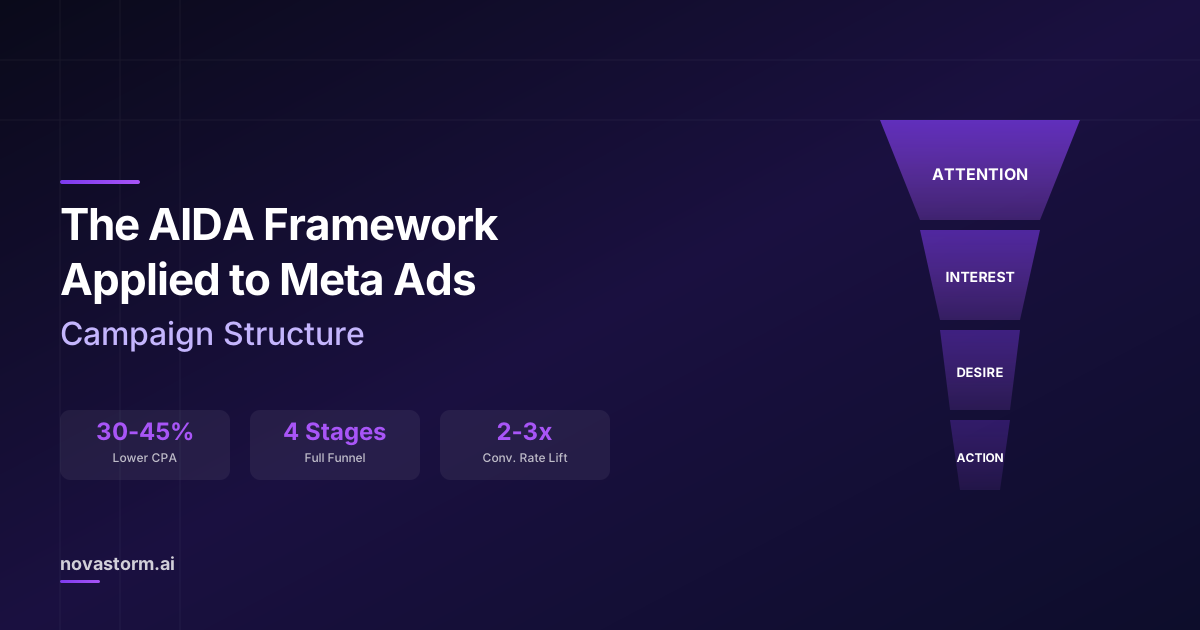
The AIDA Framework Applied to Meta Ads Campaign Structure
Use Attention, Interest, Desire and Action as message-planning questions, without mandatory campaign objectives, funnel ratios or promised CPA improvement.