

Multi-Touch Attribution: Understanding the Customer Journey in Meta Ads
Reconcile customer paths and orders across channels, compare attribution rules, and keep budget decisions separate from assigned credit.
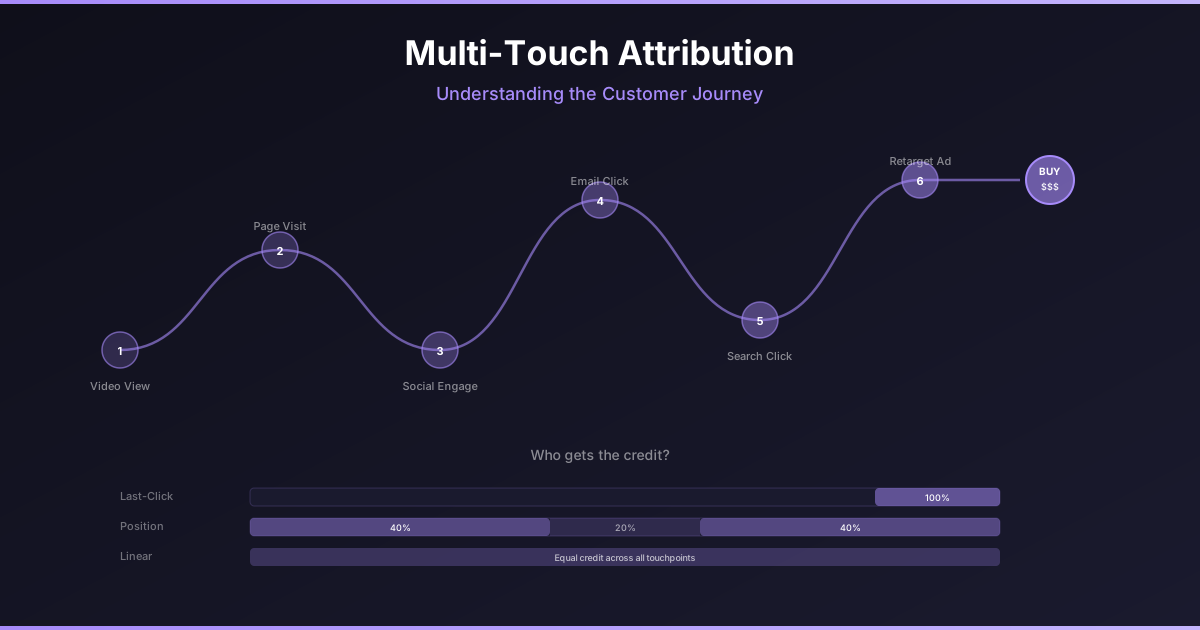
Multi-touch attribution assigns credit across recorded interactions. It does not automatically recover every interaction or establish the causal contribution of each channel. The useful starting point is one reconciled business outcome, a documented identity method and explicit attribution rules.
Credit rules are assumptions
| Illustrative rule | Allocation across four eligible touches | What it establishes |
|---|---|---|
| Linear | 25% to each touch. | Equal credit by definition, not equal measured influence. |
| Position-based | 40% first; 10% to each middle touch; 40% last. | A chosen 40/20/40 allocation, not measured contribution. |
| Time-decay | Weights increase toward the outcome under a declared decay rule. | A recency assumption, not proof of purchase psychology. |
| Last eligible click | 100% to the selected last click. | A reporting convention, not proof that earlier touches were ineffective. |
These conceptual rules need not be available as selectable models in your analytics tool. Google documents its available attribution models, including paid-and-organic last click and Google-paid-channels last click. Select the actual report settings deliberately rather than treating every GA4 report as inherently Google-biased.
Reconcile one customer and one order
Synthetic path for customer C-001 and paid order O-001, value $100: day 1 a Meta introduction is recorded; day 3 the customer visits through organic search; day 5 an email is clicked; day 8 a Meta product ad is clicked; day 12 a direct visit completes the order. This is an illustrative path, not an observed NovaStorm customer.
| Record | Join rule | Limit |
|---|---|---|
| Consented website visits | First-party customer/session linkage where available. | Anonymous or cross-device visits may remain unjoined. |
| Email click | Permitted campaign identifier linked to the customer record. | Forwarded messages or missing permission can break the join. |
| Paid order O-001 | One authoritative paid-order ID and status. | A refund changes the business value; platform credit is separate. |
| Platform reports | Reconcile claims to O-001 where identifiers permit. | Three reports claiming $100 still describe one $100 order, not $300 revenue. |
Stop wasting ad budget
NovaStorm AI cuts Meta Ads CPA by 30% on average. No complex setup required.
In this example, four non-direct recorded touches could receive $25 each under a declared linear rule, or $40/$10/$10/$40 under a position-based rule. State which touches qualify and how direct visits are handled. An external attribution service or warehouse still needs permitted identity joins and event coverage; buying a tool does not make the missing path observable or its model neutral.
A longer window does not prove upper-funnel lift
If a report shows 10 orders under a shorter click window and 15 under a longer one, the five additional credited orders are sensitive to that window. The ratio 1.5 describes reporting sensitivity. Conversion delay, collection gaps and other touches may explain the difference; it does not prove the introduction campaign caused purchases or deserves proportionally more budget. There is no required universal number of touches before a purchase.
Use uncertainty in the budget decision
- Reconcile unique paid outcomes, contribution, refunds and total spending within equally mature windows. Show unmatched records and disputed credit separately.
- Use path patterns to form a hypothesis, such as whether the introduction campaign adds profitable customers. Predefine a capped comparison with an eligible holdout where feasible, keeping the core offer and measurement window consistent.
- Judge incremental contribution against incremental spending and production costs. If identity gaps, contamination or a small sample prevent a reliable conclusion, keep the result inconclusive; do not replace uncertainty with a credit rule.
A NovaStorm brief can carry the agreed objective, attribution assumptions, budget cap and review date for user-approved campaign drafts. Cross-channel identity reconciliation and controlled incrementality measurement require their own implemented data and experiment processes.
Published by NovaStorm AI. Planning examples are illustrative assumptions, not measured customer results.
Disclaimer: This article was generated with the assistance of AI and reviewed by the NovaStorm AI team. While we strive for accuracy, we recommend verifying specific data points and consulting official sources (linked where available) for critical business decisions.
Ready to automate your Meta Ads?
NovaStorm AI takes full responsibility for your campaigns — from monitoring to optimization.
Start NowMore on Attribution and incrementality
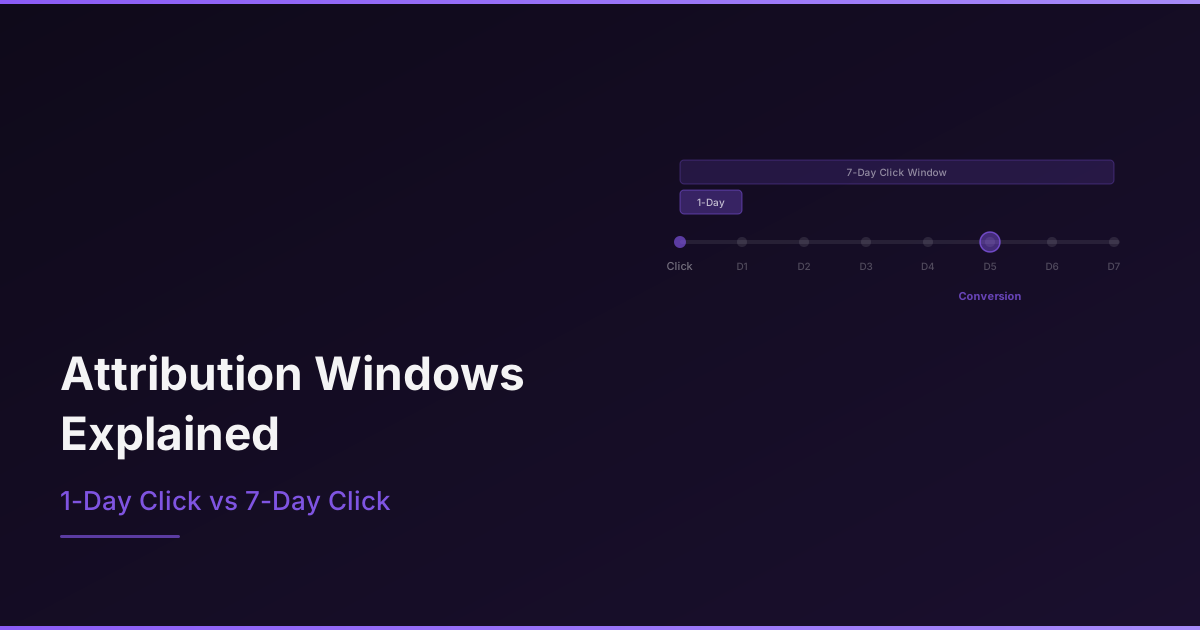
Attribution Windows Explained: 1-Day Click vs 7-Day Click
Compare attribution windows using the same spend and mature orders while separating reporting credit, delivery settings and incremental lift.
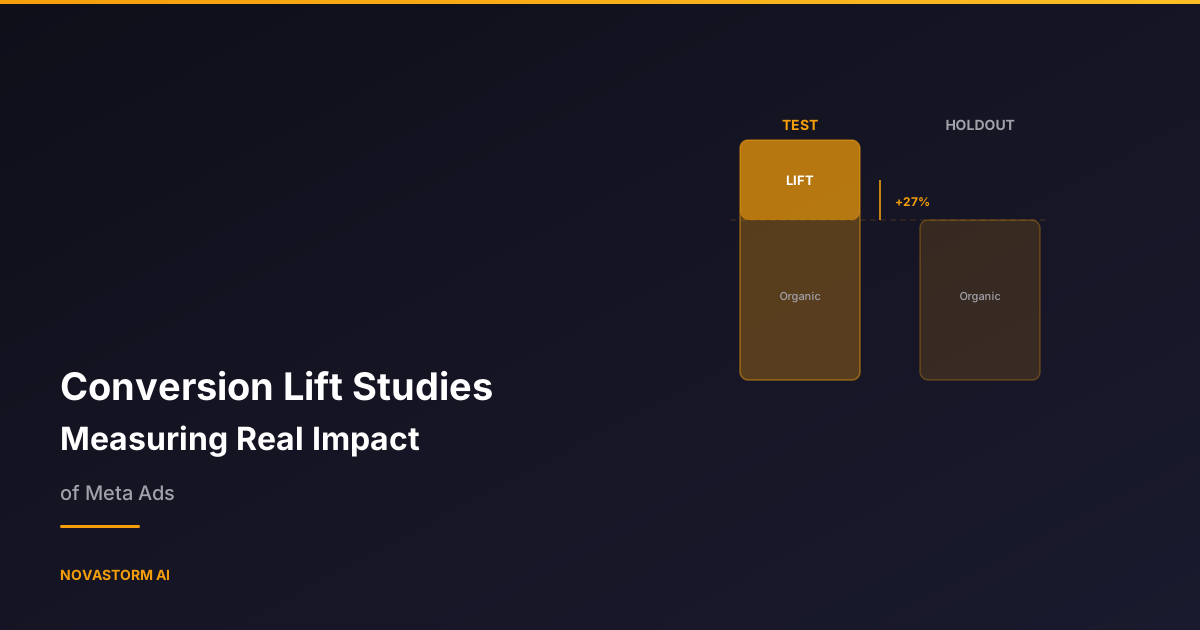
Conversion Lift Studies: Measuring Real Impact of Meta Ads
Normalize unequal holdout groups, calculate incremental conversions and revenue, and interpret uncertain lift before changing the budget.
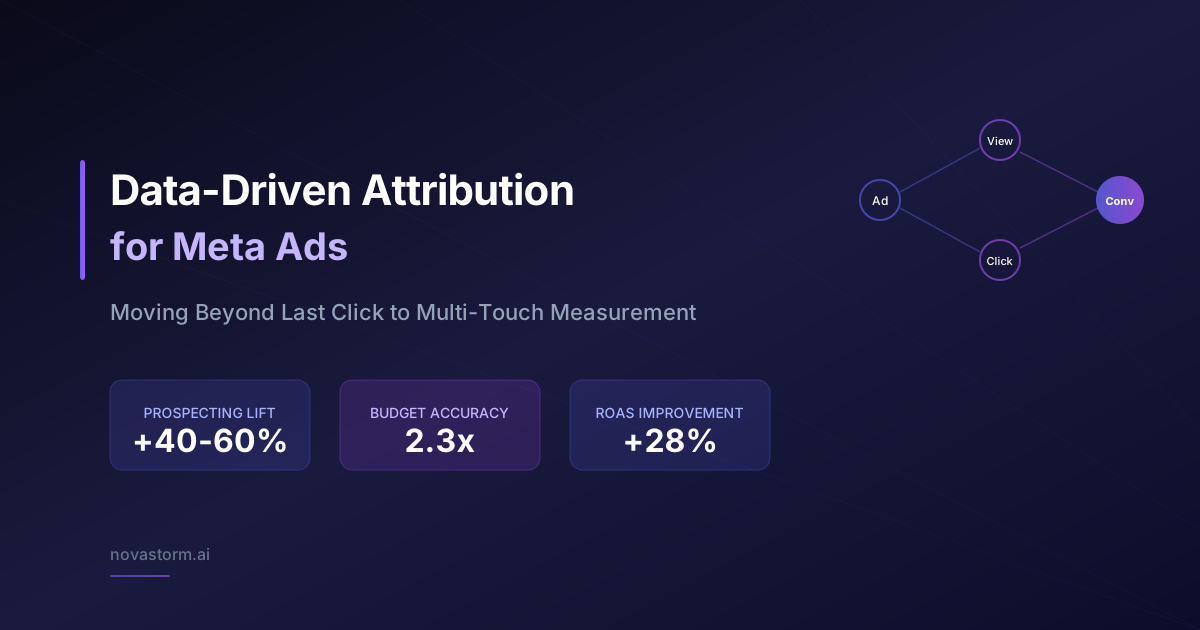
Data-Driven Attribution for Meta Ads: Moving Beyond Last Click
Compare attribution models with a reproducible credit worksheet, then use mature economics and incremental evidence for budget decisions.
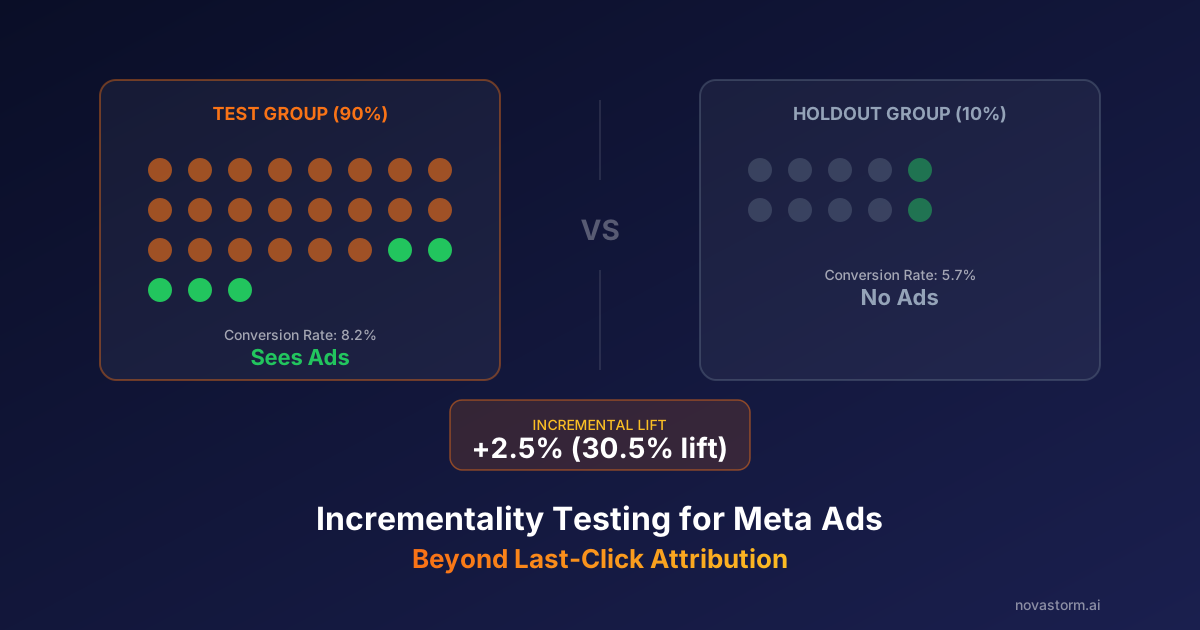
Incrementality Testing for Meta Ads: Beyond Last-Click Attribution
Design an incrementality test with a defined holdout, group-based sample assumptions, effect intervals and contribution economics.