

Incrementality Testing for Meta Ads: Beyond Last-Click Attribution
Design an incrementality test with a defined holdout, group-based sample assumptions, effect intervals and contribution economics.
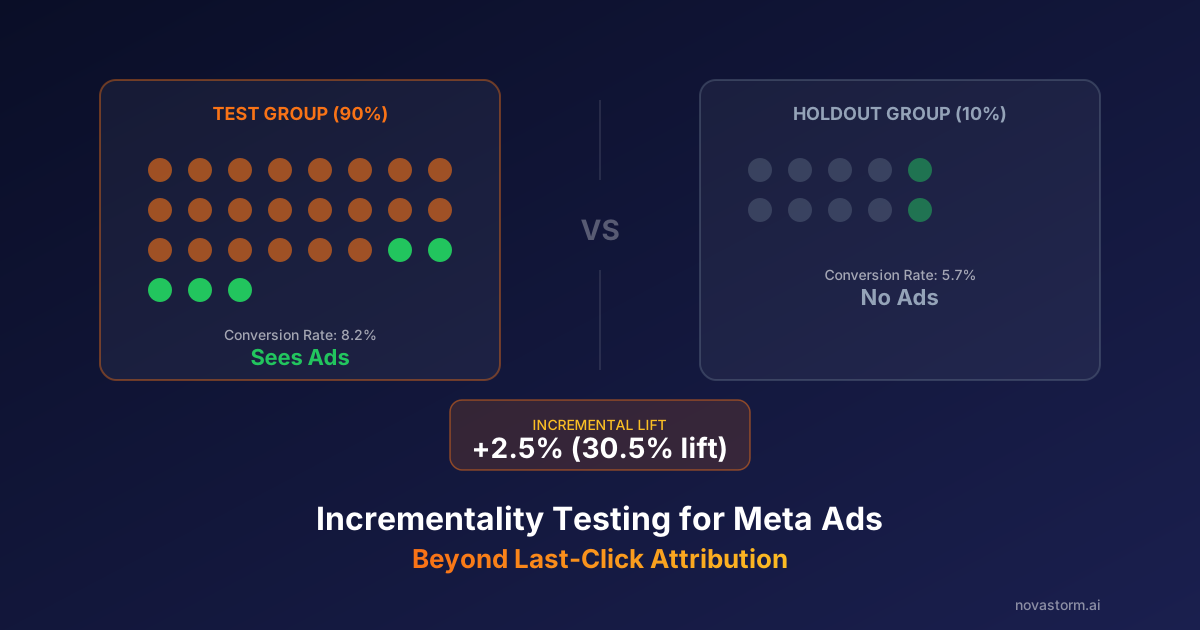
Attribution assigns credit under a reporting rule; an incrementality experiment estimates what changed because a treatment was available. Define the causal question, holdout and business outcome before comparing reported ROAS. A different attribution window cannot create a different causal effect for the same experiment.
One experiment, several credit rules
Hypothetical example, not a study of advertising accounts: spend is $1,000 and one valid experiment estimates $2,100 incremental revenue under a stated horizon, so estimated incremental ROAS is 2.1. A last-click report credits $8,200 and another window credits $5,400. Those report different attribution, not different “true” incremental ROAS. Keep the same 2.1 estimate and uncertainty when discussing that experiment.
In this illustration, ($8,200 − $2,100) / $8,200 = 74.39% is the attributed-revenue share above the estimate. The relative excess against the incremental estimate is ($8,200 − $2,100) / $2,100 = 290.48%. These denominators answer different questions. Neither proves exactly which individual purchases would occur anyway; the experiment estimates a group-level counterfactual and may not cover the same measurement scope as attribution.
Specify the treatment before choosing a tool
| Question | Treatment and control | Valid conclusion |
|---|---|---|
| Does retargeting add outcomes? | Eligible retargeting access versus no tested retargeting | Effect of that retargeting treatment in this design |
| Does Meta add outcomes? | Defined Meta treatment versus withholding that treatment | Effect of the specified channel scope |
| Which format works better? | Video versus static under an eligible comparison | Relative format effect; not either format versus no ads |
| Does a public-service ad change results? | Product ad versus PSA exposure | A different treatment contrast; PSA is not an untreated control |
Check actual lift-study eligibility, allowed assignment and outcome measurement with the supported platform or research implementation. Do not infer access from a fixed dollar budget. The 2018 research paper Designing Experiments to Measure Incrementality on Facebook treats power and sample sizing for lift studies and multi-cell comparisons; it is methodology, not proof of today’s Meta menu or minimum budget.
Plan sample size by units and meaningful effect
Record baseline outcome probability, minimum meaningful absolute effect, allocation, planned error level/power, assignment unit, clustering, outcome delay and follow-up. An illustrative simple independent two-arm binary-outcome approximation uses 2 × p̄ × (1 − p̄) × (1.96 + 0.84)² / Δ² per arm. With assumed baseline 5%, target 6% and Δ = 0.01, p̄ = 0.055, it gives about 8,150 eligible units per arm. This is a planning approximation, not a universal Meta requirement; attrition, unequal groups, geo clustering, multiple comparisons and the actual study estimator need their own calculation.
Spend does not determine sample size by itself, and an equal-looking group is not necessarily randomized. Check assignment, contamination from other campaigns/channels, eligibility and outcome collection before launch. Analyze by original assignment where appropriate: treatment assignment is not proof every assigned person saw an ad. Predefine duration and maturity, with safety stops and an approved loss allowance; avoid repeatedly looking for significance and stopping only on a favorable day.
Stop wasting ad budget
NovaStorm AI cuts Meta Ads CPA by 30% on average. No complex setup required.
Read the difference and its uncertainty
Hypothetical independent-group outcome counts: 820 / 10,000 treatment versus 570 / 10,000 control give 8.2% and 5.7%, a difference of 2.5 percentage points and relative lift of 43.86%. Under a simple independent-binomial normal approximation, standard error is about 0.359 percentage points and a 95% interval for the difference is approximately 1.80 to 3.20 points. This illustrative calculation is not a Meta study result or the correct estimator for clustered/unequal exposure designs. Validate execution and the estimator before reporting it as causal.
An interval of 5% ± 8 percentage points includes zero and negative effects; it is inconclusive for a positive-effect claim. Hypothetical estimates of 12% with interval −2% to 26% and 3% with interval −5% to 11% do not justify declaring the first treatment better from point values alone. To compare effects, use the appropriate difference estimator and its interval, compatible populations and costs. A small positive effect can still be commercially insufficient.
Convert the effect into contribution
Illustrative assumptions: incremental revenue estimate $2,100, contribution ratio before acquisition 40%, media $1,000 and separate test/production cost $100. Contribution after acquisition is $2,100 × 0.40 − $1,000 − $100 = −$260 despite positive lift. Use uncertainty on incremental outcomes, margin, returns and cash delay in the decision. Do not multiply attributed sales by an unverified “incremental share” and call it a measured result.
A complete test decision record
- Hypothesis and treatment scope; allocation unit; supported implementation and owner; holdout leakage check.
- Predefined outcome, estimator, baseline assumptions, sample/power calculation, common maturity, costs and loss allowance.
- Actual assignment/delivery and missing-outcome checks; estimated effect with interval and any execution deviations.
- Business action: continue within an approved allowance, repeat a redesigned test, or reduce spend; record why uncertainty and contribution support it.
Prioritize the unanswered decision with the greatest business cost, rather than a fixed quarterly calendar promising certainty within a year. Prepare its approved campaign brief in NovaStorm and inspect the saved draft fields; the independent experiment implementation and analysis remain separate. Do not assume NovaStorm creates randomized holdouts or calculates causal lift. For regional designs, continue with geo-lift planning.
Published by NovaStorm AI. Worked examples and proposed tests are labeled in the article.
Disclaimer: This article was generated with the assistance of AI and reviewed by the NovaStorm AI team. While we strive for accuracy, we recommend verifying specific data points and consulting official sources (linked where available) for critical business decisions.
Ready to automate your Meta Ads?
NovaStorm AI takes full responsibility for your campaigns — from monitoring to optimization.
Start NowMore on Attribution and incrementality

Incremental Lift Testing on Meta: Measuring True Ad Impact
Design and interpret a randomized advertising holdout with unequal-group normalization, sample assumptions, uncertainty and a contribution ceiling.
Marketing Mix Modeling and Meta Ads: Budget Allocation Science
Build a defensible MMM budget scenario: inspect channel identification, seasonality, held-out predictions, uncertainty and contribution margin.
Geo-Lift Testing on Meta: Measuring True Campaign Impact
Design a geo-lift test with GeoLift tutorial data, pre-period checks, power planning and margin-based decisions that account for uncertainty.
Conversion Lift Studies: Measuring Real Impact of Meta Ads
Normalize unequal holdout groups, calculate incremental conversions and revenue, and interpret uncertain lift before changing the budget.