

Conversion Lift Studies: Measuring Real Impact of Meta Ads
Normalize unequal holdout groups, calculate incremental conversions and revenue, and interpret uncertain lift before changing the budget.
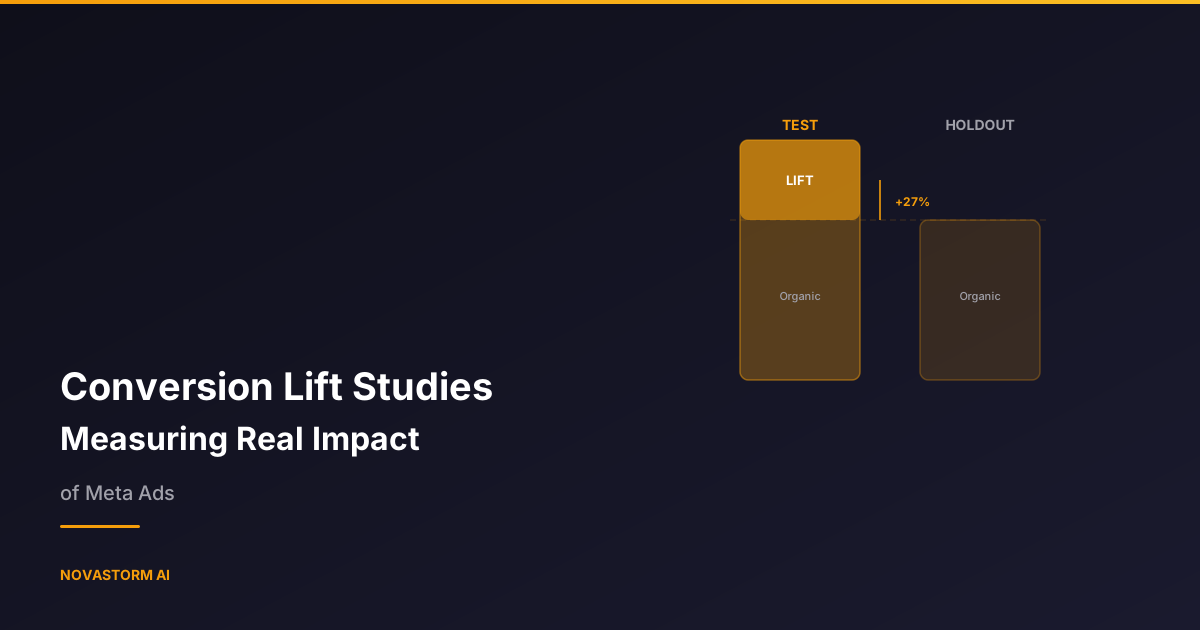
A conversion lift design compares eligible treatment and control groups to estimate outcomes added by advertising. Assignment is not the same as guaranteed exposure. Randomization improves comparability, but measurement gaps, spillover, unequal outcome maturity and implementation problems still matter. Attribution credit answers a different question.
Check availability and design before committing money
Meta’s incrementality training includes qualifying an advertiser against eligibility requirements. Verify Conversion Lift availability, supported outcomes, measurement configuration and design parameters in the current account or with the appropriate Meta contact. Do not assume every account exposes a particular self-service menu.
- Define the business outcome, minimum economically relevant effect, expected baseline rate, assignment unit and acceptable uncertainty. Plan sample size and power for those inputs.
- Choose holdout share and duration from that design and operational constraints; a 90/10 split, two-to-four weeks or 90% confidence is not a universal reliability rule.
- Keep the tested offer and delivery policy coherent, log approved changes and measurement failures, and wait for the same outcome maturity in both groups. Estimate the possible opportunity cost rather than assuming every withheld person would have bought because of the ads.
Normalize a 90/10 example
Entirely synthetic example: 9,000 assigned treatment people produce 180 converters; 1,000 control people produce 15. Each person is counted at most once for this binary outcome, with the same window. Treatment rate is 2%; control rate is 1.5%. Comparing 180 with 15 directly would confound the ninefold group-size difference.
| Calculation | Illustrative value | Interpretation |
|---|---|---|
| Control baseline at treatment size | 9,000 × 1.5% = 135 converters. | Expected treatment-sized outcome under the observed control rate. |
| Additional converters | 180 − 135 = 45. | Point estimate at the 9,000-person treatment scale. |
| Absolute rate difference | 2% − 1.5% = 0.5 percentage points. | Difference in assigned-group rates. |
| Relative lift | 0.5% / 1.5% ≈ 33.3%. | Point estimate relative to the observed control rate. |
| Media cost per additional converter | $900 / 45 = $20. | Point ratio if $900 is the tested treatment spend. |
Show the uncertainty, not only the point estimate
Stop wasting ad budget
NovaStorm AI cuts Meta Ads CPA by 30% on average. No complex setup required.
For this teaching example, an independent-binomial normal approximation gives standard error √[(0.02×0.98/9,000)+(0.015×0.985/1,000)] ≈ 0.00412. An approximate 95% interval is 0.005 ± 1.96×0.00412: about −0.307 to +1.307 percentage points. Multiplied by 9,000, this is roughly −27.6 to +117.6 additional converters. This hand calculation is not Meta’s reporting method; clustering, repeated outcomes or more complex designs require a suitable estimator.
The interval includes zero and effects in both directions. The $20 cost ratio is therefore unstable, and division by zero or a negative additional-outcome estimate is not a useful positive CPA benchmark. A point estimate of zero with a wide interval likewise means uncertainty, not proof of no effect or an obligatory shutdown.
Use the correct revenue numerator
If each converter generates one $100 retained order in this simplified example, incremental revenue is 45 × $100 = $4,500 at the treatment scale. Incremental revenue ROAS is $4,500 / $900 = 5, not total treatment revenue $18,000 / $900 = 20. If contribution per retained order is $40, point-estimated incremental contribution after media is 45 × $40 − $900 = $900, with the same substantial outcome uncertainty. Nonuniform order values require revenue or contribution measurement directly.
Choose a decision within the uncertainty
Compare plausible effects with the required contribution, cash allowance and decision value. Hold, reduce, continue a bounded study or redesign depending on risk and evidence; do not promise precision merely by waiting longer. Geo comparisons require comparable regions and spillover checks; on/off periods also mix seasonality and delayed effects.
NovaStorm can prepare approved Meta briefs and drafts carrying the experiment question and spending allowance. This does not implement randomization, establish Conversion Lift eligibility or run a validated lift study. Preserve the study configuration, outcome ledger and limitations with the measurement owner.
Published by NovaStorm AI. Planning examples are illustrative assumptions, not measured customer results.
Disclaimer: This article was generated with the assistance of AI and reviewed by the NovaStorm AI team. While we strive for accuracy, we recommend verifying specific data points and consulting official sources (linked where available) for critical business decisions.
Ready to automate your Meta Ads?
NovaStorm AI takes full responsibility for your campaigns — from monitoring to optimization.
Start NowMore on Attribution and incrementality
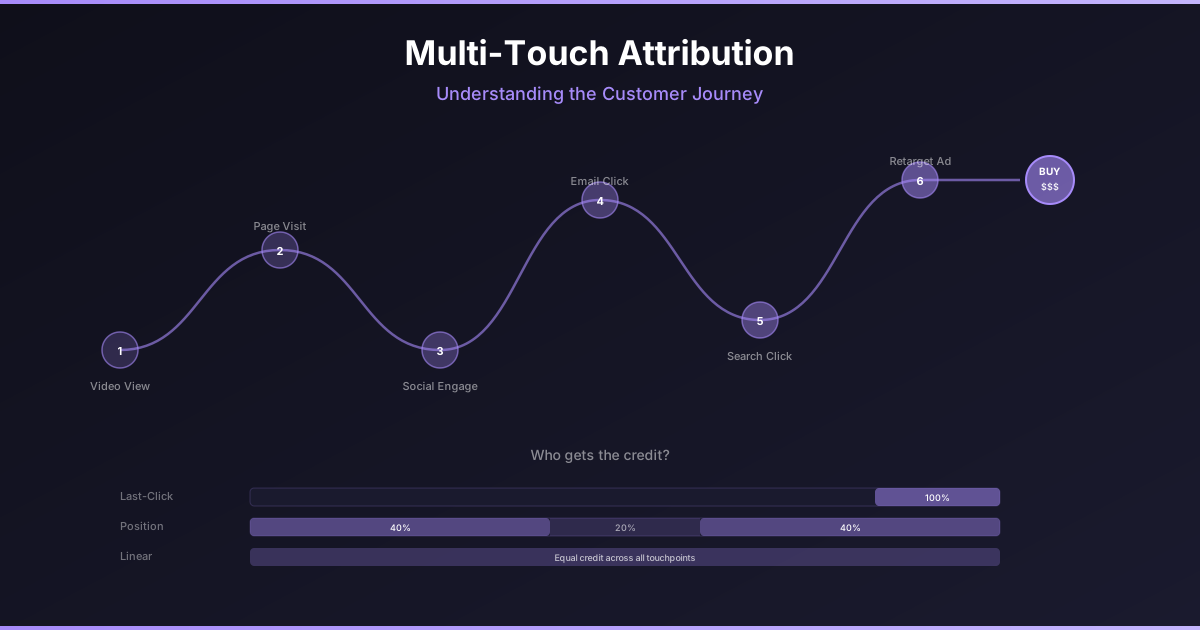
Multi-Touch Attribution: Understanding the Customer Journey in Meta Ads
Reconcile customer paths and orders across channels, compare attribution rules, and keep budget decisions separate from assigned credit.

Incremental Lift Testing on Meta: Measuring True Ad Impact
Design and interpret a randomized advertising holdout with unequal-group normalization, sample assumptions, uncertainty and a contribution ceiling.
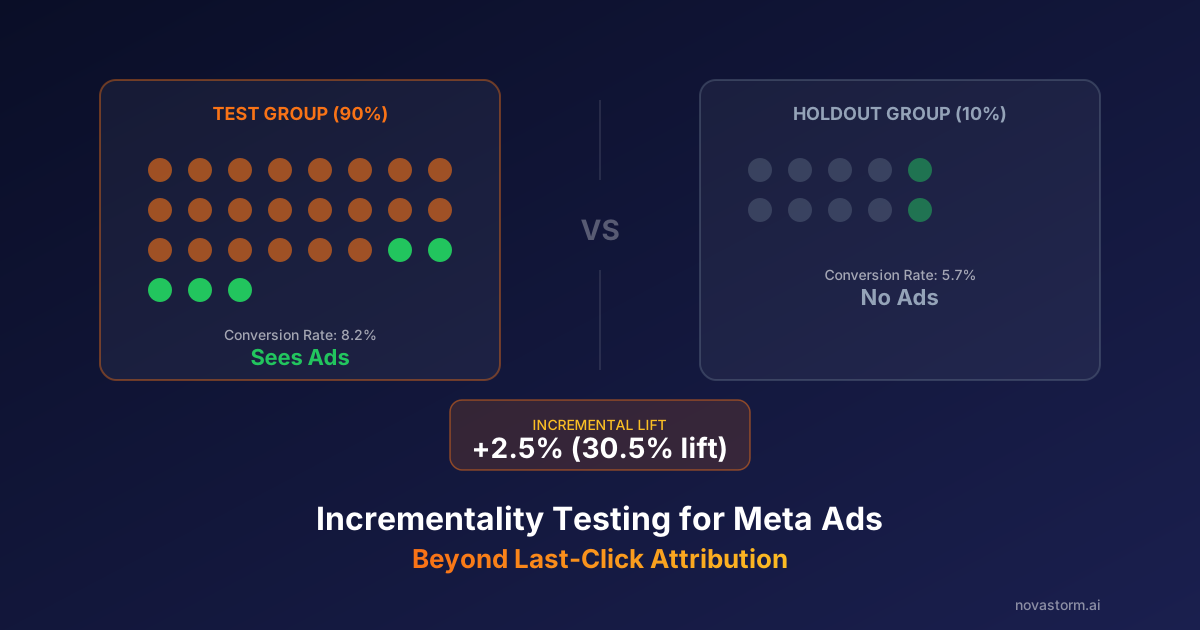
Incrementality Testing for Meta Ads: Beyond Last-Click Attribution
Design an incrementality test with a defined holdout, group-based sample assumptions, effect intervals and contribution economics.
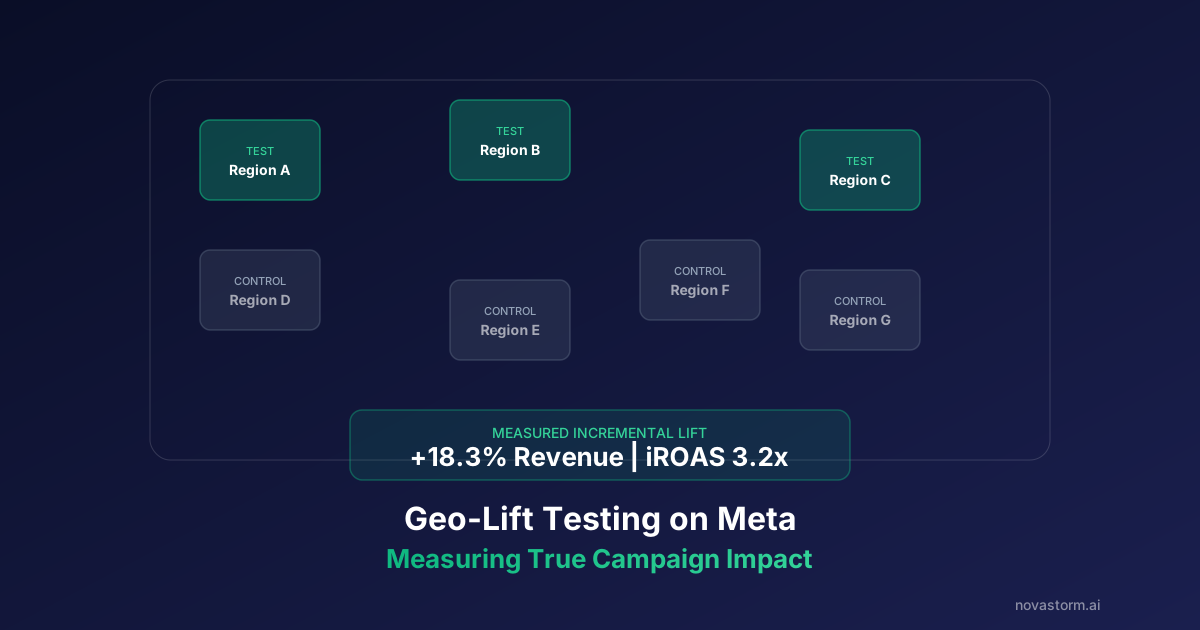
Geo-Lift Testing on Meta: Measuring True Campaign Impact
Design a geo-lift test with GeoLift tutorial data, pre-period checks, power planning and margin-based decisions that account for uncertainty.