

GA4 Measurement Protocol Validation: A Clean Response Is Not Proof of Collection
Use Event Builder to review a synthetic GA4 event, record fixes and retests, and separate structure validation from credentials and collection evidence.
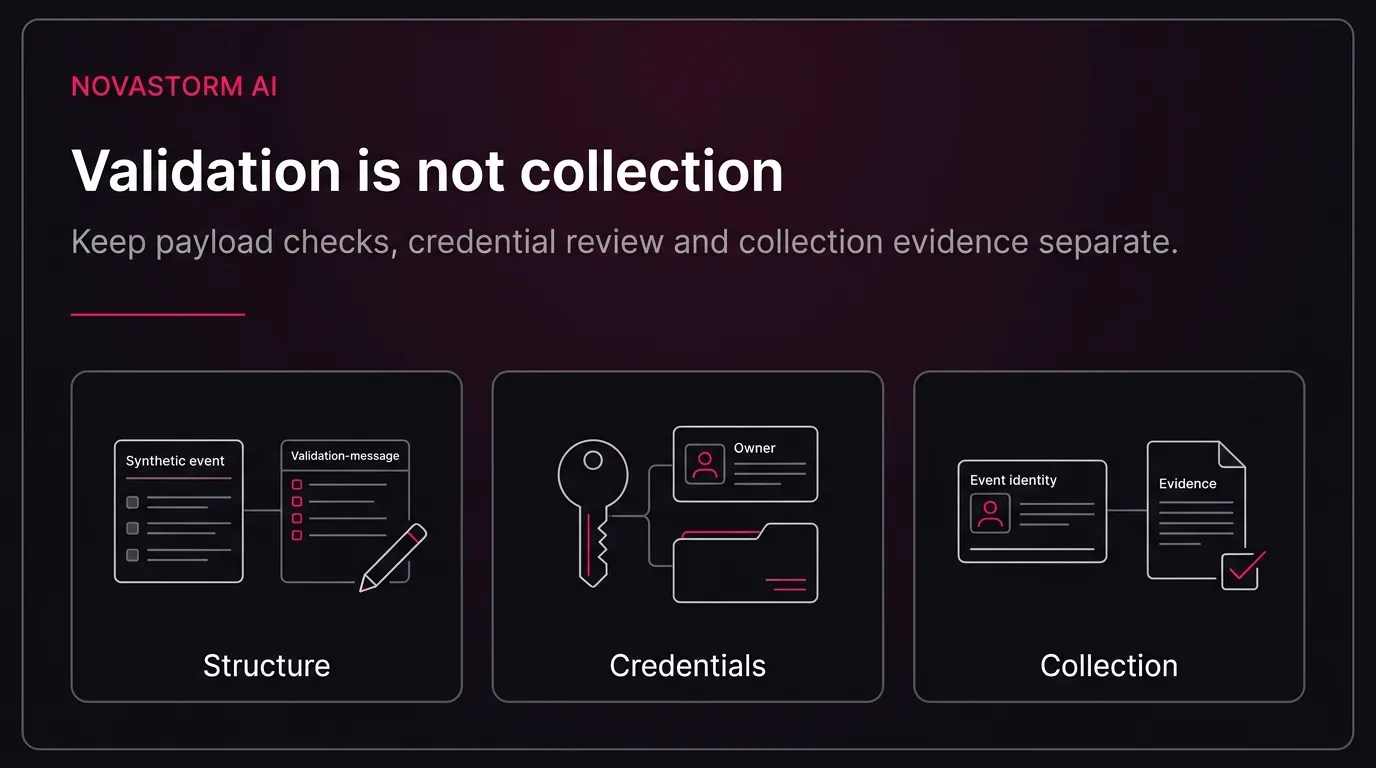
AI-generated conceptual illustration; not a platform screenshot or customer result.
For a Meta advertising measurement lead reviewing an existing GA4 Measurement Protocol integration with a developer, the deliverable is a reviewed validation record—not a blanket tracking sign-off. This article separates the documented validation mechanics from a proposed three-gate handoff and a fictional worked example.
What a clean response establishes
First, distinguish the request response from event validation: The guide warns that malformed events or missing required parameters do not necessarily produce HTTP error codes from Measurement Protocol. Source. Scope: The sentence continues in the adjacent passage with missing required parameters. A clean HTTP response alone is not a substitute for validation; do not generalize this into a claim that no transport or server errors can ever occur. For the validation result itself: A request with no validation issues is represented by an empty validationMessages array. Source. Scope: This establishes only the validation response meaning. It does not establish credential correctness, report collection, or Meta CAPI acceptance.
Events sent to the validation server do not appear in reports. Source. Scope: Applies to validation requests, including those made through Event Builder. Do not wait for a debug request to appear in reports or use it as collection evidence. Report collection therefore needs evidence outside this validation exercise.
Use Event Builder within its documented scope
The supported construction and validation capability is: Google Analytics Event Builder supports interactive event construction and uses the Measurement Protocol validation server to validate events. Source. Scope: Applies to GA4 Measurement Protocol validation; the adjacent continuation confirms validation through that server. This documents validation mechanics, not successful collection or workflow effectiveness. Event Builder is linked from Google’s validation guide. The supplied documentation does not establish current screen layouts, button labels or authentication steps, so this article does not prescribe them.
For the development validation approach: Google recommends strict validation during development, using Event Builder or validation-server requests with validation_behavior set to ENFORCE_RECOMMENDATIONS. Source. Scope: Read with the preceding development-only recommendation. The adjacent production guidance instead recommends sending production requests without validation_behavior; do not present the development setting as a production requirement. For identifying the request destination: The collection and validation requests differ in endpoint: collection uses /mp/collect and validation uses /debug/mp/collect; other request fields are the same. Source. Scope: Endpoint paths describe the documented GA4 Measurement Protocol requests. This does not establish that an arbitrary payload or its credentials are correct. These are validation mechanics, not evidence that the existing integration is correctly configured.
For interpreting returned issues: Validation messages identify an invalid field through fieldPath and describe the error through description. Source. Scope: Record the actual returned fields in the validation record. The adjacent response schema also defines validationCode as the corresponding error code. The invalid-name example provides a concrete illustration: The documented invalid-name response identifies the events field and describes the offending event name. Source. Scope: This describes the supplied invalid-event example, not an observed response from the reader's integration. Preserve the returned fieldPath rather than replacing it with an inferred more-specific path. Its corresponding code is documented separately: The documented leading-underscore event-name error has validation code NAME_INVALID. Source. Scope: Applies to the guide's example and its alphabetic-first-character rule. Other naming problems or payload issues can require additional fixes.
Copy the three-gate acceptance worksheet
The following original review aid, including its assumptions and refutable test, is a hypothesis rather than an established Google workflow: Hypothesis: A three-gate acceptance worksheet may help reviewers avoid treating structural validation as proof of collection. Gate A records the synthetic specification, platform, sanitized payload revision, validation endpoint, returned messages, field-level fix, retest response and structure-only disposition. Gate B records the authorized credential-review owner, applicable identifiers, secure evidence reference and unresolved issues without storing secret values. Gate C records a separately agreed collection-evidence method, target property or stream, event identity, observation window, reviewer and actual evidence or an explicit open status. Each gate has an owner and next action; no gate inherits a pass from another. No lift has been measured here. Scope: This is an original review aid, not a documented Google workflow or a proven performance improvement. No lift has been measured here. Assume reviewers have an existing integration and authorized access. Test it using synthetic review exercises with deliberately unresolved credentials or absent collection evidence; the proposition is not supported if reviewers still mark collection verified from validation alone or show no reduction in such errors compared with their prior checklist. The worksheet does not prescribe undocumented collection interfaces, reporting latency or credential-verification features.
Prerequisites
Use this worksheet with the existing integration’s technical owner, authorized implementation-review access, access to Event Builder, a synthetic specification without customer data, and the team’s secure credential-review process. Do not paste secrets into the record. If these prerequisites are missing, name the missing prerequisite and its owner before proceeding.
Gate A — Structure
Owner: [name or role]. Synthetic specification: [reference]. Existing integration platform: [platform]. Sanitized payload revision: [reference]. Validation endpoint: [path].
Action: Construct the synthetic event in Event Builder using the authorized integration’s platform context and applicable required fields, then validate it. Do not invent missing identifiers.
Initial response: [actual returned validationMessages]. Issue record: [returned fieldPath; description; validationCode]. Preserve the returned fieldPath; identify the affected event separately rather than rewriting the response.
Field-level fix: [affected event or field; proposed change; revised payload reference]. Expected retest: [expectation, not observation]. Actual retest: [returned response or pending].
Disposition: [open / issues remain / no validation issues reported for this revision—structure only]. Next action: [action and owner]. If messages remain, retain them, assign the next fix and repeat validation. If the response is unavailable, leave the disposition open.
Gate B — Credential review
Authorized review owner: [name or role]. Applicable identifier labels: [labels only]. Secure review reference: [nonsecret reference]. Unresolved applicability or correctness questions: [items].
Action: Have the authorized owner review the relevant values through the team’s secure process. Record the review evidence reference, not the values themselves.
Disposition: [open / reviewed with evidence reference]. Next action: [action and owner]. Missing ownership, unresolved applicability or absent review evidence keeps this gate open; Gate A cannot close it.
Gate C — Collection evidence
Owner: [name or role]. Agreed authorized evidence method: [reference]. Target property or stream: [target]. Event identity: [identity]. Observation window: [agreed window]. Reviewer: [name or role]. Actual evidence: [reference or absent].
Action: Ask the technical owner to supply the authorized method and observation window, then attach the actual evidence obtained under that method. This worksheet does not specify a reporting interface or latency threshold.
Disposition: [open / collection evidence reviewed under the agreed method]. Next action: [action and owner]. If the method, target, window or evidence is missing, record that missing item explicitly. A planned observation is not a completed observation.
Final handoff check
Can another reviewer distinguish the submitted revision, initial response, proposed fix, expected retest and actual retest? Does every gate have its own disposition, owner and next action? Return any inherited approval for separate review. Evaluate the worksheet using synthetic exercises with unresolved credentials or absent collection evidence, comparing incorrect collection sign-offs against the prior checklist; do not assume the worksheet improves decisions.
Stop wasting ad budget
NovaStorm AI cuts Meta Ads CPA by 30% on average. No complex setup required.
Filled hypothetical invalid-name example
Hypothetical example. All inputs are assumed for teaching purposes and are not customer results. A measurement lead and developer review a synthetic event named _review_probe in an existing authorized integration. The teaching record anticipates a NAME_INVALID issue associated with events because the name begins with an underscore. The developer changes the name to review_probe and submits the corrected payload for validation again. An empty validationMessages array is a conditional retest expectation only if no other validation issues remain; the actual response must be recorded. Credential review and collection evidence remain open in this fictional record. Scope: Use no customer data and no secrets in the worksheet. These are illustrative names and expected responses, not executed requests or a complete ready-to-send payload. Retain platform-appropriate required fields from the authorized integration; do not invent missing identifiers or treat a predicted response as a measured retest result.
Filled review record
Gate A owner: developer; reviewer: measurement lead. Initial specification, anticipated issue, name correction and conditional retest expectation: as stated in this hypothetical example. Actual initial response: not supplied. Actual corrected retest response: pending—not copied from the expectation. Structure disposition: open until the actual response is recorded. Next action: developer supplies the sanitized submitted revision and its returned response.
Gate B owner: authorized technical owner. Applicable identifiers: not yet established for this fictional integration. Secure review reference: absent. Disposition: open. Next action: assign the authorized reviewer and record a nonsecret review reference.
Gate C owner: measurement lead, coordinating with the technical owner. Method, target, observation window and evidence: not supplied. Disposition: open. Next action: agree the authorized evidence method before making a collection determination.
This is a filled teaching record of a proposed review, not a submission log. Its expected and actual response fields are deliberately separate; no request or retest has been executed here.
The naming constraint behind the example is limited: An event name must begin with an alphabetic character; the guide illustrates a leading-underscore name as invalid. Source. Scope: This is one naming constraint, not a complete specification of permitted or reserved event names. Correcting the initial character alone does not establish full payload validity. The full existing payload, applicable identifiers and complete naming limitations are not supplied here. The example is not a ready-to-send integration payload.
Why the other gates remain separate
The credential boundary is explicit: The validation server does not validate api_secret or firebase_app_id; those values require separate review. Source. Scope: Review the values relevant to the existing integration with its authorized technical owner. Do not infer credential correctness from an empty validation response or imply firebase_app_id is required for every platform. The documentation also separates the implementation review from structure validation: After validating event structure, Google instructs implementers to verify that their implementation uses the correct keys. Source. Scope: Read with the adjacent warning that api_secret and firebase_app_id are not validated. Structural validation and implementation-key review are distinct checks. The worksheet supplies ownership and evidence fields, not a new credential-verification mechanism.
No actual Event Builder response, credential review or collection observation is supplied for this article. The source also does not provide a complete collection-verification procedure or an expected reporting window. The worksheet leaves those implementation-specific questions to the authorized technical owner rather than filling them with assumed platform behavior.
Keep the Meta acceptance record separate
This GA4 record makes no Meta CAPI acceptance determination. No Meta validation documentation or acceptance evidence is supplied here. For the separate Meta-side task, use the Meta Conversions API setup guide to continue with its browser/server Purchase review rather than extending this synthetic GA4 record into a Meta sign-off.
NovaStorm is a place to prepare and review Meta advertising work. The output of this exercise is a handoff with separate gate dispositions and explicit unresolved questions—not a claim of verified collection or advertising improvement.
Disclaimer: This article was generated with the assistance of AI and reviewed by the NovaStorm AI team. While we strive for accuracy, we recommend verifying specific data points and consulting official sources (linked where available) for critical business decisions.
Ready to automate your Meta Ads?
NovaStorm AI takes full responsibility for your campaigns — from monitoring to optimization.
Start NowMore on Tracking and first-party data
GA4 Recommended E-Commerce Events for Meta Ads: Funnel Setup and Channel Tagging
Validate GA4 e-commerce payloads for add_to_cart, begin_checkout, and add_payment_info while aligning Meta UTM tagging to satisfy Paid Social channel grouping rules.
Server-Side Tracking for Meta Ads: Why It Matters More Than Ever
Design a consent-gated server-side event flow, recover from delivery failures, and distinguish source persistence from Meta CAPI acceptance.
HubSpot and Meta Ads: CRM-Powered Advertising Campaigns
Define HubSpot lead quality, test lifecycle and retry behavior, and approve a supported Meta campaign goal without mistaking stages for revenue.
Klaviyo and Meta Ads Integration: E-commerce Data Sync
Verify Klaviyo lead intake, audience movement and recent-buyer exclusions before using a segment in an approved Meta campaign brief.