

Server-Side Tracking for Meta Ads: Why It Matters More Than Ever
Design a consent-gated server-side event flow, recover from delivery failures, and distinguish source persistence from Meta CAPI acceptance.
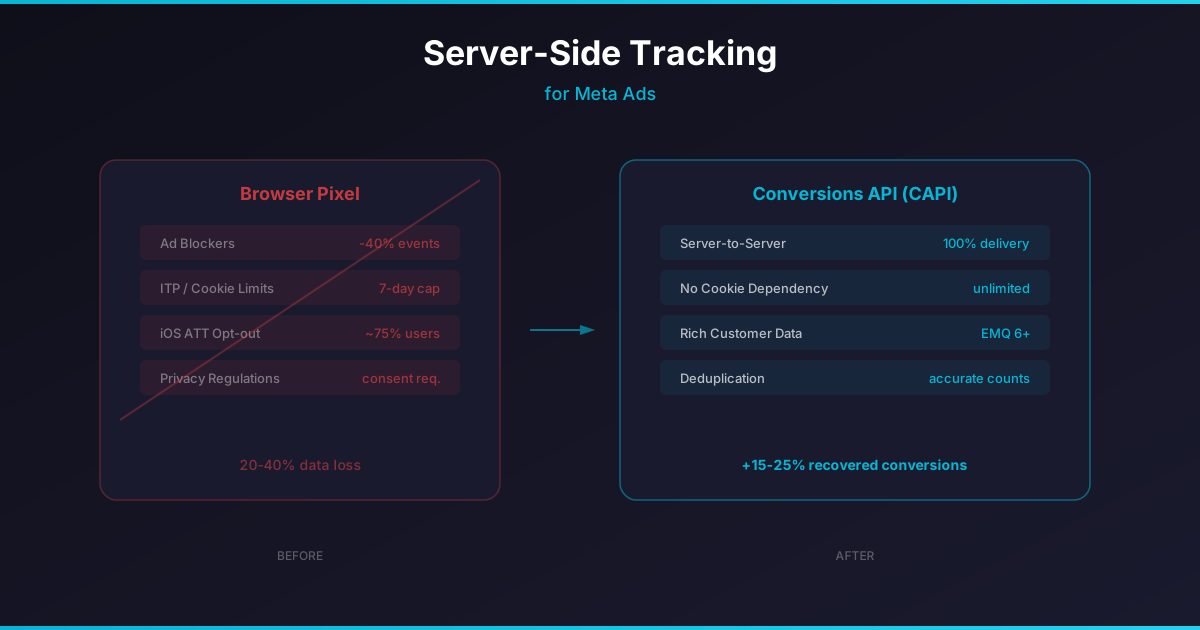
Server-side tracking moves part of event handling into an environment you operate or a configured partner operates. It can make delivery responsibilities clearer, but does not guarantee complete measurement. Choose an integration route deliberately: a partner connector, a direct server sender, or a server container with a configured destination. A Google server container alone is not a Meta destination.
Start with an authoritative business action
For Purchase, define the paid-order transition that creates the event. A checkout page load, payment attempt or form submission is not a paid order. Persist one durable logical event ID with that action and retain its actual occurrence time. If a corresponding browser event is sent, use the same event name and event ID for that business action. The Meta server-side event SDK documents these fields and their deduplication relationship.
Schematic example only, not a complete runnable request: {"data":[{"event_name":"Purchase","event_time":1790899200,"event_id":"purchase_demo_001","action_source":"website","event_source_url":"https://example.invalid/checkout","user_data":{},"custom_data":{"value":80,"currency":"USD"}}]}. The timestamp represents 2026-10-02 00:00 UTC. Empty user_data deliberately avoids personal information here; a deployed sender needs permitted matching fields that satisfy the current destination contract. The example does not demonstrate acceptance.
Before queuing or forwarding, consult the applicable consent and permission record for this destination and purpose. Keep that decision in the internal event record; do not invent a consent field in the Meta payload or treat an optimization opt-out as permission to send. Keep access tokens in the server secret path. Operational logs should use opaque identifiers and safe response categories, not personal matching fields, token values or raw payloads.
Recover from an outage without creating new purchases
- Create the durable event and its permission decision alongside the authoritative paid-order record. Track pending, accepted, permanently rejected and unresolved states separately.
- On a timeout or transient failure, retain the same logical event ID and occurrence time. Use a bounded retry policy, backoff and a queue age limit consistent with the current destination rules. A timeout may leave acceptance unknown; a new ID would describe a second action incorrectly.
- Quarantine a malformed event for correction and operator review. Stop and escalate authentication failures through the secret-management owner. Inspect per-request responses and destination diagnostics; an HTTP success or accepted event is not proof of attributed revenue.
- Reconcile unique logical events to eligible paid orders after recovery. Include failures, unresolved requests and orders intentionally withheld because permission was absent. Do not erase those categories to produce a perfect delivery rate.
Illustrative recovery ledger: 100 paid orders include 90 eligible for forwarding and 10 withheld by the permission gate. Initially, 80 eligible logical events are accepted and 10 remain queued. After successful retries, the ledger has 90 accepted unique logical events, with the same IDs, and 10 withheld orders. This is a synthetic acceptance scenario, not 100% attribution or a NovaStorm customer result.
Stop wasting ad budget
NovaStorm AI cuts Meta Ads CPA by 30% on average. No complex setup required.
What our source-persistence test actually checks
In a local NovaStorm registration-attribution test run on October 2, 2026, all 10 existing tests passed. One scenario starts at a tagged signup URL, navigates to sign-in without a query string and reloads the module; the original campaign keyword remains. Other scenarios preserve first and last touch and clear stored attribution after rejection or Global Privacy Control. This is a browser-storage test result. It does not test CAPI transmission, production delivery, Meta matching or acquisition lift.
Acceptance criteria for the sender
- A paid-order transition produces one durable logical event; repeated processing preserves its ID. Browser and server copies refer to that same action.
- An absent or rejected permission decision prevents forwarding, including queued retries when the applicable decision changes.
- Transient failures remain recoverable; permanent failures are visible and actionable; accepted and unknown responses are not mixed.
- The ledger reconciles eligible business actions, accepted events, withheld actions and unresolved delivery. Attribution and business contribution are evaluated separately.
Use the CAPI setup guide for the separate event-delivery and deduplication checks; the local storage tests here do not verify that integration.
Verify consent behavior, identifiers, matching-field treatment and real responses in the selected integration before relying on reports. Source persistence and event delivery are separate components with separate owners and checks.
Published by NovaStorm AI. Planning examples are illustrative assumptions, not measured customer results.
Disclaimer: This article was generated with the assistance of AI and reviewed by the NovaStorm AI team. While we strive for accuracy, we recommend verifying specific data points and consulting official sources (linked where available) for critical business decisions.
Ready to automate your Meta Ads?
NovaStorm AI takes full responsibility for your campaigns — from monitoring to optimization.
Start NowMore on Tracking and first-party data
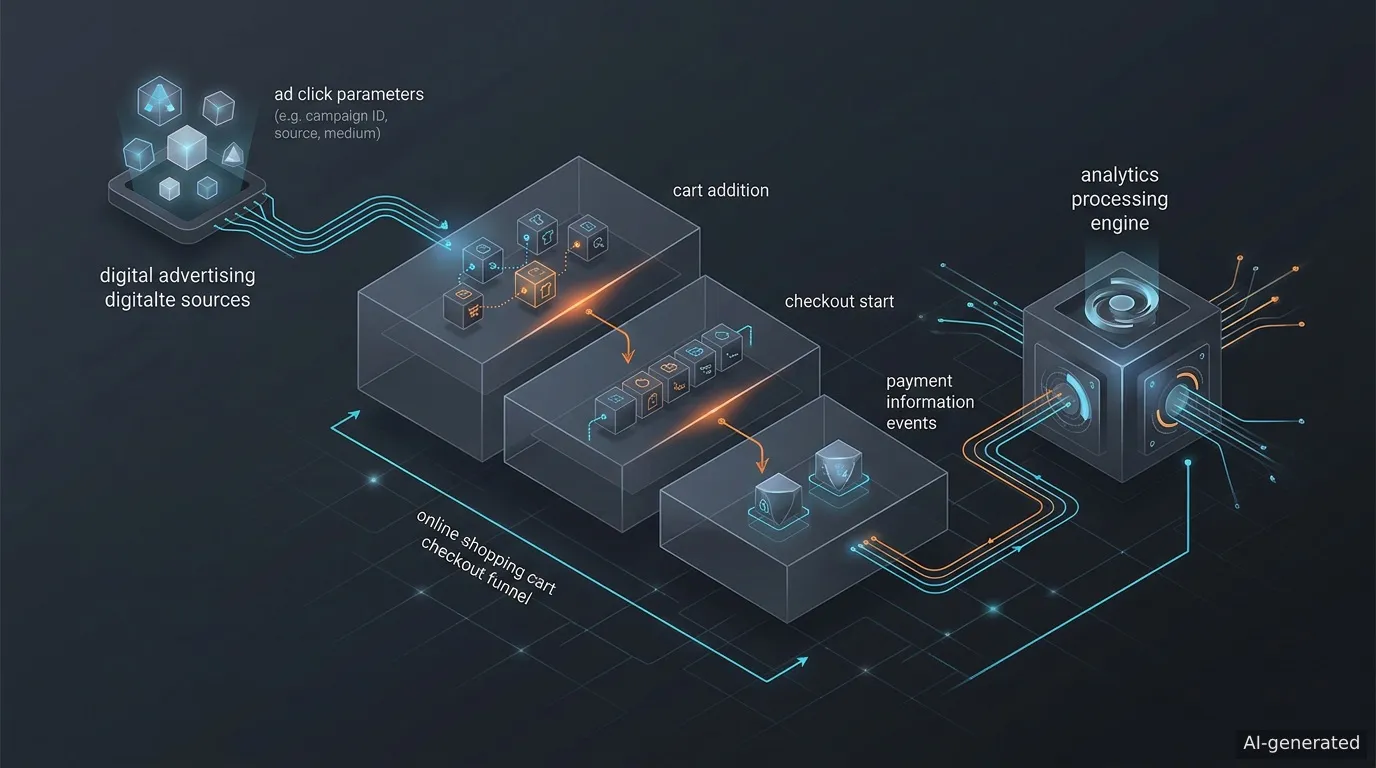
GA4 Recommended E-Commerce Events for Meta Ads: Funnel Setup and Channel Tagging
Validate GA4 e-commerce payloads for add_to_cart, begin_checkout, and add_payment_info while aligning Meta UTM tagging to satisfy Paid Social channel grouping rules.
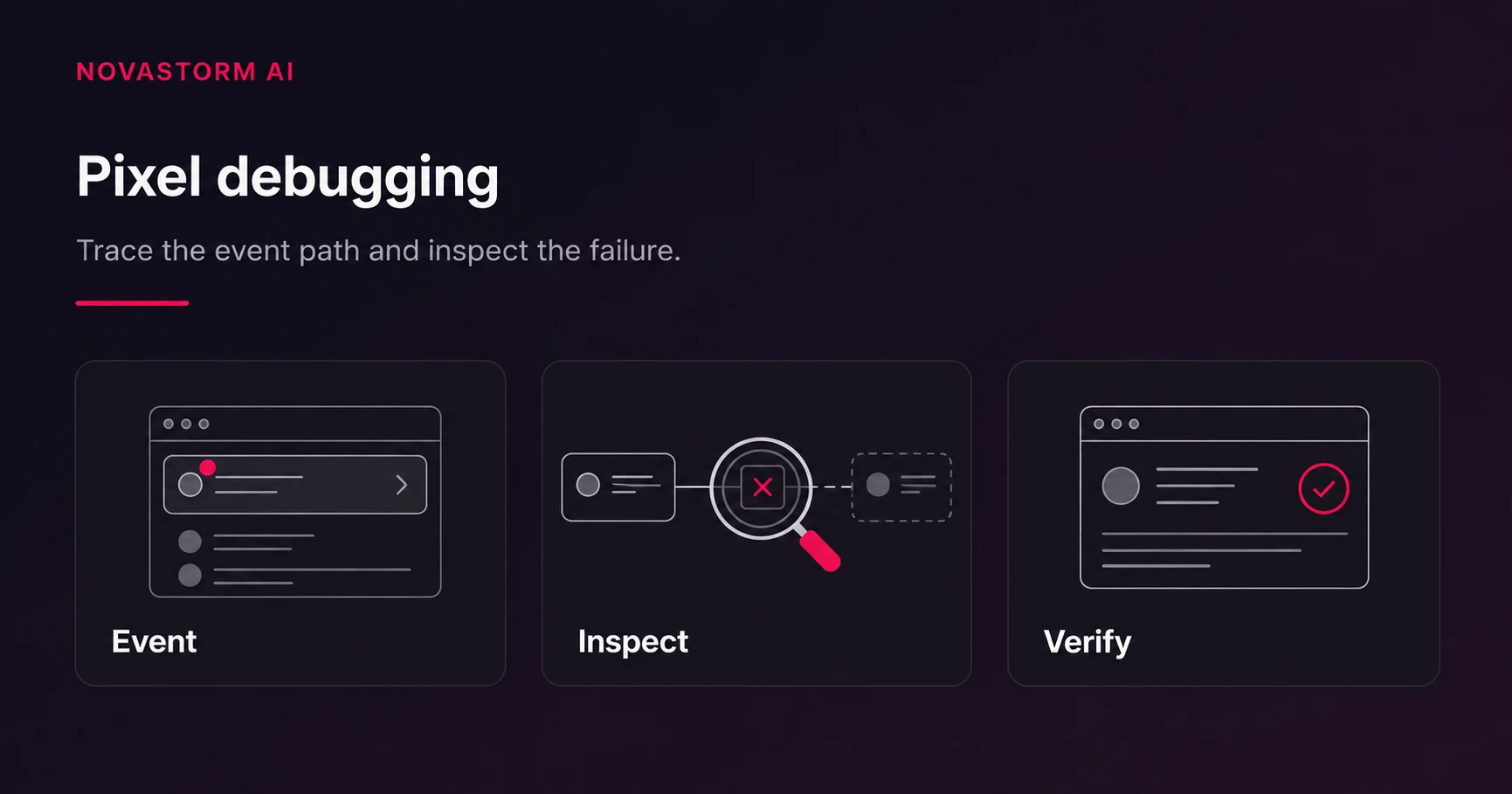
Meta Ads Pixel Debugging: How to Fix Tracking Issues Fast
Trace a paid order through browser and server checkpoints, test duplicate delivery and failed payment, and distinguish event receipt from attribution.

First-Party Data Strategy for Meta Ads in a Cookieless World
Choose a permitted first-party subset, assign data owners and expiry rules, and verify suppression across separate audience and conversion-event workflows.

Offline Conversion Tracking on Meta: Connecting Store Sales to Ads
Map confirmed store sales to connector fields, preserve event identity through retries, and reconcile delivery separately from ad credit and incremental effect.