

Klaviyo and Meta Ads Integration: E-commerce Data Sync
Verify Klaviyo lead intake, audience movement and recent-buyer exclusions before using a segment in an approved Meta campaign brief.
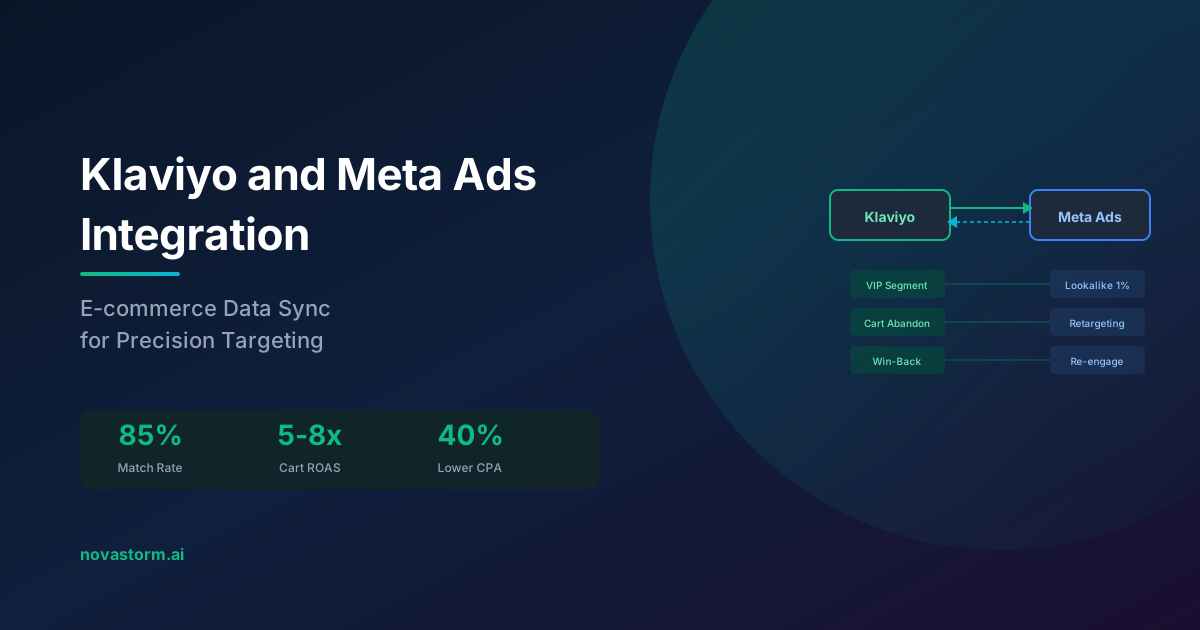
Klaviyo’s native Meta integration has separate audience and lead-intake paths. Verify both independently before using a segment in advertising. Purchase delivery is another contract, and predicted customer value is a hypothesis rather than a measured improvement.
Separate the three paths
The official integration guide documents list or segment activation and lead-form intake. It describes hourly membership updates, with Meta audience processing potentially taking 24–48 hours. It also describes a selected subscription choice for lead connections. A successful connection does not mean instant recognition or permission for every marketing purpose.
| Path | Configuration to save | Owner and contract record |
|---|---|---|
| Audience | Ad account, one-to-one segment/audience mapping and actual exclusion control | Marketing operations; native settings export and capture date |
| Lead intake | Page, form, destination list, mapped fields and subscription choice | Lifecycle owner; form version and native settings capture |
| Purchase | Verified commerce event source, currency and retry identity | Integration owner; separately selected connector release |
The native integration does not expose a release number in this setup description. Save the capture date and actual settings; do not invent an installed version. If a separate purchase connector is chosen, record its real version and event ownership. Inspect authorized page and ad-account access before accepting the mapping.
A synthetic lead and segment movement journal
The following is an unexecuted synthetic fixture, not a log of a real store. Times describe planned source actions on October 2, 2026 in UTC. Actual ingestion, dispatch and destination-processing timestamps must be observed independently. Use only a controlled test identity with permitted data.
| Planned time / record | Action | Expected check |
|---|---|---|
| 10:00 / Lead TEST-L1 | Submit selected test form | Profile, source fields, intended list and explicit preferences |
| 10:05 / Profile TEST-P1 | Make recent-purchase segment rule true | Eligibility and intended mapping visible; not proof of matched reach |
| 10:10 / TEST-P1 | Withdraw the relevant permission | Remove eligibility and request supported audience removal |
| 10:15 / TEST-P1 | Remove segment membership | Record dispatch and destination state separately |
| After processing / TEST-P1 | Review the sync result | Removal or unresolved status documented; no invented passing timestamp |
A single profile does not prove that an entire audience is available. Run movement checks within a permitted pilot audience that satisfies the current provider requirements. If removal is unresolved after the documented processing window, investigate the error and stop treating that audience as verified suppression. Subscription status and permission for audience sharing require distinct rules.
Stop wasting ad budget
NovaStorm AI cuts Meta Ads CPA by 30% on average. No complex setup required.
Verify the thirty-day exclusion in the saved campaign
Illustrative rule: a confirmed purchase during the last thirty days, plus permitted audience use. Define time zone, cancellation or refund handling and the source purchase timestamp. Then save the campaign’s actual exclusion control and audience mode. A synced recent-buyer audience does not apply itself to a campaign; an expandable hint is not a hard exclusion. Recheck expiry and withdrawal behavior.
Use the CDP acceptance map to assign identity, retry and deletion responsibility. Do not infer purchase-event delivery from successful list synchronization.
Reconcile credit before judging value
Hypothetical order O1 has USD 100 revenue. Email reporting credits USD 100 and Meta also credits USD 100 under their respective rules. The ledger still contains one USD 100 order, not USD 200 of revenue. A predicted-value segment may be worth comparing with a permitted alternative, but its prediction does not establish actual incremental contribution.
Bring the verified segment into a brief
After acceptance, prepare a paused NovaStorm draft with the observed destination audience, allowed offer, recent-buyer exclusion rationale and tested creative hypothesis. Record the owner’s approval and economic limit before publishing. This preparation step does not demonstrate a built-in Klaviyo connector, instant removal or automatic purchase attribution.
Published by NovaStorm AI. Worked examples and test fixtures in this article are illustrative, not observed customer results.
Disclaimer: This article was generated with the assistance of AI and reviewed by the NovaStorm AI team. While we strive for accuracy, we recommend verifying specific data points and consulting official sources (linked where available) for critical business decisions.
Ready to automate your Meta Ads?
NovaStorm AI takes full responsibility for your campaigns — from monitoring to optimization.
Start NowMore on Tracking and first-party data
Customer Data Platforms and Meta Ads: CDP Integration Strategy
Map four CDP flows, assign connector ownership, test identity and removals, and use verified audience data in an approved campaign brief.
HubSpot and Meta Ads: CRM-Powered Advertising Campaigns
Define HubSpot lead quality, test lifecycle and retry behavior, and approve a supported Meta campaign goal without mistaking stages for revenue.
Google Tag Manager and Meta Pixel: Advanced Setup Guide
Set up Meta Pixel in GTM with explicit tag ownership, confirmed-action data-layer events, tested consent controls and separate server delivery.

GA4 Recommended E-Commerce Events for Meta Ads: Funnel Setup and Channel Tagging
Validate GA4 e-commerce payloads for add_to_cart, begin_checkout, and add_payment_info while aligning Meta UTM tagging to satisfy Paid Social channel grouping rules.