

Diagnose an ID-Only Meta Creative Export Before Rebuilding
Use a request-aware worksheet to distinguish unrequested fields, unresolved readbacks and identity mismatches before deciding whether to rebuild a Page post creative.
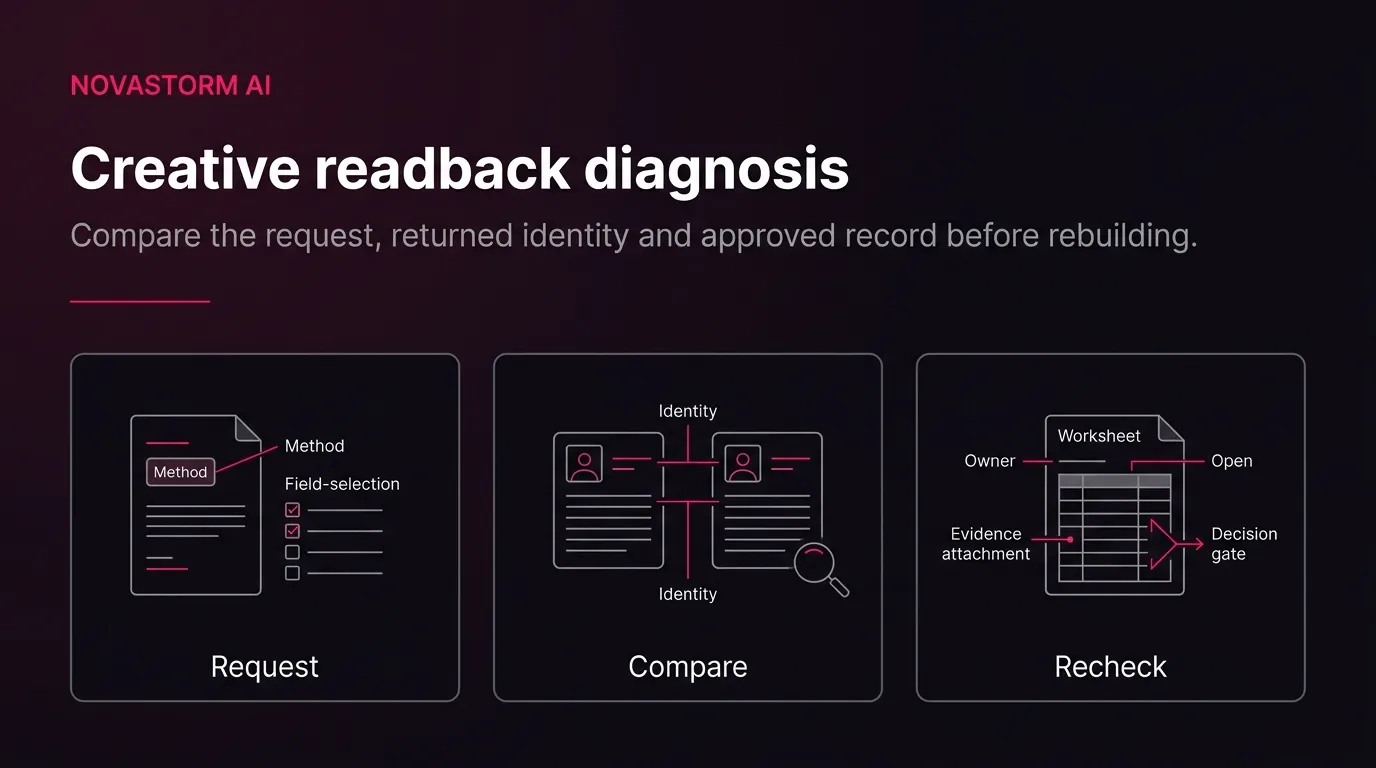
AI-generated conceptual illustration; not a platform screenshot or customer result.
For creative operations leads working with an authorized technical teammate, the task is narrow: compare an exported record with its request, raw response and approved Page post mapping. Finish with a diagnostic worksheet, an assigned owner and a documented recheck—not an asset-rebuild decision based on an incomplete row.
Prepare the evidence and worksheet
The proposed framework below supplies the prerequisites, worksheet fields and decision order. Its purpose is to keep missing evidence separate from conflicting identity; its usefulness remains unmeasured. Hypothesis: A request-aware identity worksheet can help reviewers separate incomplete evidence from identity mismatches before deciding whether to rebuild. No lift has been measured here. Scope: Assume an approved creative-to-Page-post mapping and access to credential-redacted requests and raw responses through an authorized technical teammate. Proposed worksheet fields: record label; approved creative ID; approved Page post ID; approved name if available; request method; endpoint creative ID; API version; exact requested fields; raw returned ID, name and object_story_id; whether each field was unrequested, returned or unresolved; discrepancies; disposition; owner; next readback; recheck evidence; and rebuild hold. Proposed decision order: investigate-mismatch when an available identity conflicts with the approved mapping; otherwise request-more-fields when necessary evidence is absent or unresolved; otherwise matched when the returned creative ID and Page post ID agree and name discrepancies have been reconciled. Matched means record correspondence only. Test on a fixed set of authorized, redacted records against independently adjudicated request/response evidence; compare with export-only review. Refute the proposed benefit if it does not reduce unsupported empty/deleted conclusions or if it increases incorrect matches. This is an original review heuristic, not a Meta requirement.
| Worksheet section | Fields to capture | Record entry |
|---|---|---|
| Approved record | Record label; approved creative ID; approved Page post ID; approved name if available | To confirm |
| Request evidence | Request method; endpoint creative ID; API version; exact requested fields | To confirm |
| Response evidence | Raw returned ID; name; object_story_id | To confirm |
| Field assessment | Unrequested, returned or unresolved for each field | To confirm |
| Comparison | Discrepancies against the approved record | To confirm |
| Decision | Disposition; owner; rebuild hold | To confirm |
| Follow-up | Next readback; recheck evidence | To confirm |
Use one copy per record. The filled cases below demonstrate the worksheet with fictional evidence; they are not reports of requests executed for this article.
Establish what the request can tell you
Start with the request method rather than the appearance of the export. The creation-response mechanism and the read-field mechanism are separate pieces of evidence.
- Identify whether the artifact came from creation or a read. The documented creative-creation call returns the creative object's ID. Source. Scope: This refers to the creation response in the supplied Page post creative example, not to a read request. Establish the request method before interpreting an ID-only record.
- Establish the exact field selection before interpreting omitted metadata. For API reads, fields other than id must be requested explicitly. Source. Scope: Read together with the preceding passage's explicit-field requirement. This describes field selection, not a guarantee that every requested field will be returned or populated.
- Keep readability separate from an explanation of a particular response. The documentation describes creative fields specified at creation, together with id, as readable fields. Source. Scope: Limited to the supplied creative read documentation. This does not establish the reason for an absent, null or otherwise unresolved field in a particular response.
- Confirm that the record belongs to the documented Page post scenario. The supplied documentation describes object_story_id as the Page post ID required for a Page post ad. Source. Scope: Limited to the documented Page post ad scenario, introduced in the surrounding passage as promoting a Page post with the Page Post Engagement objective; not a claim about all creative types.
- Use the supplied read example as the scope for the technical handoff. The documented creative read example requests name and object_story_id from a creative-ID endpoint using a GET request. Source. Scope: The supplied example uses API version v27.0 and authorized access. Use it as the documented scope of the readback request, not as evidence that a request was executed, that other versions behave identically or that the ad renders.
This article is a record-correspondence diagnostic, not an Ads Manager walkthrough or a rendering, delivery or approval audit. The documented read example is not evidence that a request was executed in your environment.
Run the recheck gate
Use the following proposed gate to turn the worksheet into an auditable handoff. It includes preservation of the original evidence, the scoped follow-up, ownership and handling for a failed or unresolved recheck. Hypothesis: An evidence-based recheck gate can make unresolved records harder to close prematurely. No lift has been measured here. Scope: Assume each record has a named creative operations reviewer and authorized API owner. Proposed gate: preserve the credential-redacted original request and raw response; record API version and capture time; compare requested and returned fields; obtain a scoped readback only where needed; document the exact approved-to-returned comparisons and remaining discrepancies; assign a disposition and owner; and retain a rebuild hold for unresolved or mismatched records. If approved mappings or request artifacts are missing, request them rather than assigning matched. If the scoped readback fails or remains unresolved, retain the failure evidence and escalate to the technical owner; do not prescribe undocumented retries or mutations. Test using independently adjudicated records and review closure errors; refute the gate's usefulness if unsupported closures are not reduced. This gate is a proposed operational convention, not a platform behavior or a guarantee that matched assets need no other review.
Keep the initial assessment and the recheck assessment visible as separate entries. The examples distinguish a corrected association from a still-open evidence gap; neither should disappear into a single overwritten status.
Four filled diagnostic cases
Case A: ID-only read response
Stop wasting ad budget
Plan, create and run Meta Ads campaigns with AI. Free to start, no complex setup.
Hypothetical example. All inputs are assumed for teaching purposes and are not customer results. Case A — ID-only read response. Approved mapping: creative CREATIVE_ALPHA to Page post PAGE_ALPHA_POST_ALPHA; approved name Spring launch. The recorded GET targets CREATIVE_ALPHA with no explicit fields and returns only id=CREATIVE_ALPHA. Both metadata fields were unrequested, not demonstrated empty. Initial disposition: request-more-fields. Owner: authorized API teammate. Request a scoped readback of name and object_story_id for the approved creative. In the assumed recheck, id, name and object_story_id agree with the approved record; attach that response and change the disposition to matched. Scope: Illustrative identifiers are symbolic, not executable IDs. The worksheet records the actual request method so that this assumed read response is not confused with a creation response. Hold rebuilding while readback evidence is outstanding. The assumed successful recheck is fictional, not a promised API result.
Case B: Metadata was never requested
Hypothetical example. All inputs are assumed for teaching purposes and are not customer results. Case B — unrequested metadata. Approved mapping: creative CREATIVE_BRAVO to Page post PAGE_BRAVO_POST_BRAVO; approved name Summer launch. The recorded GET targets CREATIVE_BRAVO and requests name. The response contains id=CREATIVE_BRAVO and name=Summer launch but no object_story_id. Mark object_story_id as unrequested and assign request-more-fields. Owner: authorized API teammate. Request name and object_story_id for CREATIVE_BRAVO, then compare the returned identity with the approved mapping. In the assumed recheck the Page post ID agrees; the creative operations lead documents the comparison and marks matched. Scope: The absent unrequested Page post field is an evidence gap, not proof of a missing post. Retain both the original field list and the recheck field list. The matched disposition is limited to the assumed returned record and does not establish rendering, delivery or approval status.
Case C: A requested field remains unresolved
Hypothetical example. All inputs are assumed for teaching purposes and are not customer results. Case C — unresolved requested field. Approved mapping: creative CREATIVE_CHARLIE to Page post PAGE_CHARLIE_POST_CHARLIE; approved name Autumn launch. The recorded GET targets CREATIVE_CHARLIE and requests name and object_story_id. The assumed raw response contains the matching creative ID and name but omits object_story_id. Mark the post field as requested-unresolved, not unrequested. Disposition: request-more-fields, explicitly annotated unresolved after request. Owner: authorized API teammate. Recheck the same approved creative with the documented field selection and retain any returned errors. In the assumed recheck the field remains unresolved; keep the disposition open, record the unresolved result and escalate for technical investigation rather than authorizing a rebuild. Scope: This is a fictional diagnostic condition, not a documented claim that this omission is expected API behavior. Compare the raw response with the export before blaming the API. A present null value must be recorded distinctly from an absent key. The supplied source does not establish whether permissions, object state, API version or another cause explains either condition. Do not invent a repair, permission requirement or deletion conclusion.
Case D: The request targets the wrong creative
Hypothetical example. All inputs are assumed for teaching purposes and are not customer results. Case D — wrong creative ID. Approved mapping: creative CREATIVE_DELTA to Page post PAGE_DELTA_POST_DELTA; approved name Winter launch. The recorded GET instead targets CREATIVE_OTHER and requests name and object_story_id. Its assumed response returns id=CREATIVE_OTHER, name=Winter launch and object_story_id=PAGE_OTHER_POST_OTHER. Disposition: investigate-mismatch even though the name agrees. Owner: creative operations lead for the approved mapping, with the authorized API teammate responsible for readback. Recheck the approved mapping, then request the approved creative rather than editing or rebuilding the returned creative. In the assumed recheck CREATIVE_DELTA and its Page post ID match the approved record; correct the worksheet's record association, preserve the original mismatch evidence and mark the corrected record matched. Scope: The request and response agree with each other in this fictional case; the mismatch is with the approved record. If a request targets the approved creative but the returned ID differs, retain both artifacts and escalate without guessing why. An agreeing name alone is not the proposed identity acceptance criterion. A mismatched returned Page post ID also requires investigation rather than an automatic overwrite.
Check the completed handoff
Read the completed worksheet back against the decision order—not against the status you hoped to assign. The key distinctions demonstrated above are request coverage, unresolved evidence and conflicting identity. A record that remains incomplete stays open; the fictional successful rechecks are not promises about your next response.
The deliverable is the evidence packet and its recorded disposition. Any separate production decision belongs after that review, with the remaining uncertainty still visible.
Return the record to the production workflow
For the next handoff, see Creative Production Workflow for Meta Ads: From Brief to Launch, which covers the broader brief, evidence checks and launch acceptance gates. Use it to place this narrow diagnostic within the production review rather than treating a readback as complete launch approval.
You can use NovaStorm as a place to prepare and review Meta advertising work, including the diagnostic handoff you have assembled here.
Disclaimer: This article was generated with the assistance of AI and reviewed by the NovaStorm AI team. While we strive for accuracy, we recommend verifying specific data points and consulting official sources (linked where available) for critical business decisions.
Ready to automate your Meta Ads?
NovaStorm AI takes full responsibility for your campaigns — from monitoring to optimization.
Start NowMore on Creative production and UGC

AI Image Generation for Meta Ads: Product Accuracy, Tools and Approval
Check current image models, product accuracy, rights and AI transparency before approving an advertising asset. Includes an illustrative prompt and correction worksheet.
Influencer Whitelisting: Running Ads From Creator Accounts on Meta
Prepare creator-ad permissions, rights and disclosures, verify expiry and revocation, and compare creator versus brand identity without assuming performance gains.
Adobe Creative Suite for Meta Ads: Photoshop and After Effects Tips
Rebuild a layered notebook ad in Photoshop and After Effects, verify its import and motion, and check the rendered asset before campaign approval.

Canva for Meta Ads: Designing Professional Ads Without a Designer
Build a Canva ad from an original notebook layout, verify content rights and export options, and inspect both mobile adaptations before approval.