

Daily vs Lifetime Budgets in Meta Ads: Which Strategy Wins
Choose daily or lifetime Meta budgets by operating horizon, log accepted settings and dates, and track remaining allowance with reporting delay.
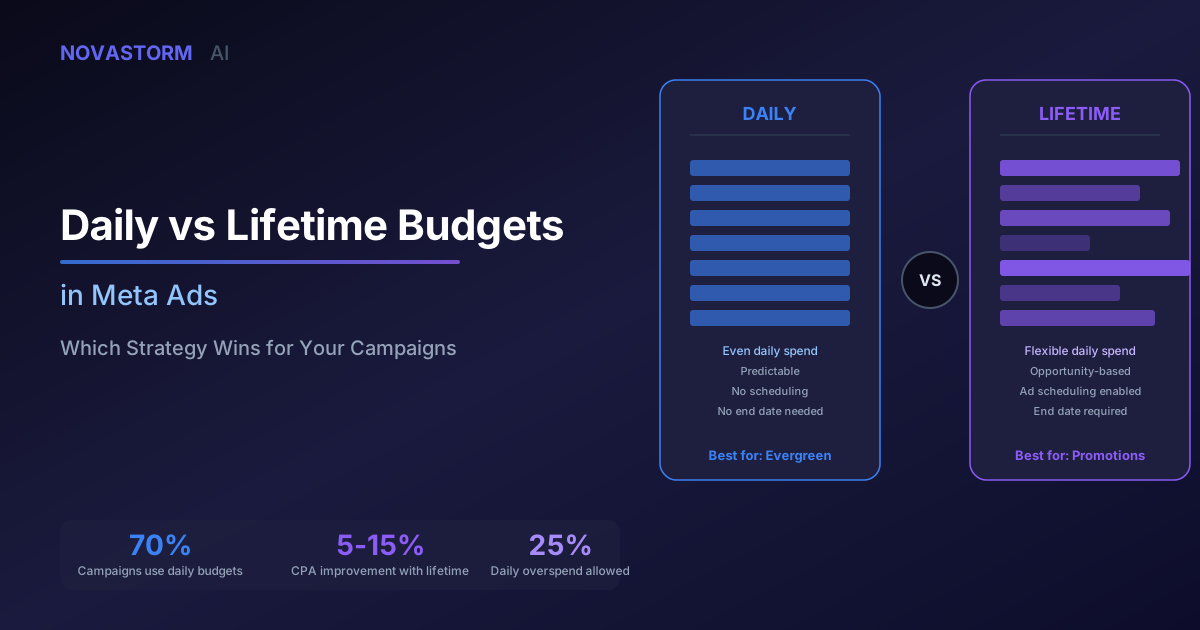
A daily budget expresses an average spending plan under Meta’s current delivery rules. A lifetime budget sets an allowance for a defined scheduled run. Neither choice guarantees a lower CPA, equal exposure or an even hourly spending pattern.
Compare the budgeting jobs
| Decision | Daily budget | Lifetime budget |
|---|---|---|
| Operating horizon | Useful for an ongoing campaign | Useful for a defined start/end period |
| Spend interpretation | Average; inspect current overdelivery rules | Total allowance over the saved period |
| Scheduling | Check eligibility in the current setup | Check eligibility in the current setup |
| Changes | Inspect the saved rules and delivery effect | Inspect dates, remaining allowance and edit behavior |
| Main risk | Mistaking an average for a strict daily cap | Mistaking a total allowance for equal daily spend |
Meta’s official campaign SDK defines daily_budget, lifetime_budget, start_time and stop_time fields. Their existence documents the API schema, not availability in every account or a promise that both budget types can be used together. Inspect the accepted configuration for your objective and budget level.
A daily planning example
A fictional ongoing campaign uses $20/day as a planning average. Thirty days at exactly that average would cost $600, but actual daily pacing can differ. If the business can lose no more than $600, verify supported spending controls and monitor the cumulative total. The average alone is not the loss-control mechanism.
A scheduled promotion example
A fictional six-day offer has a $600 lifetime allowance and a destination whose offer ends on the saved date. Equal spending would be $100/day, but the plan does not require equality. Confirm time zone, start/end settings, destination validity and remaining allowance after any edit.
Make the decision around actual constraints
- Use the operating horizon to choose the budgeting structure.
- Check scheduling and spending-limit eligibility before relying on a feature.
- Define the business outcome and allowable loss separately from pacing.
- Retain conversion-delay allowance and a change log.
- Review actual cumulative spend and mature contribution, not just a daily chart.
Use the test and monthly budget calculation before choosing either setting. For an experiment, budget consistency alone does not create randomized exposure; delivery allocation still needs the appropriate design.
After a budget edit
Stop wasting ad budget
NovaStorm AI cuts Meta Ads CPA by 30% on average. No complex setup required.
Confirm the setting actually saved, inspect delivery and investigate collection or destination failures immediately. Review mature outcomes at the agreed time. No fixed three-day wait, 50-conversion threshold or 20% edit guarantees unchanged learning or performance. The right budgeting choice serves the plan you can finance and review.
A setting record to fill after saving
Illustrative configuration records, not settings saved in a live account. Use account currency and timezone, record the actual accepted values after saving, and mark unavailable options explicitly.
| Field | Ongoing daily-plan example | Six-day promotion example |
|---|---|---|
| Currency / timezone | USD / UTC | USD / UTC |
| Start | 2026-11-01 00:00 UTC | 2026-11-01 00:00 UTC |
| End of review/run | Review 2026-12-01 00:00 UTC | End 2026-11-07 00:00 UTC |
| Budget type / level | Daily; campaign level if accepted | Lifetime; supported level must be checked |
| Entered allowance | $20 average/day | $600 total run |
| Business cumulative ceiling | $600 for the thirty-day planning window | $600 for the six-day run |
| Saved acceptance evidence | Read back actual value/status or record unavailable | Read back actual type, dates, value or record unavailable |
A proposed setting becomes a saved record only after successful readback. Do not substitute an input screenshot for evidence of acceptance. Inspect both configured and effective status before interpreting delivery.
Track the remaining allowance
Hypothetical six-day spending log: day 1 $140, day 2 $70 and day 3 $110. Cumulative spend is $320, leaving $280 of the $600 allowance. Equal remaining spending would be $93.33 per day over three days; it is a forecast, not a new enforced budget or required delivery pattern.
Suppose the display later reports $580, with an assumed possible $15 delayed charge and $10 further delivery before a stop takes effect. Potential final spend is $605. A monitor that waits until a displayed $600 may act too late. Verify supported controls and allow for reporting/action delay; record final spend after stopping. Do not assert a universal overdelivery percentage.
Review and approve a change
- Record request time, old budget/type/dates, requested new values, currency, cumulative spend and remaining business allowance.
- Have the budget owner approve the scope and cash exposure. In NovaStorm, prepare and review a paused draft; use the current supported editing route for accepted settings.
- Read back the saved values and effective status; note the timestamp and any validation error rather than assuming an edit succeeded.
- Reconcile actual delivery after the change and review matured business outcomes at the agreed time.
Equal budgets do not randomly assign audiences or guarantee equal exposure. To compare daily and lifetime delivery causally, design an appropriate experiment and preserve outcome definitions; separate campaigns with matching dollar amounts alone are insufficient.
Published by NovaStorm AI. Worked examples and proposed tests are labeled in the article.
Disclaimer: This article was generated with the assistance of AI and reviewed by the NovaStorm AI team. While we strive for accuracy, we recommend verifying specific data points and consulting official sources (linked where available) for critical business decisions.
Ready to automate your Meta Ads?
NovaStorm AI takes full responsibility for your campaigns — from monitoring to optimization.
Start NowMore on Budget and unit economics
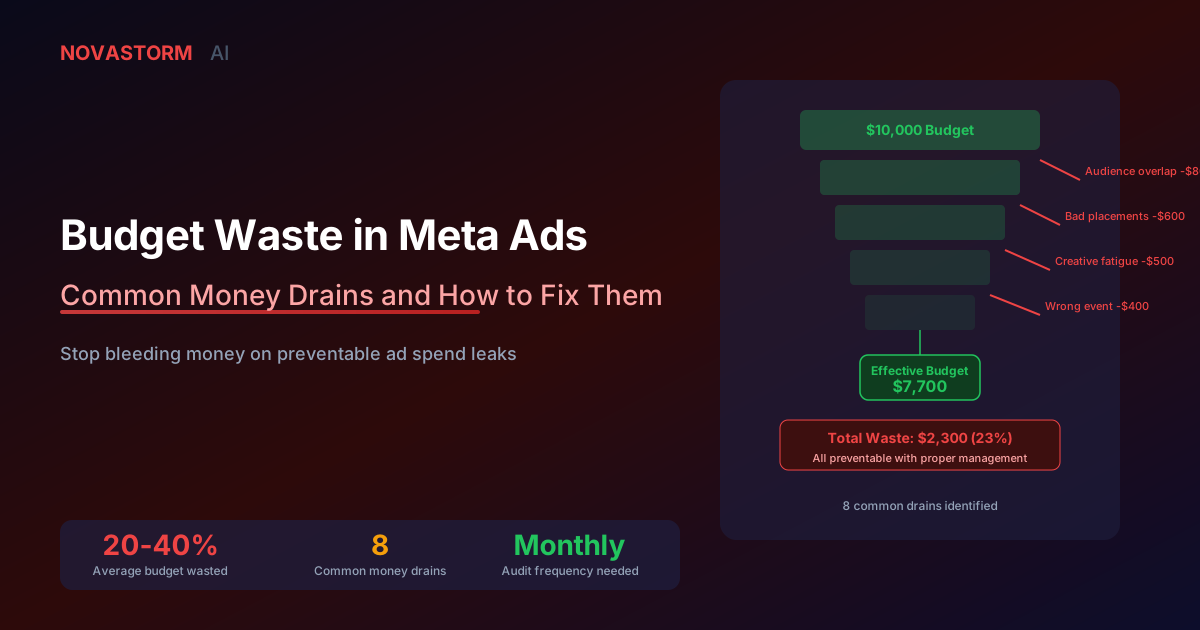
Budget Waste in Meta Ads: Common Money Drains and How to Fix Them
Audit eight potential Meta budget leaks with evidence, owners and acceptance checks, distinguish event mismatches, and act on cash-limit risk.
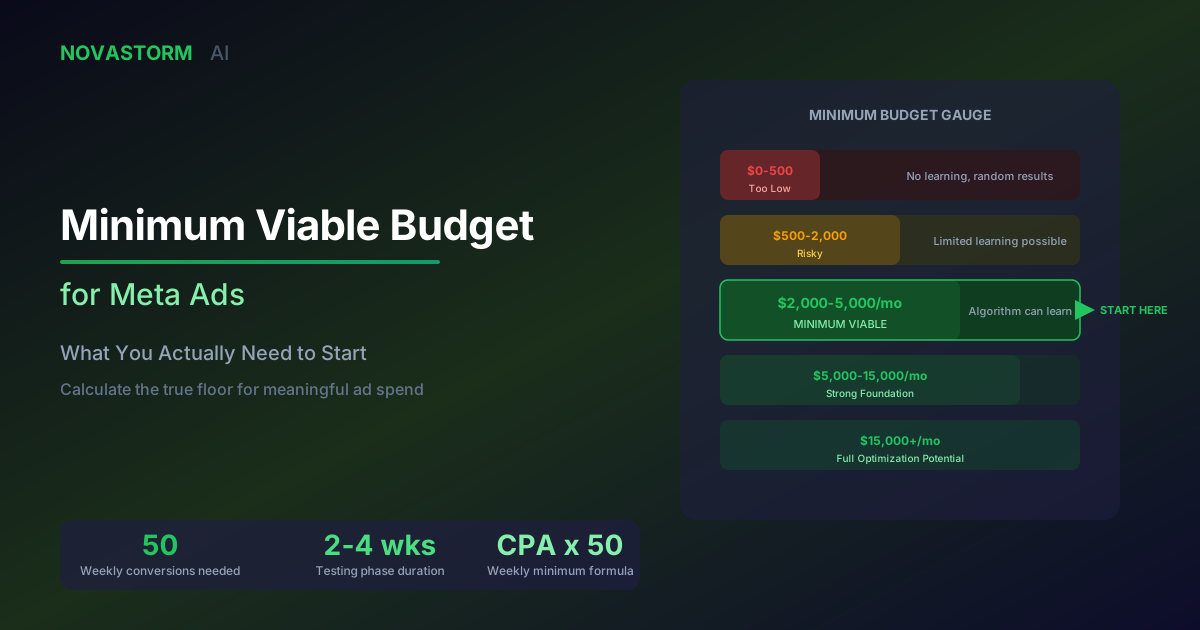
Minimum Viable Budget for Meta Ads: What You Need to Start
Judge what a small Meta ad budget can answer, verify tracking before spending, and close a capped test honestly with mature or inconclusive evidence.

Budget Allocation Across Funnel Stages in Meta Ads
Allocate Meta budget by campaign job, deduplicate credited orders, model retargeting capacity and review mature contribution under one cap.
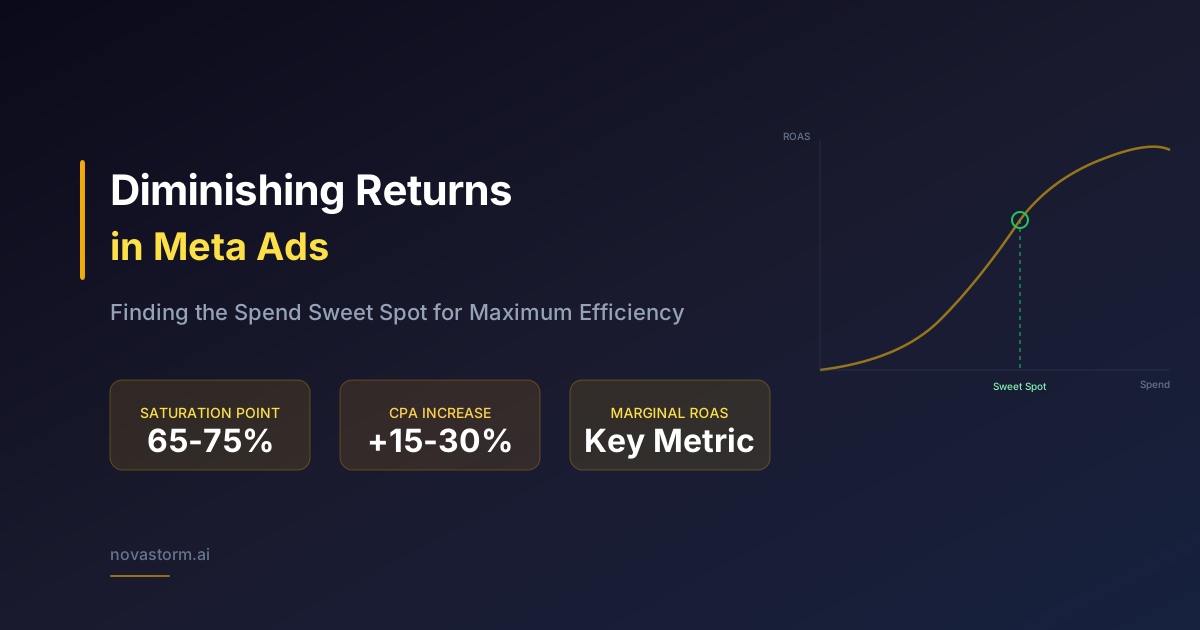
Diminishing Returns in Meta Ads: Finding the Spend Sweet Spot
Calculate a refund-adjusted marginal spending diagnostic, record confounders and propose a bounded budget test.