

Customer Data Platforms and Meta Ads: CDP Integration Strategy
Map four CDP flows, assign connector ownership, test identity and removals, and use verified audience data in an approved campaign brief.
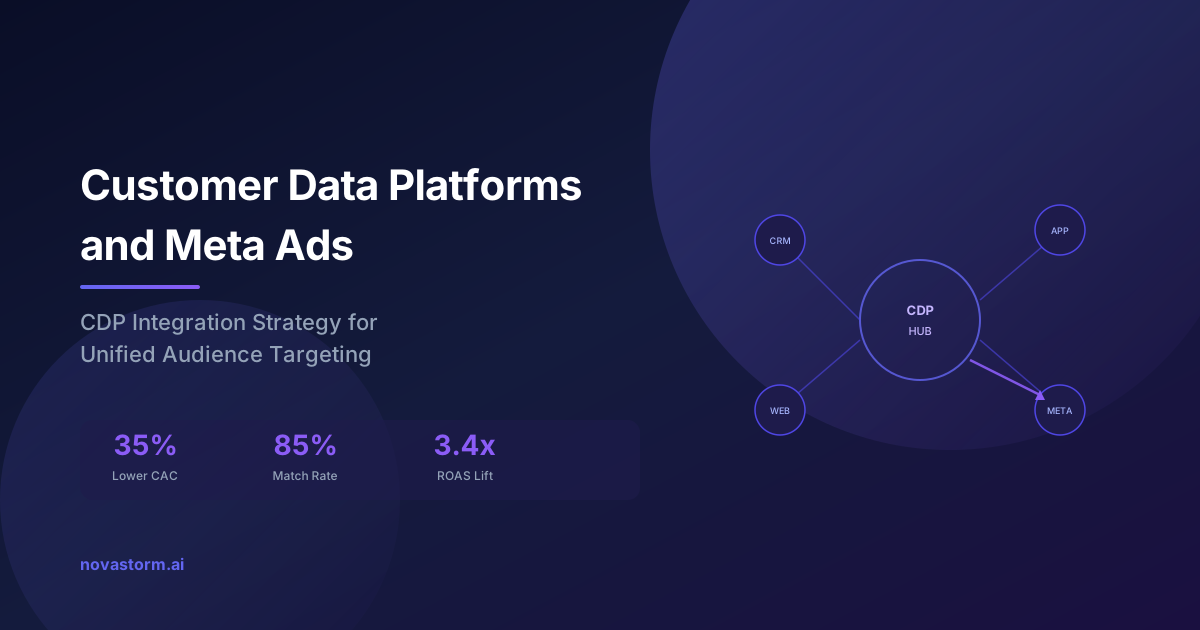
A CDP integration needs four separate contracts: profile identity, audience membership, conversion delivery and aggregate reporting. A connector logo or a successful request does not establish all four. Build an acceptance record for the precise connector release and direction of flow before using its data in a campaign.
A filled four-flow design fixture
The following is a hypothetical acceptance design for a fictional connector called Pilot Adapter 1.0, not a claim that a vendor supports these integrations or that the tests ran. Named role owners are assigned responsibilities; replace the adapter and release with the implementation actually selected before execution.
| Flow | Direction and selected contract | Owner / release | Acceptance evidence |
|---|---|---|---|
| Profile identity | Store CRM to CDP; permitted internal person key | Data steward / Pilot Adapter 1.0 | Shared-email conflict held, preferences retained |
| Audience membership | Eligible segment to Meta audience users endpoint | Marketing operations / Pilot Adapter 1.0 | Add/remove acknowledgement, processing state and timestamps |
| Conversion | Completed order to Meta server event | Integration engineer / Pilot Adapter 1.0 | Event name/time/identity/value checked; retry same identity |
| Reporting | Meta aggregate report to analytics warehouse | Analytics owner / Pilot Adapter 1.0 | Account, currency, date and attribution scope reconciled |
The Meta server event contract describes conversion fields and uses event_id together with event_name to identify browser/server duplicates. It is not an audience-upload endpoint and does not return person-level ad impressions. The CustomAudience SDK separately exposes user add and delete operations; this schema alone does not verify a particular connector’s access, processing delay or matched reach.
Count profiles without inventing reachable people
Hypothetical pilot: 1,000 permitted profiles enter a segment and forty later become ineligible. The arithmetic leaves 960 eligible source profiles if every exclusion is correctly applied. That is not 960 matched, delivered-to or reachable Meta users. Duplicates, identifier availability, matching and processing can all change the destination result. Keep source count, submitted updates and observed destination state separate.
Failure journal and proposed acceptance
Stop wasting ad budget
NovaStorm AI cuts Meta Ads CPA by 30% on average. No complex setup required.
This is an unexecuted test fixture. Times and limits are chosen test expectations, not measured connector latency or Meta guarantees. For the pilot, choose a five-minute local queue dispatch objective and a separate destination observation deadline approved by the owner; a dispatch acknowledgement is not proof of destination removal.
| Injected condition | Required action | Evidence for acceptance |
|---|---|---|
| Two people share an email | Quarantine uncertain merge; preserve separate internal keys | No order or preference reassigned without verified identity |
| Permission withdrawn at 10:02 | Cancel queued addition; request permitted removal | Change version, dispatch time, response and subsequent state |
| Order delivery times out | Retry the same logical order identity | Same event_name/event_id, no new order created |
| New order from same person | Create a distinct logical event identifier | New order stays distinct from earlier retry |
| Reporting import fails | Keep prior dataset visibly stale; retry boundedly | Last successful cutoff, owner and recovery state |
A five-minute dispatch expectation can be tested locally, while destination processing and match behavior require their own evidence. If a removal request is accepted but state remains unresolved, mark the test unresolved and stop using that audience as a verified suppression mechanism. Do not replace an uncertain observation with a passing status.
Use a verified segment in a campaign brief
- Define one permitted segment and one business hypothesis, such as an appropriate repeat-purchase offer for previous buyers. Document membership and exclusions.
- Run the identity, withdrawal, retry and reporting tests with the real connector release. Save sanitized results, timestamps and responsible owner.
- After acceptance, bring the segment definition, actual destination availability and refresh limit into a NovaStorm paused campaign brief.
- Review the offer, creative and loss allowance before publishing. Connector delivery success does not demonstrate that the offer improves contribution.
The first-party data inventory helps define permitted use and retention. NovaStorm draft preparation does not establish a built-in CDP connector, deletion synchronization or randomized performance test. Evaluate those capabilities separately against the actual implementation and a measured campaign hypothesis.
Published by NovaStorm AI. Worked examples and test fixtures in this article are illustrative, not observed customer results.
Disclaimer: This article was generated with the assistance of AI and reviewed by the NovaStorm AI team. While we strive for accuracy, we recommend verifying specific data points and consulting official sources (linked where available) for critical business decisions.
Ready to automate your Meta Ads?
NovaStorm AI takes full responsibility for your campaigns — from monitoring to optimization.
Start NowMore on Tracking and first-party data
Google Tag Manager and Meta Pixel: Advanced Setup Guide
Set up Meta Pixel in GTM with explicit tag ownership, confirmed-action data-layer events, tested consent controls and separate server delivery.
Klaviyo and Meta Ads Integration: E-commerce Data Sync
Verify Klaviyo lead intake, audience movement and recent-buyer exclusions before using a segment in an approved Meta campaign brief.
Meta Ads SDK Integration for Mobile App Tracking
Plan Meta mobile app event tracking around current SDK versions, platform permissions, confirmed purchases and tests of restricted as well as eligible states.
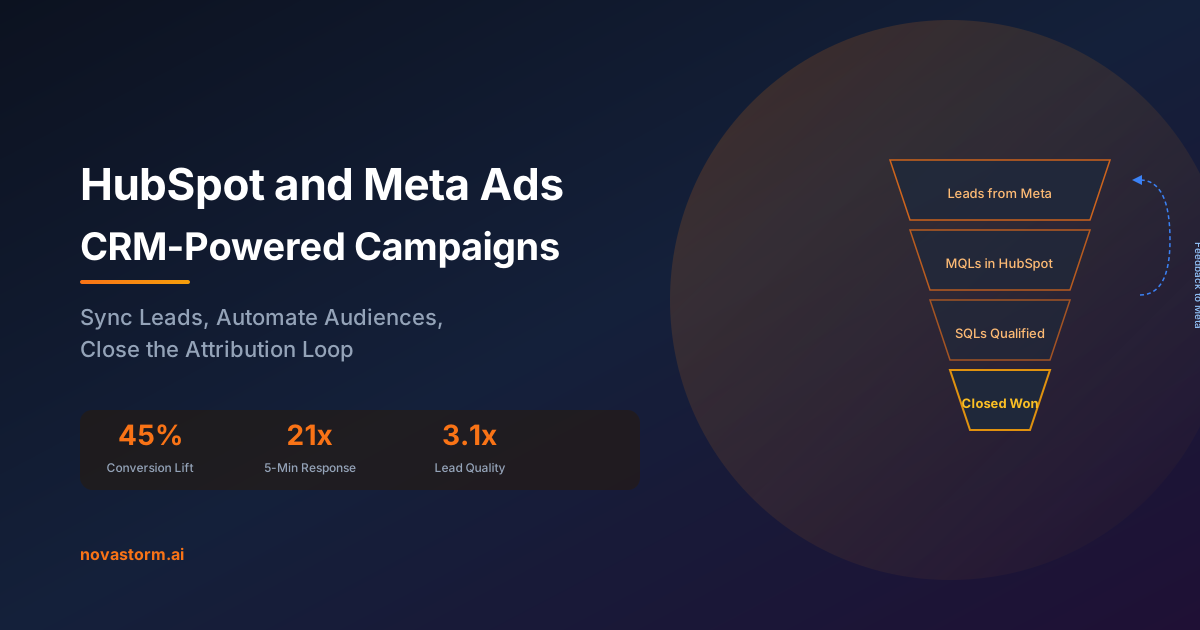
HubSpot and Meta Ads: CRM-Powered Advertising Campaigns
Define HubSpot lead quality, test lifecycle and retry behavior, and approve a supported Meta campaign goal without mistaking stages for revenue.