

First-Party Data Strategy for Meta Ads in a Cookieless World
Choose a permitted first-party subset, assign data owners and expiry rules, and verify suppression across separate audience and conversion-event workflows.

First-party records come from your own customer relationships, but accuracy and permitted advertising use still need verification. Audience membership and conversion events answer different questions. Keep their schemas, owners and permission checks separate rather than treating a CRM as an unrestricted advertising export.
Start with the eligible subset
Illustrative shop inventory: 1,000 customer records, 700 usable emails, of which 500 also qualify for the particular audience use under the shop’s configured policy. Export those 500 eligible, field-valid records. These assumptions do not predict Meta matching, reach or sales. An operational order may remain in accounting while being excluded from advertising processing.
A filled ownership and access worksheet
| Dataset | Owner and allowed access | Illustrative retention/update rule | Advertising fields |
|---|---|---|---|
| Orders | Commerce owner; finance reads full ledger; measurement operator reads eligible subset | Reconcile daily; accounting retention follows applicable obligations | Order ID, paid time, currency and value when permitted |
| Contact permissions | Preference-service owner; activation worker reads purpose-specific current status | Update on change; retain required evidence under the approved policy | Purpose, destination, status, effective time and policy version |
| Audience candidate list | CRM owner; authorized export operator only | Chosen 30-day revalidation; expire stale candidates before export | Only permitted normalized identifiers required by destination |
| Delivery/rejection log | Integration owner; restricted technical access | Chosen 14-day diagnostic retention; avoid raw personal payloads | Internal job ID, safe reason category, status and timestamp |
The 30-day and 14-day choices are hypothetical operating rules, not universal legal periods. Approve actual retention with the responsible team, document exceptions and apply deletion/access controls. Do not expose full payment records to a creative collaborator merely because a customer audience exists.
Keep audience and CAPI schemas distinct
| Workflow | Safe schematic fields | What it does not establish |
|---|---|---|
| Audience export | Job reference, purpose, destination, policy version, eligible normalized/hashed identifier fields | No purchase event; no prediction of matched size |
| Conversion event | event_name, event_time, event_id, truthful value/currency, permitted user_data | No automatic audience list; no complete ad-exposure history |
| Operational reconciliation | Order ID, preference change, source and delivery status | Not a public payload and not advertising permission by itself |
Stop wasting ad budget
NovaStorm AI cuts Meta Ads CPA by 30% on average. No complex setup required.
These are conceptual schemas without real identifiers, credentials or an executable request. Follow the selected customer-list template for audience normalization. For CAPI, check Meta’s field-specific user-data implementation; identifiers, cookies and request context have different handling. Hashing identifiers does not make the records anonymous or grant permission to transfer them.
Propagate withdrawal and reject stale work
- A permission owner records withdrawal with purpose, effective time and affected destinations. The export worker rechecks current status immediately before sending, not only when building yesterday’s queue.
- Remove the record from future candidate exports and use the destination’s supported audience removal or replacement process as applicable. Verify completion/status; dropping a row from the next file alone does not prove an already uploaded audience lost that member.
- Suppress future events for withdrawn advertising use according to the applicable policy. Cancel queued work that no longer qualifies; do not retry it after withdrawal. Existing operational payment records and historical advertising data need their separate retention/removal processes.
- Quarantine stale policy versions, expired eligibility or rejected records. Log a safe reason, assign an owner and rebuild only from current eligible data. Never broaden the eligible list to make an export succeed.
An illustrative suppression acceptance test
Assume one of the 500 eligible records, customer R, withdraws before the next audience job and has one queued event. Expected result: the future eligible set is 499; R is absent from export output and the queued event is suppressed. The supported audience removal job must complete separately. A retry of a previously rejected export must rebuild from current preferences and exclude R again. These are expected assertions for a proposed test, not a reported deletion result.
Test stale cached preferences and duplicate withdrawal delivery. Check the rendered export in a protected environment, a sanitized job log and actual destination status; do not publish identifiers. If removal or event suppression fails, suspend the affected activation workflow and resolve the ownership gap before sending more.
Use the CDP architecture guide for separate audience/event responsibilities. Measure eligible coverage, stale preferences and rejected delivery before buying more tooling. NovaStorm can support creative preparation; this article does not demonstrate that it collects customer records, exports audiences or transmits CAPI events.
Published by NovaStorm AI. Planning examples are illustrative assumptions, not measured customer results.
Disclaimer: This article was generated with the assistance of AI and reviewed by the NovaStorm AI team. While we strive for accuracy, we recommend verifying specific data points and consulting official sources (linked where available) for critical business decisions.
Ready to automate your Meta Ads?
NovaStorm AI takes full responsibility for your campaigns — from monitoring to optimization.
Start NowMore on Tracking and first-party data

Meta Ads Pixel Debugging: How to Fix Tracking Issues Fast
Trace a paid order through browser and server checkpoints, test duplicate delivery and failed payment, and distinguish event receipt from attribution.

Offline Conversion Tracking on Meta: Connecting Store Sales to Ads
Map confirmed store sales to connector fields, preserve event identity through retries, and reconcile delivery separately from ad credit and incremental effect.
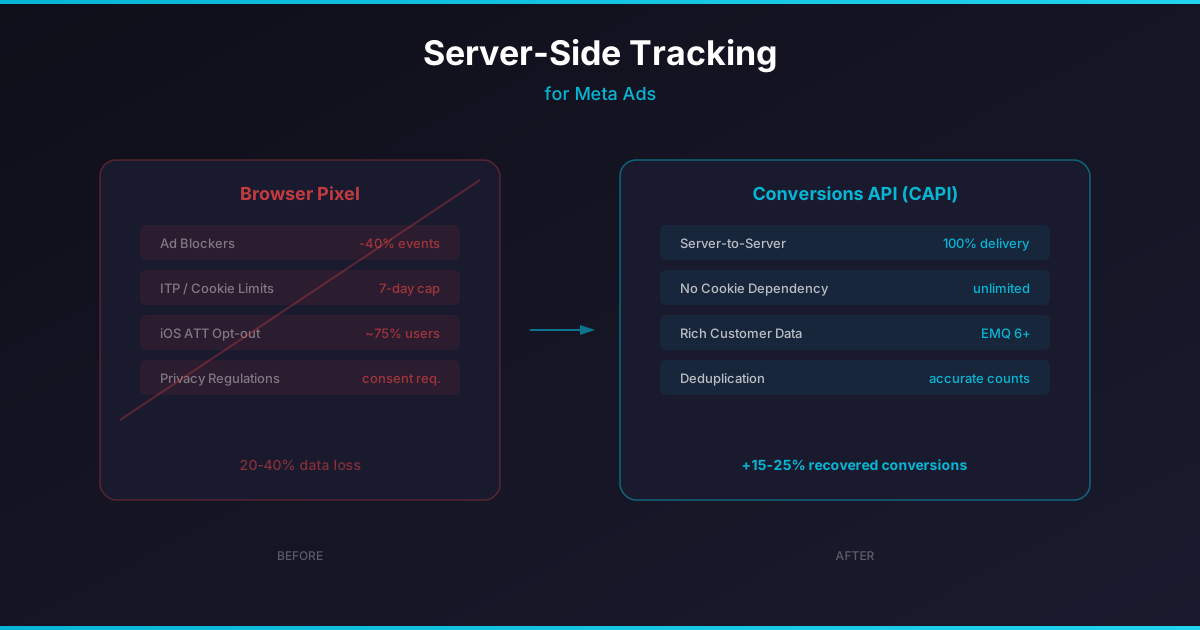
Server-Side Tracking for Meta Ads: Why It Matters More Than Ever
Design a consent-gated server-side event flow, recover from delivery failures, and distinguish source persistence from Meta CAPI acceptance.

Meta Conversions API (CAPI): Setup Guide and Best Practices
Validate a browser/server Purchase pair against paid orders, test retries and second purchases, and keep CAPI delivery separate from source persistence and attribution.