

Cart Abandonment Retargeting on Meta: Test Incremental Profit
Plan a cart-retargeting sequence, verify purchases and suppression, and compare incremental contribution after discounts, delivery and advertising costs.
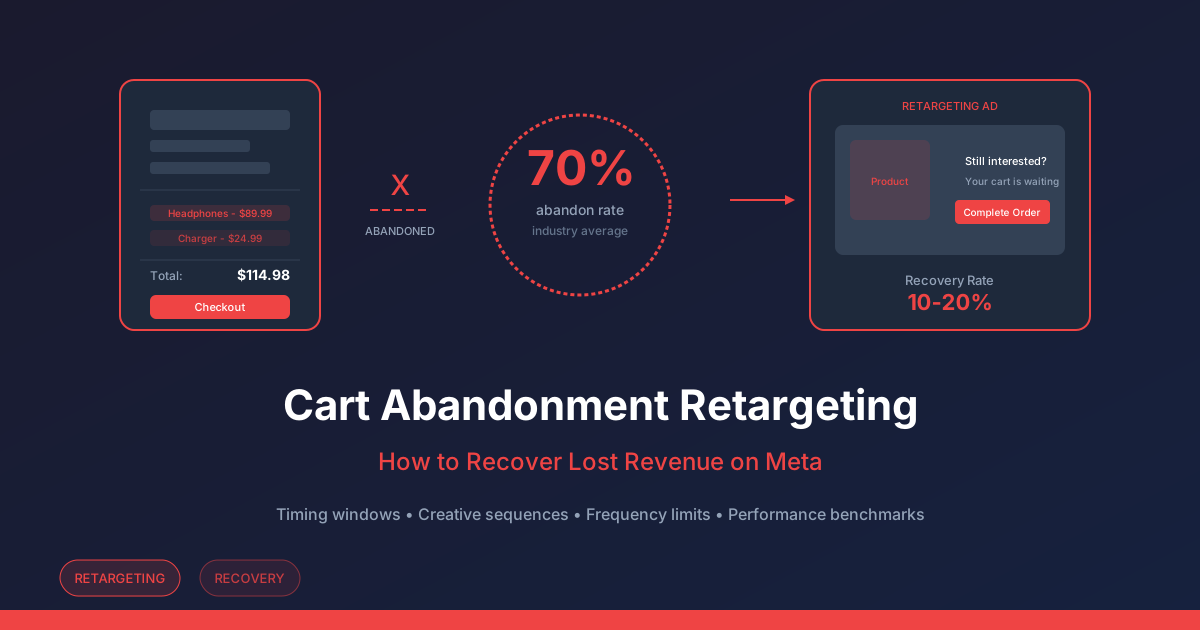
A purchase following a reminder ad is not automatically a sale caused by that ad. Some shoppers return organically, through email or because they were already ready to buy. Treat cart retargeting as a hypothesis about additional profitable purchases, then verify events and compare outcomes.
Check the cart-to-purchase path first
- Define abandonment using actual cart/checkout activity and a declared observation window. A cart event is not a unique person or confirmed purchase.
- Complete a test order and reconcile the paid order with Purchase, value, currency and duplicate collection paths. Check canceled/refunded orders separately.
- Verify the purchaser suppression source, update schedule and supported exclusion controls in the saved configuration. Suppression may lag or fail to match; do not promise immediate removal of every buyer.
- For catalog ads, compare the exact item/variant identifier in the catalog with content_ids in cart and purchase events. Resolve mismatches, unavailable stock and broken images before launch.
- Confirm consent, offer rights, checkout totals and destinations. Do not send customer information into public creative briefs.
A proposed message sequence
The following windows are illustrative planning choices, not measured optimal timings. Choose actual windows from purchase-delay observations and available audience controls. Time-based segments do not guarantee that every person sees every message in order.
| Candidate window | Message | Truth and suppression check |
|---|---|---|
| First day after abandonment | "Still considering the everyday bag? Review the size and delivery details." | Product remains available; purchaser exclusion is supported and checked |
| Days 2–3 | Show a verified feature demonstration or a consented genuine review | No invented review count or unsupported product claim |
| Days 4–7 | Offer a genuine approved incentive if its economics allow it | State exact terms and real expiry; exclude confirmed buyers |
| After the selected window | Stop the sequence or review a different eligible use case | Do not move everyone into indefinite repeated reminders |
Compare economics, not just attributed ROAS
Stop wasting ad budget
NovaStorm AI cuts Meta Ads CPA by 30% on average. No complex setup required.
Illustrative assumptions: a $100 order has $60 variable costs, leaving $40 before ads. A $10 discount leaves $30 if costs stay unchanged; a $6 delivery subsidy leaves $34. If the business requires $10 contribution after advertising, candidate CPA limits are $30 without an incentive, $20 with the discount and $24 with the delivery subsidy. Real tax, refund, fulfillment and payment costs may change these values.
A filled control-comparison plan
Synthetic arithmetic, not an experiment result: two comparable assigned groups each contain 500 eligible abandoners. The no-ad group has 30 paid orders and the ad group has 40. The difference is 10 orders, or two percentage points, before uncertainty and validity checks. At $40 contribution per order and $300 ad spend, the candidate net difference is 10 × $40 − $300 = $100. If all 40 treatment orders also receive a $10 discount and control orders do not, the same calculation becomes $100 − $400 = −$300. Discounts on purchases that would happen anyway matter.
- Use feasible supported controlled assignment and define eligibility, suppression and measurement before exposure. Ordinary exposed-versus-unexposed customers may differ systematically.
- Keep concurrent email/SMS, offer, stock and observation windows consistent or record their differences. Count mature unique paid orders and net contribution in both groups.
- Approve sample feasibility, a spend ceiling, cash-loss cap and review date. Include incentive costs on all qualifying purchases, not only presumed additional ones.
- Report uncertainty and inconclusive outcomes. Without a valid control, label post-ad orders attributed rather than incremental.
Bound repetition and prepare the draft
Review observed frequency, complaints and marginal mature contribution together. Only apply an individual frequency cap if the selected configuration supports it; otherwise use a bounded spend/window and a review. There is no universal three-to-five exposure target. NovaStorm can prepare truthful sequence briefs as paused campaign and local ad-set drafts. Catalog retargeting, suppression syncing and holdout execution need separately confirmed capabilities.
Published by NovaStorm AI. Planning examples are illustrative assumptions, not measured customer results.
Disclaimer: This article was generated with the assistance of AI and reviewed by the NovaStorm AI team. While we strive for accuracy, we recommend verifying specific data points and consulting official sources (linked where available) for critical business decisions.
Ready to automate your Meta Ads?
NovaStorm AI takes full responsibility for your campaigns — from monitoring to optimization.
Start NowMore on Custom audiences and retargeting
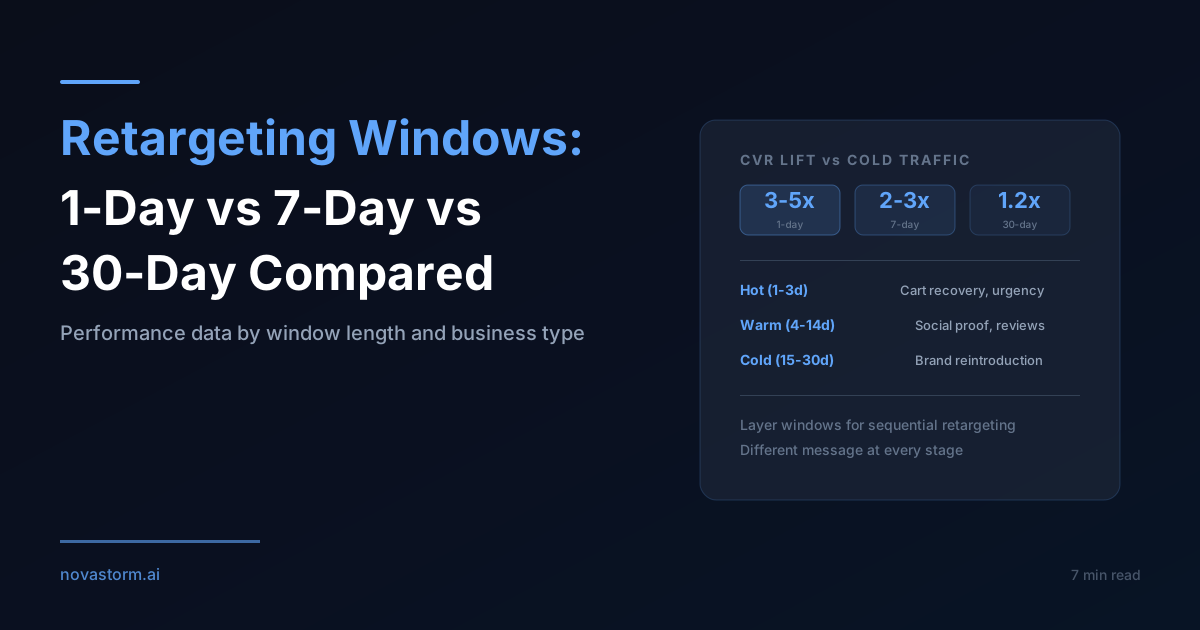
Retargeting Windows: 1-Day vs 7-Day vs 30-Day Performance Compared
Build supported 1-, 7- and 30-day retargeting tiers, plan re-entry and measure incremental paid orders rather than assume recency multipliers.
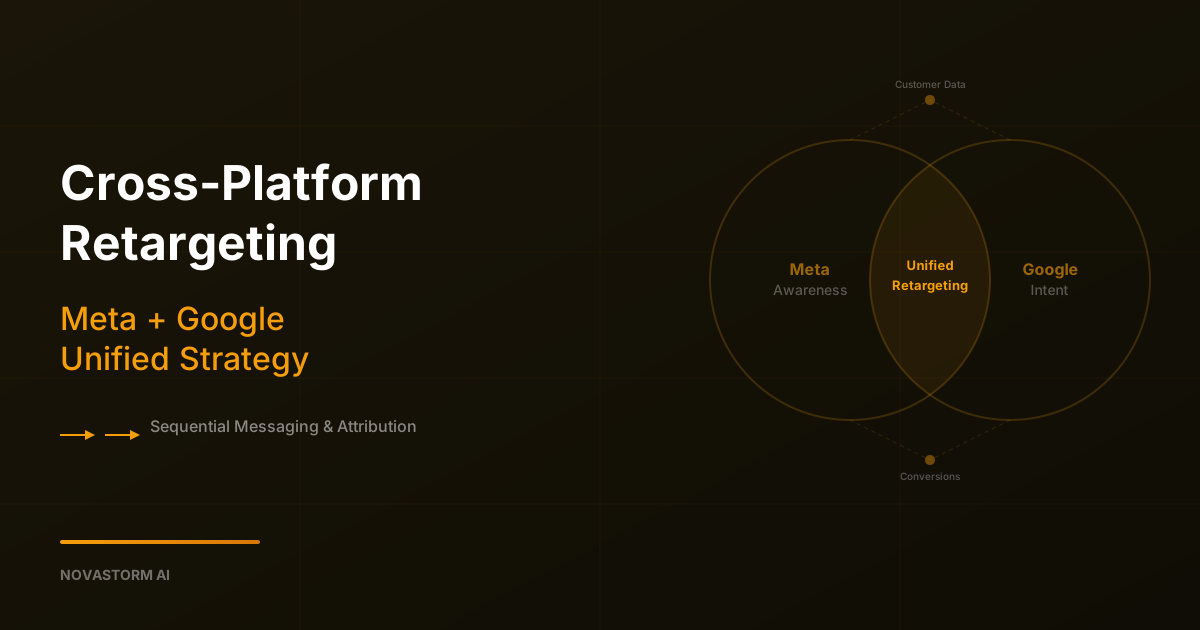
Cross-Platform Retargeting: Meta + Google Unified Strategy
Coordinate Meta and Google retargeting messages with permission-aware segment records, visible sync failures and separately tested incremental outcomes.
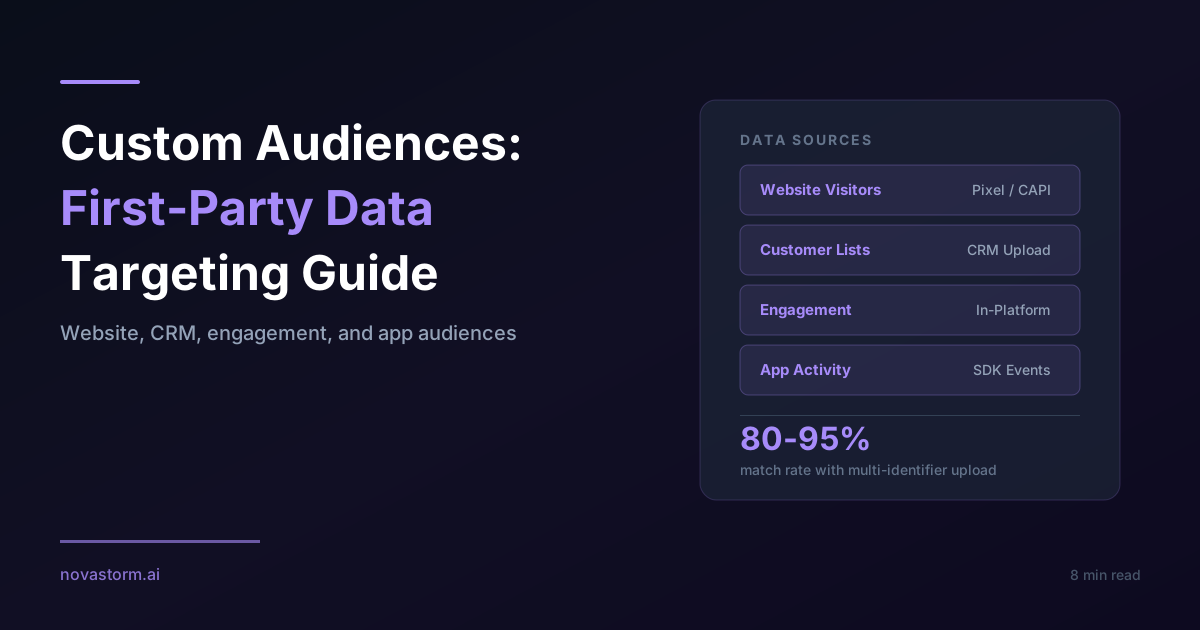
Custom Audiences: The Complete Guide to First-Party Data Targeting
Prepare a permitted customer-list upload, diagnose its processing errors and plan audience refreshes without invented match-rate benchmarks.
Retargeting Frequency: How Often Should You Show Ads to the Same Person
Diagnose retargeting frequency against your buying cycle, verify available controls and compare creative rotation using unique reach and mature acquisition cost.