

Behavioral Segmentation for Meta Ads: Action-Based Audiences
Master behavioral segmentation for Meta Ads. Build action-based audiences from website events, app activity, and engagement signals to drive higher conversion rates.
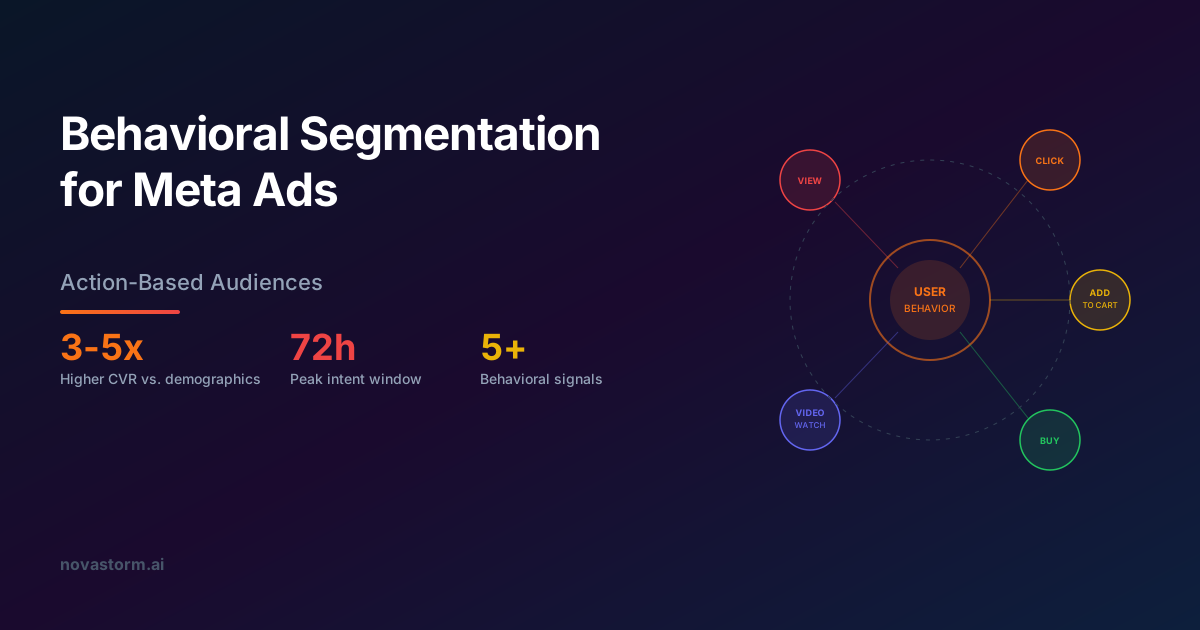
Behavior is evidence of an action, not a complete explanation of intent. A cart event can support a relevant follow-up hypothesis, while a FAQ visit may indicate a careful buyer. Start with one manageable audience and verify actual account controls rather than assuming any event combination can be expressed or delivered.
One proposed cart audience
Unexecuted account configuration worksheet: include eligible people with an AddToCart occurrence in the last seven days; exclude a separately configured Purchase audience covering the last 30 days, plus applicable marketing objections or suppression. These windows are chosen for a fictional shop, not recommended universal retention periods. Keep event collection lawful and verify purchases correspond to genuine accepted transactions.
| Field | Teaching configuration | Acceptance before launch |
|---|---|---|
| Source | Authorized website event source | Correct source ownership and permitted collection |
| Inclusion | AddToCart; seven-day chosen window | Read back available rule and retention in the actual account |
| Purchase exclusion | Purchase; 30-day chosen window | Confirm exclusion is attached and reflects current accepted purchases |
| Other suppression | Permission withdrawals and ineligible records | Verify removal process in the source and account |
| Message | “Still considering this product? Review details and delivery terms.” | Correct product; no false scarcity or assumed personal condition |
| Delivery boundary | Read back effective targeting and expansion settings | Do not infer a hard boundary from the audience name |
The Meta custom-audience SDK schema includes website-audience, rule and retention concepts; the targeting schema includes custom-audience exclusions. These establish configuration vocabulary, not that this specific account accepts every rule. Do not launch until the actual supported configuration has been read back. No audience was created in this teaching article.
Avoid unsupported intersections and frequency promises
A “watched video, then visited a page within 48 hours” sequence requires reliable identity, ordering and an actually supported rule or an authorized external derivation. Listing the two audiences is not proof of that sequence. This worksheet does not require a cross-source AND intersection and does not promise three impressions per day for every objective. Check objective-specific frequency controls and delivery eligibility in the actual account; ordinary observed average frequency is not an individual cap.
There is no assumed three-to-fivefold conversion improvement or universal minimum of 1,000 retargeting members or 10,000 seed members. Small groups can make estimates unstable and delivery difficult, but the decision needs actual eligible size, matching, reach and mature economics rather than a copied numeric threshold.
Stop wasting ad budget
NovaStorm AI cuts Meta Ads CPA by 30% on average. No complex setup required.
Diagnose apparent negative behavior
| Action | Plausible alternative explanation | Check before excluding |
|---|---|---|
| Reads FAQ | Needs delivery or product clarity | Which question, whether it is answered and accepted next action |
| Views return policy | Evaluates purchase risk | Terms visibility and subsequent order; not disinterest by default |
| Repeated product views | Compares variants or experiences a broken selection control | Reproduce selection and checkout on the same build |
| Visits support after purchase | Needs legitimate service | Keep service access; separate suppression from withholding support |
Measure additional purchases rather than attributed ones alone
Hypothetical external holdout plan: randomize eligible shoppers into comparable groups under an approved protocol, keep existing service access in both, and suppress the new advertising intervention in the control where technically feasible. Document assignment, delivery contamination, purchase maturity, refunds and contribution. A user’s subsequent purchase may have happened without the ad.
A simple teaching result of 12 purchases among 100 contacted shoppers and ten among 100 controls gives a two-percentage-point descriptive difference, not reliable proof of lift. At assumed contribution USD 25 per extra purchaser, two × 25 = USD 50; media USD 80 and production USD 20 leave a point estimate of −USD 50. Report uncertainty and assignment limitations instead of calling a positive conversion rate a winning campaign.
Turn the confirmed behavior and offer into a message brief for a reviewed NovaStorm draft. Complex audience sequencing, randomization and suppression verification remain separate account and data work. The cart recovery guide covers the adjacent economics and destination checks.
Published by NovaStorm AI. Worked examples and test fixtures in this article are illustrative, not observed customer results.
Disclaimer: This article was generated with the assistance of AI and reviewed by the NovaStorm AI team. While we strive for accuracy, we recommend verifying specific data points and consulting official sources (linked where available) for critical business decisions.
Ready to automate your Meta Ads?
NovaStorm AI takes full responsibility for your campaigns — from monitoring to optimization.
Start NowMore on Audience targeting and prospecting
RFM Segmentation for Meta Ads: Recency, Frequency, Monetary Targeting
Learn how to apply RFM segmentation to your Meta Ads campaigns. Target audiences by recency, frequency, and monetary value to maximize ROAS and reduce wasted ad spend.
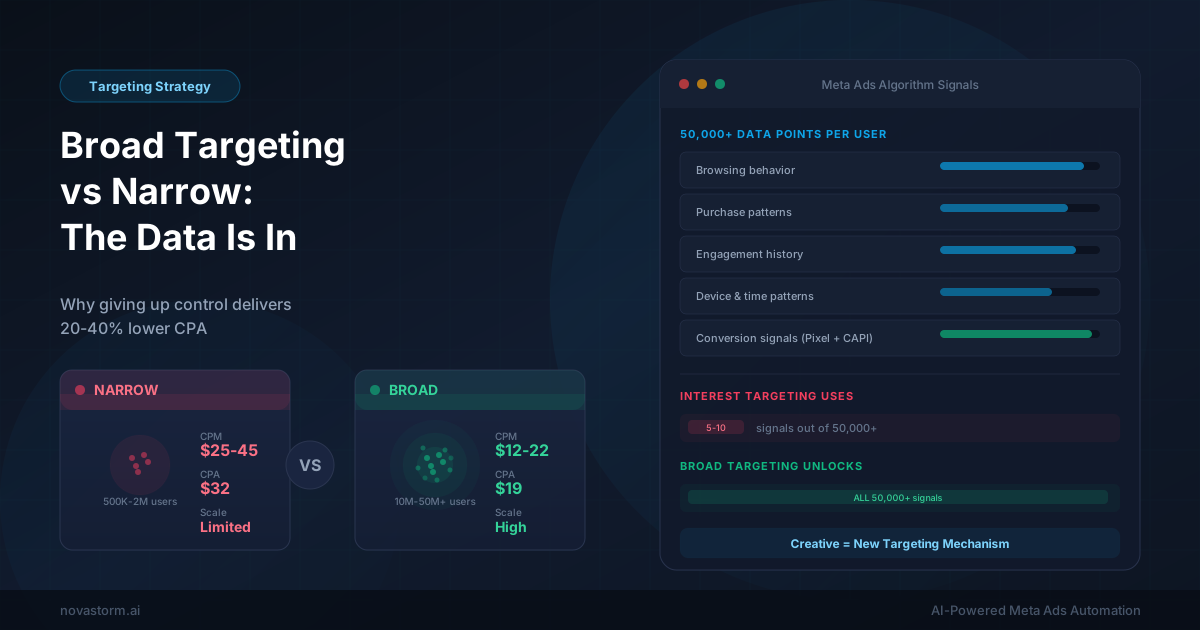
Broad Targeting in Meta Ads: Set Boundaries Before Testing
Prepare a broad-versus-narrow targeting comparison with business boundaries, mature paid-order metrics, a loss cap and an explicit inconclusive outcome.
Lookalike Audiences in 2026: How to Build and Scale Them
Validate a permitted lookalike source and saved expansion behavior, then plan mature-order reviews and a total capped budget.

Automated Audience Expansion: When to Let Meta Find New Segments
Test audience expansion with enforced service geography, qualified mature outcomes, explicit spend limits and a real assignment plan.