

Broad Targeting in Meta Ads: Set Boundaries Before Testing
Prepare a broad-versus-narrow targeting comparison with business boundaries, mature paid-order metrics, a loss cap and an explicit inconclusive outcome.
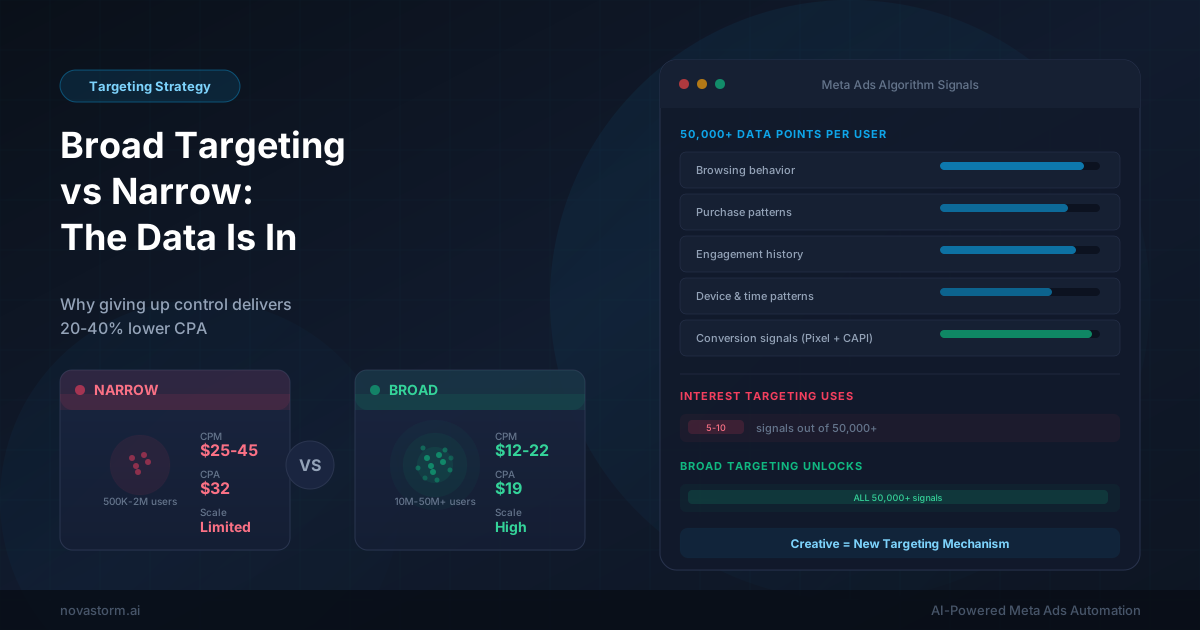
Broad targeting gives delivery more freedom inside the audience your business can serve. Whether it improves acquisition is a hypothesis to test, not a promised CPA reduction. Start by separating business requirements from assumptions about who will respond.
Write the eligible-market brief first
Hypothetical example: a nationwide online shop wants to compare broad delivery with an interest-based audience. This is a planning worksheet, not a customer account or a measured result. All monetary inputs below are illustrative assumptions.
| Brief field | Illustrative entry | Review before delivery |
|---|---|---|
| Availability | Ships only to the market selected in the brief | Check the actual saved location boundary; expansion must not include an unserviceable market |
| Offer | Same product, price and shipping promise in both arms | Confirm stock, shipping exclusions and the destination page |
| Order economics | Assumed revenue $80; variable costs $50; contribution before ads $30 | Use net paid orders after discounts, refunds and variable fulfilment costs |
| Business target | Assumed target paid-order CPA $20, leaving $10 contribution per order | The target is a business choice, not a Meta benchmark |
| Audience hypothesis | Interest suggestions identify more relevant customers than broad eligible delivery | Verify which saved settings constrain delivery and which only suggest a starting audience |
| Signal | Paid orders reconciled with the order system | Check event duplication and attribution before evaluating audience performance |
Service eligibility must survive both configurations. A narrow hypothesis is optional; a required market restriction is not. For the distinction between controls and suggestions, use the Advantage+ audience guide and inspect your account’s actual saved settings. Do not assume every account exposes the same configuration.
Define one comparison and its stopping conditions
- Use the same offer, destination, conversion event and creative in both arms. Record any difference that cannot be held constant.
- Choose net paid-order CPA as the shared primary metric: advertising spend divided by mature eligible paid orders. Also inspect contribution after ads and service eligibility; a cheap order that cannot be fulfilled is not a win.
- Decide how to assign comparable traffic. Use an available randomized experiment if a causal comparison is required; two parallel campaigns alone do not remove audience overlap or delivery differences.
- Set a conversion-maturity rule from your own click-to-order and refund timing. For this hypothetical plan, assume seven days after the last test click before final order reconciliation. Seven days is an assumption to validate, not a required attribution window.
- Predeclare a calendar limit, spend limit and business-loss limit. Illustrative assumptions: up to $200 spend per arm, up to $100 negative contribution after ads per arm, and fourteen delivery days. Stop on a cap or an eligibility/tracking failure; these limits protect cash but do not guarantee statistical power.
- At the deadline, report an inconclusive comparison if uncertainty is too large or outcomes are too few. Do not declare broad targeting the winner merely because one arm has the lower point estimate. Estimate the needed sample from baseline variability and the smallest economically useful difference before running another test.
Stop wasting ad budget
NovaStorm AI cuts Meta Ads CPA by 30% on average. No complex setup required.
Illustrative calculation only: suppose each arm spends $200. Ten mature paid orders produce CPA $20; eight produce CPA $25. With assumed $30 contribution before ads per order, contribution after ads is $100 and $40 respectively. These are arithmetic examples, not observed performance or evidence of superiority. Such small counts can be unstable; a follow-up design must evaluate uncertainty and budget feasibility.
The A/B testing guide covers experiment planning. Changing the conversion event to get more signals changes what is being optimized; first establish whether that event predicts the paid-order outcome you care about.
Keep a draft review log in NovaStorm
Proposed preparation workflow: write the brief, prepare the campaign structure, and review the paused campaign and local ad-set drafts before approving delivery. The supported preparation state does not prove settings are live or that an audience will perform. No broad-versus-narrow outcome has been measured for this example.
| Review entry | What to record | When to check |
|---|---|---|
| User-confirmed boundary | Service market, stock and eligibility approved by the responsible person | Before approval; inspect saved settings after any publication |
| Economic assumptions | Source of margin inputs and the approved CPA and cash-loss caps | Before approval and when actual order costs change |
| Unresolved hypothesis | Whether the narrower audience improves mature paid-order contribution | After the prespecified maturity window, or mark inconclusive |
| Delivery status | Actual campaign/ad-set state and spend; paused preparation is not delivery | After any separately approved publication and on the first delivery check |
| Final decision | Continue, revise or stop, with uncertainty and reconciled order counts | At a cap or the declared deadline; record any early change |
Make eligibility and the real benefit clear in the creative. Creative relevance is another hypothesis; it does not deterministically select a customer segment. Check the targeting options available in your account and validate the saved configuration before committing money.
Published by NovaStorm AI. The worked example and thresholds are explicitly hypothetical; no customer result is claimed.
Disclaimer: This article was generated with the assistance of AI and reviewed by the NovaStorm AI team. While we strive for accuracy, we recommend verifying specific data points and consulting official sources (linked where available) for critical business decisions.
Ready to automate your Meta Ads?
NovaStorm AI takes full responsibility for your campaigns — from monitoring to optimization.
Start NowMore on Audience targeting and prospecting
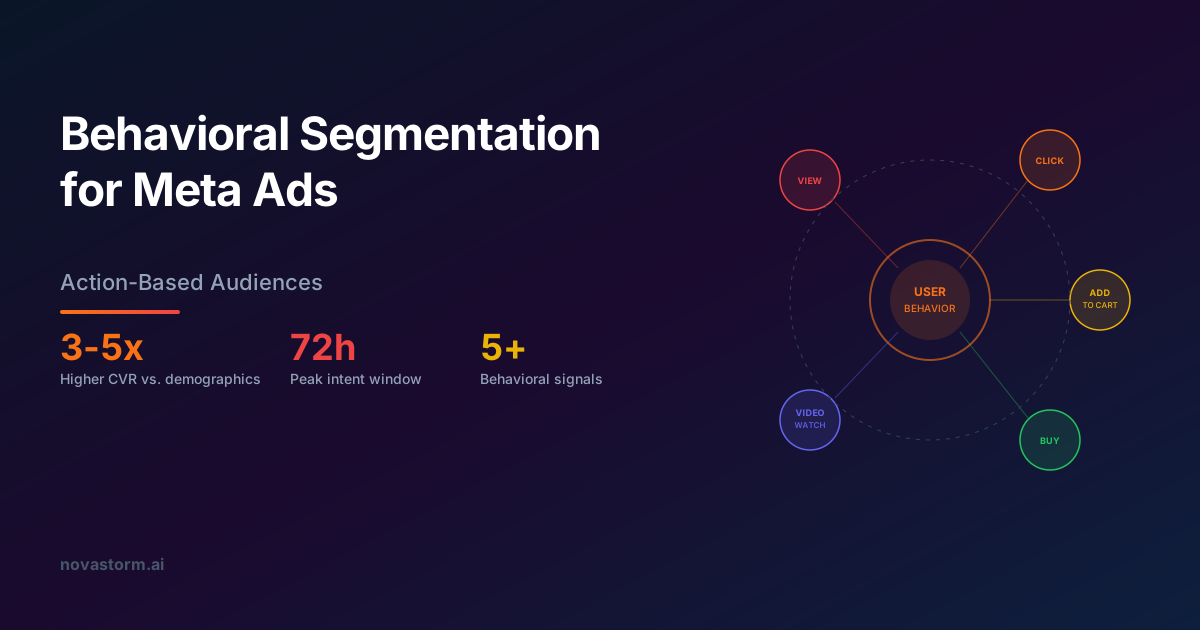
Behavioral Segmentation for Meta Ads: Action-Based Audiences
Master behavioral segmentation for Meta Ads. Build action-based audiences from website events, app activity, and engagement signals to drive higher conversion rates.
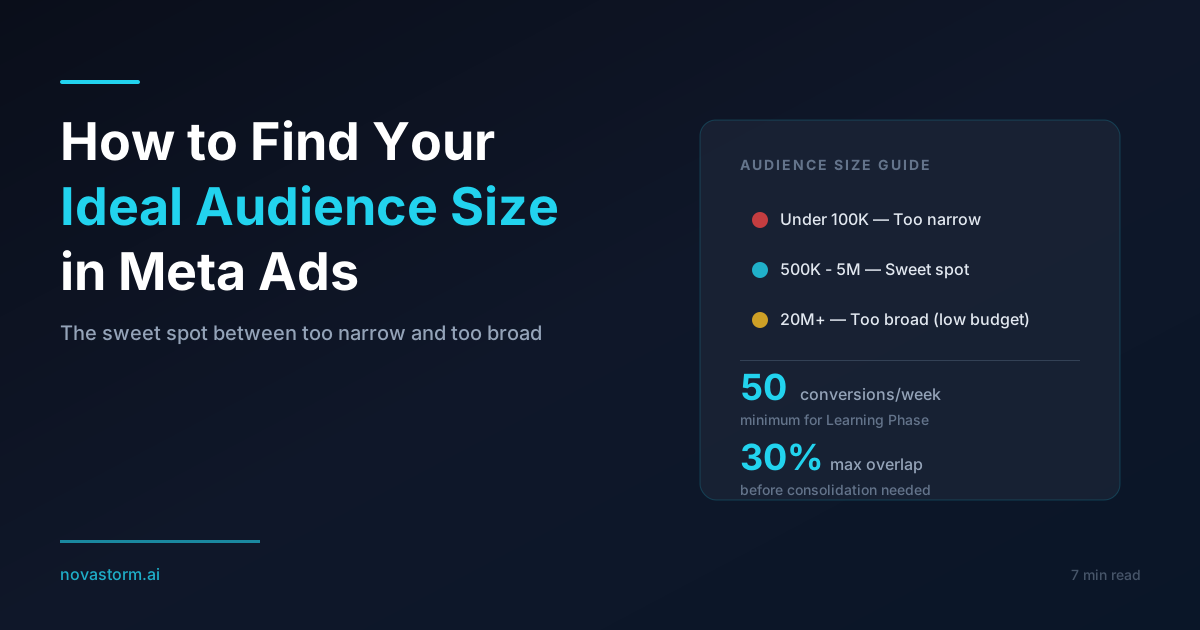
How to Find Your Ideal Audience Size in Meta Ads
Calculate feasible audience tests from budget, expected CPA and order margin instead of universal audience-size benchmarks.
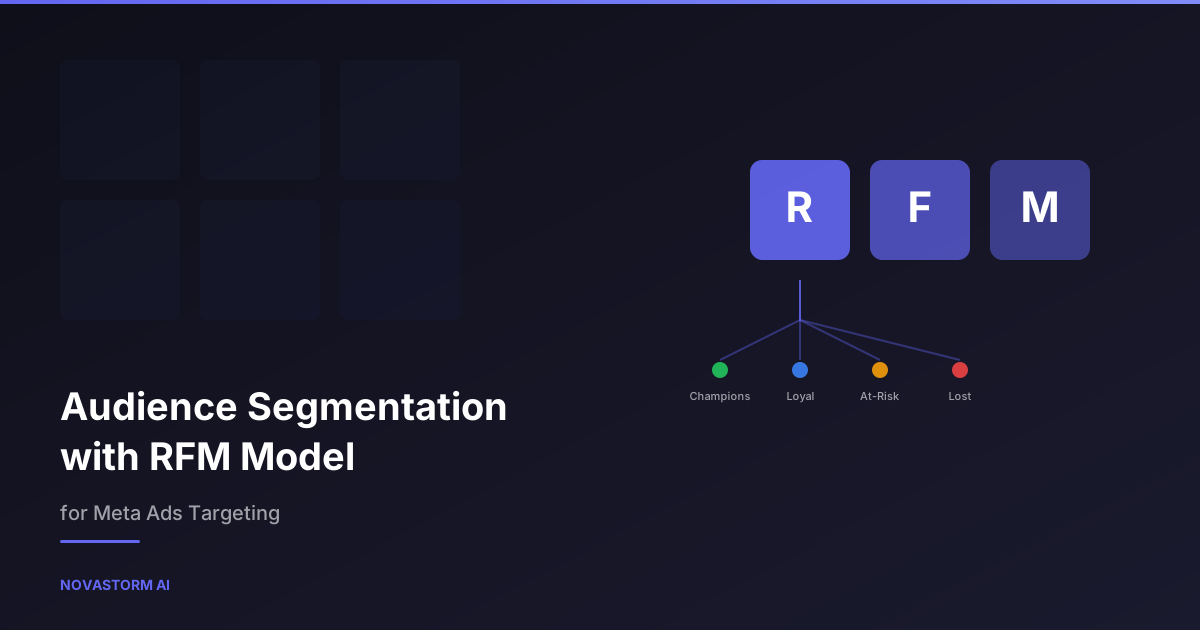
Audience Segmentation with RFM Model for Meta Ads Targeting
Calculate RFM from cleaned transactions, apply one reproducible scoring rule, export exclusive segments and test their future contribution.

Automated Audience Expansion: When to Let Meta Find New Segments
Test audience expansion with enforced service geography, qualified mature outcomes, explicit spend limits and a real assignment plan.