

The Bandwagon Effect: Why Social Proof Numbers Matter in Ads
Audit social-proof numbers with a dated claim register and correct CTR comparisons, then test retained contribution with approved evidence.
Social-proof copy should communicate a verifiable fact that matters to the buyer. It can motivate a messaging hypothesis, but a large count is not evidence of product fit, customer results or an inevitable conversion gain.
Goldstein, Cialdini and Griskevicius (2008) studied descriptive-norm messages in hotel towel-reuse field experiments. That context supports asking whether relevant peer information matters; it does not supply a Meta CTR benchmark or a minimum of 1,000 users.
Keep a claim register
Every row below is hypothetical, not a NovaStorm adoption or outcome claim.
| Proposed claim | Definition/source | Date and owner | Publication treatment |
|---|---|---|---|
| “120 active workspaces” | Distinct eligible workspace IDs active in declared 30-day window | September 30; analyst | State window; do not call them paying customers |
| “4.6/5 from 80 reviews” | Named review source; included valid review count | September 30; marketer | Check rights and current score before reuse |
| “12 retained customers joined this month” | Distinct paid customers after refund definition | September 30; finance | State month; no live counter unless verified |
| “Average customer ROI” | No complete customer cost/outcome dataset | Unverified; owner assigned | Do not publish |
Use a manual approved snapshot, keep the source export and review any reuse after its expiry date. A dynamic creative does not automatically fetch a correct real-time database count. If a number is small, describe it honestly or omit it; there is no universal threshold requiring inflation or “exclusive” language.
Compare CTR values, not differences between uplift labels
Stop wasting ad budget
NovaStorm AI cuts Meta Ads CPA by 30% on average. No complex setup required.
Synthetic example: control has 1,000 clicks / 50,000 impressions = 2.00% CTR. Cumulative-proof copy has 1,320 / 50,000 = 2.64%, a 32% relative lift. Recent-proof copy has 1,370 / 50,000 = 2.74%, a 37% relative lift. The recent-versus-cumulative difference is 0.10 percentage points, or (2.74 − 2.64) / 2.64 = 3.79% relative. It is not a 14% improvement obtained from the two uplift labels.
These are arithmetic teaching rows, not a 1,400-variant study. Always show compatible periods, allocations, counts and uncertainty. A higher CTR does not establish retained paid improvement, and a revenue-managed total is not a customer-profit measure.
Test the actual evidence and next step
- Verify that the crowd description matches the counted entities and intended audience.
- Keep the offer, CTA, audience and allocation comparable when testing proof wording.
- Measure mature contribution per assigned visitor along with clicks and complaints; account for creative-production cost.
- Set a loss allowance and outcome window before evaluating interim numbers.
- Retain logo, quotation and review permissions; do not imply every customer achieved an aggregate result.
Use the approved claim register to prepare a NovaStorm creative brief and campaign draft. The evidence owner approves exact wording, dates and destination before publication; review the saved fields and replace stale proof manually unless an independently verified update workflow exists.
Published by NovaStorm AI. Worked examples and proposed tests are labeled in the article.
Disclaimer: This article was generated with the assistance of AI and reviewed by the NovaStorm AI team. While we strive for accuracy, we recommend verifying specific data points and consulting official sources (linked where available) for critical business decisions.
Ready to automate your Meta Ads?
NovaStorm AI takes full responsibility for your campaigns — from monitoring to optimization.
Start NowMore on Buyer psychology
Social Identity Theory in Ad Targeting and Creative
Use customer self-description responsibly in Meta creative, with permissioned language, stereotype checks and a same-audience message test.
Cognitive Load Theory: Simplifying Your Meta Ad Message
Review Meta ad clarity with a seven-second usability probe, a before-and-after message example and quality outcomes that preserve material disclosures.
Herd Mentality in Meta Ads: Test Truthful Social Proof
Use permissioned social proof in Meta creative, verify existing-post rendering and measure acquisition cost including any engagement seeding.
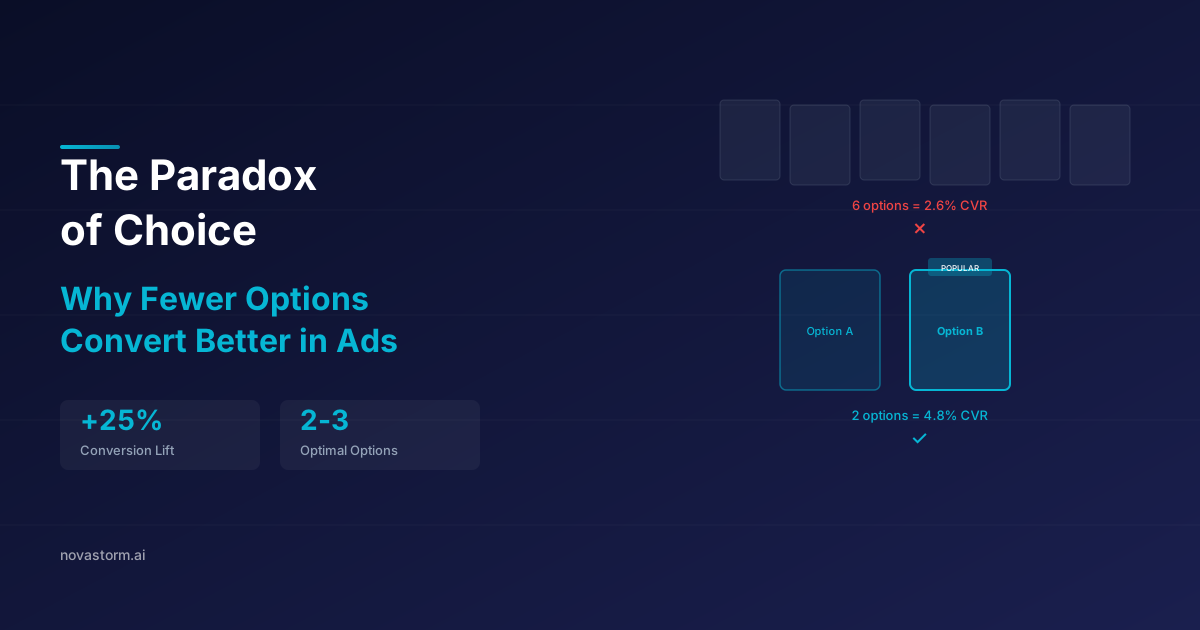
The Paradox of Choice in Meta Ads: Test Clearer Product Selection
Test choice reduction by distinguishing narrative cards from assortment decisions, using truthful recommendations and retained-contribution outcomes.