

Audience Testing Framework: Systematic Approach to Finding Winners
Separate prospecting from warm retargeting, verify audience controls and overlap, and compare mature customer contribution under a clear test design.
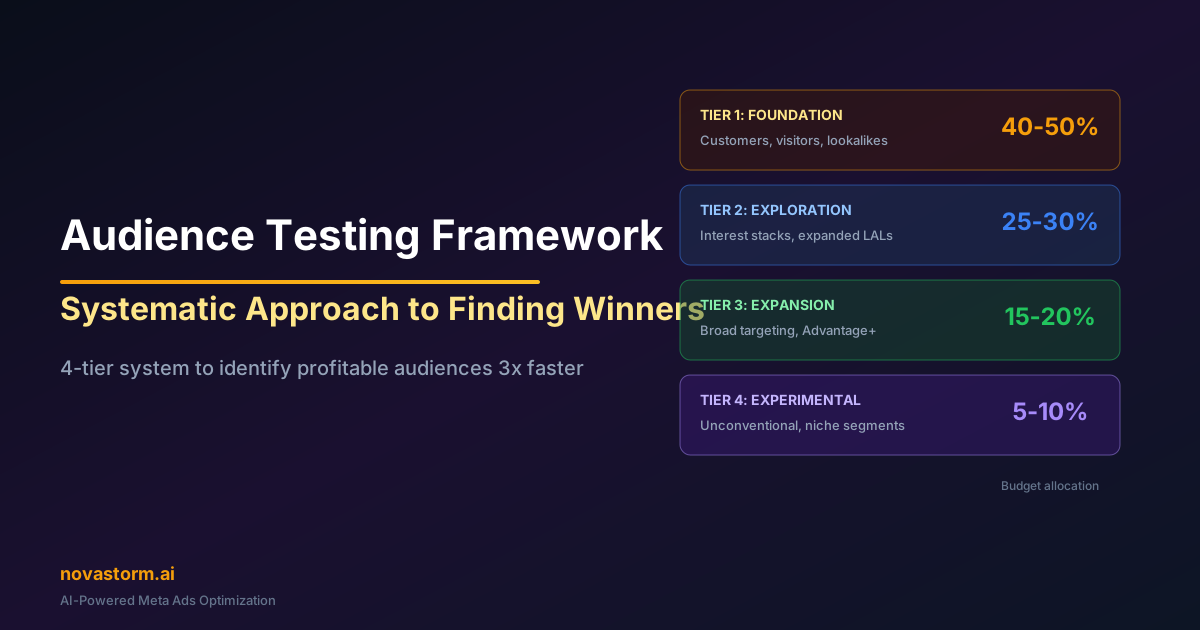
Audience discovery begins by separating new-customer acquisition from re-engagement. A recent visitor or past buyer is not an equivalent benchmark for a person who has never interacted with the brand. Compare strategies within the same acquisition objective, then evaluate their customer contribution and limits.
Separate warm campaigns from the prospecting framework
| Population | Suitable question | Interpretation limit |
|---|---|---|
| Existing customers | Does a re-engagement offer add purchases beyond a holdout? | Attributed CPA alone does not establish incremental sales. |
| Recent visitors | Does follow-up improve completed purchases? | Prior intent differs from prospecting; do not use its CPA as a new-person baseline. |
| Prospecting strategies | Which eligible targeting strategy acquires new customers efficiently? | Verify exclusions and actual delivery; matching or identity gaps can leave warm people in the population. |
Lookalike or other suggested prospecting audiences can be hypotheses, but a source of buyers is not the same as delivering only to new buyers. Record the accepted configuration and its limits.
An exact prospecting allocation, not expected win rates
| Illustrative prospecting pool | Share | From a $10,000 prospecting budget |
|---|---|---|
| Current acquisition strategy | 50% | $5,000 |
| Adjacent permitted customer-context hypothesis | 25% | $2,500 |
| Broad or automated strategy available in the account | 20% | $2,000 |
| Unusual but relevant hypothesis | 5% | $500 |
| Total | 100% | $10,000 |
This allocation is a cash planning example, not a recommendation supported by observed win rates. Warm re-engagement has a separate budget. The $500 exploratory cell may be too small for a purchase comparison; calculate feasible evidence before launch.
Write a targeting integrity record
- Record inclusion and exclusion lists, geographic controls, accepted age settings, objective, optimization event and actual expansion/suggestion behavior. Distinguish a firm control from an audience suggestion.
- Verify that the same eligible customer-status definition is used in all acquisition strategies. Reconcile lag in customer-list updates and match failures.
- Check whether audiences overlap. If the experiment mechanism supports mutually exclusive randomized eligible groups, document that assignment. Separate ordinary ad sets or identical budgets do not themselves randomize people.
- Record placement, offer, creative and simultaneous enrollment conditions. Inspect delivered audience summaries and spending; do not assume a campaign shares learning in a way that removes confounding.
- If expansion makes intended cells indistinguishable, interpret the result as a comparison of available delivery strategies rather than a test of isolated named interests.
Stop wasting ad budget
NovaStorm AI cuts Meta Ads CPA by 30% on average. No complex setup required.
Meta’s SDK schema exposes targeting, custom-audience exclusions and automation fields. That is evidence of field definitions, not universal eligibility or an available UI setting. Use the audience overlap diagnosis when interpreting actual configuration and delivery.
Replace a mixed metric score with contribution
| Hypothetical mature new-customer cohort | A | B |
|---|---|---|
| Media spend | $1,000 | $1,000 |
| New retained customers | 40 | 30 |
| Revenue per retained initial order | $50 | $70 |
| Variable cost per retained initial order | $30 | $35 |
| Contribution before media | 40 × $20 = $800 | 30 × $35 = $1,050 |
| Contribution after media | −$200 | +$50 |
A has lower acquisition cost ($25 versus about $33.33), but B has higher contribution under these assumptions. Include refunds, servicing, fulfillment and qualification in real variable costs. B’s higher average order value does not establish higher lifetime value; compare equally mature future retention and contribution cohorts before extending the conclusion.
A reviewable test brief
Illustrative brief: compare two available prospecting delivery strategies for new retained customers in the same region, with one approved message and a fixed outcome window. Prespecify the allocation mechanism, primary contribution measure, cash cap, exclusion refresh and uncertainty method. For a binary retained-customer indicator use an appropriate sample plan; contribution per assigned person needs a variance-aware analysis. No threefold acceleration or universal broad-targeting lift follows from this framework.
Prepare the same audience hypotheses and ad message as NovaStorm campaign drafts for review. Record exclusions and experiment assignment in the tools that actually implement them. Draft preparation is not automatic overlap removal or a causal measurement service.
Source: Meta targeting SDK schema. The allocation and cohort arithmetic are explicitly hypothetical.
Published by NovaStorm AI. Worked examples and proposed tests are labeled in the article.
Disclaimer: This article was generated with the assistance of AI and reviewed by the NovaStorm AI team. While we strive for accuracy, we recommend verifying specific data points and consulting official sources (linked where available) for critical business decisions.
Ready to automate your Meta Ads?
NovaStorm AI takes full responsibility for your campaigns — from monitoring to optimization.
Start NowMore on Creative and audience testing
Creative Testing Velocity: How Many Ads to Test Per Week
Choose creative production pace from team hours, media budget and mature evidence; keep asset counts separate from experimental conclusions.

Offer Testing on Meta Ads: Price Points, Bundles, and Free Trials
Compare prices, annual billing, bundles and trials with explicit payment arithmetic, full contribution costs, random assignment and mature follow-up.
Statistical Significance in Ad Testing: When Results Are Real
Calculate independent binary-test samples, distinguish significance from contribution, and decide whether budget and outcome delays support a test.
Growth Hacking With Meta Ads: Rapid Experimentation Framework
Plan a bounded Meta Ads experiment with explicit assignment, power, stopping rules and marginal economics. Includes a reproducible hypothetical sample calculation.