

Growth Hacking With Meta Ads: Rapid Experimentation Framework
Plan a bounded Meta Ads experiment with explicit assignment, power, stopping rules and marginal economics. Includes a reproducible hypothetical sample calculation.
A rapid experiment is useful when it answers a bounded business question. Launching many variants, splitting equal budgets or reading a dashboard after 72 hours does not establish a causal winner. Design the allocation, sample and decision rule before buying traffic.
Write a falsifiable hypothesis and ledger
| Hypothetical experiment field | Precommitted design |
|---|---|
| Hypothesis | A product-first opening increases mature paid acquisition probability versus the existing opening |
| Change | Only first two seconds; remaining creative, offer and destination unchanged |
| Unit and allocation | Eligible person randomly assigned once to A or B before exposure; maintain assignment across repeated impressions |
| Outcome | Unique paid acquisition within seven days of first eligible exposure; refund outcomes reviewed afterward |
| Primary analysis | One comparison at fixed sample and completed outcome delay |
| Safety | Pause for broken checkout, false claim or approaching the authorized total spend; stopped tests are not efficacy wins |
| Data record | Assigned users, exposure, outcome dates, spend, exclusions, missing records and deviations |
This is an illustrative protocol, not a delivered campaign. Verify the actual randomized method and allocation unit in the available platform test. A and B ad sets with equal budgets can reach different people and receive different optimization; label such results descriptive. If the platform only reports aggregate delivery, do not pretend to have person-level assignment evidence.
Estimate sample and affordability before launch
Hypothetical planning assumptions: independent equal-sized groups, baseline acquisition probability 5%, useful alternative 6%, two-sided alpha 0.05 and power 80%. A normal approximation gives about 8,158 eligible people per arm. With average paid exposure cost USD 0.50 per assigned person, the planning budget is 2 × 8,158 × 0.50 = USD 8,158, before production. These assumed rates and cost are not Meta benchmarks. Repeated exposure, clustered assignment, unequal delivery, missing outcomes or a different primary metric require a different model.
Reproducible approximation: n per arm = [z(0.975) × sqrt(2 × p̄ × (1 − p̄)) + z(0.80) × sqrt(0.05 × 0.95 + 0.06 × 0.94)]² / (0.06 − 0.05)², where p̄ = 0.055. Calculated n = 8,157.73, rounded up. The official statsmodels power interface exposes alpha, power, allocation ratio and effect size for explicit planning; select the effect transformation appropriate to proportions instead of inserting a raw percentage difference blindly.
At an assumed 500 eligible assignments per arm per day, 8,158 / 500 requires about 17 acquisition days plus the chosen seven-day outcome maturation after the last entrant. This is an example of timing derived from evidence needs, not a mandatory test duration. If only USD 300 is authorized, change the research question or report a pilot as a pilot; 1,000 impressions or three times target CPA cannot supply the missing power.
Stop wasting ad budget
NovaStorm AI cuts Meta Ads CPA by 30% on average. No complex setup required.
Fix the analysis rule, including repeated checks
For a fixed-sample design, do not inspect daily efficacy p-values and extend until one is significant. Safety monitoring may continue without declaring an efficacy winner. If a sequential design is needed, predefine its stopping boundaries and analysis with suitable expertise. Record every interim look and deviation; an unplanned extension remains exploratory.
NIST’s multiple-comparison guidance explains why repeated pairwise comparisons need an explicit family of tests. Choose one primary contrast, or prespecify an adjustment such as Bonferroni for the intended comparisons. Three planned primary comparisons could use 0.05 / 3 as a conservative per-comparison alpha; recompute power and sample for that design. It is not permission to inspect arbitrary variants and keep the best nominal p-value.
Compare the difference directly. NIST documents confidence intervals for a difference of proportions, including limitations of the simple normal interval. Overlap of two separate intervals does not itself test their difference. For sparse outcomes, use a method appropriate to sparse counts; do not treat a conversion-rate interval as a CPA interval.
A statistical winner can have poor marginal growth
Hypothetical next scaling step: another USD 200 of media produces four additional retained acquisitions with USD 30 contribution each, plus USD 20 incremental production. Marginal contribution = 4 × 30 − 200 − 20 = −USD 100. A favorable average CPA from the prior campaign does not make this step profitable. Measure the next increment and its uncertainty before assigning all budget to a winner; duplication can also create overlapping delivery and operational cost.
Use Meta’s description of Ad Library as evidence of visible advertising, not a leaderboard of competitors’ profitable creatives. Save a message as an idea and test it; ad presence or longevity does not reveal paid acquisition results. Prepare the bounded creative brief and paused draft in NovaStorm, then verify allocation and measurement in the actual test system. The statistical testing guide helps interpret uncertainty; NovaStorm generation does not guarantee an adequately powered experiment.
Published by NovaStorm AI. Worked examples and test fixtures in this article are illustrative, not observed customer results.
Disclaimer: This article was generated with the assistance of AI and reviewed by the NovaStorm AI team. While we strive for accuracy, we recommend verifying specific data points and consulting official sources (linked where available) for critical business decisions.
Ready to automate your Meta Ads?
NovaStorm AI takes full responsibility for your campaigns — from monitoring to optimization.
Start NowMore on Creative and audience testing

Offer Testing on Meta Ads: Price Points, Bundles, and Free Trials
Compare prices, annual billing, bundles and trials with explicit payment arithmetic, full contribution costs, random assignment and mature follow-up.
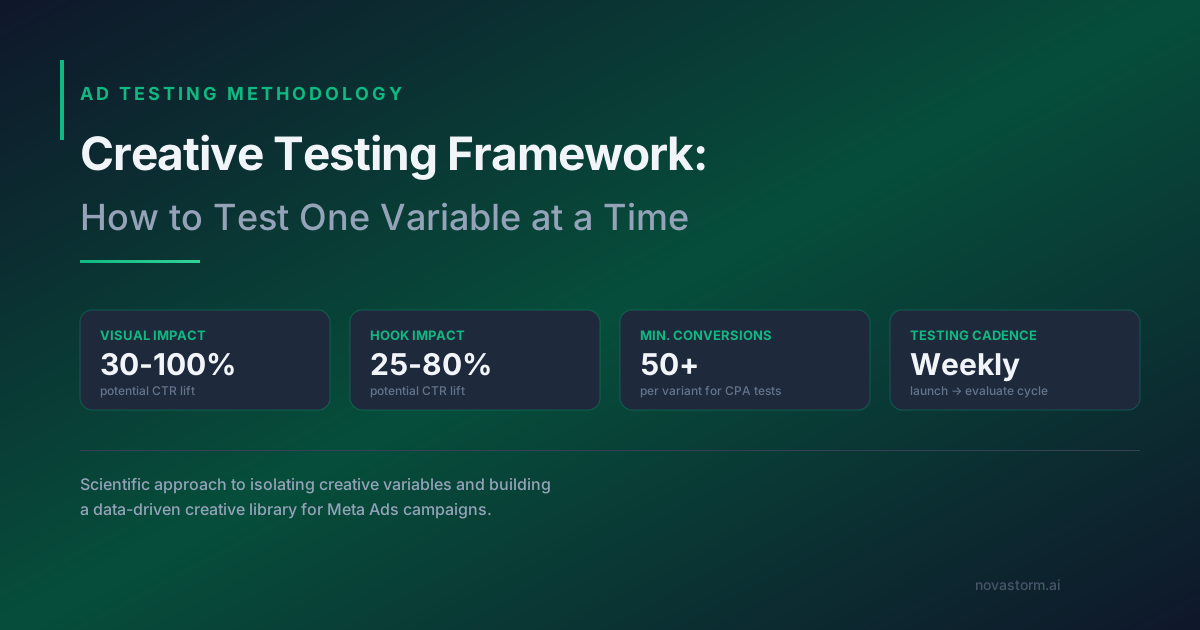
Creative Testing Framework: How to Test One Variable at a Time
Turn a creative hypothesis into a controlled variant, a mature-outcome decision log and a safe manual handoff if the preparation route fails.
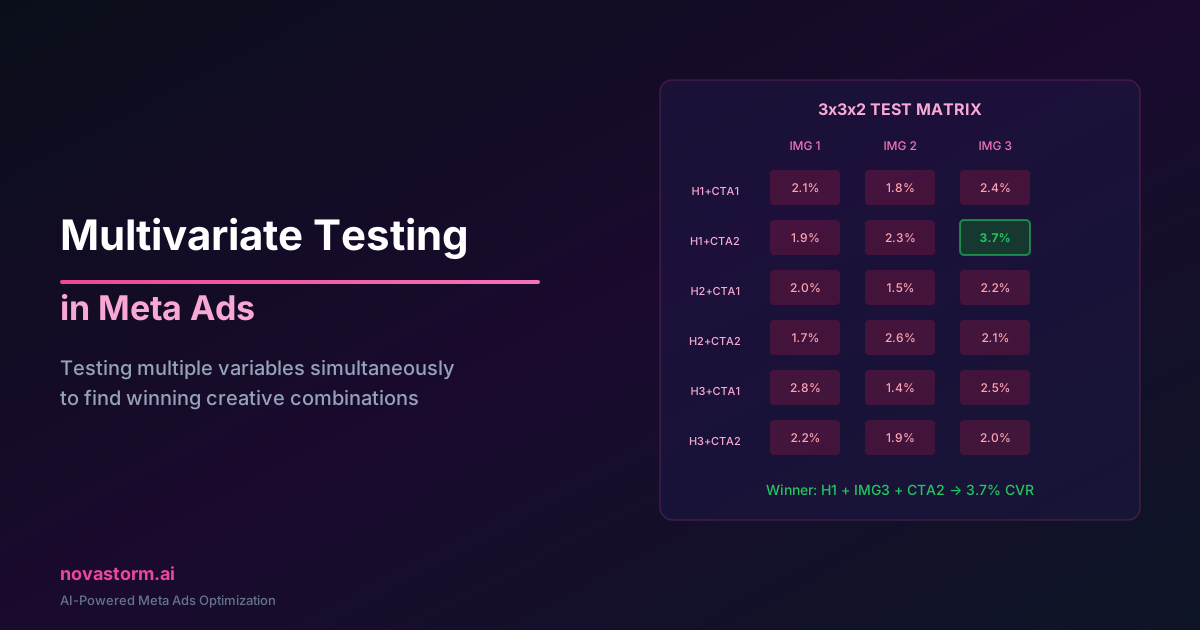
Multivariate Testing in Meta Ads: Testing Multiple Variables
Build an 18-cell creative matrix, distinguish adaptive delivery from random assignment, and plan interactions, uncertainty and an affordable comparison.
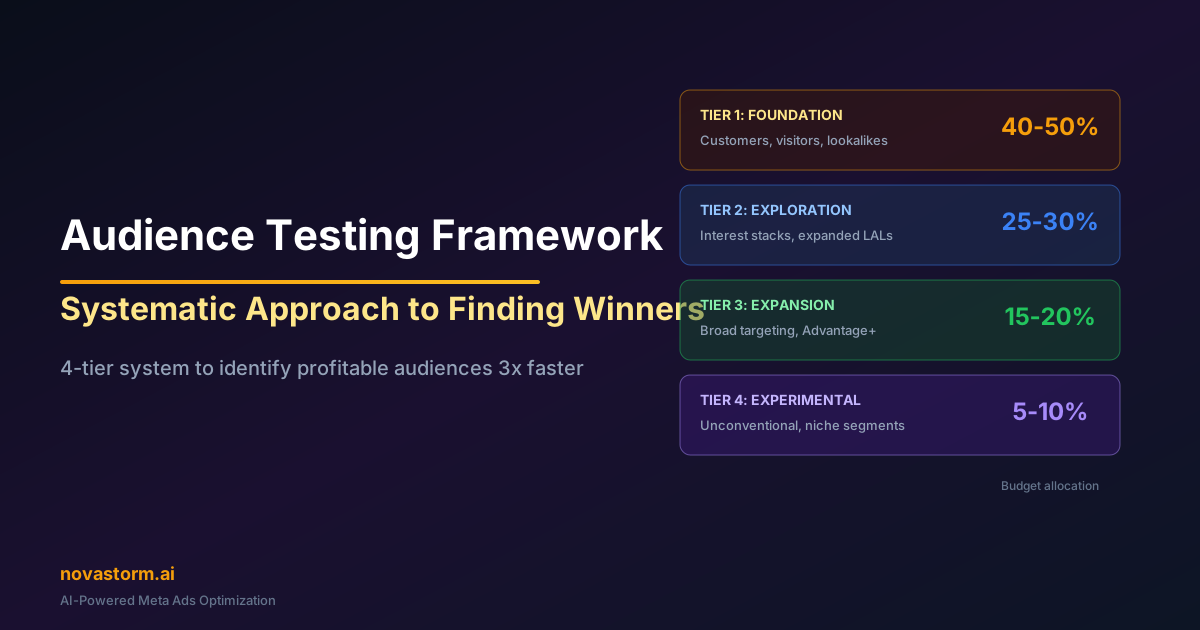
Audience Testing Framework: Systematic Approach to Finding Winners
Separate prospecting from warm retargeting, verify audience controls and overlap, and compare mature customer contribution under a clear test design.