

Audience Overlap in Meta Ads: How to Diagnose and Fix It
Diagnose overlapping Meta audiences as a structure and evidence problem, then test consolidation while preserving commercial boundaries.
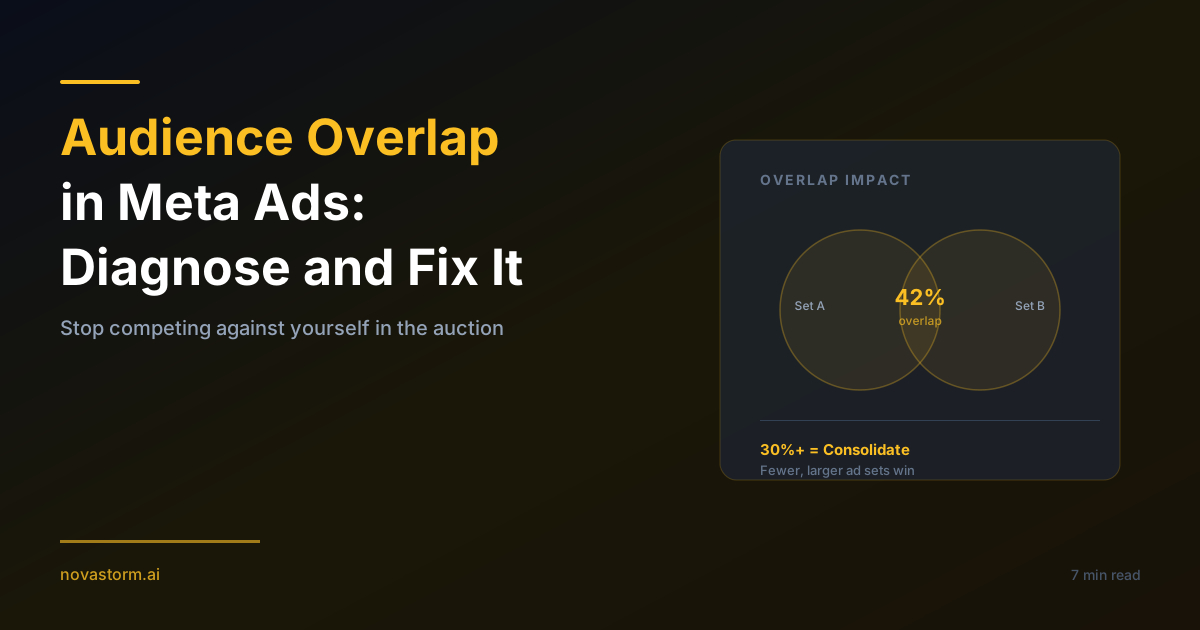
Audience overlap means some eligible people can belong to more than one planned group. A broad eligible audience includes narrower eligible interest or customer groups unless enforceable exclusions say otherwise. Three separate campaign names do not create three distinct populations.
Map eligibility instead of inventing overlap percentages
| Structure | Overlap implication | Usable planning decision |
|---|---|---|
| Broad plus two interest hypotheses | The broad pool can overlap both; interest groups may overlap each other | Treat them as alternative hypotheses or simplify, not as distinct tiers |
| Prospecting plus website retargeting | Website visitors may also belong to prospecting | Use a supported saved visitor exclusion if separation is required |
| Purchaser-based similarity plus purchaser exclusion | Removing the seed does not exclude every member of a similar audience | Verify the actual inclusion/exclusion roles; do not infer separation |
| Different service markets | May require separate margins and contracts | Retain commercial boundaries even when shared learning is tempting |
Inspect current account reporting for audience estimates and delivery diagnostics. Record exactly what the report measures and what it omits; an estimated overlap of saved lists is not a complete view of expanded delivery. If no suitable overlap report is available, use the saved-eligibility map and spend/outcome records without fabricating a percentage.
Separate fragmented evidence from an auction story
Multiple small ad sets can leave each hypothesis with too few outcomes to judge. That is an evidence-allocation problem. Overlap alone does not establish that your own bids inflated auction prices or caused a particular CPA rise; do not diagnose a hidden auction mechanism from the overlap map. Tracking, offer demand, placements and fulfilment can also explain changes.
There is no universal overlap percentage that mandates consolidation. Shared eligible membership can be justified when different contracts, products or experimental arms require it.
Stop wasting ad budget
NovaStorm AI cuts Meta Ads CPA by 30% on average. No complex setup required.
Run a reversible consolidation plan
- Write the pre-change configuration and mature baseline: offer, event, geography, creative, spend, net orders and contribution.
- Choose which redundant hypotheses to combine. Preserve required service and margin boundaries, and confirm any supported exclusions actually save.
- Keep offer, conversion event and creative unchanged during the structure comparison. Record any unavoidable change as a limitation.
- Set an approved incremental spend and cash-loss cap; use your own conversion delay and return timing for the review date.
- Compare mature paid-order CPA and contribution. A before/after check is descriptive; use supported random assignment if a causal consolidation claim is required.
- If evidence is sparse, report inconclusive. If eligibility, payment tracking or the cash-loss limit fails, stop and restore the documented permitted structure rather than chasing a CPM improvement.
A synthetic structure decision
Hypothetical worksheet: a shop has $210 weekly cash available and assumes $15 CPA, yielding 14 expected orders overall. Splitting into three equal ad sets gives about 4.7 expected orders per set. One combined eligible prospecting structure could concentrate evidence, but actual CPA and order quality are unknown. The calculation establishes feasibility only; it does not prove consolidation wins.
Prepare a reviewable plan
In NovaStorm, prepare the proposed campaign structure as paused campaign and local ad-set drafts and have the user approve the grouping and cash limits. Verify saved settings before delivery and reconcile outcomes afterward. Use the broad-targeting brief and suppression guide to document boundaries.
Published by NovaStorm AI. Planning examples are illustrative assumptions, not measured customer results.
Disclaimer: This article was generated with the assistance of AI and reviewed by the NovaStorm AI team. While we strive for accuracy, we recommend verifying specific data points and consulting official sources (linked where available) for critical business decisions.
Ready to automate your Meta Ads?
NovaStorm AI takes full responsibility for your campaigns — from monitoring to optimization.
Start NowMore on Audience targeting and prospecting
Exclusion Audiences: Stop Wasting Budget on Wrong People
Choose buyer suppression windows from repurchase behavior, verify saved exclusions and measure new-customer outcomes without promising CPA gains.

Negative Ad Feedback on Meta: Diagnose and Respond
Investigate negative ad feedback, distinguish criticism from verified defects, and choose a bounded response without assuming an algorithm penalty.
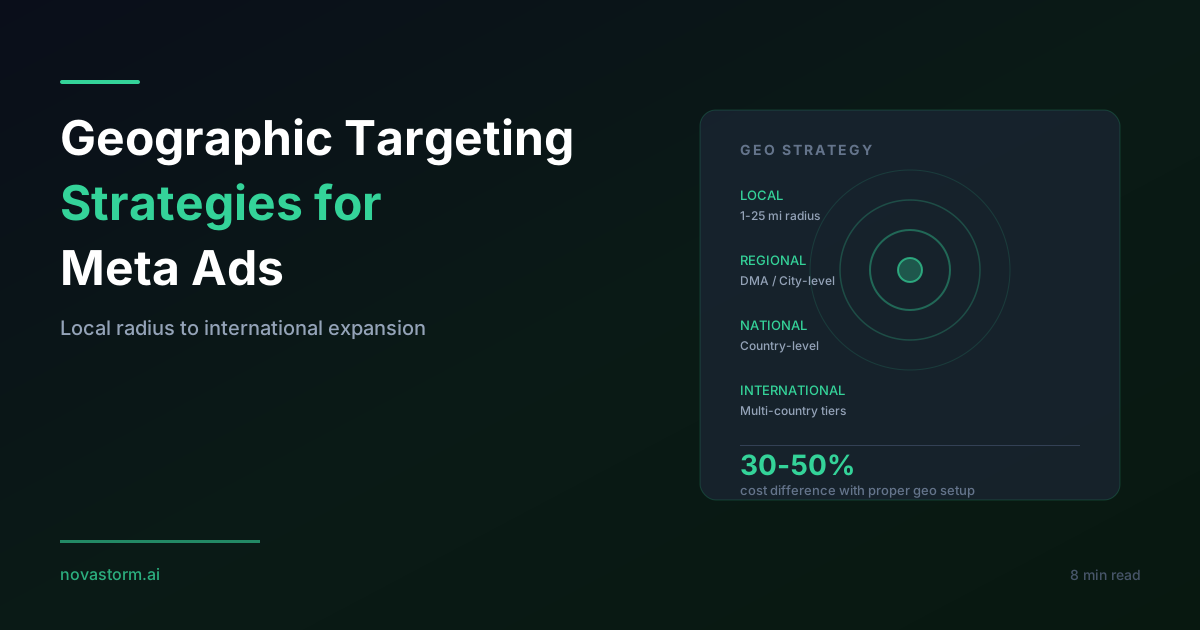
Geographic Targeting Strategies for Meta Ads: Local vs International
Plan local and international Meta audiences from service coverage, market contribution and a two-market localization worksheet.
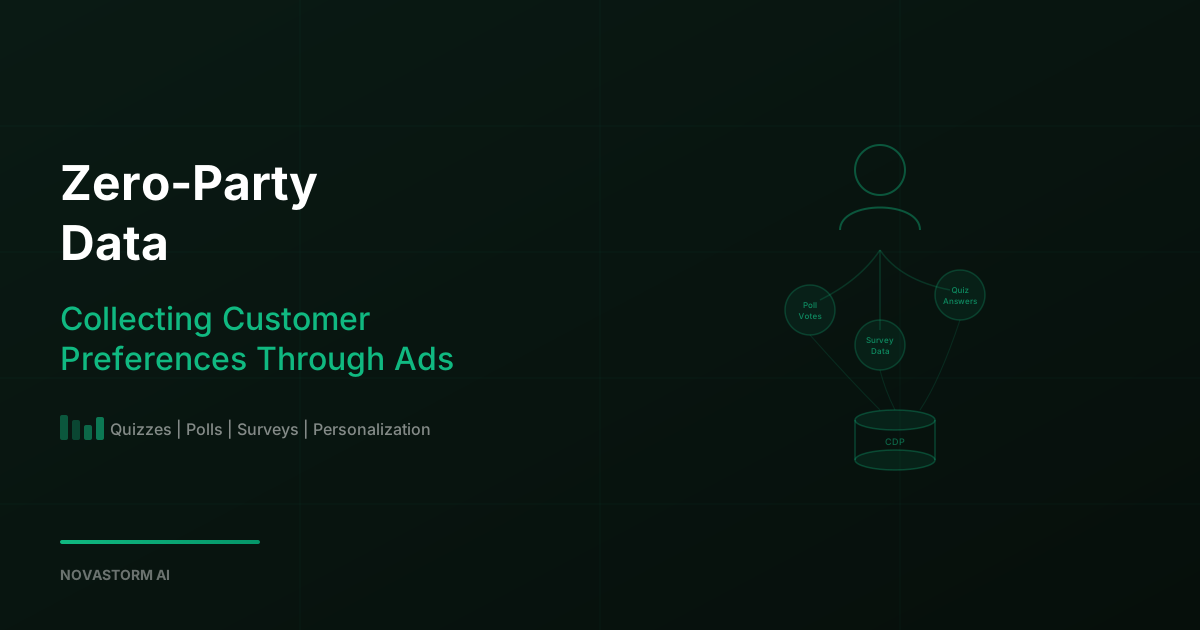
Zero-Party Data: Collecting Customer Preferences Through Ads
Collect useful declared preferences with clear permission records, refresh stale answers, and test an offer against contribution rather than engagement promises.