

Offer Testing on Meta Ads: Price Points, Bundles, and Free Trials
Compare prices, annual billing, bundles and trials with explicit payment arithmetic, full contribution costs, random assignment and mature follow-up.

An offer test asks whether a price, bundle, trial or delivery promise produces more contribution from the eligible population. A higher sign-up rate or revenue per click is useful information, but neither is the final profit criterion. Plan the offer terms, assignment and mature follow-up before spending.
Five offer decisions and their costs
| Offer | Customer-visible change | Costs or guardrails to record |
|---|---|---|
| Percentage or cash discount | Lower payable price | Contribution lost per retained order; valid reference price |
| Free or paid trial | Different trial charge and billing transition | Activation, paid conversion, support, cancellation and refunds |
| Bundle or gift | Different item quantity or included goods | Item cost, shipping, handling and unused inventory |
| Free shipping | Different shipping charge or threshold | Carrier cost, delivery region and order contribution |
| Monthly versus annual subscription | Different billing period and upfront charge | Service liability, refund rules and equally mature cohort contribution |
Correct the annual payment arithmetic
Illustrative price table: the conversion rate is a hypothetical share of 100 eligible visitors who pay the stated charge, not a benchmark. Monthly rows show only the first monthly payment; the annual row charges the entire year upfront.
| Price and billing | Assumed payer rate | Gross initial receipts per 100 visitors |
|---|---|---|
| $29 charged monthly | 4.2% | 4.2 × $29 = $121.80 |
| $49 charged monthly | 2.8% | 2.8 × $49 = $137.20 |
| $79 charged monthly | 1.5% | 1.5 × $79 = $118.50 |
| $348 charged annually, equivalent to $29/month | 3.5% | 3.5 × $348 = $1,218.00 |
The annual row cannot produce $121.80 upfront at that conversion rate and charge. Its higher initial cash also does not establish higher lifetime contribution: it carries a year of service and possible refunds. Compare cash collection separately from contribution earned or allocated over the chosen period.
Compare contribution per eligible visitor after media
Hypothetical 100-visitor monthly cohorts at assumed $0.80 per visitor cost $80 each. For the $29 plan, assume $10 variable service cost and $5 expected refund/support allowance per paid first month: 4.2 × ($29 − $10 − $5) − $80 = −$21.20. For the $49 plan, assume $15 service cost and $6 allowance: 2.8 × ($49 − $15 − $6) − $80 = −$1.60. Both are negative over this initial window despite the second plan’s higher receipts.
Use real retained revenue, refunds, payment fees, delivery or service cost, and attributable support costs in the final cohort. Label future renewals as a forecast until observed. Revenue per click = conversion rate × revenue per conversion describes receipts; subtract costs and CPC before claiming an economic winner.
Stop wasting ad budget
NovaStorm AI cuts Meta Ads CPA by 30% on average. No complex setup required.
Thirty percent off differs from three for two
Illustrative unit price $30 and variable item cost $12, excluding shipping. One item at 30% off brings $21 and $9 contribution. Three for two brings $60 for three items, costing $36 and contributing $24 per order, or $8 per item. Three items each at 30% off bring $63 and $27 contribution. Different quantities, shipping and customer demand mean these offers are not margin equivalents.
Assignment, sample and a mature comparison
- Define whether the experiment compares only the on-page offer or the entire ad-and-offer package. Different ad copy and pages change several parts of the package.
- Randomize eligible independent participants with consistent repeat assignment using an implemented method; ordinary equal-budget ad sets targeting the same audience do not establish randomization.
- Choose one primary outcome and record checkout acceptance, terms, cancellation and support guardrails. Fix a follow-up window such as 90 days only when it fits the business; keep cohorts equally mature.
- Prespecify multiple-comparison handling if screening five offers. Validate selected finalists on fresh data rather than treating the best noisy cell as proof.
Illustrative binary planning: detecting 2% → 2.4% paid conversion with two-sided α 0.05 and 80% power needs approximately 21,200 independent visitors per group. At $0.80 per visitor, one two-arm comparison costs $33,920 before production and 90-day follow-up. A contribution-per-person test needs a design and variance estimate for that outcome; 200 conversions is not a universal adequate sample. See sample planning and uncertainty.
Prepare consistent offer drafts
In NovaStorm, prepare the approved offer messages as campaign drafts for review. Keep actual billing configuration, random assignment and cohort finance analysis in the systems that implement them. A paid trial may improve qualification or may deter suitable users: that is a hypothesis, not a universal performance advantage.
Source: ASA statement on statistical interpretation. All price examples and conversion rates above are hypothetical calculations.
Published by NovaStorm AI. Worked examples and proposed tests are labeled in the article.
Disclaimer: This article was generated with the assistance of AI and reviewed by the NovaStorm AI team. While we strive for accuracy, we recommend verifying specific data points and consulting official sources (linked where available) for critical business decisions.
Ready to automate your Meta Ads?
NovaStorm AI takes full responsibility for your campaigns — from monitoring to optimization.
Start NowMore on Creative and audience testing
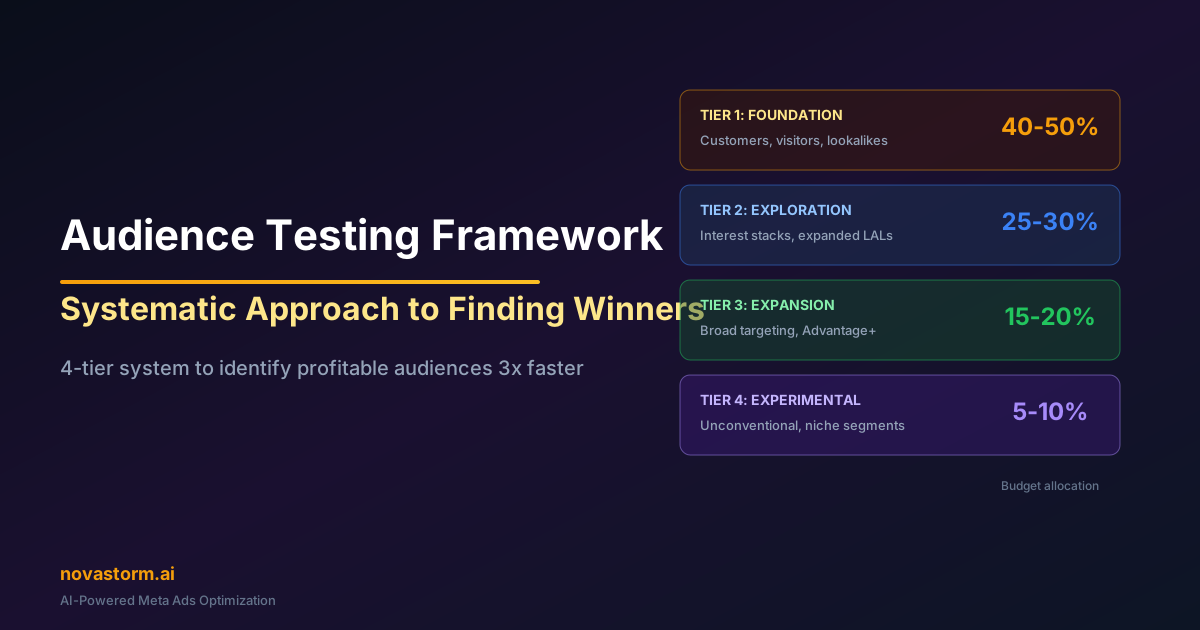
Audience Testing Framework: Systematic Approach to Finding Winners
Separate prospecting from warm retargeting, verify audience controls and overlap, and compare mature customer contribution under a clear test design.
Growth Hacking With Meta Ads: Rapid Experimentation Framework
Plan a bounded Meta Ads experiment with explicit assignment, power, stopping rules and marginal economics. Includes a reproducible hypothetical sample calculation.
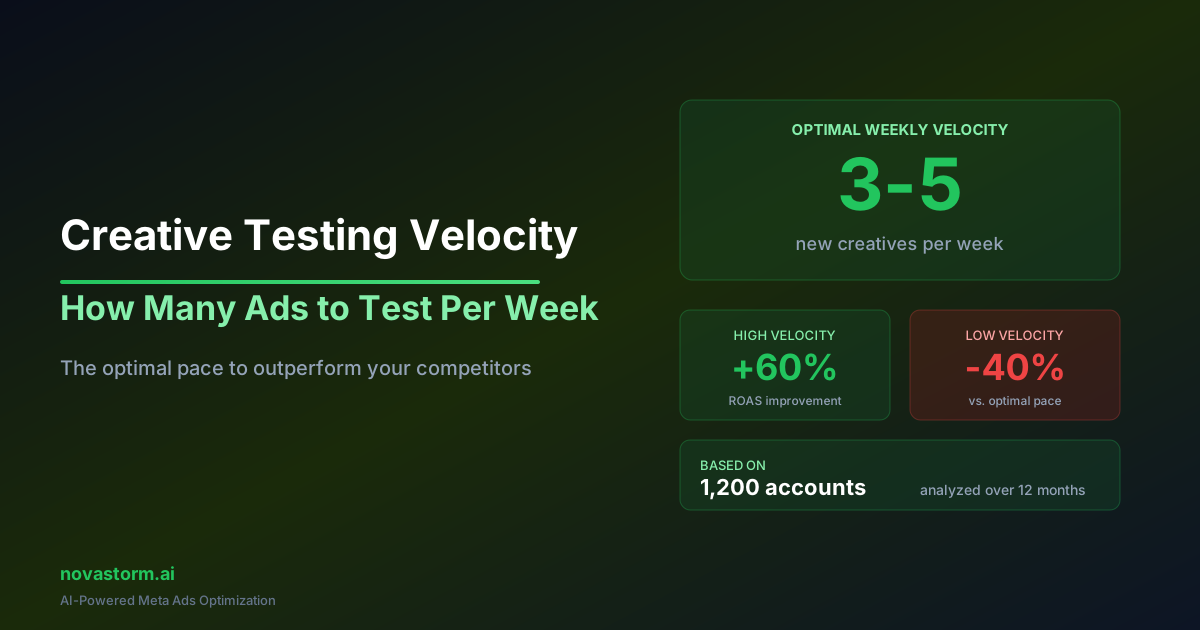
Creative Testing Velocity: How Many Ads to Test Per Week
Choose creative production pace from team hours, media budget and mature evidence; keep asset counts separate from experimental conclusions.
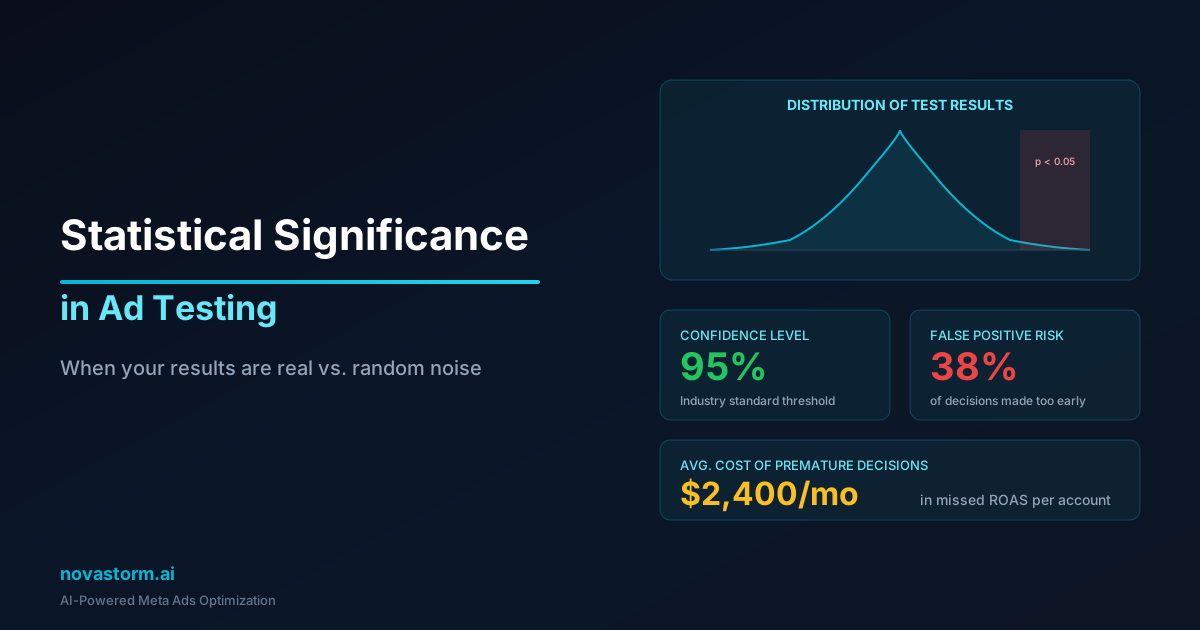
Statistical Significance in Ad Testing: When Results Are Real
Calculate independent binary-test samples, distinguish significance from contribution, and decide whether budget and outcome delays support a test.