

Negative Ad Feedback on Meta: Diagnose and Respond
Investigate negative ad feedback, distinguish criticism from verified defects, and choose a bounded response without assuming an algorithm penalty.

Negative feedback is a reason to investigate the experience behind an ad. A complaint, a policy issue and a rising CPA are different observations. This procedure helps choose a response without inventing a hidden quality score or assuming every negative reaction increases auction costs.
Start with the evidence you can actually collect
Save the ad version, offer, destination, comment or available feedback metric, reporting period and denominator. If hide/report counts are unavailable, record them as unavailable. Do not infer sentiment from an angry emoji alone. There is no universal hide-rate target in this guide, and a comment sample does not represent everyone who saw the ad.
| Observation | Investigation | Response |
|---|---|---|
| Genuine criticism: "Shipping was slower than promised" | Compare the stated delivery promise with the actual order record | Acknowledge the issue, offer support privately and correct a false promise |
| Abuse or exposed personal information | Apply the published moderation policy and preserve relevant evidence | Moderate the content; do not treat genuine criticism as abuse |
| Possible policy violation or rejection | Read the actual rejection and applicable current policy | Pause or correct the affected ad and use the supported review process |
| Ad says $40; checkout says $55 | Reproduce the path, including delivery and tax | Explain the true total or fix the confirmed mismatch |
| CPA rises with negative comments | Check mature orders, spend mix, tracking, stock and page errors | Investigate competing explanations before an audience or creative test |
Check settings before proposing exclusions
Inspect the selected objective and saved audience controls. Do not plan an exclusion of people who hid an ad unless the account actually exposes a supported audience source for that action. If it does not, correct the offer or destination instead. Likewise, only use a per-person frequency cap when the chosen configuration provides it; a daily budget or average frequency is not an individual cap.
Stop wasting ad budget
NovaStorm AI cuts Meta Ads CPA by 30% on average. No complex setup required.
Turn a complaint into a testable hypothesis
- Resolve confirmed factual, service or tracking defects first. A controlled test should not intentionally preserve a misleading ad.
- For a non-defective message, write one hypothesis, such as: "Showing the delivery estimate before the click may reduce mismatched inquiries." This is a hypothesis, not a measured result.
- Compare complete truthful variants with the same eligibility, offer, destination and conversion definition. Use supported controlled assignment when a causal conclusion matters.
- Approve spend and cash-loss limits, the purchase/qualification maturity period and a review time. Keep an inconclusive option for sparse outcomes.
- Record complaints and available feedback beside mature customer quality, CPA and contribution. A reduction in comments does not prove a profitable improvement.
A filled response log
Synthetic example: three delivery complaints are found among 20 visible comments. The observed share is 3/20 = 15% of this comment sample, not 15% of viewers. The page promises two-day delivery while the service team confirms a five-day estimate. Correct that verified mismatch; do not estimate an auction surcharge from the comments. Review future complaints and completed orders separately.
NovaStorm can help prepare the revised brief as paused campaign and local ad-set drafts for user review. Comment collection, moderation, hidden-user audiences and automatic sentiment-based optimization are not assumed. For the broader performance check, use the CPA diagnosis guide.
Published by NovaStorm AI. Planning examples are illustrative assumptions, not measured customer results.
Disclaimer: This article was generated with the assistance of AI and reviewed by the NovaStorm AI team. While we strive for accuracy, we recommend verifying specific data points and consulting official sources (linked where available) for critical business decisions.
Ready to automate your Meta Ads?
NovaStorm AI takes full responsibility for your campaigns — from monitoring to optimization.
Start NowMore on Audience targeting and prospecting
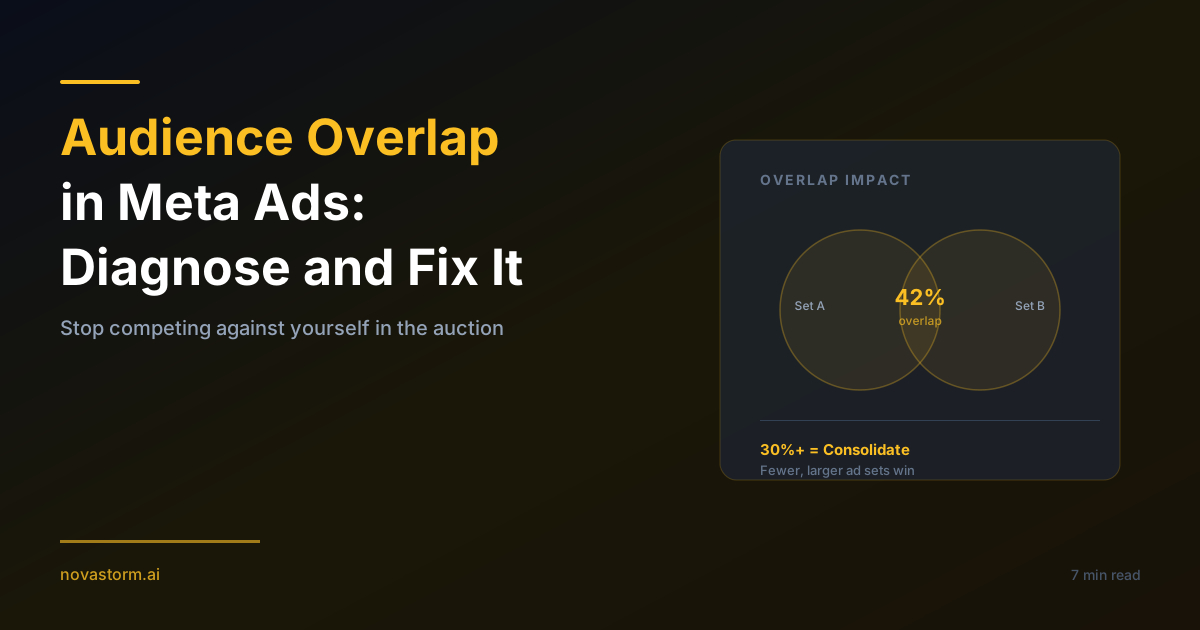
Audience Overlap in Meta Ads: How to Diagnose and Fix It
Diagnose overlapping Meta audiences as a structure and evidence problem, then test consolidation while preserving commercial boundaries.
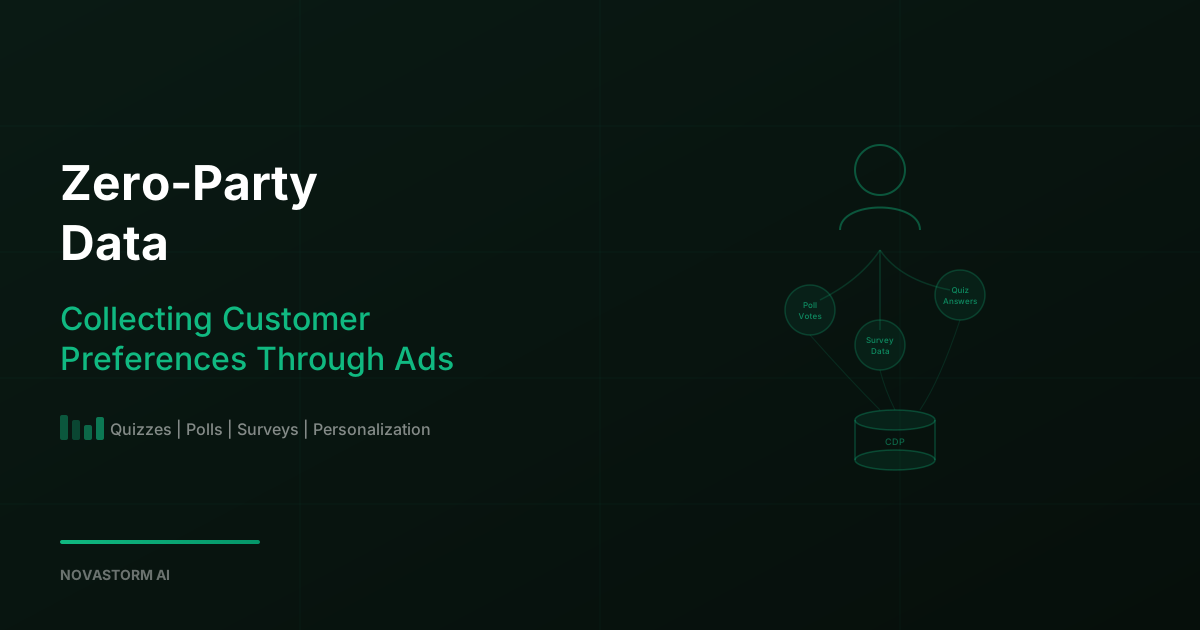
Zero-Party Data: Collecting Customer Preferences Through Ads
Collect useful declared preferences with clear permission records, refresh stale answers, and test an offer against contribution rather than engagement promises.
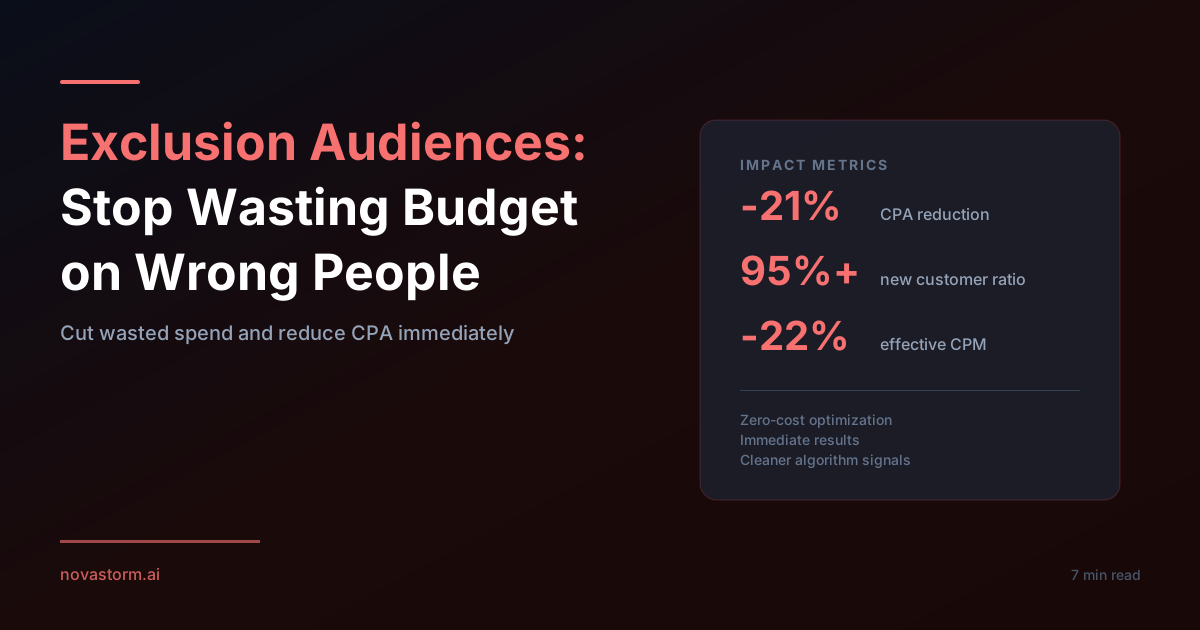
Exclusion Audiences: Stop Wasting Budget on Wrong People
Choose buyer suppression windows from repurchase behavior, verify saved exclusions and measure new-customer outcomes without promising CPA gains.
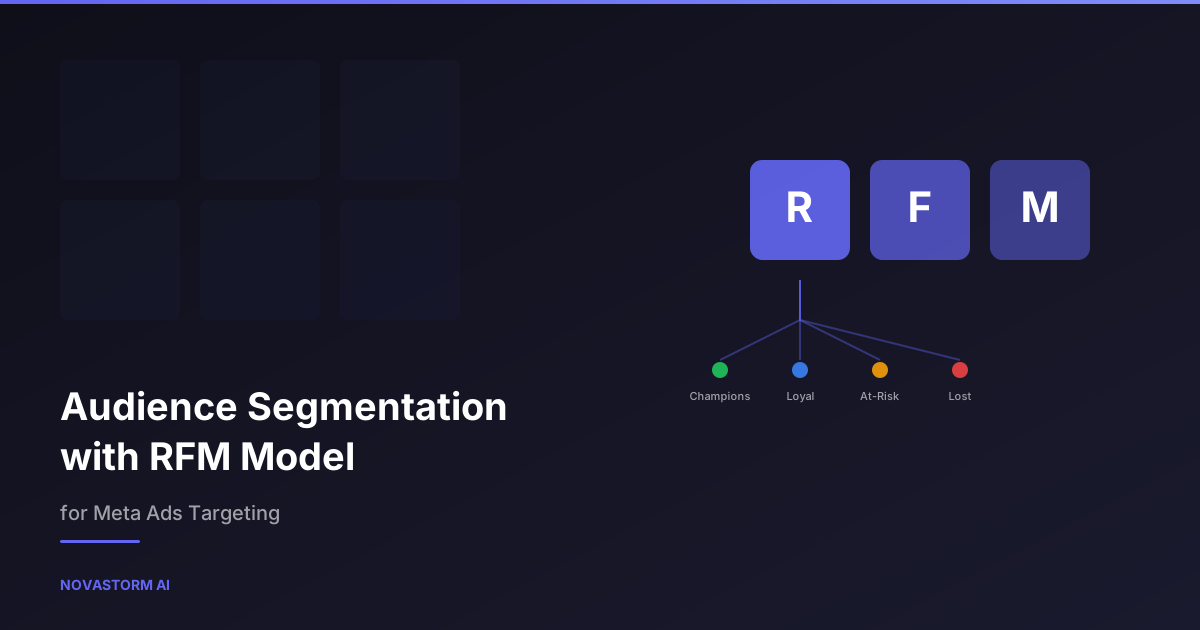
Audience Segmentation with RFM Model for Meta Ads Targeting
Calculate RFM from cleaned transactions, apply one reproducible scoring rule, export exclusive segments and test their future contribution.