

Zero-Party Data: Collecting Customer Preferences Through Ads
Collect useful declared preferences with clear permission records, refresh stale answers, and test an offer against contribution rather than engagement promises.
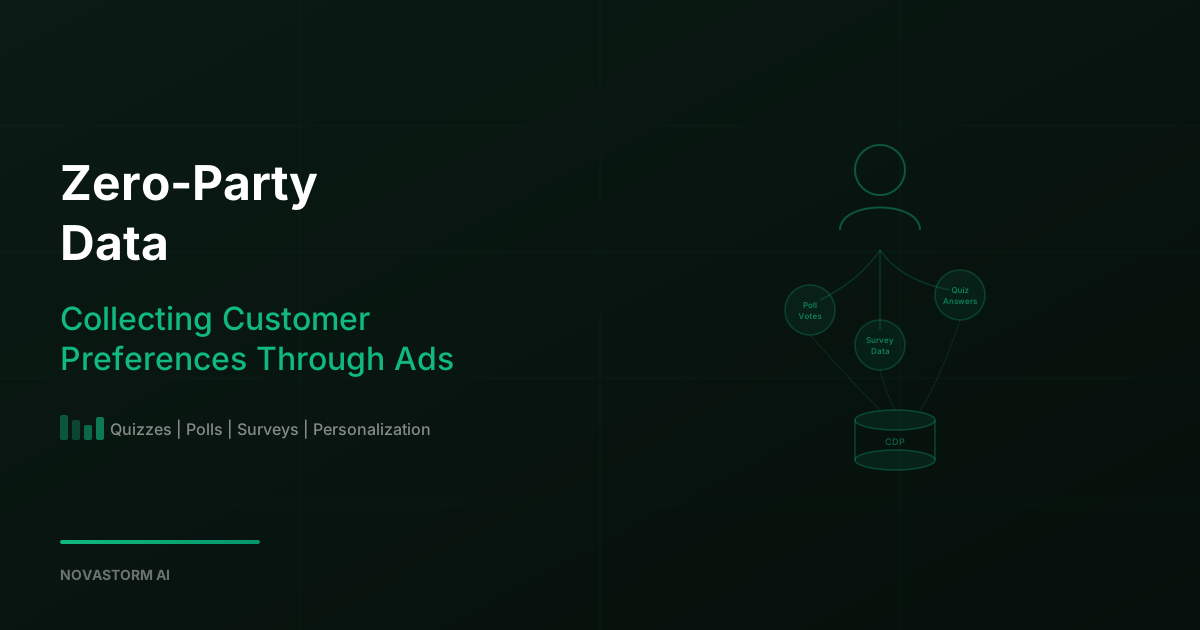
Declared preferences are answers a customer chooses to provide. They can help tailor a recommendation, but may be incomplete, mistaken or outdated. Answering a question does not make someone inherently more valuable or automatically authorize advertising use. Explain the immediate benefit and planned use before asking.
Verify the collection route
Check the actual account and format for response export, answer-based audience creation and branching. Do not assume an Instagram poll exposes identifiable answers for ad targeting or that an Instant Experience supplies a quiz engine. When the required behavior is unavailable, use an implemented website preference form with a clear destination and permitted data flow.
| Record field | Purpose | Update rule |
|---|---|---|
| Opaque customer ID | Link answers to an authorized profile. | Keep anonymous responses anonymous if no permitted join exists. |
| Question and answer version | Interpret the exact choice offered. | Save a new version when wording or options change. |
| Answer time and review/expiry date | Avoid treating an old preference as permanent. | Refresh or expire when the offer or declared need changes. |
| Purpose and permission state | Separate recommendation use from advertising forwarding. | Apply withdrawal and destination-specific rules before further use. |
| Storage owner and access | Limit handling to necessary users and systems. | Document retention, correction and deletion processes. |
Follow one answer to an honest offer
Illustrative answer: customer C-001 selects a $30–$50 product budget. Recommend an actually available $40 skincare item only if the other relevant answers fit its documented attributes. Do not infer a medical condition or claim suitability from price alone. Example copy hypothesis: “Explore the $40 option and check the ingredients before you choose.” Show shipping and other charges so the apparent budget fit is not misleading.
Illustrative economics: a $40 order minus $22 product, fulfillment and expected return costs gives $18 contribution. A $6 reserve leaves $12 for acquisition; with $2 allocated to recommendation operations, the media allowance is $10. An advertised $5 discount reduces contribution to $13 and media allowance to $5 under the same reserve and operating assumptions. More form completions or clicks do not compensate for an unaffordable offer.
Stop wasting ad budget
NovaStorm AI cuts Meta Ads CPA by 30% on average. No complex setup required.
Test question length and personalization
Treat four or eight questions as configurations to compare, not a universal optimum. Synthetic example: 100 eligible starts produce 60 completions with four questions versus 40 with eight; later, both routes produce six mature paid orders. Completion rates are 60% and 40%, while orders per eligible start are 6% in both. The extra questions did not increase that outcome in this example; actual differences require uncertainty and comparable assignment.
- Choose only questions needed for a useful recommendation. Record eligible starts, completion, abandonment point and whether the recommendation was actually delivered.
- Compare personalized and general recommendations among comparable eligible people with the same outcome window and permission treatment. Comparing respondents with nonrespondents also mixes willingness to respond and other selection differences.
- Use mature contribution, acquisition costs and refunds. A lifetime-value claim requires equally mature cohorts and a documented calculation; engagement, CPA and LTV improvements should remain hypotheses until measured.
Refresh and honor customer choices
Let customers correct a preference or withdraw an applicable use. Record the desired downstream state and confirm updates in each implemented connector; an internal change does not instantly remove a matched audience member. Avoid sending sensitive answers or personal identifiers through public URLs and planning logs.
Use NovaStorm to prepare creative variants from an approved, permitted segment brief and truthful offer, then have the user review them. Collection forms, quiz branching, profile storage and CRM/audience synchronization require separately implemented systems. Generation does not prove a personalized segment improves margin.
Published by NovaStorm AI. Planning examples are illustrative assumptions, not measured customer results.
Disclaimer: This article was generated with the assistance of AI and reviewed by the NovaStorm AI team. While we strive for accuracy, we recommend verifying specific data points and consulting official sources (linked where available) for critical business decisions.
Ready to automate your Meta Ads?
NovaStorm AI takes full responsibility for your campaigns — from monitoring to optimization.
Start NowMore on Audience targeting and prospecting

Negative Ad Feedback on Meta: Diagnose and Respond
Investigate negative ad feedback, distinguish criticism from verified defects, and choose a bounded response without assuming an algorithm penalty.
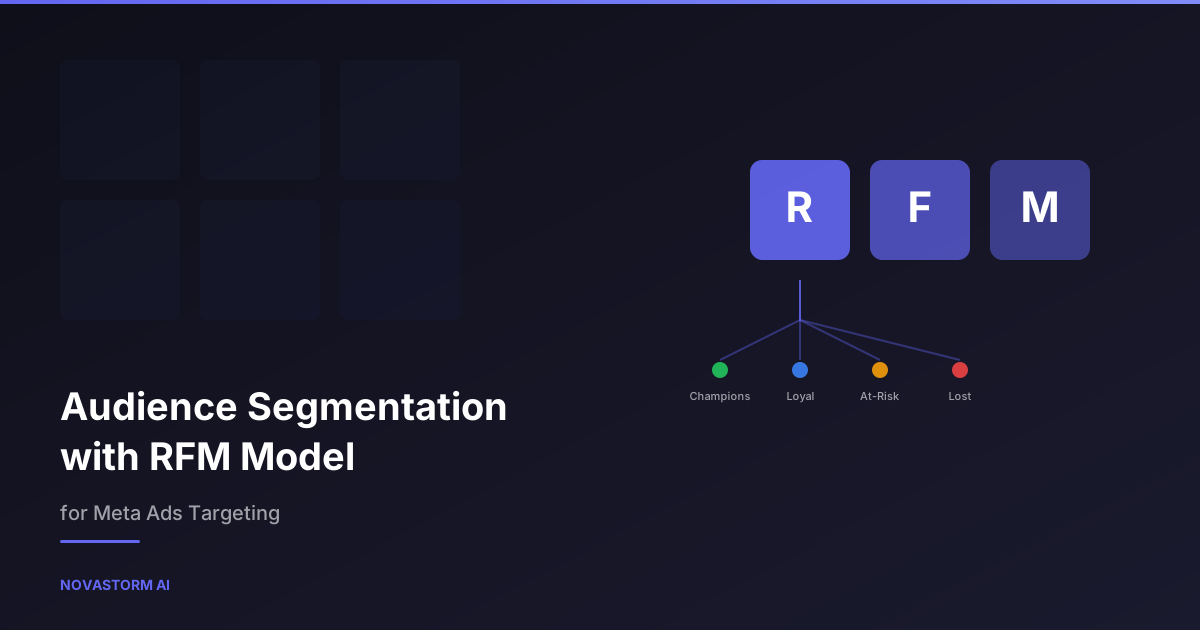
Audience Segmentation with RFM Model for Meta Ads Targeting
Calculate RFM from cleaned transactions, apply one reproducible scoring rule, export exclusive segments and test their future contribution.
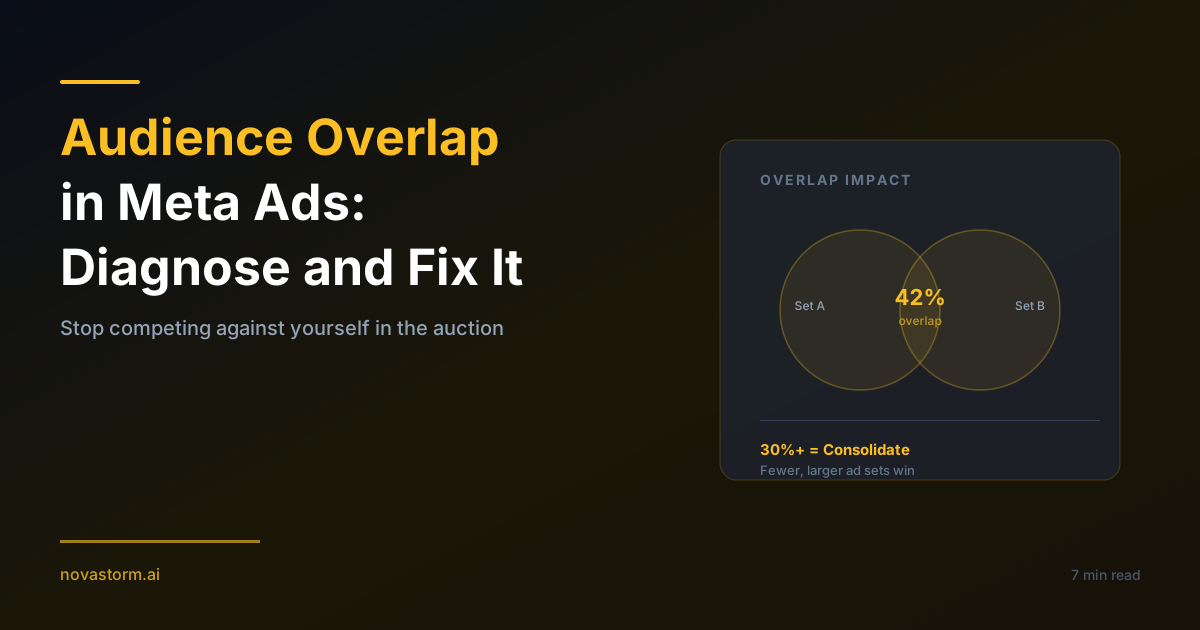
Audience Overlap in Meta Ads: How to Diagnose and Fix It
Diagnose overlapping Meta audiences as a structure and evidence problem, then test consolidation while preserving commercial boundaries.
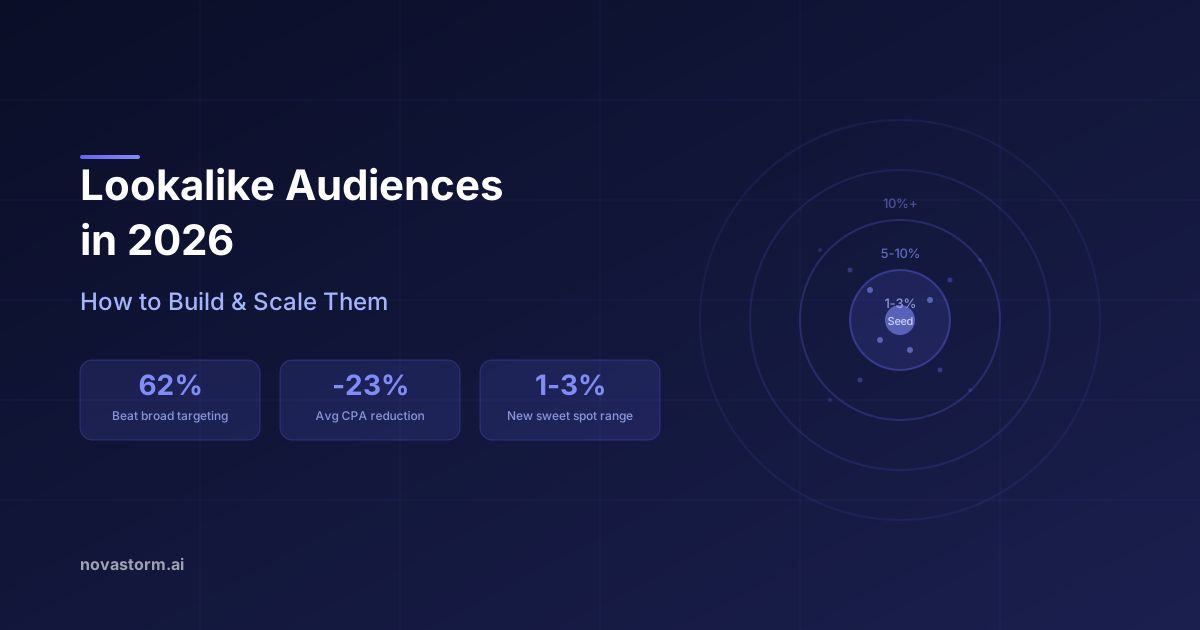
Lookalike Audiences in 2026: How to Build and Scale Them
Validate a permitted lookalike source and saved expansion behavior, then plan mature-order reviews and a total capped budget.