

Valentine's Day Meta Ads: Romance-Driven Campaign Strategies
Plan Valentine’s Meta ads around delivery cutoffs, gift-message hypotheses and margin, with transparent cart-recovery denominators.
Build a Valentine’s campaign backward from the last order you can deliver, not from a predicted February auction spike. Separate shipped gifts, pickup and digital experiences so that each ad makes a promise its fulfillment route can keep.
Market context is not a campaign benchmark
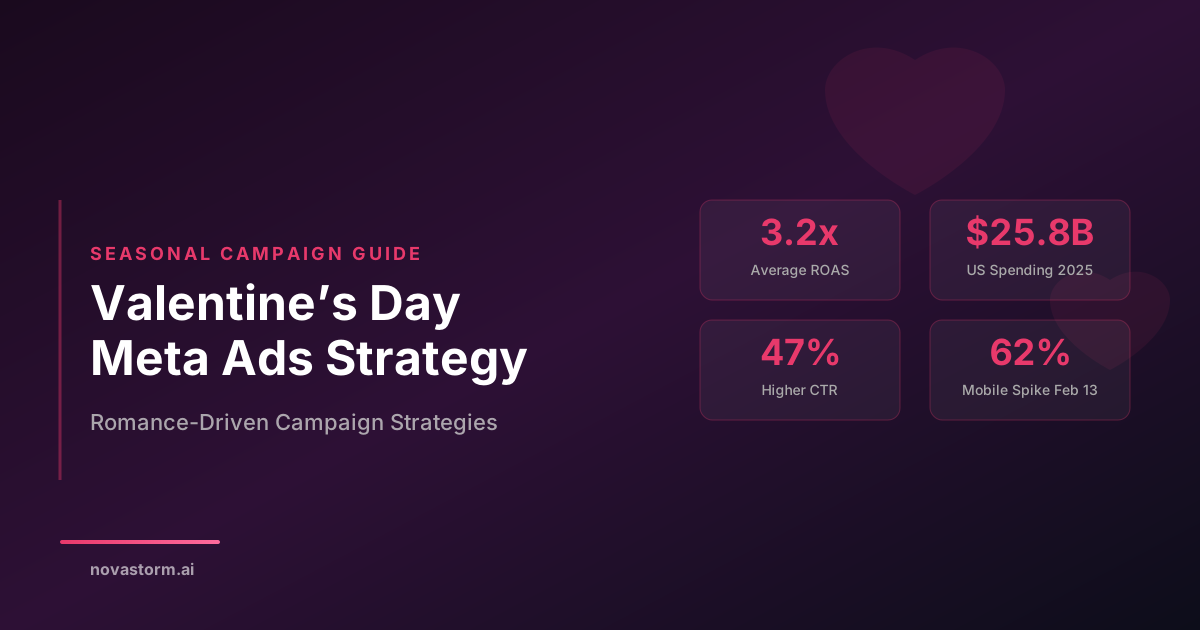
The NRF/Prosper January 2025 survey projected $27.5 billion in US Valentine’s spending; $25.8 billion was the 2024 comparison. It surveyed 8,020 adults on January 2–7, 2025, with a reported ±1.1 percentage-point margin of error. These are consumer plans, not measured Meta revenue, attribution or a guarantee of demand for your store.
An order cutoff controls the spend calendar
Hypothetical US gift shop for February 14, 2027: assume the warehouse requires one business day and the carrier’s supported route requires three business days. A merchant-chosen one-business-day buffer makes the standard order cutoff February 7 at 18:00 in the warehouse’s time zone, subject to confirmation with the actual operating calendar. The date is an illustrative conservative cutoff, not a courier commitment.
| Illustrative phase | Eligible offer | Maximum allocated spend |
|---|---|---|
| January 20–31 | Gift selection; validate inventory and price | $1,200 |
| February 1–7 before cutoff | Standard shipping only to verified service areas | $3,600 |
| February 8–12 | Only approved express routes and pickup inventory | $900 |
| February 13–14 | Pickup slots or immediately deliverable digital gifts | $300 |
This chosen $6,000 ceiling allocates 20%, 60%, 15% and 5%, respectively. It intentionally does not put the largest share after the standard shipping cutoff. Keep express campaigns separate so exhaustion of courier capacity cannot leave a standard-shipping promise live. Disable or revise urgency copy when stock, handling time or region eligibility changes.
Audience signals need an available mechanism
- Use eligible adult prospecting within service regions. An available interest can be an experiment input; it does not reveal a person’s relationship or gift deadline.
- Use consented first-party seasonal purchase cohorts if you have permission and an accepted custom-audience mechanism. Do not infer anniversaries from scraped profiles or assume “anniversary within 30 days” exists as a selectable control.
- Define last-minute shopping through a recent eligible cart or visit event plus the currently deliverable offer. It is an operational segment, not a universal Meta behavior label.
- Exclude fulfilled purchasers when your chosen setup supports it and refresh consented source data. A customer-list upload is not instant or perfect purchaser suppression; monitor match and refresh delay.
- Inspect which audience inputs are binding controls and which permit expansion. Preserve the actual accepted configuration for review rather than promising an exact relationship-status filter.
Two messages worth testing
| Hypothesis | Example English ad copy | Evidence needed before launch |
|---|---|---|
| Meaningful gesture plus practical certainty | “A note they can keep. See the gift set and delivery options for your postcode.” | Actual gift set, accurate note option and postcode-specific estimate |
| Convenient last-minute alternative | “Choose a pickup gift for February 14. Check available collection slots.” | Live stock, staffed pickup hours and supported slot reservation |
Stop wasting ad budget
NovaStorm AI cuts Meta Ads CPA by 30% on average. No complex setup required.
Use genuine product footage and licensed reactions; do not stage a testimonial as a real buyer’s review. Hypothetical CTR comparison: 280 clicks from 10,000 impressions is 2.8%, versus 190 from 10,000 at 1.9%. The relative difference is (2.8 − 1.9) / 1.9 ≈ 47.4%, but these assumed counts are not evidence that an emotional angle improves purchases.
Cart recovery needs one cart population
Visitors, cart abandoners and social engagers are overlapping groups with different eligibility rules. Their response percentages cannot be added or described collectively as a recovered-cart rate. For cart recovery, freeze unique abandoned cart IDs, define when an order counts as recovered, exclude prior paid orders and deduplicate across touches.
Hypothetical disjoint abandoned-cart cohorts: 100 same-day carts produce 15 paid orders; 200 carts aged one to three days produce 56; 700 older eligible carts produce 266. The weighted descriptive recovery is (15 + 56 + 266) / (100 + 200 + 700) = 337 / 1,000 = 33.7%. Without cohort sizes, the original 15%, 28% and 38% inputs cannot establish any combined rate. These are teaching assumptions, not observed Valentine’s recovery.
To estimate additional recovery from advertising, randomize eligible carts or customers to treatment and suppression where a valid design is possible, then compare paid-order rates over the same maturity window. Organic checkout completion and email recovery must be counted in both groups. Use the cart retargeting guide to define the outcome.
Choose a compatible objective and a profitable offer
For orders, use a sales-oriented objective and an accepted purchase optimization event when your data and account support it. Awareness delivery cannot simply inherit a purchase cost goal or a revenue bid setting. Verify objective, conversion location, optimization goal, bid strategy and required value signals together before making an approved change. Calendar phases alone do not justify changing them.
Hypothetical gift economics: retained net revenue $60, product cost $20, shipping $8, payment/handling $4 and expected refund/support cost $3 leave $25 contribution before advertising. Revenue ROAS of 3 implies $20 advertising cost per order and $5 contribution after advertising, before fixed costs. Express shipping that adds $10 lowers allowable acquisition cost to $15. Use mature paid and delivered cohorts, not same-hour reported ROAS, to compare routes.
Prepare the offer, budget ceiling and destination in NovaStorm campaign drafts, then review them against stock and the accepted Meta configuration. Assign a responsible operator to delivery cutoffs and spend checks. Draft preparation does not guarantee hourly bid management or prevention of overspend.
Published by NovaStorm AI. Worked examples and proposed tests are labeled in the article.
Disclaimer: This article was generated with the assistance of AI and reviewed by the NovaStorm AI team. While we strive for accuracy, we recommend verifying specific data points and consulting official sources (linked where available) for critical business decisions.
Ready to automate your Meta Ads?
NovaStorm AI takes full responsibility for your campaigns — from monitoring to optimization.
Start NowMore on Seasonal and launch campaigns
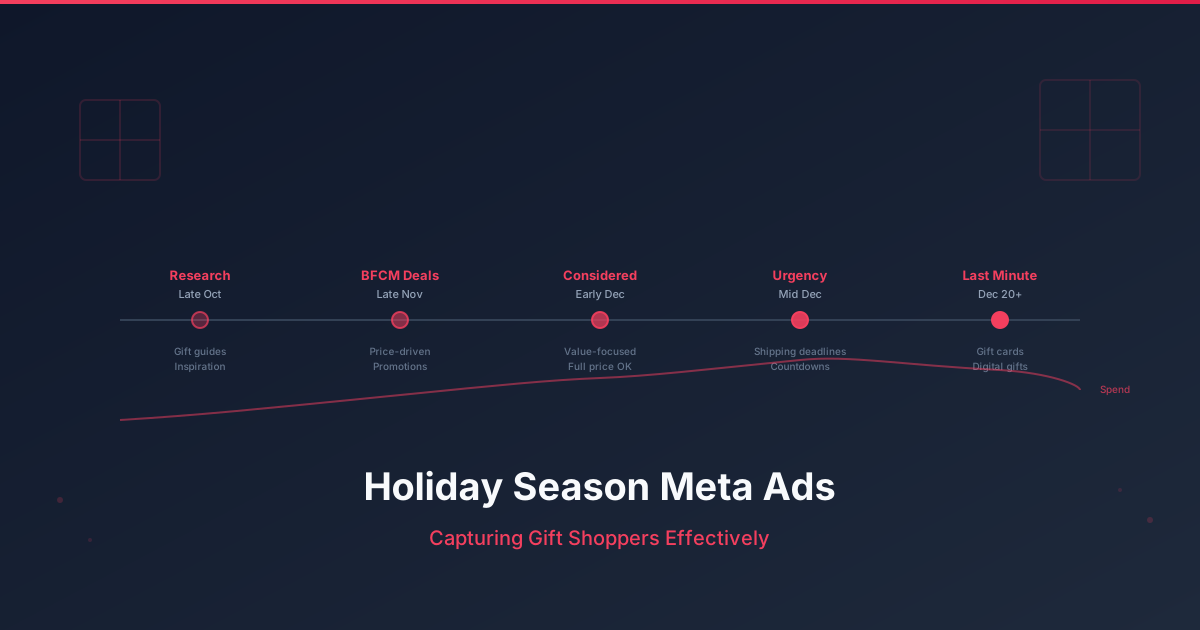
Holiday Season Meta Ads: Capturing Gift Shoppers Effectively
Build gift offers around the buyer’s decision, verified delivery and return terms, then compare price-tier creative by retained contribution.
Back-to-School Meta Ads: Targeting Parents and Students
Build back-to-school Meta campaigns for adult buyers using verified school lists, local delivery dates and honest bundle economics.
Summer Sale Campaigns on Meta: Beating the Seasonal Slump
Reconcile summer ad costs, plan a dated local sales calendar, and allocate capped budgets using retained purchase contribution.
New Year Resolution Ads on Meta: January Campaign Playbook
Plan January Meta ads around truthful product actions, transparent trials and mature contribution rather than assumed resolution behavior.