

Summer Sale Campaigns on Meta: Beating the Seasonal Slump
Reconcile summer ad costs, plan a dated local sales calendar, and allocate capped budgets using retained purchase contribution.
A summer sales decline can be real for a particular product and market. Cheaper impressions do not resolve weak demand, stock constraints or lost margin. Compare mature purchases and contribution before reallocating budget from Q4 or treating summer as a prospecting opportunity.
Reconcile CPM, CTR and CPC
Hypothetical comparable impression-based report, not seasonal benchmark data: assume CPM $14.20 and CTR 1.8% in period A, versus CPM $10.80 and CTR 1.6% in period B. CTR means the same click type in both periods. With 1,000 impressions, expected clicks are 18 and 16, so CPC is $14.20 / 18 ≈ $0.79 and $10.80 / 16 = $0.675, respectively.
| Metric | Assumed period A | Assumed period B | Calculated relative change |
|---|---|---|---|
| CPM | $14.20 | $10.80 | −23.94% |
| CTR | 1.8% | 1.6% | −11.11% |
| CPC | $0.7889 | $0.6750 | −14.44% |
| Click-to-purchase rate | 3.1% | 2.8% | −9.68% |
| CPA from these inputs | $0.7889 / 0.031 ≈ $25.45 | $0.675 / 0.028 ≈ $24.11 | −5.27% |
These calculations require compatible click, impression and purchase definitions, with cohorts allowed to mature. Mixing all-click CTR with link-click CPC breaks the reconciliation. They illustrate why a large CPM decrease may produce a much smaller CPA improvement; they do not show a platform-wide summer pattern.
Use a dated, local calendar
The US OPM 2026 holiday schedule places Memorial Day on May 25 and Labor Day on September 7. Independence Day is July 4; the federal observed holiday is July 3 that year. These are calendar facts, not suggested discount periods. Memorial Day belongs in May, outside a June–August budget table.
| 2026 US reference date | Planning use | Operational check |
|---|---|---|
| May 25: Memorial Day | Optional pre-summer event, separate budget | Delivery/pickup hours and actual offer |
| July 4: Independence Day | Optional relevant product use case | Holiday carrier schedule and local audience fit |
| Merchant-chosen July sale | Inventory or campaign test, no official event implied | Genuine end date, stock and margin |
| Local August school preparation | Relevant only for that school calendar | Required items and first class date |
| September 7: Labor Day | Separate September event | End-of-season demand and warehouse capacity |
June–August is not summer everywhere. Confirm country, weather-sensitive category, travel patterns and local events. Use your own matched period reports with stock, promotions, channel mix and tracking changes documented. A broad seasonal claim about mobile use, weekend engagement or lower competition should not substitute for those observations.
A coherent $10,000 summer ceiling
Stop wasting ad budget
NovaStorm AI cuts Meta Ads CPA by 30% on average. No complex setup required.
Hypothetical allocation chosen for arithmetic clarity, not a recommended universal split. Keep the campaign capped at $10,000, with $6,000 prospecting and $4,000 retargeting in total. Retargeting eligibility and reach may justify spending less; unspent money does not need to be forced into delivery.
| Month | Total | Prospecting | Retargeting |
|---|---|---|---|
| June | $2,500 | $1,750 (70%) | $750 (30%) |
| July | $4,000 | $2,600 (65%) | $1,400 (35%) |
| August | $3,500 | $1,650 (47.14%) | $1,850 (52.86%) |
| Total | $10,000 | $6,000 (60%) | $4,000 (40%) |
The weighted allocation is what determines the total split. For comparison, monthly shares of 25%, 40% and 35% combined with prospecting fractions of 70%, 55% and 40% produce 0.25 × 0.70 + 0.40 × 0.55 + 0.35 × 0.40 = 53.5% prospecting, not 60%. Do not treat an attractive diagram as a reconciled budget.
Cheap impressions need a commercial release gate
Hypothetical product: retained revenue $80, variable product/fulfillment/payment/returns costs $50 leave $30 contribution before advertising. At revenue ROAS 2.4, CPA is $80 / 2.4 ≈ $33.33 and contribution after advertising is −$3.33. Thus ROAS 2.4 does not establish profitability. The break-even revenue ROAS under these assumptions is $80 / $30 ≈ 2.67, before fixed costs.
A proposed CPM trigger can only create a review candidate. Require stable measurement, mature retained purchases, sufficient planned evidence, inventory and positive marginal contribution before approving more budget. Cap each permitted change and cumulative seasonal spend; choose a review interval suited to attribution lag. If purchases are insufficient, defer the change rather than interpreting cheaper impressions as proof of value.
Test seasonal creative and Q4 opportunity cost
- Hypothesis: a truthful outdoor use case improves retained order contribution compared with the existing product demonstration. Keep offer and audience comparable, use licensed footage and show only supported claims such as actual portability or product specification.
- A summer variant winning engagement does not establish purchasing lift. Prespecify the primary commercial outcome and planned sample; seven days alone does not make the result reliable.
- A summer audience might be too old or uninterested by Q4. Test the incremental later purchase contribution of a summer acquisition strategy against a holdout where feasible, including consent, attrition and all acquisition/retargeting cost.
- Compare reallocating, for example, an assumed $2,000 with retaining that money for Q4 or not spending it. Document expected margin, uncertainty and stock/cash constraints; no fixed 20% transfer is inherently beneficial.
Use the annual seasonal budget guide to weigh these alternatives. Prepare approved summer campaign changes in NovaStorm drafts; CPM monitoring and automatic budget reallocation require a separately verified implementation and do not guarantee profit.
Published by NovaStorm AI. Worked examples and proposed tests are labeled in the article.
Disclaimer: This article was generated with the assistance of AI and reviewed by the NovaStorm AI team. While we strive for accuracy, we recommend verifying specific data points and consulting official sources (linked where available) for critical business decisions.
Ready to automate your Meta Ads?
NovaStorm AI takes full responsibility for your campaigns — from monitoring to optimization.
Start NowMore on Seasonal and launch campaigns
Back-to-School Meta Ads: Targeting Parents and Students
Build back-to-school Meta campaigns for adult buyers using verified school lists, local delivery dates and honest bundle economics.
New Year Resolution Ads on Meta: January Campaign Playbook
Plan January Meta ads around truthful product actions, transparent trials and mature contribution rather than assumed resolution behavior.
Valentine's Day Meta Ads: Romance-Driven Campaign Strategies
Plan Valentine’s Meta ads around delivery cutoffs, gift-message hypotheses and margin, with transparent cart-recovery denominators.
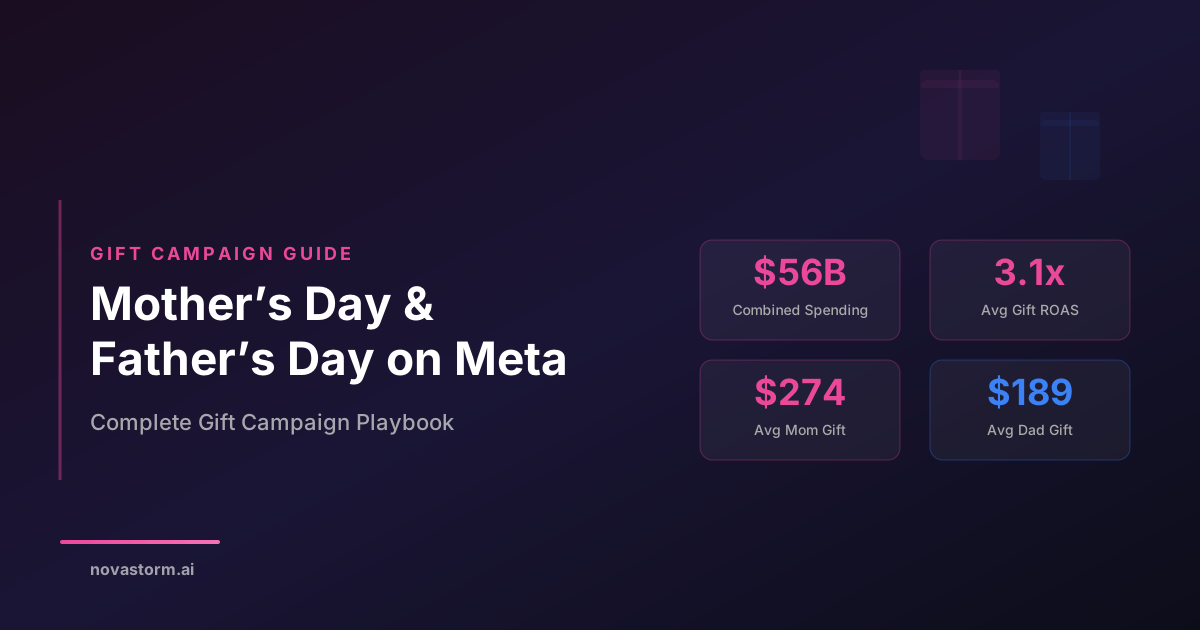
Mother's Day and Father's Day Ads on Meta: Gift Campaign Guide
Plan parent-holiday gift ads with local dates, personalization cutoffs, permitted family footage and a reconciled approved budget.